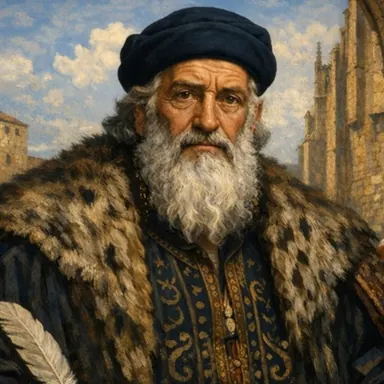
The Work, Teaching, and Leadership of the Rashba: Pillar of the Torah in Christian Spain
18 min read3,697 words
Summary
This article surveys the life and monumental contribution of the Rashba, Rabbi Shlomo ben Aderet, who was the undisputed spiritual and political leader of Spanish Jewry in the 13th century. The text presents his figure as an intercultural bridge who merged the analytical methods of the sages of France and Germany (Ashkenaz) with the Spanish tradition, while establishing the foundations of Hebrew administrative law and maintaining close mutual relations with the royal court. The source details his extensive halakhic output, from the thousands of his responsa, which became a foundation for the "Shulchan Arukh," through his profound novellae on the Talmud, to his codificatory works such as "Torat ha-Bayit." Finally, the article emphasizes the Rashba's role as guardian of the walls of tradition, who conducted sharp polemics against extreme rationalism and messianic mysticism in order to ensure the spiritual future of the Jewish people.
The thirteenth century in Christian Spain was marked by profound religious, political, and cultural change, and at its center stood the monumental figure of Rabbi Shlomo ben Avraham ibn Aderet, known to the generations as the Rashba. The Rashba was not only an influential halakhic decisor or a profound Talmudic commentator, but served as the undisputed leader of Spanish Jewry and of the Jewish world as a whole for nearly five decades.[1] The Rashba's work represents the unique meeting point between the scholarly tradition of the sages of Spain and the analytical methods of the Tosafists of the north, with a delicate integration of the revealed and the hidden worlds, and of spiritual leadership with political standing at the royal court.[1, 2] His figure serves to this day as a vital connecting link between the period of the Rishonim and later generations, as his rulings and writings constitute an unshakable foundation for every halakhic decisor, from the Tur and the Shulchan Arukh to our own day.[1, 2]
Chapter 1: Historical Foundations and the Rise of a Leader
Rabbi Shlomo ben Aderet was born in Barcelona, in the Kingdom of Aragon, around the year 1235 (Hebrew year 4995), though there are opinions that place his birth earlier, in 1220.[1, 3] He grew up in a wealthy and distinguished family, a fact that gave him early access to the corridors of power and a broad education that went beyond the confines of the traditional study hall.[2] The period of his birth and life coincided with the peak flourishing of the Jewish community of Barcelona, which became under his leadership the most important Torah and political center in the Iberian Peninsula.
His Principal Teachers and the Shaping of His Torah Identity
The Rashba's spiritual development rested on three central pillars, each of which gave him a different layer in his multifaceted personality. His principal teacher was Rabbeinu Yonah Gerondi, author of "Sha'arei Teshuvah," who instilled in him the aspiration to moral perfection and a deep commitment to the details of halakha.[1, 2] Alongside him, the Rashba studied with the Ramban (Rabbi Moshe ben Nachman), who was the most dominant figure in Spain at that time. From the Ramban the Rashba inherited a method of analysis that combines straightforward reasoning with loyalty to the sources of the Geonim, as well as an affinity for the wisdom of Kabbalah.[1, 4] A third figure who influenced the shaping of his thought was Rabbi Yitzchak bar Avraham of Narbonne, who connected him to the tradition of the sages of Provence.[1, 2]
The combination of his teachers created in the Rashba a unique methodology: loyalty to the Spanish tradition from the study hall of the Rif and Maimonides, together with openness to the method of pilpul and analysis of the sages of France and Germany.[1, 2] This understanding of "Spain meets Ashkenaz" later enabled him to become a living bridge between the different traditions within the people of Israel.
The Transition from the World of Practice to Public Leadership
Unlike many of the great figures of Israel, the Rashba did not devote all his youthful years to professional rabbinic office. In his early career he engaged in commerce and finance, and even served as a lender and financier of the state treasury and the crown.[2, 4] This experience in the business and financial world was not merely a means of livelihood, but became a vital tool in shaping his halakhic thought. His intimate familiarity with contracts, taxation, partnerships, and the laws of acquisition enabled him to rule on complex economic questions with a sober and practical outlook, which is especially prominent in his thousands of responsa dealing with monetary law.[2] Only after establishing his economic standing did the Rashba devote himself entirely to the rabbinic seat in Barcelona, on which he sat for about fifty years until his death in 1310 (Hebrew year 5070).[2, 3]
Chapter 2: The Royal Rabbi and Hebrew Administrative Law
The Rashba's standing went far beyond the boundaries of the modern concept of "city rabbi." He served in the status of "court rabbi" (Rab de la Corte), and was very close to the royal court of Aragon.[2] Thanks to his full command of the Latin language and his deep understanding of Roman law and the laws of the land, the Rashba received official recognition from the king as a supreme judicial authority, not only in religious matters but also in civil and administrative matters of the Jewish communities.[2]
Judicial Powers and Capital Cases
The Rashba's political importance was expressed in the fact that the king granted him official authorization to adjudicate even "capital cases"—an extremely exceptional authority for a Jewish sage in the period of exile.[2] This fact turned his halakhic responsa into a kind of official documents of the kingdom. When the Rashba ruled on a particular matter, his ruling was often backed by the coercive power of the Christian authority, which enabled him to impose order in the communities and prevent legal anarchy. The ability to maneuver between loyalty to the laws of the Torah and the demands of the local government made him a political strategist of the first rank.[2]
The Foundations of Administrative Law and Communal Enactments
The Rashba is regarded in halakhic and academic research as the father of Hebrew administrative law.[1] He was the great ideologue of the "communal enactments" (takkanot ha-kahal), and systematically defined the relationship between the individual and the public and the limits of the authority of the community leadership. The Rashba determined that every community has authority over its individual members, and that they are entitled to make fences and enactments in their town just as the Great Court was authorized to enact for all of Israel.[2, 6]
Among the administrative principles the Rashba established are:
- Majority rule and minority rights: The Rashba ruled that the majority cannot adopt a binding decision without the minority having been given an opportunity to voice its opinion in a full forum. He compared this to the procedures of the Sanhedrin, where no ruling may be issued unless all the members are present and deliberate the matter.[6]
- Disqualification due to personal interest: The Rashba applied the laws of disqualification of judges to elected public officials as well. He determined that communal representatives may not make decisions that directly benefit themselves, and thereby laid the foundations for proper administration and for the prevention of conflict of interest in the Jewish community.[6]
- The validity of communal agreements: He recognized the possibility of a civil law based on community agreements (enactments) alongside pure Torah law. This approach was later used by Rabbi Yitzchak Isaac HaLevi Herzog in his proposals for establishing the law in the modern State of Israel on the foundations of Hebrew law.[2]
Chapter 3: The Methodology of the "Chiddush" and the Interpretation of the Talmud
The Rashba's scholarly power finds special expression in his novellae on the tractates of the Talmud. These novellae are not merely local commentaries, but an attempt to build a broad and systematic logical structure for each and every topic.[2] The Rashba developed a style of study in which he examines the Talmudic topic not only through the lens of the sages of Spain, but in constant dialogue with the method of the Tosafists.[1]
Style of Study and Broadening the Boundaries of Discussion
The Rashba's novellae are characterized by lucid language, rare explanatory power, and verbal precision.[2] He is not content with explaining the plain sense, but strives to understand the "sevara"—the legal logic underlying the halakha. The Rashba frequently brings a wide variety of literary sources, from the Geonim and the Rif to Maimonides and the sages of France, weaving them into one coherent fabric.[2]
Three central aspects distinguish his interpretive path:
- Comparative analysis: Constant comparison between parallel topics in the Talmud in order to resolve apparent contradictions and to build a uniform halakhic system.[2]
- Humility alongside firmness of opinion: The Rashba at times disagrees with the words of his predecessors, but he does so gently and with exceeding humility, in soft and pleasant language, yet with complete confidence and strong reasoning.[2]
- Orientation toward halakha: Unlike the novellae of the Tosafists, which at times remain on the theoretical-pilpulistic plane, the Rashba's aim is always to reach a clear halakhic conclusion—"to bring the Talmudic discussions to a conclusion in accordance with the halakha."[7]
The Yeshiva in Barcelona and Its Worldwide Dissemination
The yeshiva headed by the Rashba became a magnet for students from throughout the Jewish world. Students came to it from Ashkenaz (Germany), from France, and from North Africa, seeking to learn his integrative method.[5] These students later became the leaders of the next generation, among them the Ritva, Rabbeinu Bachya, and the Ran, who carried his teaching to all the dispersions of Israel.[2, 4]
Chapter 4: "Torat ha-Bayit" and Halakhic Codification
One of the Rashba's most important undertakings is his book "Torat ha-Bayit," which deals with the laws of forbidden and permitted foods, kashrut, ritual purity, and mikva'ot.[1, 5] This book is not merely a collection of halakhot, but an attempt to present halakha in a revolutionary didactic structure designed to respond to different levels of learners.[2]
The Dual Format: The Long and the Short
The Rashba arranged his work in two separate editions:
- "Torat ha-Bayit ha-Arokh" (The Long): A detailed work that includes all the sources of the topic, the halakhic give-and-take, the opinions of the Rishonim, and final decisions. This book was intended for Torah scholars and judges who seek to go to the depth of matters.[2]
- "Torat ha-Bayit ha-Katzar" (The Short): A condensed and clear edition that includes only the halakhic conclusions without pilpul. This edition was intended for daily use by householders and people preoccupied with their daily toil, so that they might know the deed they are to do.[2, 8]
This structure served as direct inspiration for Rabbi Yosef Karo in the 16th century, when he composed the "Beit Yosef" (corresponding to the long) and the "Shulchan Arukh" (corresponding to the short).[1]
"Mishmeret ha-Bayit" and the Struggle for Halakhic Truth
Critical objections to "Torat ha-Bayit" were written by Rabbi Aharon HaLevi (the Ra'ah), the Rashba's colleague and contemporary, in his book "Bedek ha-Bayit."[4, 5] The Rashba did not remain in debt and wrote "Mishmeret ha-Bayit," a response book defending his rulings. The debate between these two giants became one of the most fascinating discussions in the history of halakha, with the Rashba presenting a firm and uncompromising position, but always within a framework of mutual respect.[4, 5]
Additional Halakhic Works
"Avodat ha-Kodesh": A book dealing with the laws of Shabbat (especially eruvin) and festivals. The book is divided into "Beit Netivot" and "Beit Mo'ed."[4]
- "Piskei Challah": A short and focused work on the laws of separating challah.[3, 4]
- "Sha'ar ha-Mayim": A fundamental and profound essay on the laws of mikva'ot, which serves to this day as a basis for every student of the laws of ritual purity.[1, 8]
Chapter 5: The Responsa of the Rashba—A Window onto the Jewish World in the Middle Ages
The crowning achievement of the Rashba's influence throughout the generations is the thousands of halakhic responsa that he wrote. The Responsa of the Rashba, which comprises seven parts and about 3,000 responsa, is a foundational book in every Jewish library and in every study hall.[1, 4]
Scope and International Authority
The Rashba's responsa were sent to every corner of the globe—from France and Germany to the Land of Israel and North Africa.[5] Many of the questioners were his former students who had been appointed as rabbis in various communities and continued to consult their teacher on every complicated question that came before them.[2] These responsa deal with all areas of life: faith, philosophy, the fine points of the commandments, laws of marital relations, and above all monetary law and the conduct of the public.[1, 2]
Those Attributed to the Ramban
A special collection known as the "Responsa of the Ramban" was attributed for many years to the Rashba's teacher. However, halakhic and historical research has proved that the overwhelming majority of the collection was actually written by the Rashba himself, and it is therefore called today the "Responsa of the Rashba Attributed to the Ramban."[4] This fact attests to the closeness of opinions and writing style between teacher and student, to the point that it was difficult to distinguish between them.
Influence on the "Beit Yosef"
Rabbi Yosef Karo, in his introduction to his book "Beit Yosef," counts the Rashba among the eight most esteemed rabbis on whom he bases his rulings. He calls him "the ever-strengthening spring, the pillar of the world by whose light we see light."[1] The Rashba's influence on the Shulchan Arukh is so decisive that it can be said that a considerable part of the practical halakhot in force today originate in the study hall of Barcelona.[2]
Chapter 6: The Controversy over Philosophy and the Defense of the Faith
One of the formative moments in the Rashba's leadership was the great controversy surrounding the study of philosophy and the sciences that erupted in 1305 (Hebrew year 5065). This event was not merely an intellectual debate but a struggle over the character and education of the Jewish people.[9]
The Background: Allegorical Preaching and the Fear of Heresy
The controversy began in the wake of an appeal by Rabbi Abba Mari ha-Yarchi of Montpellier to the Rashba. In the communities of Provence, an extreme allegorical preaching had begun to spread under the influence of Aristotelian philosophy.[2, 9] These preachers claimed, for example, that Abraham and Sarah are not historical figures but symbols of philosophical ideas, and that the commandments of the Torah have only conceptual value, with no need for their concrete observance.[9] The Rashba saw in this an existential danger to the preservation of the Torah and the tradition.
The Ban of the Year 5065
In response to these trends, and with the encouragement of the Rosh, the Rashba's court in Barcelona issued a severe ban (herem) on Shabbat Chazon of 1305.[2, 9] The main provisions of the ban were:
- Age restriction: A prohibition on teaching philosophy and the natural sciences to young men under the age of 25. The assumption was that only after the student has established his faith through the study of Talmud and halakha can he be exposed to external wisdoms without being harmed.[2, 9]
- Exempting the books of Maimonides and medicine: The Rashba took care to exclude from the ban the books of Maimonides and the study of medicine, because of the immense respect he held for Maimonides and the practical need for the science of medicine.[9]
- Burning of books: A burning was decreed for books that remove the words of the Torah from their plain sense in an extreme allegorical manner.[2, 9]
The Controversy and Its Implications
The ban aroused an enormous storm in the Jewish world. On one side stood the supporters of philosophy, headed by Rabbi Yaakov ben Machir ibn Tibbon, who argued that science strengthens faith, and on the other side stood the Rashba and his supporters, who sought to fortify the walls of tradition.[9] The debate lasted many years and included sharp exchanges of letters, among them the "Letter of Apology" (Iggeret ha-Hitnatzlut) of Rabbi Yedaya ha-Penini.[9] The Rashba's role in this affair shaped the approach of Jewish education for generations, establishing priorities that placed the Torah at the center.
Chapter 7: The Hidden World and Opposition to Extreme Mysticism
Despite his opposition to philosophy, the Rashba was not a "dry rationalist." He was himself a Kabbalist, a student of the Ramban in the hidden wisdom, and was deeply influenced by the mystical conception that saw in the Torah and the commandments upper spiritual worlds.[1]
The Rashba and Traditional Kabbalah
The Rashba saw Kabbalah as a "hidden wisdom" transmitted by tradition from person to person, and not as the product of personal inspiration. He engaged in interpretations of the secrets of the Ramban, and one of his students, Rabbi Shem Tov ibn Gaon, composed the book "Keter Shem Tov," which explains the Kabbalistic hints of the Ramban in his commentary on the Torah.[1] His attitude toward Kabbalah was conservative—he saw it as a tool for understanding the inner dimension of the Torah, but rejected any attempt to turn it into an instrument of "practical mysticism" or prophecy.
The Struggle against Abraham Abulafia
A sharp conflict erupted between the Rashba and Rabbi Abraham Abulafia, founder of prophetic Kabbalah. Abulafia preached techniques of ecstasy and claimed a personal prophetic ability. The Rashba saw Abulafia as a deluded visionary and a dangerous man, and acted resolutely to distance him from the Jewish communities.[1, 5] This struggle attests to the character of the Rashba as guardian of the walls of tradition, defending Judaism both from extreme rationalism and from unrestrained mysticism.
Commentaries on the Aggadot
The Rashba composed a special book of commentaries on the aggadot of the Talmud. The purpose of the writing was to respond to heretics and Christians who were accustomed to use the puzzling aggadot of the Sages to mock Judaism.[4] In these commentaries, the Rashba incorporates profound conceptual explanations, some of them Kabbalistic, in order to show the wisdom hidden in the words of the Sages even in places that appear to be parable or hyperbole.[10, 11]
Chapter 8: Interreligious Disputations and the Defense of the People
As leader of the community in Barcelona, the Rashba stood on the front line of the struggle against Christianity and Islam. In that period Christian missionary activity intensified, and the Rashba was compelled to conduct disputations, oral and written, in order to defend the positions of Judaism.[2]
Facing the Christian Church
The Rashba confronted Christian scholars such as Raymundus Martini, who wrote books attempting to prove the truth of Christianity from the Talmud itself. The Rashba defended passionately the eternity of the Torah and the value of the commandments, and refuted the claims that the commandments were annulled with the coming of Christianity.[2] His familiarity with Latin and with Christian sources enabled him to respond to the Christian scholars in their own language and with their own tools of analysis.
"Treatise on Ishmael"
This polemical work was composed by the Rashba in response to a Muslim scholar who attacked Judaism. In this treatise the Rashba refutes the claims of Islam and fortifies the faith of the Jews living under Muslim or Christian rule.[4, 5]
Chapter 9: The Generation of Students and the Continuity of the Legacy
The Rashba's work did not end with his death. He raised a long line of students who became the great figures of the next generation and shaped the face of Jewish scholarship for hundreds of years.[2, 4]
His Prominent Students
The Ritva (Rabbi Yom Tov ben Avraham Ashvili): Regarded as his most distinguished continuer in Talmudic interpretation. His novellae are the final refinement of the Rashba's method, which merges Spanish analysis with Ashkenazi pilpul.[2, 4]
- Rabbeinu Bachya ben Asher: Author of the famous commentary on the Torah, who brought the foundations of Kabbalah and mussar of the Rashba's study hall into every Jewish home.[2, 4]
- Rabbi Shem Tov ibn Gaon: Author of the "Migdal Oz" on Maimonides and the "Keter Shem Tov" on the Ramban.[1, 2, 4]
- The Ran (Rabbeinu Nissim Gerondi): From the later generations of the study hall in Barcelona, who continued the line of Talmud-based halakhic ruling.[4]
Summary: The Rashba as a Connecting Link for the Generations
Rabbi Shlomo ben Aderet represents the culminating point of Spanish Jewry in the transition from the period of the "Rishonim" to the development of modern halakha. He was the leader who united the Jewish world under one roof of authoritative halakhic ruling, profound scholarship, and resolute public leadership.[1]
His influence on the world of Torah is twofold: on the one hand, he fortified the walls of tradition against the challenges of philosophy and extreme mysticism, and thereby ensured the continuity of rabbinic Judaism based on the Talmud. On the other hand, he opened new horizons in administrative and public law, and raised students who became the pillars of Jewish creativity.[1, 2]
Rabbi Yosef Karo's words about him—"the pillar of the world by whose light we see light"—are not mere rhetorical praise but an accurate description of reality. Without the work and teaching of the Rashba, the map of halakha and Jewish thought would have looked entirely different. To this day he remains the great teacher, the courageous leader, and the decisor whose words live and endure in every folio of Gemara and every paragraph of halakha.[1]
Sources11
- 1.רשב"א – ויקיפדיה, he.wikipedia.org/wiki/רשב"א
- 2.קווים לדמותו של הרשב"א - BeitChabad.com - בית חבד, he.chabad.org/library/article_cdo/aid/3321965
- 3.מחבר:רשב"א – ויקיטקסט, he.wikisource.org/wiki/מחבר:רשב"א
- 4.רבי שלמה בן אדרת – ויקישיבה, yeshiva.org.il/wiki/index.php/רבי_שלמה_בן_אדרת
- 5.רשב"א | מקורות מתוך ספריית ספריא, sefaria.org.il/topics/rashba1
- 6.סמכות הקהל לתקן תקנות כסמכות בית דין - מכון משפטי ארץ, dintora.org/Show_article/1066
- 7.פרק 11 – הספרדי שבא מבגדד. על תולדות האשכנזים והספרדים. | הסיפור שלנו, jewstory.net/11_sfarad_ashkenz/
- 8.תורת הבית לרשב"א שולחן מלכים - אוצר הספרים, sefer.org.il/items/3731174-תורת-הבית-לרשב-א-שולחן-מלכים-הוצאה-לאור-שולחן-מלכים
- 9.פולמוס הרבנים אודות לימוד הפילוסופיה - ויקיפדיה, he.wikipedia.org/wiki/פולמוס_הרבנים_אודות_לימוד_הפילוסופיה
- 10.חידושי הרשב"א פירושי ההגדות - מוסד הרב קוק, mosadharavkook.com/shop/חידושי-הרשבא-פירושי-ההגדות/
- 11.ספר חידושי הרשב"א : על אגדות הש"ס / מאת רבנו שלמה בן אדרת - הספרייה הלאומית, nli.org.il/he/books/NNL_ALEPH990011244450205171/NLI