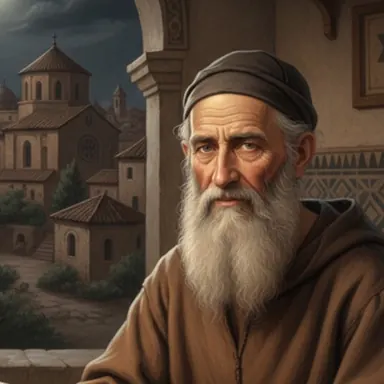
The Luminous Path: A Comprehensive Analysis of the Interpretive and Ethical System of Rabbenu Bachya ben Asher
24 min read4,848 words
Summary
This source offers an in-depth survey of the work of Rabbenu Bachya ben Asher, a central thinker in medieval Spain who served as a link between the rationalist current and the teaching of Kabbalah. His renowned work on the Torah is presented as a methodological innovation based on the PaRDeS method, by means of which he combines the plain meaning, philosophy, homiletics and the esoteric into a single interpretive harmony. The text emphasizes that his works, among them "Kad ha-Kemach" and "Shulchan shel Arba," were intended to make moral ideas and mysticism accessible to the broad public, while turning everyday actions, such as eating, into sanctified service of God. In conclusion, the source describes a figure who shaped the spiritual world of Spanish Jewry by synthesizing diverse sources and who laid the foundations for disseminating the hidden teaching as an integral part of the accepted study of Torah.
The intellectual landscape of Iberian Jewry in the late 13th and early 14th centuries was characterized by a deep tension between rationalist philosophy and the young and increasingly influential schools of Kabbalah. Within this volatile cultural environment, Rabbenu Bachya ben Asher ben Chalawa emerged as a central figure, serving as a bridge between the elitist mysticism of the Gerona circle and the broad Jewish public. Born in Saragossa around ...1255 and disappearing from view around 1340, Bachya's career unfolded in parallel with the publication and initial dissemination of the Zohar, a period in which the "Path of Light"—as he called Kabbalah—began to illuminate the previously opaque layers of traditional interpretation.[1, 2] His scholarly work represents one of the earliest and most successful attempts to synthesize the "four-part" interpretive method, known by its acronym PaRDeS, into a coherent pedagogical framework.[3, 4] Through his great work on the Five Books of the Torah, his ethical encyclopedia "Kad ha-Kemach," and his guide to the sanctity of nutrition, "Shulchan shel Arba," Bachya fundamentally reshaped the way the Torah is studied and experienced by the masses, and ensured that the mystical traditions of Spain would not remain the exclusive possession of those who had sanctified themselves.[1, 5, 6]
The Historical and Biographical Context of Saragossa
The life of Rabbenu Bachya ben Asher is situated within the Crown of Aragon, and in particular in Saragossa, a city that served as a vibrant center of both Talmudic and philosophical study. Although few details exist about his early years, it is evident that he was a scion of the respected Chalawa family, a dynasty of rabbis and scholars.[4, 7] Bachya's principal intellectual formation took place under the guidance of Rabbi Shlomo ben Aderet, known as the Rashba, the undisputed leader of Spanish Jewry and head of the academy in Barcelona.[6, 7] Although the Rashba was known chiefly for his legal responsa and his Talmudic mastery, he was also a recipient of the mystical traditions of the Gerona school, a heritage that he passed on to Bachya.[3, 4]
Despite his deep learning, Bachya's life was marked by material hardship. He served as a preacher (darshan or exegete) in Saragossa, a post he shared with several others, which resulted in a meager salary that often did not suffice to support his family. [2, 6] This struggle for a livelihood most likely influenced his theological focus on the concept of trust (bitachon) in divine providence, which occupies a central place in his ethical writings. [4, 8] Furthermore, his role as a public preacher required a clear and engaging style, which became the hallmark of his literary work and distinguished him from his more esoteric predecessors such as Nahmanides. [2, 6]
An analysis of his biography reveals a figure who stood at the crossroads of different Jewish cultural currents. As a student of the Rashba, he was anchored in the rigorous halakhic tradition of the Spanish center.[7] Yet as a recipient of the mystical teaching of the school of Nahmanides, he was charged with translating the most complex and often secret traditions of Kabbalah into a language that the entire community could understand.[2] This dual role, as a traditional rabbi and as a mystical innovator, is essential to understanding his literary work. The economic difficulties he faced also provide a human context for his writings on the virtues of contentment and faith, and suggest that his ethical teaching was not merely theoretical but was forged in the crucible of personal experience.[2]
The intellectual environment of Bachya's time was also defined by the aftermath of the Maimonidean controversy. The Jewish community was divided between those who supported Aristotelian rationalism and those who saw it as a threat to traditional faith. Bachya adopted a nuanced position, acknowledging the validity of philosophical truth while insisting that it is already encoded in the supreme wisdom of the Torah. [2, 6] This synthesis allowed him to use philosophical terminology and concepts without alienating the traditional sectors of his target audience. His work on the Torah, begun in 1291, serves as testimony to this integrative approach, in which he consciously sought to combine the different currents of Jewish thought into a single, comprehensive narrative. [1, 4]
The Methodology of PaRDeS: A New Hermeneutical Interpretation
Rabbenu Bachya's most significant contribution to the history of Jewish interpretation is his "Midrash on the Torah" (often called simply Rabbenu Bachya on the Torah), which he began in 1291.[1, 4] This work was the first to build its interpretation explicitly around the four levels of understanding represented by the acronym PaRDeS: Peshat (plain meaning), Remez (allusive/philosophical meaning), Derush (homiletic meaning), and Sod (secret/kabbalistic meaning). [3, 4, 5] This structural innovation was not merely an aesthetic choice but a theological statement concerning the multilayered nature of divine revelation.
The Foundations of the Plain Meaning
In the first layer of his commentary, Bachya draws heavily on the writings of Rashi and Rabbenu Chananel, focusing on the linguistic and contextual understanding of the biblical text.[2, 6] His aim in this section is to provide a grounded and accessible reading of the Torah that answers the basic demands of the reader. He acknowledges Rashi and Chananel as the principal authorities in this area, and his own contributions here are often characterized by diligent use of their writings to clarify the literal intent of the text.[2] However, unlike Rashi, who often sought to reconcile the plain meaning with the midrashic tradition, Bachya maintains a clearer separation between these layers, allowing the peshat to stand on its own as a legitimate level of meaning.[2, 6]
The peshat layer serves as the necessary physical body for the deeper spiritual truths that follow. Bachya believes that without a firm understanding of the literal text, the higher levels of interpretation risk becoming detached from the reality of revelation. This level of analysis often involves investigating the scientific and natural aspects of the world, since he believes that the Torah, as the act of God, must be consistent with the observed laws of nature.[6] By rooting his interpretations in the peshat, he ensures that his more esoteric interpretations will be perceived as an organic outgrowth of the text and not as an external imposition.
Philosophical Inquiry and the Level of Remez
The second level, remez, is used by Bachya to integrate logical analysis and philosophical inquiry. Here, he engages with the works of Maimonides and Abraham bar Hiyya, demonstrating that the scientific and philosophical truths of his era were essentially contained within the biblical narrative.[4, 6] He accepts the findings of human reason only to the extent that they do not contradict the Jewish tradition, and regards philosophy as a handmaiden of theology rather than an independent authority.[2, 6] His aim in the remez section is to show that "philosophical truths are already embodied in the sacred writings," which, as the act of God, necessarily transcend all human wisdom.[2, 6]
This layer of interpretation reflects the great value that Bachya attached to the intellect. He wrote the philosophical sections of his commentary especially for "those with a scientific education," recognizing that for a certain group of Jewish scholars, faith must be strengthened by rational persuasion.[2] By integrating philosophy into the interpretation of the Torah, he provided a safe haven for rationalists who might otherwise have strayed from the tradition, and showed them that the depths of the Torah are broad enough to encompass their intellectual concerns. This layer also functions as a critique of non-Jewish sources, since Bachya frequently cites philosophers in order to contrast their views with what he regards as the superior wisdom of the Jewish tradition.[4]
The Homiletical Path of Derush
The third level, derush, reflects Bachya's professional background as a preacher (darshan). In this section, he fills his commentary with a wide range of midrashic material, much of which is drawn from sources that are now lost to us.[2] He often presents these midrashim as moral or ethical lessons, and uses them to reinforce the spiritual and psychological demands of a holy life.[1, 4] His ability to weave these aggadot into the fabric of the text contributed greatly to the popularity of the commentary.[9] Bachya's derush is characterized by verbatim quotation without excessive explanation, allowing the emotional and pedagogical power of the midrashic narrative to speak for itself.[2]
One of the distinctive features of Bachya's derush is his willingness to incorporate "non-canonical" aggadot that were widespread in medieval Jewish culture. A prominent example is his interpretation of Genesis 15:7, where he includes an original medieval legend concerning the birth and childhood of Abraham.[9] By including such material in a formal Torah commentary, he helped shape the written form of these oral traditions and ensured their survival for future generations. The inclusion of this legend serves to humanize the biblical patriarchs, making their spiritual struggles and triumphs more accessible to the ordinary reader.
The Secret Path and the Systematization of Kabbalah
The fourth and final level, sod, represents the "Path of Light"—the kabbalistic interpretation of the Torah. Bachya was the first commentator to present Kabbalah systematically to the broad public.[2] As a model to be emulated, he used mystical traditions to clarify "dark passages" and to reveal the hidden mechanics of the universe.[2, 6] Although he rarely names his contemporary sources, he frequently refers to the Sefer ha-Bahir and twice to the Zohar, which marks him as one of the first authors to make use of the Zohar corpus.[1, 6]
The level of sod is for Bachya the ultimate destination of the soul that seeks truth. He believes that only through this method can the profound mysteries concealed in the biblical word be fully revealed.[2] His kabbalistic interpretations often focus on the nature of the sefirot (the divine emanations), the mechanics of prayer, and the influence of human action on the upper worlds.[10] However, in keeping with his role as a popularizer, his presentation of Kabbalah is notably restrained in comparison with more esoteric works. He often frames his mystical insights as "hints" or "reminders" of the teaching of Nahmanides, whom he describes as one who "taught us the way to ascend and set us on the way of truth."[1]
The success of this methodology was unprecedented. The commentary was printed in numerous editions, beginning in Naples in 1491 or 1492, and gave rise to at least ten supercommentaries by later scholars such as Rabbi Naftali ben Eliezer Treves and Rabbi Chaim ha-Kohen of Tripoli.[1, 2, 6, 7] Its distinctive form—in which each weekly portion opens with an introductory motto from the Book of Proverbs—turned the study of the Torah into a structured intellectual and spiritual journey.[2, 6]
Kad ha-Kemach: An Ethical and Theological Encyclopedia
Whereas the Torah commentary served the "scientific scholars" and those seeking a deeper interpretation, Bachya's "Kad ha-Kemach" was intended for a wider audience.[2] This work, arranged in alphabetical order, consists of ...82 or 60 (depending on the edition) discourses on the principles of Jewish faith, ethics and ritual.[1, 6, 11] It is a masterpiece of mussar (ethical literature) that seeks to ground the Jew's outward actions in an inner framework of devotion and refinement of character. The title itself is a reference to the biblical jar of flour that never failed, symbolizing the continual sustenance that the wisdom of the Torah provided during the "drought" of exile.[1, 6, 12]
The Architecture of Faith and Trust
At the heart of "Kad ha-Kemach" is an examination of the basic virtues of faith (emunah) and trust (bitachon). Bachya argues that faith is the foundation of the entire Torah, stating that "one who has no faith, it would have been better for him had he not been created."[13] He emphasizes that trust in God must be absolute, extending even to the most everyday aspects of physical survival.[4, 12] For Bachya, trust is not merely a passive state but an active orientation of the soul that enables a person to face the reversals of fortune with equanimity.[2]
He examines the nature of God's interaction with the world, balancing the concept of divine justice against the attribute of mercy.[2, 6, 14] A large part of the work is devoted to the divine attributes and the nature of providence, where he argues that human suffering and prosperity are never arbitrary but always the result of a precise and purposeful divine plan.[6] This perspective serves a crucial pedagogical function, providing the reader with a framework for understanding both the national exile of the Jewish people and the personal suffering of the righteous.
Social Virtues and the Ethics of the "Other"
A large part of "Kad ha-Kemach" is devoted to social virtues, such as peace, kindness and the duty of charity toward humanity. [2, 6, 13] He regards Abraham's hospitality as a direct extension of the divine attribute of chesed (kindness), and teaches that imitating the divine attributes is the highest moral achievement. [13] One of the most striking features of the work is its emphasis on the duty of charity toward the non-Jewish brother, which reflects a breadth of outlook that was unique in the medieval period. [2]
Bachya's ethical method is intrinsically connected to his conception of the human being as a creature of both body and soul. He teaches that "the duties of the limbs will not be fulfilled except through the will of the heart."[4, 8] This insistence on inner motivation for ethical action ensures that religion does not degenerate into mere ritualism. He encourages the reader to walk before God in simplicity and humility, and to fear God not merely out of fear of punishment but out of reverence for the divine majesty.[2, 6]
The Sanctification of Time: Festivals and Rituals
Every festival is treated in "Kad ha-Kemach" not merely as a series of laws but as a spiritual opportunity for growth. For example, his treatment of Yom Kippur is combined with a commentary on the Book of Jonah, while Purim is linked to the Scroll of Esther. [1, 11] He also provides discourses on prayer, the house of God, and the main points of ritual, always seeking to uncover the spiritual logic behind the practical requirements of the law. [2, 6]
The pedagogical power of "Kad ha-Kemach" lies in its simplicity and clarity. Although it draws from the same deep wells of kabbalistic and philosophical thought as the Torah commentary, its language is intended to speak directly to the reader's heart.[2] It is a work of "ardent reverence" that turned the abstract concepts of medieval theology into practical guidelines for a holy life in a difficult world.
Shulchan shel Arba: The Sacramental Character of the Meal
In Shulchan shel Arba, Rabbenu Bachya applies his philosophical and mystical insights to the most basic human activity: eating. The work is structured in four "gates," corresponding to the four levels of human existence and the four elements that compose the human body. [7, 15, 16] The title reflects several themes: the four elements of the body, the four kinds of creatures, and the four stages of the spiritual journey. [16]
The First Gate: Physics and the Laws of Existence
The first gate discusses the laws of meals, including the requirement of washing the hands and the specific blessings over different foods.[15, 17] Bachya explains that because the human body is composed of four elements, its nutritional intake must be balanced in order to prevent illness and spiritual distraction.[7] He argues that "if one element is lacking or overpowers its neighbor, a person will immediately fall ill and will be unable to eat or drink."[7] In this sense, physical health is presented as a prerequisite for spiritual development.
This gate also deals with the concept of blessings (berakhot). Bachya explains that there are four main blessings associated with a meal: two for purifying the body and two for purifying the soul.[7] He notes that the soul derives pleasure from the "aroma" of the food, and that this pleasure moves the soul to offer praise to its Creator.[7] This link between the physical sensation of eating and the spiritual act of blessing is central to his conception of the meal as a sacramental event.
The Middle Gates: Ethical Conduct and Spiritual Intention
The middle gates focus on "the way of the world" and on the spiritual intentions that should accompany eating. Bachya emphasizes that the table should be treated as an altar, and that the act of eating should be a kind of holy service. [7, 15 , 17] This includes modesty, gratitude toward the host, and avoiding gluttony, which he regards as a degradation of the human intellect. [13] He stresses "the proper honor due to the use of the mouth," teaching that the mouth that is used for Torah and prayer must be kept pure during the act of eating. [7]
The second and third gates function as a guide for the "pilgrim" through the depths of physical existence. Bachya encourages the diner to focus his mind on "the table that is before the Lord," turning an everyday bodily activity into an intellectual one.[16] He reminds the reader that whereas the upper beings (the angels) are nourished without toil by the radiance of the Divine Presence, human beings must toil for their food as a result of Adam's primordial sin.[16] The meal is therefore a moment of physical need and spiritual repair alike.
The Fourth Gate: Eschatology and the Feast of the Righteous
The last gate is an eschatological inquiry into the reward awaiting the righteous in the World to Come. Bachya provides a detailed description of the "feast of the future," at which the righteous will feast on the Leviathan, the Behemoth and the Ziz (a mythical bird).[1, 18, 19] He interprets these traditions not only literally but also as metaphors for the profound intellectual and spiritual delight that the soul will experience when it is no longer bound to the physical world.[16, 19, 20]
Bachya's description of the Leviathan is especially rich in detail. He relates the midrashic tradition according to which God created a male and a female Leviathan, but when He understood that their union would destroy the world, He killed the female and salted her for the righteous in the future. [18, 19] He interprets the "salting" as a metaphor for preserving the potential of the physical world in a state that will be accessible only in the World to Come. [18] The fourth gate serves to turn the diner's attention from the temporary pleasure of the present meal to the ultimate eternal joy of the messianic age. [7, 15, 17]
Mystical Transformation and the Hierarchy of Perfection
Recent academic studies, and in particular the work of Adam Afterman and Idan Pinto, have identified a sophisticated doctrine of mystical transformation, or apotheosis, in Bachya's writings.[21] Bachya does not view human perfection as a static state but as a hierarchical path comprising several stages of spiritual evolution. This path is meant to lead the mystic toward an "eschatological perfection" in which the boundaries between the human and the divine become increasingly permeable.[21, 22]
This hierarchy is built around four central conceptual qualities found in the biblical narrative:
- Temimut (wholeness/integrity): the initial stage of settling into the divine law, characterized by simplicity of heart and complete commitment to the commandments.[21]
- Hitalkhut (walking with God): a state of constant awareness of, and closeness to, the divine, as exemplified by figures such as Noah and Enoch who "walked with God."[21, 22]
- Hipukh (inversion): the transformation or reversal of the individual's nature from the physical to the spiritual. [21, 22]
- Lekichah (translation/taking): the final stage of mystical union or transcendence, as seen in the "taking" of Enoch and the ascent of Elijah. [21, 22]
Bachya uses "apotheotic figures"—biblical figures such as Enoch, Noah, Abraham, Moses and Elijah—to illustrate different stages of this path.[21] For Bachya, these figures are not merely historical symbols but archetypes of the mystical potential inherent in every human soul. His discussion of their intellectual, ethical and mystical attainments provides a roadmap for the individual seeker to rise toward a state of angelic existence.[21, 22] This focus on the "path of perfection" suggests that for Bachya, the ultimate goal of the Torah is the ontological transformation of the human being.
The Classification of the Commandments and the Logic of the Heart
Bachya's theological system provides a comprehensive framework for understanding the commandments (mitzvot). He classifies the commandments into two main categories based on their accessibility to human reason:
- Rational commandments (musalot): these are laws regarded as reasonable and necessary by all of humanity, such as the prohibitions on murder, theft and adultery, as well as the duty to honor parents.[7] These commandments serve the basic needs of a functioning society and are consonant with natural law.
- Received commandments (mekubalot): these are laws that seem logically unnecessary and cannot be fully understood by the ordinary human mind, such as the laws of the shofar, the sukkah, kashrut and the sacrifices.[7]
Despite the supra-rational character of the mekubalot, Bachya argues that they are rooted in "supreme wisdom" and have profound benefits for both the physical body and the spiritual soul.[7] He argues that observing these commandments opens the "gates of divine flow" and enables a person to participate in the cosmic maintenance of the universe.[10]
Central to his understanding of the commandments is the role of the "heart." He teaches that the "duties of the limbs" (external actions) are complete only when accompanied by "the will of the heart and the will of the soul."[4, 8] This emphasis on inner intention (kavvanah) is a recurring theme in his works. He presents a "ladder" of spiritual ascent, whose first step is the knowledge of God and whose last step is the pure love of the Divine.[8] Each commandment is a step on this ladder, leading a person closer to the hidden and exalted source of all existence.
The Connection with the Zohar and the Dissemination of Secrets
One of the most significant aspects of Rabbenu Bachya's career is his relationship to the Zohar. His works appeared in the critical decades following the emergence of the Zohar in the late 13th century, which makes him one of the earliest and most important witnesses to its dissemination.[1] There is considerable scholarly debate concerning the nature of this connection. Some scholars, such as Yehuda Liebes, have identified Bachya as a potential candidate for inclusion in the "circle" of authors who created the Zohar, citing the deep similarity between his Torah commentary and the text of the Zohar.[1] Others, such as Ephraim Gottlieb, argue that Bachya was an avid student of the Zohar who exploited its teaching to create a more accessible mystical synthesis.[1]
Regardless of his specific role in its composition, Bachya's role as a "translator" of Kabbalah for the masses is beyond dispute. He had an exceptional ability to take the obscure and often "stammering" language of the early kabbalists and to reformulate it in a clear and elegant style.[1] He achieved this through:
- Selective editing: he consciously omitted terms and concepts that were deemed superfluous or too misleading for the broad public.[1]
- Reduction of radical symbolism: he often moderated or removed the bold sexual and mythological symbolism found in the Zohar and other kabbalistic works.[1]
- Narrative integration: he placed kabbalistic "secrets" alongside the literal, philosophical and midrashic meanings, showing that the mystical dimension is an organic part of the unity of the Torah. [1, 3, 4]
By synthesizing the "Path of Light" into his four-dimensional commentary, Bachya ensured that Kabbalah would not remain repressed or forbidden knowledge. Instead, he made it a pillar of the standard Jewish library. His commentaries became so popular that they were studied regularly in Jewish communities on the Sabbath, thereby effectively "democratizing" the secrets of the Spanish mystics for generations of saints and ordinary people alike.[1]
Influence and Literary Legacy
The influence of Rabbenu Bachya ben Asher spread far beyond the borders of medieval Spain and continues to the present day. His writings became standard points of reference for later generations of Jewish scholars throughout the world.
Influence on the Biblical Commentators of the Following Century
Bachya's most immediate influence can be seen in the works of his younger contemporary, Rabbi Yaakov ben Asher (the Baal ha-Turim). Although best known for his legal code, the Arba'ah Turim, Yaakov also composed a comprehensive commentary on the Torah, drawing heavily on the same pool of sources as Bachya—Rashi, Nahmanides and philosophical inquiry. [23, 24] The "abridged" version of this commentary, focusing on the masoretic and numerological "gems" (the Baal ha-Turim), is printed in almost every standard edition of the Five Books of the Torah, alongside the works of his predecessors. [23, 24]
Another central figure influenced by Bachya was Don Isaac Abravanel. In his extensive commentaries on the Hebrew Bible, Abravanel frequently cites Bachya, particularly with regard to his incorporation of midrashic aggadot and his philosophical explanations of the narrative.[9] The enduring popularity of Bachya's Torah commentary is further reflected in the fact that it was one of the first Hebrew books printed after the invention of printing, appearing in Naples in 1491.[1, 2, 7]
The Enduring Value of His Ethical and Nutritional Teaching
Kad ha-Kemach and Shulchan shel Arba remain central texts in Jewish ethical and ritual literature. The discourses of Kad ha-Kemach, arranged in alphabetical order, provided a template for later encyclopedic works of mussar.[2] Its clear and simple style made it accessible to those untrained in the complexities of the academy, and ensured that the message of "ardent reverence" and social justice would reach the widest possible circle of readers.[2]
Shulchan shel Arba carved out a unique niche as a guide to sanctifying everyday life. Its focus on the "spiritual aspects of eating" influenced the way Jews approached the dining table, turning a daily physical need into a moment of spiritual awareness. [3, 5] The work's fourth gate, with its vivid descriptions of the messianic banquet, continued to nourish the Jewish imagination and to provide consolation during centuries of exile and persecution. [7, 15]
Rabbenu Bachya ben Asher ben Chalawa stands as a monumental figure in the history of Jewish thought. By refusing to separate the intellect from the soul, and by synthesizing the different currents of literalism, philosophy and mysticism, he created a holistic vision of the Torah that could speak to "every soul."[7] His legacy is that of a "path of light" that continues to illuminate the depths of the Bible and the demands of a holy life, demonstrating that the deepest mysteries of divinity are often found in the simplest acts of faith and devotion.
----- ...
Sources24
- 1.בחיי בן אשר – ויקיפדיה, he.wikipedia.org/wiki/בחיי_בן_אשר
- 2.BAḤYA (BEḤAI) BEN ASHER BEN HALAWA - JewishEncyclopedia.com, jewishencyclopedia.com/articles/2367-bahya-behai-ben-asher-ben-halawa
- 3.בחיי בן אשר | מקורות מתוך ספריית ספריא, sefaria.org.il/topics/bachya-ben-asher
- 4.מי היה רבינו בחיי בן אשר? - Chabad.org, chabad.org/library/article_cdo/aid/6541551/jewish/Who-Was-Rabbeinu-Bachye-Ben-Asher.htm
- 5.בחיה בן אשר | טקסטים מספריית ספריא, sefaria.org/topics/bachya-ben-asher
- 6.בהיה בן אשר - ויקיפדיה, en.wikipedia.org/wiki/Bahya_ben_Asher
- 7.רבנו בחיי בן אשר – ויקישיבה, yeshiva.org.il/wiki/index.php/רבנו_בחיי_בן_
- 8.רבינו בחיי והספר חובת הלבבות - BeitChabad.com - בית חב"ד, he.chabad.org/library/article_cdo/aid/3164431
- 9.(PDF) טוהר, ורד. "פירוש בהיא בן אשר לבראשית טו:ז", כתב העת האירופי ללימודי יהדות של EJJS 9, מס' 2 (2015): 134–153 [אנגלית]. - ResearchGate, researchgate.net/publication/284001548_Tohar_Vered_The_Exegesis_of_Bahya_Ben_Asher_for_Gen_157_EJJS_European_Journal_for_Jewish_Studies_9_no_2_2015_134-153_English
- 10.השתלשלות הקבלה - אור הרשב"י, miron.org.il/%D7%94%D7%A9%D7%AA%D7%9C%D7%A9%D7%9C%D7%95%D7%AA-%D7%94%D7%A7%D7%91%D7%94C%D
- 11.שולחן של ארבע / רבינו בחיי - כד הקמח - הדף היהודי, hamadaf-y.co.il/%D7%97%D7%A0%D7%95%D7%AA/%D7%9E%D7%95%D7%A1%D7%A8-%D7%95%D7%90% D7%9E%D7%95%D7%A0%D7%94/%D7%A2%D7%95%D7%93-%D7%91%D7%90%D7%9E%D7%95%D7%A0%D7%94-%D7%95%D7%9 E%D7%95%D7%A1%D7%A8/%D7%9B%D7%93-%D7%94%D7%A7%D7%9E%D7%97-%D7%A9%D7%95%D7%9C%D7%97%D7%9F-%D 7%A9%D7%9C-%D7%90%D7%A8%D7%91%D7%A2-%D7%A8%D7%91%D7%99%D7%A0%D7%95-%D7%91%D7%97%D7%99%D7%99/
- 12.כד הקמח | ספריית ספריא, sefaria.org.il/Kad_HaKemach
- 13.בחיי בן אשר - ויקיציטוט, he.wikiquote.org/wiki/בחיי_בן_אשר
- 14.רבנו בהיא | ספריית ספריה, sefaria.org/Rabbeinu_Bahya
- 15.שלחן של ארבע | ספריית ספריא, sefaria.org.il/Shulchan_Shel_Arba
- 16.שלחן של ארבע: הקדמה, jkraus.webspace.wheatoncollege.edu/shulhan-shel-arba-table-of-contents/shulhan-shel-arba-introduction/
- 17.שולחן של ארבע | ספריית ספריא, sefaria.org/Shulchan_Shel_Arba
- 18.רבינו בחיי על בראשית א כא - ויקיטקסט, he.wikisource.org/wiki/%D7%A8%D7%91%D7%99%D7%A0%D7%95_%D7%91%D7%97%D7% 99%D7%99_%D7%A2%D7%9C_%D7%91%D7%A8%D7%90%D7%A9%D7%99%D7%AA_%D7%90_%D7%9B%D7%90
- 19.משתה לצדיקים לעתיד לבוא | טקסטים מספריית ספריא, sefaria.org/topics/the-banquet-for-the-righteous-in-the-future-to-come
- 20.ישעיהו ס"ד עם שולחן של ארבע - ספריא, sefaria.org/Isaiah.64?with=Shulchan Shel Arba
- 21.על אפותאוזיס בקבלה של רבי חייא בן אשר - אוניברסיטת תל אביב, cris.tau.ac.il/en/publications/התהלכות-התהפכות-ולקיחה- %D7%A2%D7%9C-%D7%90%D7%A4%D7%95%D7%AA%D7%99%D7%90%D7%95%D7%96%D7%94-%D7%91%D7%A7% D7%91%D7%9C%D7%AA-%D7%A8-%D7%91%D7%97%D7%99%D7%99-%D7%91%D7%9F-%D7%90%D7%A9%D7%A8/
- 22.על אפותאוזיס בקבלה של רבי חייא בן אשר , jstudies.huji.ac.il/sites/default/files/jstudies/files/tarbiz_- 8703-00 - abstracts - e - for_press - 13.5.2021_4 - _afterman_pinto.pdf
- 23.רבי יעקב בן אשר (הטור) - (התשמ"ט בקירוב; 1269-1340) - Chabad.org, chabad.org/library/article_cdo/aid/111937/jewish/Rabbi-Jacob-Ben-Asher-The-Tur .
- 24.פירוש על התורה, מאת יעקב בן אשר: מתאבנים מסורה ונומרולוגית (ונציה, 1544) - ארכיון האינטרנט, archive.org/details/commentary-on-the-torah-by-jacob-ben-asher-masoretic-and-numerological-appetizers-venice-1544-images