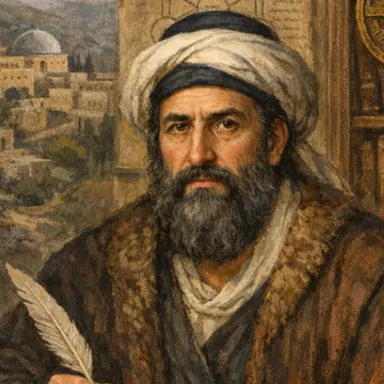
Rabbi Shem Tov ben Avraham ibn Gaon
23 min read4,506 words
Summary
This source surveys the life and work of Rabbi Shem Tov ben Avraham ibn Gaon, a multidisciplinary sage of the 14th century who was active in Spain and in Safed and served as a connecting link between pure halakha and the esoteric teaching. The text details his central contributions, first among them the commentary "Migdal Oz," which defends the rulings of Maimonides (Rambam), and the book "Keter Shem Tov," which deciphers the kabbalistic allusions of Nahmanides (Ramban). Alongside his work as a commentator, the source highlights his skill as a meticulous Masorah scholar in the work "Shem Tov Bible," which combines artistic aesthetics with a unique kabbalistic scribal practice. The main aim of the article is to present ibn Gaon as a "comprehensive sage" who sought to create a harmonious synthesis between the world of the revealed and the world of the hidden and to establish Kabbalah as the inner soul of the Jewish tradition.
The Torah Teaching and Literary Work of Rabbi Shem Tov ben Avraham ibn Gaon: A Synthesis of Halakha, Kabbalah and Masorah in the Passage from Spain to Safed
Rabbi Shem Tov ben Avraham ibn Gaon represents one of the most complex and influential figures of the fourth and fifth generations of the sages of Spain, a period characterized by growing tension between the philosophical-rationalist tradition and the rise of the kabbalistic esoteric teaching. As one who was educated in the splendid study halls of Barcelona and Castile and ended his life among the mountains of the Galilee in Safed, ibn Gaon's work spans a wide range of fields: from comprehensive halakhic commentary on the Rambam's code, through the disclosure of the Ramban's kabbalistic mysteries, to meticulous philological and Masoretic work on the text of Scripture.[1, 2, 3] His is the figure of a "comprehensive sage" who seeks to create harmony between worlds that seemed contradictory to his contemporaries, using the tools of polemical defense, source research and artistic ornamentation.[1, 4, 5]
Chapter 1: Biography and Stations of Life – From Soria to Safed
Rabbi Shem Tov ibn Gaon was born in the city of Soria in the region of Castile, Spain, in about 1283.[2, 6] The origin of his family has stood at the center of scholarly discussion; while some of the early bibliographers, such as the Chida in his book "Shem ha-Gedolim," held that the title "Gaon" attests to descent from an ancient family of Geonim, modern scholars such as Zunz and Geiger proposed that it is a Hebrew transcription of the name of the Spanish city of Jaén, from which the family migrated to northern Spain.[2, 6] This family was part of the spiritual and social elite of Castilian Jewry, which enabled the young Shem Tov to receive a broad education that included not only Talmud and halakha but also philosophy, the sciences and the esoteric teaching.[1, 7]
His early years were shaped under the influence of the great sages of the generation in Catalonia. He moved to Barcelona to study in the study hall of Rabbi Shlomo ben Avraham Aderet (the Rashba), who was the undisputed leader of Spanish Jewry at that time.[2, 8] With the Rashba, ibn Gaon acquired the method of in-depth Talmud study and the foundations for wide-ranging halakhic decision-making. At the same time, he pursued advanced study of Kabbalah with Rabbi Yitzhak ben Todros, a central figure in the circle of the kabbalists of Barcelona, from whom he received the kabbalistic traditions that had passed from generation to generation since the days of the Ramban.[1]
In 1312, out of a sense of spiritual mission and a desire to find a place more suitable for kabbalistic meditation, ibn Gaon decided to immigrate to the Land of Israel.[1, 2] This migration was not merely a personal act but part of a broader trend among Spanish kabbalists who saw the Land of Israel as the only place where spiritual perfection and prophetic attainment could be achieved. Before his departure, he completed in Soria the writing of his magnificent Bible codex, known today as the "Shem Tov Bible."[4] After a short stay in Jerusalem, he settled in the city of Safed, which was then at the very beginning of its formation as a spiritual center, some two hundred years before the famous "golden age" of the 16th century.[2, 5] Ibn Gaon was active in Safed until his death in about 1330, and there he composed most of his kabbalistic and halakhic books.[3, 6] His personal life was full of tragedies; in the introduction to his book "Baddei ha-Aron," he describes with sorrow how he lost all his children, sons and daughters, and was left without biological continuity – a fact that drove him to perpetuate his memory through his Torah writing.[3, 9]
Chapter 2: His Teachers and Spiritual Influences – Between the Rashba and the Ramban
Ibn Gaon's spiritual figure is the product of a synthesis between two central schools of Spanish Jewry. On the one hand stands the Rashba, who instilled in him a total commitment to the Talmudic sources and to the legal structure of halakha.[1, 8] With the Rashba, ibn Gaon learned how to cope with the philosophical challenges of his time; he witnessed the great controversy of 1305, in which the Rashba prohibited the study of physics and metaphysics before the age of 25, and he internalized the need for a cautious approach that combines broad learning with loyalty to tradition.[1]
On the other hand, the influence of the Ramban (Rabbi Moshe ben Nachman) was the most decisive on his inner world. Although ibn Gaon did not study with the Ramban directly (the Ramban died in 1270, before ibn Gaon was born), he saw himself as a disciple-colleague and the distinct continuer of his path through the teaching of his own teachers.[1, 10] Ibn Gaon saw in the Ramban the perfect model of the "complete sage," capable of uniting the plain meaning with the esoteric, the interpretation of Scripture with theosophical Kabbalah.[1] He devoted a considerable part of his work to deciphering the Ramban's kabbalistic allusions, out of the belief that Kabbalah is the true key to understanding the Torah and reality.[2, 11]
Another teacher who influenced him in the field of Kabbalah was Rabbi Yitzhak ben Todros (called the Rivat), who was known for his expertise in the doctrine of the sefirot and in the kabbalistic traditions of Provence.[1, 2] Ibn Gaon took care to record the chain of kabbalistic tradition he had received, which connects him directly to the first kabbalists in France and Spain, and he thereby sought to establish his authority as a representative of authentic, traditional Kabbalah.[5, 12] He used to present himself as one who held the "oral Kabbalah" that had passed from generation to generation since the revelation at Mount Sinai.[5, 11]
Chapter 3: The Commentary "Migdal Oz" – Shield and Source for the Rambam
Rabbi Shem Tov ibn Gaon's most important halakhic contribution is the commentary "Migdal Oz" ("Tower of Strength") on the Rambam's "Mishneh Torah." This book is the fruit of strenuous work intended to address two central criticisms that had been directed at the Rambam since the publication of his code: the absence of references to his sources, and the sharp glosses (hassagot) of the Ra'avad (Rabbi Avraham ben David of Posquières).[1, 2] Ibn Gaon was the first to make a comprehensive and systematic attempt to locate the Talmudic, midrashic and geonic sources on which the Rambam based each and every ruling.[6, 13]
The methodology of "Migdal Oz" is characterized by deep loyalty to the Rambam, at times to the point of overt apologetics. Ibn Gaon argues that in places where the Rambam appears to disagree with the Babylonian Talmud, this stems from more accurate textual versions that the Rambam had in hand, or from the Rambam's preference for the tradition of the Geonim or for the Jerusalem Talmud.[14] He attacks the Ra'avad in sharp language and tries to show that his glosses stem at times from a failure to grasp the depth of the Rambam's intention or from unfamiliarity with the hidden sources that were available to the author.[1, 2, 6]
Beyond the defensive aspect, "Migdal Oz" is a monumental research enterprise. In it ibn Gaon quotes from the Rambam's responsa that were in his possession (thereby helping to preserve them), and corrects copyists' errors that had crept into the manuscripts of the "Yad ha-Chazakah."[1, 13] The book was accepted throughout all the Jewish diasporas, and since 1524 it has been printed in all the major editions of the Rambam alongside the "Maggid Mishneh."[1, 2] Nevertheless, later sages such as the Maharshal (Rabbi Shlomo Luria) criticized the work for at times including irrelevant details or for failing truly to resolve the Ra'avad's difficult objections.[1]
One of the most interesting aspects of "Migdal Oz" is the integration of Kabbalah into halakhic commentary. Ibn Gaon, unlike many others, saw no contradiction between the world of the Rambam and the world of the esoteric. In Hilkhot Yesodei ha-Torah (Laws of the Foundations of the Torah), he cites a tradition (disputed in scholarship) according to which the Rambam retracted the philosophical approach at the end of his life and began to engage in Kabbalah.[1, 5] This claim allowed ibn Gaon to present the Rambam as an inseparable part of the chain of the sages of the esoteric, and to interpret certain laws in the "Mishneh Torah" as allusions to deep kabbalistic conceptions.[1, 5]
Chapter 4: "Keter Shem Tov" – Deciphering the Secrets of the Ramban
In the field of Kabbalah, ibn Gaon's most famous work is "Keter Shem Tov" (not to be confused with later Hasidic books bearing the same name).[15] It is a "super-commentary" (a commentary on a commentary) devoted entirely to disclosing the kabbalistic "secrets" that the Ramban concealed in his commentary on the Torah.[2, 16] The Ramban, who feared exposing the esoteric teaching to the general public, used to write brief and cryptic remarks that ended with the phrase "and by way of truth," with a warning that they can be understood only from the mouth of a sage.[11, 16] Ibn Gaon took upon himself the complex role of the mediator, deciphering these allusions for the "enlightened" who were worthy of them.[8, 16]
Ibn Gaon began writing the book in Spain and completed it in Safed in 1315.[2, 6] At first he called the book "Sitrei Sitrim" ("Secrets of Secrets"), but after a new revision he called it "Keter Shem Tov."[2, 6] The book is not merely a lexicon of the Ramban's terms but a theosophical work that formulates the foundations of Catalonian Kabbalah. It deals with subjects such as the ten sefirot, the essence of the holy names, the doctrine of reincarnation and the reasons for the commandments according to the esoteric teaching.[17, 18]
The completion of the work in Safed marked the beginning of the Ramban's transformation into the central source of authority of written Kabbalah in the 14th century.[16] Nevertheless, ibn Gaon's activity aroused fierce controversy. The kabbalist Rabbi Yitzhak of Acre, in his book "Me'irat Einayim," sharply attacked ibn Gaon and claimed that many of the interpretations in "Keter Shem Tov" are nothing but inventions of the author ("he says them from his own heart") and do not reflect the true Kabbalah that the Ramban had received.[2, 6] This dispute reflects the inner tension in the world of Kabbalah at that time over the question of who has the right to write down and disclose the oral secrets.
Chapter 5: The "Shem Tov Bible" – Scripture as a Work of Art, Masorah and Secret
One of ibn Gaon's most impressive and unique achievements is the writing of the Bible codex known as the "Shem Tov Bible" (also known as the Sassoon 1053 manuscript). It is a magnificent manuscript completed in 1312 in Soria, just before the author's immigration to the Land of Israel.[4] This manuscript is a multidisciplinary masterpiece that combines precise calligraphy, philological Masorah research and breathtaking artistic illustration.[4]
Ibn Gaon invested many years in editing the text of Scripture, out of an aspiration to produce the most accurate version that could be attained.[4] He relied on ancient and authoritative manuscripts, first among them the "Hilleli Codex," a legendary 11th-century manuscript that was later lost and was known for its extraordinary accuracy.[4] Ibn Gaon attested that he checked every letter, vowel point and cantillation mark, and in places of doubt decided according to ancient traditions and according to the rules of the Masorah.[4]
The uniqueness of this Bible lies in the integration of Kabbalah into the writing of the letters themselves. Ibn Gaon is the only known medieval scribe who systematically incorporated "unusual letters" (curved, coiled or bearing unusual crowns) throughout all five books of the Torah, according to a secret kabbalistic tradition from the first millennium.[4, 19] In his view, the physical form of a letter is not merely a vehicle for conveying information but a channel for divine forces; a small change in the form of a letter may reveal a cosmic secret or protect the tradition from corruption.[4]
The artistic side of the codex reflects the unique cultural encounter of Spain:
- Gothic aesthetics: the use of gold and silver leaf and of decorations reminiscent of the Christian manuscripts of the period.[4]
- Islamic influence: architectural motifs of horseshoe arches and geometric ornaments characteristic of Muslim art in Andalusia.[4]
- Jewish symbolism: illustrations that depict the text, such as a ship beside the Book of Jonah, or lions and birds adorning the margins.[4]
This codex passed through many vicissitudes; after ibn Gaon's death it reached Baghdad, where it was held by the leaders of the community, and later it passed to North Africa.[4] In these communities the book was treated with holy awe and was ascribed the powers of an amulet protecting the community.[4] Recently the manuscript was offered at public auction at a value of millions of dollars, a testimony to its standing as one of the most important documents in the history of the Jewish people.[4]
Chapter 6: "Baddei ha-Aron u-Migdal Hananel" – The Encyclopedia of the Esoteric in Safed
In 1325, while residing in Safed, ibn Gaon completed his most extensive kabbalistic work: "Baddei ha-Aron u-Migdal Hananel" ("The Poles of the Ark and the Tower of Hananel").[2, 3] The book is dedicated to the memory of his close friend and companion on the journey to the Land of Israel, Rabbi Hananel ben Avraham Askira, who died only about three months after they arrived in Safed.[3] In the book's title ibn Gaon alluded both to his friend's name ("Hananel") and to the essence of the Torah ("the poles of the Ark").[3, 9]
"Baddei ha-Aron" is an encyclopedic work divided into five gates, encompassing all the fields of the esoteric teaching that were known in his time. The book includes in-depth discussions of:
The chain of transmission: ibn Gaon cites letters and traditions about the passage of Kabbalah from the centers of Babylonia (Sura and Mata Mehasia) to Italy and from there to Provence and Spain.[12]
The doctrine of the sefirot and the Godhead: an abstract analysis of the ten sefirot as forces operating within the Godhead and in creation.[2, 18]
Mysticism of letters and vowel points: an elaboration on the kabbalistic meaning of the form of the letters, the crowns (tagin) and the cantillation marks of Scripture.[4, 12]
Reasons for the commandments and intentions of prayer: an explanation of the way in which the performance of the commandments affects the "tikkun" (repair) in the upper worlds.[9]
The aggadot of the Sages: a kabbalistic interpretation of puzzling sayings of the Sages in the Midrash and the Talmud.[5, 20]
The book constitutes a valuable historical source because in it ibn Gaon quotes from many works of his own and of others that were lost over the years, such as "Zivchei Tzedek" and "Rosh ha-Shalishim."[1, 2] In "Baddei ha-Aron" ibn Gaon emerges as an original thinker who combines the theosophical Kabbalah of the Ramban with elements of prophetic and meditative Kabbalah.[21] New studies indicate that he used scientific and astronomical concepts to explain spiritual processes, thereby anticipating later attempts to create a synthesis between Kabbalah and science.[22, 23]
Chapter 7: His Work in the Field of the Masorah – The "Dakka" or "Dakkah" Controversy
Rabbi Shem Tov ibn Gaon was among the most important Masorah scholars of his generation, and his work in this field went beyond the writing of the magnificent Bible. He was actively involved in discussions of the text of the Torah, and his words are quoted to this day in the central works of the Masorah. A prominent example of this is the dispute over the spelling of the word "dakkah" (or "dakka") in the verse "He that is wounded by crushing (petzua dakkah) shall not enter" (Deuteronomy 23:2).[24, 25]
The dispute was between the tradition of spelling the word with an alef ("dakka"), which was customary in the communities of Yemen and in some of the ancient books of Spain, and the general tradition of spelling it with a he ("dakkah").[24, 25] Ibn Gaon, as a thorough scholar, examined many ancient Torah scrolls and noted that in the great majority of them he had found the spelling with a he, in accordance with the opinion of the Ramah (Rabbi Meir ha-Levi Abulafia).[24] Nevertheless, he honestly documented the existence of the alef versions in other books he had seen.[24]
Ibn Gaon's testimony served as a basis for later halakhic discussions. The author of the "Minchat Shai" (Rabbi Yedidyah Shlomo of Norzi) quotes his words at length in order to decide the accepted text.[24] It is interesting to note that in Chabad Hasidism, in accordance with the instruction of the Alter Rebbe, the custom was to write "dakka" with an alef, and they found support for their custom in testimonies about ancient Torah scrolls that match the tradition ibn Gaon documented.[26, 27] This activity illustrates how ibn Gaon served as a bridge between the world of philological research and the world of practical halakha.
Chapter 8: The Torah Teaching – Uniting the Revealed and the Hidden
The very heart of ibn Gaon's work is the attempt to abolish the dichotomy between the "revealed" (halakha and Talmud) and the "hidden" (Kabbalah). In his view, these are not two separate worlds but two faces of the same divine truth. He developed a worldview in which every halakhic detail is a reflection of a sefirotic reality, and every commandment is a vessel for connecting man with the Godhead.[5, 28]
- 1.The theurgy of the commandments: following the Ramban, ibn Gaon emphasized that the commandments are not merely disciplinary or educational injunctions but possess a "theurgic" power – the ability to affect the upper worlds and to bring about union and unification among the sefirot.[29] An example of this is his attitude to the commandment of the sacrifices; unlike the Rambam, who saw them as a means of distancing people from idolatry, ibn Gaon explained that the sacrifice creates a direct connection between the various forces within the Godhead.[29]
- 2.Kabbalah as the soul of halakha: in his commentary "Migdal Oz," ibn Gaon incorporates kabbalistic explanations for the customs of Israel.[9] He argues that the customs of the communities, even those that seem puzzling from a purely halakhic point of view, are rooted in deep secrets that were handed down in family tradition.[9] He thereby grants kabbalistic legitimacy to the accepted halakhic reality.
- 3.The idea of tikkun and man: ibn Gaon sees man as the axis of reality. Man's actions below awaken an "itaruta de-letata" (arousal from below), which affects the divine abundance descending to the world.[28] The concept of "tikkun," which in time became central in the Kabbalah of the Ari and in Hasidism, appears in ibn Gaon as part of the responsibility incumbent upon the Jew in observing the Torah and the commandments.[28, 30, 31]
- 4.The secret of the androgyne: ibn Gaon dealt extensively with the question of the "du-partzufin" (the two faces) – the conception that within the Godhead there exist masculine and feminine elements (mercy and judgment).[5, 18] He interpreted the creation of man as an "androgyne" as a reflection of the supernal sefirotic structure, and saw married life and family purity as a means of restoring the divine union.[5, 18]
Chapter 9: Meditative Kabbalah and Mystical Experience
A less familiar but significant aspect of ibn Gaon's teaching, as revealed in the studies of Prof. Oded Israeli, is his engagement with meditative Kabbalah.[21] Ibn Gaon did not see Kabbalah merely as a theoretical system of symbols, but as a way of life aimed at attaining a deep religious experience of devekut (cleaving to God).
In his article "As If You Had Seen with My Own Eyes," Israeli analyzes texts of ibn Gaon that describe techniques of concentration and contemplation.[21] Ibn Gaon describes states in which the kabbalist focuses on holy names or on combinations of letters until he reaches a level of "vision" or a sense of tangible divine presence.[21] He stresses the importance of inner purity, asceticism and pure intention as preconditions for attaining this inspiration.[21] This approach links ibn Gaon to the traditions of the Kabbalah of Abraham Abulafia on the one hand, and to the later Kabbalah of Safed on the other, which places devekut and personal experience at the center.[21, 23]
Chapter 10: Reception, Influence and Legacy Through the Generations
Rabbi Shem Tov ibn Gaon died in Safed around 1330, but his legacy continued to resonate for hundreds of years throughout the Jewish world. His influence is evident in three main circles:
- 1.The world of halakha: the commentary "Migdal Oz" became one of the pillars of the study of the Rambam. Every student of the Rambam since the 16th century has been exposed to its comments, and central authors such as Rabbi Yosef Karo in his book "Kesef Mishneh" relied on it extensively.[1] Ibn Gaon is regarded as one who prepared the ground for the great codification of the "Shulchan Arukh" by turning the "Mishneh Torah" into a source-based book.[13]
- 2.The world of Kabbalah: his commentary "Keter Shem Tov" has remained the main key to understanding the secrets of the Ramban. Later kabbalists, including those of the circles of the Ari, saw ibn Gaon as a vital link in the transmission of the kabbalistic tradition of Spain.[12, 16] His book "Baddei ha-Aron" served as a source of inspiration for discussions of the reasons for the commandments and the intentions of prayer.[9]
- 3.The world of the Masorah and bibliography: the "Shem Tov Bible" remains a living testimony to the capacity for precision and to Jewish art. The manuscript is considered a national and cultural treasure, which teaches us about the way Scripture was perceived in the Middle Ages – not only as a sacred text but as a work of art containing layers of secret meaning.[4] His testimony on the text of Scripture ("dakkah/dakka") continues to occupy halakhic authorities and scholars to this day.[24]
It is interesting to note the vicissitudes of his name; at times there has been confusion between him and other sages with a similar name, such as Rabbi Yom Tov ben Avraham (the Ritva), to whom the commentary "Migdal Oz" was mistakenly attributed by some of the sages.[2, 6] Likewise, some confuse him with Rabbi Shem Tov ibn Shaprut or with Rabbi Shem Tov ibn Shem Tov, who was a later kabbalist who opposed philosophy.[7] Modern scholarship has worked hard to separate the figures and to attribute to each its precise work.
Summary
Rabbi Shem Tov ben Avraham ibn Gaon was a bridging figure. He bridged between Spain and the Land of Israel, between Castile and Catalonia, and above all between pure halakha and profound Kabbalah. His work teaches us about a period in which Torah thought recognized no narrow boundaries, and a single sage could be at one and the same time a meticulous Masorah scholar, a logical halakhic commentator and a mystical kabbalist cleaving to the Godhead.
His teaching, which emphasizes the unity of all the parts of the Torah, left an indelible mark. He succeeded in making Kabbalah an inseparable part of the central Torah discourse, while using the tools of source research and textual precision to establish its truth. The "Migdal Oz" he built to defend the Rambam, the "Keter" (crown) he placed on the head of the Ramban, and the "Bible" he adorned with his own hands constitute to this day pillars of the Jewish library, and they remind us of the good name of a sage who left no sons, but left a spiritual legacy that nourishes the world of Torah to this day.
Sources32
- 1.Ibn Gaon, Shem tov ben Abraham - Encyclopedia.com, encyclopedia.com/religion/encyclopedias-almanacs-transcripts-and-maps/ibn-gaon-shem-tov-ben-abraham
- 2.Shem Tov ben Abraham ibn Gaon - Wikipedia, en.wikipedia.org/wiki/Shem_Tov_ben_Abraham_ibn_Gaon
- 3.שם טוב אבן גאון - ויקיפדיה, he.wikipedia.org/wiki/שם_טוב_אבן_גאון
- 4.The Shem Tov Bible and Mysticism in the Golden Age of Spain ..., sothebys.com/en/articles/the-shem-tov-bible-and-mysticism-in-the-golden-age-of-spain
- 5.GOD AS ANDROGYNE IN MEDIEVAL KABBALAH: TOWARD A HISTORY OF THE DOCTRINE | Traditio - Cambridge University Press, cambridge.org/core/journals/traditio/article/god-as-androgyne-in-medieval-kabbalah-toward-a-history-of-the-doctrine/A3942859D27D6244BF25862333F05446
- 6.SHEM-ṬOB BEN ABRAHAM IBN GAON - JewishEncyclopedia.com, jewishencyclopedia.com/articles/13543-shem-tob-ben-abraham-ibn-gaon
- 7.Shem Tov - Encyclopedia of medieval literature, medieval_literature.en-academic.com/532/Shem_Tov
- 8.Shem Tov ben Avraham ibn Gaon | Texts from the Sefaria Library, sefaria.org/topics/shem-tov-ben-avraham-ibn-gaon
- 9.על שנים ממפרשי משנה תורה לרמב"ם: מגדל עוז ומגיד משנה – ספריית אסיף, asif.co.il/wpfb-file/על-שנים-ממפרשי-משנה-תורה-לרמבם-מגדל-עו/
- 10.Nahmanides | Stanford University Press, sup.org/books/history/nahmanides
- 11.By Way of Truth: Aspects of Naḥmanides' Kabbalistic Hermeneutic | AJS Review, cambridge.org/core/journals/ajs-review/article/by-way-of-truth-aspects-of-nahmanides-kabbalistic-hermeneutic/2E3BACF0CFAD363772B220427BCD345D
- 12.R a b b in ic F ig u r e s in C a stilia n K a b b a listic Pseudepigraphy: R. Yehudah He-l:Iasid and R. Elhanan of Corbeil - Yeshiva University, repository.yu.edu/server/api/core/bitstreams/0ec31b2d-d2ff-4bd8-85da-ce6414e4adb3/content
- 13.Halachic Commentary on Rambam's Yad Chazakah | PDF | Talmud | Judaism - Scribd, scribd.com/document/9657314/Chain-of-Transmission-Halacha-Part-II
- 14.Mishneh Torah - Wikipedia, en.wikipedia.org/wiki/Mishneh_Torah
- 15.כתר שם טוב - ויקיפדיה, he.wikipedia.org/wiki/כתר_שם_טוב
- 16.Keter Shem Tov of R. Shem Yov Ibn Gaon: A Chapter in the History ..., cris.bgu.ac.il/en/publications/תולדות-החיבור-כתר-שם-טוב-לר-שם-טוב-אבן-גאון-פרק-בהתקבלות-קבלת-רמב/
- 17.כתר שם טוב א׳:קנ״ג | ספריית ספריא, sefaria.org.il/Keter_Shem_Tov.1.153
- 18.god as androgyne in medieval kabbalah: toward a history of the doctrine - ResearchGate, researchgate.net/publication/398378593_GOD_AS_ANDROGYNE_IN_MEDIEVAL_KABBALAH_TOWARD_A_HISTORY_OF_THE_DOCTRINE
- 19.Torah-Scroll [Kabbalistic Circle of Shem Tov ben Abraham ibn Gaon, Northern Spain: late 13th century] - Sothebys.com, sothebys.com/en/auctions/ecatalogue/2009/important-judaica-n08606/lot.142.html
- 20.רמב"ן - ויקיפדיה, he.wikipedia.org/wiki/רמב"ן
- 21.Oded Israeli - Ben-Gurion University Research Portal, cris.bgu.ac.il/en/persons/oded-israeli/
- 22.Updated_Complete Dissertation - Knowledge UChicago, knowledge.uchicago.edu/record/15875/files/Updated_Complete Dissertation.pdf
- 23.Kabbalistic Diagrams in Medieval Science | PDF | Kabbalah - Scribd, scribd.com/document/898553130/Chajes-Spheres-Sefirot-And-the-Imaginal-Astronomical-Discourse-of-Classical-Kabbalah
- 24.מנחת שי על תורה, דברים כ״ג:ב׳ | ספריית ספריא, sefaria.org.il/Minchat_Shai_on_Torah,_Deuteronomy.23.2
- 25.כיצד כותבים בספר תורה - 'דכא' או 'דכה'?, app.torahb.co.il/topics/כיצד-כותבים-בספר-תורה-דכא-או-דכה/
- 26.ספר תורה עתיק שהתגלה קובע - 'פצוע דכא' דווקא בא'! - הגאולה, hageula.com/study/judaism/15038.htm
- 27.פצוע דכה או דכא? | דין | שאל את הרב, din.org.il/2015/08/27/פצוע-דכה-או-דכא/
- 28.The Truth About the Baal Shem Tov - Chabad.org, chabad.org/library/article_cdo/aid/2139/jewish/The-Truth-About-the-Baal-Shem-Tov.htm
- 29.Tabernacle, Sacrifices, and Judaism: Maimonides vs. Nahmanides - TheTorah.com, thetorah.com/article/tabernacle-sacrifices-and-judaism-maimonides-vs-nahmanides
- 30.Baʿal Shem Tov | Biography, Teachings, Stories, Kabbala, Founder of Hasidism, & Jewish History | Britannica, britannica.com/biography/Baal-Shem-Tov
- 31.The Sixth Millennium and the Age of Moshiach - If we map time, will we see where it's leading us? - Chabad.org, chabad.org/library/article_cdo/aid/2057885/jewish/The-Sixth-Millennium-and-the-Age-of-Moshiach.htm
- 32.Full text of "127581585 Samael Lilith And The Concept Of Evil In Early Kabbalah", archive.org/stream/127581585SamaelLilithAndTheConceptOfEvilInEarlyKabbalah/127581585-Samael-Lilith-and-the-Concept-of-Evil-in-Early-Kabbalah_djvu.txt