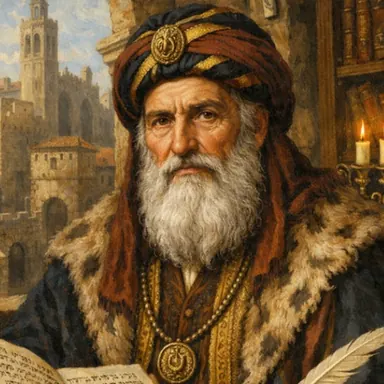
Rabbi Yehuda ben Barzilai of Barcelona: A Comprehensive Historiographical and Torah Analysis
11 min read2,145 words
Summary
This text surveys the figure and work of Rabbi Yehuda ben Barzilai of Barcelona, who served as a decisive intellectual and halakhic bridge between the era of the Geonim in Babylonia and the Torah centers developing in medieval Europe. The source presents the monumental attempt of "the Nasi" to forge a comprehensive halakhic and encyclopedic codex, including the "Sefer HaIttim" on the festivals, the "Sefer HaDinim" on civil law, and a rationalist commentary on the "Sefer Yetzirah." Throughout the analysis, the importance of al-Barceloni in preserving ancient sources and in shaping the legal and theological foundations for the great Rishonim who came after him, such as the Ramban and the Ba'al HaTurim, is emphasized. Beyond the halakhic aspect, the article illuminates his conservative-rationalist worldview, which found expression in his struggle against the anthropomorphization of God and in his rejection of astrology in favor of pure halakhic commitment.
The Codificatory Structure and the Theological Teaching of Rabbi Yehuda ben Barzilai of Barcelona: A Comprehensive Historiographical and Torah Analysis
Rabbi Yehuda ben Barzilai of Barcelona, known by the epithet "al-Barceloni" or "the Nasi," stands as one of the central pillars in the transition from the Torah of the Geonim of Babylonia to the flourishing of the Torah center in the Iberian Peninsula and in Provence.[1, 2, 3] His work, which became known at the end of the 11th century and the beginning of the 12th, represents a monumental and pioneering attempt of its kind to summarize the entire halakhic, legal and theological knowledge of the Jewish people in a single, broad and profound codificatory work.[4, 5] Although considerable parts of his writings were lost or survived only as fragments, his influence on generations of decisors—from the first and second Raavad to the Ramban and the Ba'al HaTurim—attests to his unchallenged centrality in shaping the face of medieval Jewish halakha.[2, 5, 6]
The Historical and Geographical Context: Barcelona as a Cultural Crossroads
The activity of Rabbi Yehuda of Barcelona took place in the county of Barcelona, in a period when the Jewish communities of Christian Spain began to occupy a central place in spiritual leadership, parallel to the decline of the great centers in Babylonia.[1, 7] The Barcelona of those days served as a bridge between the Muslim world in southern Spain, where the sciences and philosophy flourished, and the Christian world then developing in Europe.[2, 5] His status as "Nasi" is not merely an honorific title but an indication of a high social and political standing, hinting at a genealogical line connected to the exilarchs of Babylonia and even to the House of David.[2, 3]
This period was characterized by an urgent need to compile halakhic books that would make the sea of the Talmud and the responsa of the Geonim accessible to communities that were not in direct contact with the yeshivot of Babylonia. Rabbi Yehuda of Barcelona took this task upon himself by way of "exceptional length" (Prolixity), with the aim of creating a codex that not only rules halakha but also explains its sources and its development.[4]
The Methodology of the "Long Ruling": The Creation of a Comprehensive Halakhic Codex
Rabbi Yehuda of Barcelona chose a distinctive methodology of combining sources. Unlike the Rif, who was his older contemporary and who preferred brevity and adherence to the language of the Gemara, al-Barceloni built a broad composition combining three layers of authority [2, 8]:
- The Talmudic layer: analysis of the topics of the Gemara as the basis of every discussion.
- The layer of the Geonim: extensive and precise quotation of the responsa of the Geonim of Babylonia (Saadia, Sherira, Hai Gaon), some of which were preserved solely thanks to him.[2, 3, 8]
- The early Spanish layer: integration of the teaching of the first sages of Spain such as Rabbi Shmuel HaNagid ("Hilkheta Gavrata") and Rabbi Yitzchak ibn Giyyat.[2, 8]
The choice to expand on every subject and to discuss every detail made his works a veritable encyclopedia, but it was also the reason that in the course of the years they were pushed aside in favor of shorter and more efficient codices, such as the "Mishneh Torah" of the Rambam and the "Tur."[2, 4, 5]
"Sefer HaIttim": The Codification of Time and Commandment
"Sefer HaIttim" is al-Barceloni's most prominent halakhic work, dealing with the commandments that depend on time: Sabbath, festivals, the new moon and fasts.[1, 3, 5, 9] The original book encompassed all the components that would later become part of "Orach Chayim," but most of it was lost.[5, 9] The surviving fragments, foremost among them the laws of Sabbath, constitute an inexhaustible source for understanding the early Spanish custom and the Babylonian tradition.[8, 9]
In this book, al-Barceloni serves as a recorder of oral traditions. One of the best known of them, cited by the Tosafot in Tractate Berakhot, concerns a pillar of fire that used to descend from heaven upon the sages during the assemblies of the "kallah" in Babylonia in the months of Elul and Adar.[8] These descriptions attest that al-Barceloni saw himself as a linking element between the mystical aura of the yeshivot of Babylonia and the practical codification of European Jewry.[2, 3]
The influence of "Sefer HaIttim" on the sages of Provence was decisive. Rabbi Abraham ben Isaac of Narbonne (the Ra'avi, head of the beit din) wrote his book "Sefer HaEshkol" as an adaptation and abridgment of "Sefer HaIttim."[2, 4, 6, 10] Scholars such as Chanoch Albeck have shown that in many places the "Eshkol" is in effect an almost word-for-word copy of al-Barceloni's words, which underscores the fact that al-Barceloni was the principal "supplier" of the Torah of Spain and of the Geonim to the sages of southern France.[6, 11]
"Sefer HaDinim" and "Sefer HaShetarot": The Infrastructure of Civil Law
In the field of Jewish law (Choshen Mishpat), al-Barceloni composed the "Sefer HaDinim."[2, 5] The central part that survives of it is the "Sefer HaShetarot," which contains 138 different formulas of legal documents.[5, 12] The importance of the "Sefer HaShetarot" goes beyond the narrow halakhic domain; it is a window onto the economic and social world of 11th-century Jewry.[2]
The documents include contracts for the sale of slaves, land and movable property, business partnership deeds, and also marriage and divorce documents.[5] Al-Barceloni was meticulous about linguistic and legal precision, adapting biblical and Talmudic terminology to the changing economic reality.[2] Simcha Assaf, in his studies on the "Likutei Sefer HaDin," uncovered further fragments dealing with the laws of claims and counterclaims, which attest to the depth of al-Barceloni as an expert in procedural law.[2, 13]
"Yichus She'er Basar": The Halakha of the Family Unit
The third part of al-Barceloni's codificatory structure is called "Yichus She'er Basar" (or "Seder Nashim").[1, 5] This work dealt with the laws of marriage, divorce and family lineage.[1, 2] Although the book was lost, quotations from it appear in the Rashba, the Ritva and the Tashbetz.[1, 2] From the importance of the quotations it emerges that al-Barceloni developed a comprehensive legal theory concerning the status of the woman and the protection of her economic rights within marriage, basing himself on the ordinances of the Geonim on matters of the ketubah and divorce.[1, 2]
Philosophy and Theology: The Commentary on the Sefer Yetzirah
Rabbi Yehuda of Barcelona was one of the first Rishonim in Spain to compose an extensive philosophical-intellectual commentary on the "Sefer Yetzirah."[2, 5, 14, 15] The commentary, which was first printed by S. Z. Halberstam in 1885, is not a "kabbalistic" commentary in the later sense of the word, but a rationalist-theological work that seeks to explain the structure of the universe and the nature of the Divinity.[2, 5]
The Preservation of Philosophical Sources: Al-Muqammis and Rav Saadia Gaon
In his commentary, al-Barceloni preserved spiritual treasures that would have been lost without his work. He translated and summarized extensive portions of the "Ishrun Maqala" (the Twenty Treatises) of David al-Muqammis, an early Jewish philosopher of the 10th century who wrote in Arabic.[2, 16] These summaries are the principal source extant today for understanding al-Muqammis's thought.[2, 16, 17] He also cited extensive passages from an early Hebrew translation of Rav Saadia Gaon's commentary on the Sefer Yetzirah.[2]
The Struggle against Anthropomorphism and in the Interreligious Polemic
Al-Barceloni waged a tenacious war against the Karaites and against any attempt to attribute corporeal attributes to God.[2, 5] His theological teaching rests on three central axes:
- The negation of attributes: under the influence of al-Muqammis, he argued that every positive description of God (such as "living" or "wise") must be understood as the negation of its opposite, since God bears no resemblance whatsoever to created beings.[2, 16, 17]
- The doctrine of the "Glory": in order to explain the visions of prophecy without impairing the absolute spirituality of God, al-Barceloni adopted the view of the Geonim holding that the prophets saw a "created Glory"—a wondrous light or an angel created especially for the revelation.[2]
- Opposition to Christian allegories: in his commentary he comes out against the Christian interpretation that seeks to see the commandments of the Torah as mere symbols, and insists on the importance of observing the commandments in their plain sense and in practice.[2]
The Polemic with Rabbi Abraham bar Chiya: Between Halakha and Astrology
A central event in al-Barceloni's life, reflecting his Torah teaching, is the public debate with the scientist and astrologer Rabbi Abraham bar Chiya.[4, 5] Bar Chiya sought to postpone a wedding in Barcelona because the constellations on that day were "bad," whereas Rabbi Yehuda of Barcelona opposed this vigorously.[4] Al-Barceloni argued that reliance on astrology for the purpose of performing commandments is an outright prohibition of "divination" and hints at a lack of trust in God.[4, 5]
This dispute is not merely technical; it reflects an intellectual tension between the rationalist-scientific current (Bar Chiya) and the conservative-halakhic current (al-Barceloni) at the end of the 11th century.[4, 5] Al-Barceloni refused to allow the external sciences to dictate the timetable of the commandment, and thereby shaped the boundaries of the use of science within the halakhic framework.[4]
Influence and Legacy: The Transition to Provence and to the Method of the "Rishonim"
Rabbi Yehuda of Barcelona is regarded as the "teacher of rabbis."[1, 3] Although his books were neglected as practical codices, they served as the principal raw materials for the creation of the great Rishonim:
The Ra'avi, head of the beit din (Rabbi Abraham ben Isaac of Narbonne): as noted, his "Sefer HaEshkol" is an abridgment of "Sefer HaIttim."[2, 6, 10]
- The third Raavad: the author of the Hasagot on the Rambam cites al-Barceloni as a supreme authority and calls him "the master, the author."[2, 5]
- The Ramban: he saw in al-Barceloni the source of the halakhic tradition of his city, Barcelona, and used his formulas for documents as a basis for ruling.[2]
- The Ba'al HaTurim: Rabbi Yaakov ben Asher drew a great deal of material from "Sefer HaIttim" and rearranged it within the Tur, which made al-Barceloni's words an integral part of the later Shulchan Arukh.[5]
Al-Barceloni's approach—combining ruling, commentary, history and philosophy—created a model of the "comprehensive Torah scholar" that characterized Spanish Jewry at its peak.[2, 3] He succeeded in passing the torch of the yeshivot of Babylonia into the legal and social structure of European Jewry, and thereby ensured the continuity of Jewish halakha in a critical period of transition.[3, 7, 8]
Summary of His Torah Contribution
Rabbi Yehuda ben Barzilai of Barcelona was more than a codifier; he was the central bridge across which the Torah of the Geonim passed into the world of the Rishonim.[1, 2, 3] His work is characterized by a combination of deep loyalty to the Babylonian tradition together with sensitivity to the social and economic reality of Spain.[2] In his writings he laid the foundation for the laws of Sabbath and festivals ("Sefer HaIttim"), for civil law ("Sefer HaDinim") and for Jewish thought ("Commentary on the Sefer Yetzirah"), and thereby became one of the most influential architects of halakhic Jewish existence to this day.[2, 5, 8]
Sources17
- 1.יהודה בן ברזילי הברצלוני – ויקיפדיה, he.wikipedia.org/wiki/יהודה_בן_ברזילי_הברצלוני
- 2.Judah ben Barzillai ("Ha-Nasi"), al-Bargeloni | Encyclopedia.com, encyclopedia.com/religion/encyclopedias-almanacs-transcripts-and-maps/judah-ben-barzillai-ha-nasi-al-bargeloni
- 3.Yehuda ben Barzillai | Texts from the Sefaria Library, sefaria.org/topics/yehuda-ben-barzillai
- 4.Judah bar Barzillai - Jewish Virtual Library, jewishvirtuallibrary.org/judah-bar-barzillai
- 5.Judah ben Barzillai - Wikipedia, en.wikipedia.org/wiki/Judah_ben_Barzillai
- 6.Abraham ben Isaac of Narbonne - Wikipedia, en.wikipedia.org/wiki/Abraham_ben_Isaac_of_Narbonne
- 7.Rishonim - ZambiaWiki - ZambiaFiles, zambiafiles.com/wiki/Rishonim
- 8.ספר העתים - ויקיפדיה, he.wikipedia.org/wiki/ספר_העתים
- 9.Sefer HaItim | Sefaria Library, sefaria.org/Sefer_HaItim
- 10.Jewish Law (Chapter 23) - The Cambridge History of Judaism, cambridge.org/core/books/cambridge-history-of-judaism/jewish-law/A2CB5D33B5982CC8FC1EE27957AA4EAC
- 11.Fragments of a New Manuscript of Sefer Ha-Eshkol, bwb.hypotheses.org/394
- 12.Judah ben Barzillai, al-Bargeloni, 1070- | The Online Books Page, onlinebooks.library.upenn.edu/webbin/book/lookupname?key=Judah ben Barzillai%2C al-Bargeloni%2C 1070-
- 13.אברהם בן יצחק מנרבונה - ויקיפדיה, he.wikipedia.org/wiki/אברהם_בן_יצחק_מנרבונה
- 14.פירוש ספר היצירה - ברצלוני - ספרי קודש - המדף היהודי, hamadaf-y.co.il/חנות/ספרי-קבלה/עוד-בספרי-קבלה/פירוש-ספר-היצירה-ברצלוני/
- 15.ספר יצירה - ויקיפדיה, he.wikipedia.org/wiki/ספר_יצירה
- 16.Muqammi?, David ben Merwan al- | Encyclopedia.com, encyclopedia.com/humanities/encyclopedias-almanacs-transcripts-and-maps/muqammis-david-ben-merwan-al
- 17.David ibn Merwan al-Mukkamas - Wikipedia, en.wikipedia.org/wiki/David_ibn_Merwan_al-Mukkamas