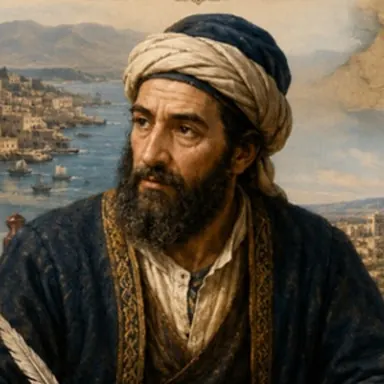
Rabbi Yaakov ben Chananel Sikili
9 min read1,758 words
Summary
This survey sketches the multifaceted portrait of Rabbi Yaakov ben Chananel Sikili, one of the sages of Spain in the 14th century and the foremost disciple of the Rashba, dwelling on his unique contribution to the preservation of tradition on the one hand and to halakhic innovation on the other. The text emphasizes his great literary work in composing "Yalkut Talmud Torah," a monumental anthology that preserved lost midrashim and arranged them according to the order of the Torah, alongside his extensive homiletic and kabbalistic creativity. At the center of the article stands his revolutionary messianic-activist teaching, which seeks to establish practical Jewish sovereignty in the Land of Israel through the renewal of the Sanhedrin, the offering of sacrifices and a return to the Temple Mount. The author makes clear that for R. Yaakov Sikili, Jewish autonomy and the demographic reality are what confer on the Land its binding halakhic sanctity, and thereby he becomes a unique connecting link between conservative Catalan scholarship and practical national aspirations.
The Torah Teaching, Literary Work and Leadership of Rabbi Yaakov ben Chananel Sikili
Historical Background and the Author's School of Origin
Rabbi Yaakov ben R. Chananel Sikili (who appears in the sources also in the spellings Tzikli or Tzikili) was active at the end of the first century of the sixth millennium (the first half of the 14th century) as an inseparable part of the golden age of the sages of Spain.[1, 2] His work was shaped mainly under the direct influence of his foremost teacher, Rabbi Shlomo ben Avraham Aderet (the Rashba), who was the undisputed leader of the Jewry of Spain and Catalonia at that time and acted as the chief rabbi of Spain.[1, 3] This affiliation places Rabbi Yaakov Sikili at the heart of a splendid chain of transmission, which began with Nahmanides (Ramban) (the foremost teacher of the Rashba and his principal successor in the interpretation of the Talmud) and the circle of his disciples in Barcelona, and continued in the shaping of the pillars of Jewish learning and halakhic ruling for generations.[3, 4]
The spiritual environment in which Rabbi Yaakov grew up was characterized by a unique synthesis: profound Talmudic scholarship and attention to detail, systematic and wide-ranging halakhic ruling, alongside a controlled integration of esoteric teaching.[4] The Rashba, who raised disciples from all over the Jewish world (including a considerable number from Germany) and wrote more than a thousand responsa, bequeathed to his disciples – among them Rabbi Yaakov Sikili, Rabbi Avraham ben Ishmael, Rabbi Meir ibn Sahula and Rabbi Chaim of Tudela – the twofold commitment both to pure halakha and to the preservation of Midrash and of speculative thought.[3, 4] Out of this religious and social soil grew the varied teaching of Rabbi Yaakov Sikili, which sought to bridge between the preservation of the Torah past and religious and ideological activism.
The Enterprise of the Midrashic Anthology: Yalkut Talmud Torah
One of the monumental enterprises of Rabbi Yaakov Sikili, which presents him as a researcher and compiler of extraordinary stature, is the work "Yalkut Talmud Torah" (sometimes known simply as the book "Talmud Torah").[1, 2] The writing of the work was completed on 6 Tishrei of the year 5097 (1337).[1, 2] To carry out this wide-ranging project, Rabbi Yaakov wandered through various countries of the Mediterranean basin, locating and gathering hundreds of ancient works and manuscripts that were scattered among the communities of Israel.[1]
The work was constructed on a pattern similar to that of "Yalkut Shimoni," and in it the author gathered various midrashim of the Sages from the books of aggadah and Midrash, and arranged them according to the order of the verses of the Torah.[1, 2] Beyond its religious and educational value, the work has acquired enormous scholarly importance in recent generations, since by means of passages preserved in it scholars have succeeded in reconstructing extensive parts of the lost Midrash "Yelammedenu" (of the Tanchuma family of midrashim).[1]
The history of the preservation and wanderings of the manuscript reflects the geographical spread of the work and the high esteem it enjoyed over the generations in the Middle East and in Europe, as shown in the following table:
Evidence of the long-term influence of the Yalkut is evident in the works of later generations. The kabbalist Rabbi Shlomo Alkabetz, in his book "Manot HaLevi" (folio 99b), explicitly notes the findings he found "in the book of the Yalkut called Talmud Torah."[2] He was followed by Rabbi Chaim Yosef David Azulai (the Chida), who gave the work official recognition in his bibliographical encyclopedia "Shem HaGedolim" (in the section on books, letter Tav) as well as in his book "Midbar Kedemot" (section Vav, paragraph 20).[2]
His Halakhic Teaching and Activism for the Land of Israel
Alongside his documentary work in midrashic literature, Rabbi Yaakov Sikili expressed an innovative and extraordinary halakhic conception regarding the status of the Land of Israel and the immigration of Jews to it, as expressed distinctly in his book "Hilkhot Eretz Yisrael" (Laws of the Land of Israel).[1] The work, which was published from manuscript by the scholar Efraim Kupfer, includes practical, halakhic and moral guidance intended for immigrants to the Land of Israel, and presents fundamental and highly significant halakhic rulings.[1]
The Scope of the Torah Obligation of Terumot and Ma'asrot in Our Time
One of the most revolutionary rulings of Rabbi Yaakov Sikili states that the obligation of the commandments dependent on the Land does not depend solely on a defined historical-ritual sanctification, but is directly affected by the actual sovereign and demographic reality.[1] The author rules that if there exists in the Land of Israel (within the borders of "those who came up from Egypt") a city designated and set apart for the dwelling of Jews, who are not subject there to the fear of a gentile king threatening to expel them, a full obligation of separating terumot and ma'asrot (priestly gifts and tithes) by Torah law (mi-de'oraita) will apply in that place.[1]
This determination makes superfluous the need for a special formal act of sanctification, and assumes that the very creation of an autonomous Jewish settlement space in the Land restores to it its original sanctity with regard to the agricultural commandments.[1] This ruling reflects a deep affinity with the teaching of Nahmanides (Ramban), who saw settling the Land of Israel as a positive Torah commandment equal to all the commandments together, and it provides for the first time a solid halakhic basis for the idea of practical Jewish autonomy as a sanctifying factor.[5]
An Active Messianic Conception and the Renewal of the Institutions of the Torah
Rabbi Yaakov Sikili was not content with the halakhic discussion in the agricultural fields, but outlined a practical and comprehensive path based on uncompromising religious activism.[1] Among the prominent public and halakhic positions he explicitly supported in his writings:
- Renewal of the Sanhedrin: the establishment of the central legal and halakhic authority in the Land, a step perceived as the beginning of the process of practical redemption.[1]
- Entering the Temple Mount: granting halakhic permission to ascend the Temple Mount for the purpose of prayer, while strictly observing the laws of purity and the permitted boundaries.[1]
- Renewal of the sacrificial service: striving to offer actual sacrifices even before the full building of the Temple, in accordance with the halakhic principle that permits sacrifice at the site of the altar.[1]
- Preparing the red heifer: initiating the complex process of producing the ashes of the heifer for purification from the impurity of the dead, which is a necessary condition for any Temple activity.[1]
These conceptions paint the figure of Rabbi Yaakov Sikili as a pioneer of the realistic-halakhic messianic conception. In contrast to approaches that advocated passive waiting for the mercies of Heaven, Sikili saw human, legal and logistical actions in the Land of Israel as an essential instrument for the return of the Divine Presence and for the establishment of religious sovereignty.
His Homiletic Creativity and Esoteric Teaching in His Thought
Apart from his work in halakha and in the compilation of midrashim, Rabbi Yaakov Sikili was known as an outstanding preacher.[1] His book "Torat HaMinchah" is a comprehensive collection of sermons arranged according to the weekly Torah portions.[1, 2, 4] The sermons are formulated in a rich reflective style, combining biblical interpretation, moral guidance, halakhic clarifications and philosophical and kabbalistic foundations.[1]
A significant part of the work of Rabbi Yaakov Sikili was devoted to esoteric teaching, as he himself testifies in his introduction to "Yalkut Talmud Torah."[1] Although these works did not survive and are considered lost, their very existence teaches about the depth of his involvement in the world of Jewish mysticism of that time [1]:
"Galut HaKoterot": a work that dealt with the wording of the prayers according to the method of Kabbalah and esoteric teaching.[1]
"Yayin HaMeshumar BeAnavav" (Wine Preserved in Its Grapes): a work devoted entirely to the explanation of the mysteries of Kabbalah and the secrets of the Torah.[1]
In order to understand the intellectual channel within which Rabbi Yaakov worked, it is appropriate to examine the intellectual sources from which he drew his teaching, as detailed in the following table presenting the Catalan chain of transmission:
Summary and Conclusions
The work and Torah teaching of Rabbi Yaakov ben R. Chananel Sikili present an extraordinary model of a Spanish sage who combined the preservation of the heritage of the past with practical, forward-looking halakhic writing. Through his monumental anthological enterprise in "Yalkut Talmud Torah" he rescued entire passages of the literature of the Sages and laid the foundation for scholarly reconstructions of lost midrashim in later generations.[1]
At the same time, his halakhic teaching appearing in "Hilkhot Eretz Yisrael" places him among the earliest and boldest formulators of practical Jewish nationalism and messianism.[1] His innovative rulings on applying the Torah obligation of terumot and ma'asrot in Jewish cities possessing political independence, alongside his call for the renewal of the Sanhedrin, the sacrificial service and the ascent to the Temple Mount, attest to a dynamic halakhic outlook that identifies the conditions of geopolitical reality as generators of halakhic sanctity.[1] His theological thinking, which weaves together peshat (plain meaning), derash (homily), halakha and sod (the esoteric), constitutes a splendid and unique link in the chain of Torah of the sages of Catalonia and Spain in the Middle Ages.[1, 4]
Sources5
- 1.יעקב סקילי - ויקיפדיה, he.wikipedia.org/wiki/יעקב_סקילי
- 2.אוצר מדרשים, תלמוד תורה | ספריית ספריא, sefaria.org.il/Otzar_Midrashim,_Talmud_Torah
- 3.רשב"א | מקורות מתוך ספריית ספריא, sefaria.org.il/topics/rashba1
- 4.רשב"א - ויקיפדיה, he.wikipedia.org/wiki/רשב"א
- 5.מצוות יישוב ארץ ישראל - ויקיפדיה, he.wikipedia.org/wiki/%D7%9E%D7%A6%D7%95%D7%95%D7%AA_%D7%99%D7%99%D7