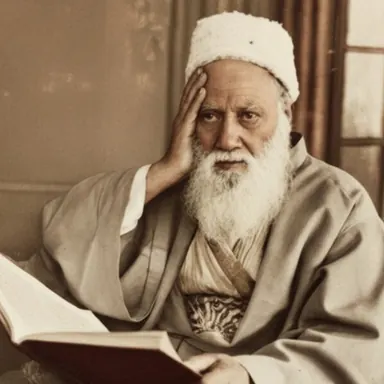
The Work, Torah Teaching and Kabbalistic Teaching of Rabbi Yehuda Fatiya: A Historical, Intellectual and Practical Analysis
14 min read2,721 words
Summary
This source surveys the life and extensive teaching of Rabbi Yehuda Fatiya, one of the great kabbalists of Baghdad and Jerusalem, focusing on the uniqueness of his practical Kabbalah and his metaphysical thought. The text presents the structure of his thought around the rectification of souls, reincarnations and the struggle against the forces of impurity, alongside detailed documentation of the ceremonies of exorcising dybbuks and interpreting dreams that he performed throughout the years of his leadership. In addition, the survey highlights the Rabbi's public and spiritual involvement during the Holocaust through prayers and liturgical poems, and provides a bibliographical analysis of his main works, which are an enduring asset of kabbalistic literature. Finally, the source describes the line of generations he left behind, which continues to this day to influence the religious, cultural and academic sphere in Israel.
The Life and Early Path of Rabbi Yehuda Fatiya in Baghdad
Rabbi Yehuda Moshe Yeshua Fatiya was born in Baghdad in the Ottoman Empire on 2 Shevat 5619 (7 January 1859), the third son of the kabbalist Rabbi Moshe Yeshua and his wife Hannah.[1, 2, 3] From the dawn of his childhood he showed exceptional talents and a deep aspiration to a life of abstinence and religious devotion.[1] He received his early education at the local "Midrash Talmud Torah," and when he came of age he went on to study at the "Midrash Beit Zilkha" yeshiva, which was the main Torah center of Babylonian Jewry at that time.[1, 3, 4] In this period he absorbed the teaching of the community's spiritual leader, Rabbi Yosef Chaim of Baghdad (the "Ben Ish Chai"), whose sermons he regularly heard and who later became his principal teacher in the esoteric teaching.[3, 4]
A formative event in the life of Rabbi Yehuda Fatiya took place when he was only seventeen.[1, 4] He was asked to go up as cantor in the study hall of the head of the yeshiva, Rabbi Abdallah Somekh.[1] One of those present in the congregation objected to the appointment, arguing that this was a young man whose beard had not yet filled out.[1] In response to this protest, Rabbi Abdallah Somekh rose and ordained him on the spot as a rabbi and halakhic authority, thereby giving public validation to his precocious Torah greatness.[1] This ordination paved the way for Rabbi Yehuda as one of the leading Torah giants of Baghdad, and these biographical details were later documented in S. N. Gottlieb's work "Oholei Shem," printed in Pinsk in 1912.[5]
While engaged in the revealed Torah and in halakhic rulings, Rabbi Yehuda Fatiya began to delve in secret into the study of the wisdom of Kabbalah.[1] By the age of twenty-five he already possessed outstanding expertise in both the revealed and the hidden, and he published his first work in Kabbalah, "Yayin ha-Rekach."[1] His thought was deeply influenced by the Kabbalah of the Ari, which he later in life expounded in his monumental work "Beit Lechem Yehuda."[4, 6] Alongside his theoretical study, Rabbi Yehuda Fatiya developed a unique practical approach to Kabbalah, which included writing amulets, healing the sick by means of incantations and prayers, interpreting dreams, and performing "rectifications of the soul" for the dead.[1, 4]
The Metaphysics of the World of Souls: Reincarnation, Rectification and the Forces of Impurity
The kabbalistic teaching of Rabbi Yehuda Fatiya is based on a dynamic and intensive conception of the world of souls and their passage between worlds.[7, 8] According to his system, the human soul does not complete its role with the death of the physical body, but is subject to a complex system of judgments and refinements.[8, 9] Souls that sinned or did not complete their mission in this world must undergo processes of the purging of sins, foremost among them the punishment of the "kaf ha-kela" (the hollow of the sling), Gehenna, or a return to the world by way of reincarnation.[10, 11]
Rabbi Yehuda Fatiya delved deeply into the subject of reincarnations and the need to complete the 248 positive commandments.[10] He clarified that a person who did not fulfill positive commandments that he was able to fulfill (such as tzitzit and tefillin) is forced to return in reincarnation again and again until he fulfills them completely.[10] By contrast, for commandments that cannot be fulfilled in the present time, such as the Temple service, the soul does not return in reincarnation.[10]
A fascinating layer of his teaching deals with the reincarnation of souls in foods.[10] According to his teaching, certain souls may be reincarnated in plants or animals, and if a person eats such food with the correct kabbalistic intention, he is able to rectify the reincarnated soul and release it from its suffering.[10] On the other hand, eating without proper intention may cause serious spiritual harm, in which the reincarnated soul influences the person for the worse and arouses in him urges to sin as it itself sinned in its lifetime.[10]
A personal testimony that illustrates his deep belief in reincarnation and in spiritual diagnosis concerns Rabbi Yehuda's son.[10] The kabbalist Rabbi Avraham Adas revealed to Rabbi Yehuda Fatiya that his son was a reincarnation of a rabbi who used to beat his students in this world.[10] When the son fell ill, Rabbi Yehuda turned to him and told him that he must make confession and complete his spiritual rectification in light of this revelation.[10] The son indeed accepted these words, recited the confession, and departed from the world in acceptance and rectification.[10]
The Struggle Against Dybbuks: Exorcism of Spirits and Metaphysical Dialogues
One of the most famous aspects of Rabbi Yehuda Fatiya's work is his direct confrontation with the phenomenon of the "dybbuk" – the penetration of a sinful and tormented soul into the body of a living person.[1, 4, 8] Rabbi Yehuda developed a systematic practice based on kabbalistic "yichudim" (unifications), the blowing of shofars and the recitation of prayers in the presence of a large crowd.[8] The aim of the exorcism ceremony was not only to save the person possessed by the dybbuk, but also to grant rectification and mercy to the reincarnated soul itself so as to enable it to enter Gehenna or the Garden of Eden and to cease its wandering in the kaf ha-kela.[8, 11] In modern research literature this work has received comprehensive analysis, such as the article by Prof. Yehuda Liebes and articles in academic journals dealing with the magical and exorcistic aspects of his Kabbalah.[3]
The following is a detailed account of central cases that Rabbi Yehuda Fatiya handled, which present the various ways of dealing with them and the metaphysical complexity of the ceremonies:
The Orders of Rectification and the Interpretation of Dreams
Rabbi Yehuda Fatiya established an entire teaching aimed at saving the souls of the dead, particularly those who did not observe the Torah and the commandments in their lifetime and are in great suffering in the World of Truth.[7, 9] He distinguished between different types of rectifications and defined the spiritual conditions for performing them:
- The great rectification for the dead: a complex and structured order of prayer intended for ten men above bar mitzvah age.[7, 11] The rectification includes reading the entire Book of Psalms with an internal division into circuits (hakafot), reciting a special text of rectification for the dead composed by the Rabbi, and an addition of the "annulment of vows and curses" for the deceased.[7, 11, 12] Its purpose is to save the soul from the beating of the grave (chibut ha-kever), from the kaf ha-kela, from harsh reincarnations and from Gehenna.[11] The rectification is usually held on the eve of the New Moon (Yom Kippur Katan) or during the Ten Days of Repentance.[7, 13]
- The short rectification for the dead: an abbreviated order of prayer composed by Rabbi Yehuda for those who are unable to organize a quorum of ten men.[11, 14] The uniqueness of this rectification is that even an individual can recite it at home, and it includes a focused request that the deceased no longer be in a state of being "naked and bare" in the world of souls.[14]
His books emphasize that the ability to identify the precise flaw in the soul of the deceased and to rectify it directly was unique to righteous men of the stature of Rabbi Yehuda Fatiya.[9] For this reason, the study and prayers conducted today by various organizations under the name "rectification for the dead" consist mainly of acts of charity, study of Mishnayot, public recitation of Psalms and the recitation of the hashkava (memorial prayer) for the merit of the deceased, which greatly benefit the soul but are not entirely identical to the original and personal practice that the Rabbi himself performed.[9]
Alongside the rectifications for the dead, Rabbi Yehuda Fatiya acted as a distinguished interpreter of dreams.[1, 4] He devoted a considerable part of his writings to the metaphysical distinction between dreams that originate in the human psyche or in forces of impurity and demons, and prophetic dreams or those sent from heaven to hint to a person about his sins or about the need of a deceased relative for rectification.[5] Many sought him out in order to obtain the interpretation of their dreams and the performance of a "rectification of a dream" (tikkun chalom) to remove harsh decrees.[1, 4]
The Ascent to Jerusalem and the Spiritual Mobilization During the Holocaust
Rabbi Yehuda Fatiya aspired to immigrate to the Land of Israel throughout his life.[1] He went up to Jerusalem twice but was forced to return to Baghdad because the Jerusalem climate did not suit his delicate state of health.[1] In 5694 (1933) he went up a third time and settled in Jerusalem permanently, where he was active and led the circle of kabbalists until his last day.[1, 3, 4]
With the outbreak of the Second World War and the arrival of the shocking news of the extermination of European Jewry, alongside the advance of the Nazi army under the command of Rommel in North Africa toward the gates of the Land of Israel, Rabbi Yehuda Fatiya enlisted in intensive spiritual activity for the rescue of the Jewish Yishuv.[3, 15] He saw these events as an immediate existential threat and organized mass prayers and orders of "Tikkun Chatzot" (the midnight lament) at Rachel's Tomb in Ephrath.[3] For him, Rachel's Tomb represented the national focal point of mercy, the place where the mother weeping for her children can arouse heavenly mercy and prevent the shedding of blood.[3, 16]
In 5700 (1940), in light of the decrees, he printed the booklet "Machberet Asirei ha-Tikvah" (Notebook of the Prisoners of Hope) (and in 1942 "Machberet Asirei ha-Tefillot").[3, 15] In these booklets he collected orders of supplication for mercy and prayers for a time of trouble, calling for the spiritual unification of the entire public for the sake of saving the nation.[15]
Out of this spiritual activity grew his famous liturgical poem "Zekhut Rachel" (The Merit of Rachel).[3, 16] This poem has exceptional dramatic power, describing Rachel our Mother going out of her tomb and wandering among the fathers of the nation, Moses our teacher, Joshua son of Nun and the kings of the House of David, to demand answers from them about the fate of her children being led to slaughter.[16] Only when she turns directly to the Holy One, blessed be He, and refuses to be comforted, is a voice heard from heaven promising her that there is reward for her work and her children shall return to their own border.[16] The poem became an enduring asset of the liturgy of the Eastern communities in times of trouble and in the days of Selichot.
Bibliographical Analysis of His Kabbalistic Writings and Works
The works of Rabbi Yehuda Fatiya are considered masterpieces of Lurianic kabbalistic literature, combining philological precision in the writings of the Ari and the Rashash with a phenomenology of the practical world.[6, 8, 17]
The Line of Generations and Spiritual and Cultural Continuity
Rabbi Yehuda Fatiya and his wife Jahla Rachel left behind them a large family that continued his kabbalistic and public path.[3] Prominent among his children was his son, Chacham Shaul Fatiya, who was active as a kabbalist, writer of amulets and interpreter of dreams.[3, 18, 19] Chacham Shaul conducted his activity from his shop and from the "Minchat Yehuda" synagogue in Jerusalem, and himself performed a number of exorcisms of dybbuks in the manner of his father.[19] He was known as a folk healer who diagnosed illnesses by a person's pulse, classifying the source of the illness into three main categories: fright, grief or physical illness.[19]
The legacy of Rabbi Yehuda Fatiya continues to influence the religious, scholarly and cultural sphere in Israel through his many descendants and great-grandchildren, whose details have been documented in memorial books such as "Arzei ha-Levanon" (Jerusalem, 5766) [3]:
- Rabbi David Batzri: the Rabbi's great-grandson, who serves as head of the kabbalists' yeshiva "Ha-Shalom" in Jerusalem and is considered one of the senior kabbalists of our generation, who in practice continues the tradition of performing rectifications for the dead and exorcising dybbuks.[3]
- Rabbi Ezra Batzri: the Rabbi's great-grandson, served as a member of the Great Rabbinical Court and as av beit din in Jerusalem, and is the author of many books of halakha.[3]
- Rabbi Yitzchak Batzri: the Rabbi's great-grandson, author of dozens of books on halakha, aggadah and Kabbalah.[3]
Prof. Haviva Pedaya: the Rabbi's great-granddaughter, a world-renowned scholar of Kabbalah, a professor at Ben-Gurion University, a poet and writer who integrates the heritage of Eastern Kabbalah into her research.[3]
- Hannah Fatiya: the Rabbi's great-granddaughter, a researcher of music and liturgical poetry who promotes the preservation of the traditions of kabbalistic song and melody of Babylonian Jewry.[3]
- Asaf Pedaya: the Rabbi's great-grandson, a contractor and entrepreneur involved in construction and development in the country.[3]
- Rabbi Yehuda Ovadia: the Rabbi's great-grandson, served as rabbi of the "Orot ha-Choma" community in the Har Choma neighborhood of Jerusalem and as a rabbi at Yeshivat ha-Kotel, and died of cancer on 4 Cheshvan 5775.[3]
- Moshe Barazani: grandson of Rabbi Yehuda Fatiya, one of the Olei ha-Gardom (those who went to the gallows) and a member of the Irgun (Etzel) underground, who consumed himself in fire in a cell of the Jerusalem prison together with Meir Feinstein in order to prevent their hanging by the British.[3]
The figure of Rabbi Yehuda Fatiya has remained, in the eyes of halakhic decisors and kabbalists, a symbol of a rare combination of rigorous scholarship, systematic writing, and absolute devotion to the rescue of sinful and suffering souls, a work that continues to resonate in the creations and deeds of his descendants.[3, 4, 7]
Sources19
- 1.לרגל יום ההילולה (כ"ז אב) - עובדות וסגולות מחכם יהודה פתיה זצ"ל, כולל גילוי מצאצאו הרב בצרי, tehillim-center.co.il/article/4752
- 2.כ"ז אב: חכם רבי יהודה פתיה - הרב יורם אברג'ל ובנו הרב ישראל | המאיר לארץ, hameir-laarets.org.il/hilulots/כז-אב-חכם-רבי-יהודה-פתיה/
- 3.יהודה פתיה - ויקיפדיה, he.wikipedia.org/wiki/יהודה_פתיה
- 4.סיפורים על הרב יהודה פתיה - אגדה - בית סיפורי העם היהודי, agadah.org.il/person/הרב-יהודה-פתיה/
- 5.Yehuda Fatiyah - Wikipedia, en.wikipedia.org/wiki/Yehuda_Fatiyah
- 6.עץ חיים - 4 כרכים / עם פירוש בית לחם יהודה לרב יהודה פתיה | ספרי זוהר | ספרים מובילים - ספרי חיים, hbooks.co.il/product/עץ-חיים-4-כרכים--עם-פירוש-בית-לחם-יהודה-לרב-יהודה-פתיה
- 7.כל מה שרציתם לדעת על תיקון נפטרים, nachat-ruach.co.il/כל-מה-שרציתם-לדעת-על-תיקון-נפטרים/
- 8.הרב יהודה פתיה – רוחות מספרות – Breslev, breslev.co.il/1091904/
- 9.תיקון נפטרים - הדרך שלכם לעשות נחת רוח לנשמת יקירכם - קדיש לנשמה, kadish.org.il/lifting-soul/repair-deceased/
- 10.הרב בניהו שמואלי שליט"א - גלגולי נשמות - ישיבת המקובלים נהר שלום, naharshalom.co.il/מאמר/1922/גלגולי-נשמות
- 11.תיקון הנפטרים הגדול הרב יהודה פתיה זצ"ל / ברית עולם - אוצר הספרים, sefer.org.il/items/5525510-תיקון-הנפטרים-הגדול-הרב-יהודה-פתיה-זצ-ל-ברית-עולם
- 12.הרב בניהו שמואלי שליט"א - תיקון נפטרים - ישיבת המקובלים נהר שלום, naharshalom.co.il/מאמר/609/תיקון-נפטרים
- 13.ישיבת המקובלים נהר שלום | הרב בניהו שמואלי שליט"א - תיקון נפטרים בערב יום הכיפורים, naharshalom.co.il/מה-חדש/94/תיקון-נפטרים-בערב-יום-הכיפורים
- 14.תיקון נפטרים הקצר של הרב פתיה, din.org.il/2023/03/20/תיקון-נפטרים-הקצר-של-הרב-פתיה/
- 15.מחברת אסירי התקווה – מהמקובל רבי יהודה פתיה, 1940 | קדם בית מכירות פומביות בע״מ, kedem-auctions.com/he/מחברת-אסירי-התקווה-–-מהמקובל-רבי-יהודה-פתיה-1940
- 16.זכות רחל – מילים, פירושים וביצועים | ר' יהודה פתיה | פיוט | הספרייה הלאומית – אתר הפיוט והתפילה, nli.org.il/he/piyut/Piyut1song_010083100000005171/NLI
- 17.עץ חיים עם פירוש בית לחם יהודה ד' כרכים / ר' יהודה פתיה זיע"א - אוצר הספרים, sefer.org.il/items/3732226-עץ-חיים-עם-פירוש-בית-לחם-יהודה-ד-כרכים-ר-יהודה-פתיה-זיע-א
- 18.פתיה - ויקיפדיה, he.wikipedia.org/wiki/פתיה
- 19.שאול פתיה - ויקיפדיה, he.wikipedia.org/wiki/שאול_פתיה