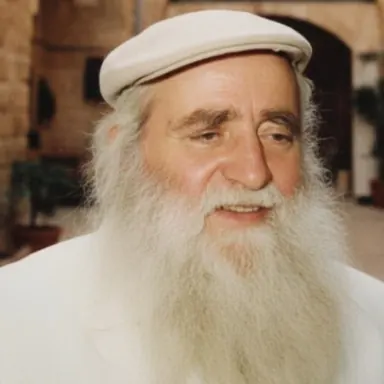
The Work, Figure and Torah Teaching of the Kabbalist Chacham Tzion Chaviv Bracha, of Blessed Memory
15 min read2,952 words
Summary
The text surveys the life story and spiritual figure of the Jerusalem Kabbalist Chacham Tzion Chaviv Bracha, presenting a unique portrait that combines deep Kabbalistic knowledge with a popular and simple manner of conduct. The source describes the course of his life from the orphanage in Aleppo until he became a "hidden tzaddik" in Jerusalem, who chose to earn his living as a greengrocer and a postman while diligently studying the esoteric teaching with the great men of the generation. On the practical plane, the text emphasizes the founding of the "Leshem" yeshiva as a center for bringing the distant near and his absolute devotion to the rectification of the Shekhinah, and concludes with a description of his acceptance of suffering with love and of the spiritual legacy he left behind. The aim of the survey is to illuminate the singular combination of asceticism and supreme holiness with deep social involvement and concern for the whole of Israel.
The figure of the Kabbalist Chacham Tzion Chaviv Bracha, of blessed memory (5680–5765), is one of the most fascinating and unique phenomena in the spiritual history of Jerusalem in the twentieth century [cite: 1, 2]. As a many-sided personality who united within himself deep Kabbalistic study, a hidden Hasidic-style conduct, simple manual labor and energetic activity in bringing the distant near in the neighborhoods of Jerusalem, Chacham Tzion Bracha represented the classic type of the "hidden tzaddik" who acted within the broad public [cite: 1, 2, 3]. His Torah teaching was not set down in writing in homiletic or halakhic literature systematically composed by his own pen; rather, it was embodied entirely in his way of life, in the founding of the Leshem yeshiva, in the combination of the Kabbalistic intentions (kavanot) with the rectification of the community, and in an uncompromising self-sacrifice for raising the Shekhinah from its exile [cite: 1, 2].
His Life: From the Orphanage in Aleppo to Jerusalem
Chacham Tzion Chaviv Bracha was born in the city of Aleppo (Aram Tzova) in Syria in the year 5679 [cite: 1, 2, 4]. The circumstances of his birth were interwoven with bereavement and orphanhood: his father, Chacham Chaviv, died before he came into the world, and therefore the newborn was named "Tzion Chaviv" after his late father [cite: 1, 2, 4]. His mother, Mrs. Jamila, who was blind, raised him and his brothers and sisters in great hardship and with self-sacrifice on the foundations of Torah and the fear of Heaven [cite: 1, 2, 4]. In his youth he studied at the Jewish orphanage in the city of Aleppo, where he stood out for his diligence and his blessed talents, and alongside his sacred studies he acquired a comprehensive command of several languages, among them Hebrew, Arabic, English and French – knowledge that later served him in his close approach to diverse souls from all strata of the people [cite: 1].
When he reached the age of thirteen, his soul became bound with cords of love to the Land of Israel, and after a journey full of hardships and dangers he succeeded in immigrating to the Land and arrived first in the city of Tel Aviv [cite: 1, 2, 4]. The turning point in his life came when he was invited to spend Shabbat at the home of his aunt in the Nachlaot neighborhood of Jerusalem; the encounter with the holiness of the city of the Temple captured his heart, and he decided to make his home there while deepening his diligence in Torah [cite: 1, 2, 4].
When he came of age, the hidden Kabbalist Rabbi Aharon Moallem (author of "Toldot Aharon u-Moshe") proposed a bride to him – his sister, Mrs. Pnina Nazima [cite: 1, 2]. Out of absolute faith in the sages and complete self-nullification, Chacham Tzion refused to meet her beforehand and saw her for the first time only under the wedding canopy [cite: 1]. His conduct in his home was marked by extraordinary respect for his wife, by complete avoidance of remarks, and by the establishment of a house of Torah and charity out of dire poverty [cite: 1].
| Category | Details of figures and names |
|---|---|
| Parents | Chaviv (father, died before his birth), Jamila (mother, blind) [cite: 1, 2, 4]. |
| Brothers and sisters | Avraham, Chalfon, Latifa (wife of Eliyahu Bililius), Salcha [cite: 1, 4]. |
| Wife | Rabbanit Pnina Nazima (sister of the Kabbalist Rabbi Aharon Moallem) [cite: 1, 2]. |
| Sons | R. Yitzchak (author of "Birkat Yitzchak"), R. Moshe [cite: 1, 4]. |
| Daughters and sons-in-law | Esther; Rabbanit Yafa (wife of R. Meir Kedar); Rabbanit Nechama (wife of R. Tzadok Pinchas Alhav ha-Kohen); Rivka (wife of R. Shimon Ouaknine); Simcha (wife of R. Yosef Sar Shalom) [cite: 1, 4]. |
| Residences in Jerusalem | 2 Yosef Chaim Street (in a cramped rented apartment), and from 5745 at 5 Nissim Bachar Street [cite: 1]. |
| Death and burial | Eve of Sukkot, 14 Tishrei 5765; buried on Har HaMenuchot near his teacher Rabbi Mordechai Sharabi [cite: 1, 2]. |
Combining Torah, Manual Labor and the Concealment of His Spiritual Level
One of the most prominent features of Chacham Tzion Bracha's figure was the sharp contrast between his modest outward appearance and his spiritual standing as a genius in the hidden teaching [cite: 1, 2, 3]. For his livelihood he refused to earn a living from the crown of Torah, and worked a few hours a day as a greengrocer in the Machane Yehuda market, and later as a postman at the Postal Bank [cite: 1, 2]. His meticulous daily schedule combined manual labor with continuous asceticism; he slept very little at night, and when he awoke from his sleep he rose at once with alacrity, recited "Tikkun Chatzot" (the midnight lament) with bitter weeping, and afterwards continued studying the esoteric teaching [cite: 1, 2].
After a lengthy morning prayer conducted with the Kabbalistic intentions and study according to the "Chok le-Yisrael" order, he would go out at about ten in the morning to his work in the market [cite: 1, 2]. When the time for the afternoon prayer (Mincha) arrived, he would cover the vegetable stall with a blanket and leave his trade in favor of prayer and fixed study [cite: 1]. In the period of his work as a postman, he took care to finish delivering the letters quickly, and from then until the late hours of the night he went to the Western Wall, where he used to complete the entire Book of Psalms in one sitting every day [cite: 1, 2].
His outward appearance gave him the look of a simple ordinary man – sandals, a flat cap and a checked shirt – and in this way he disguised his greatness in Torah and the fact that he was, as the great men of his generation testified of him, one of the company of the thirty-six hidden righteous [cite: 1, 3]. He spoke of himself with exceeding humility as an "am ha-aretz" (an unlearned man), whereas in fact he was wonderfully versed in the wisdom of physiognomy and in the wisdom of palmistry, and possessed manifest divine inspiration (ruach ha-kodesh) [cite: 1, 2]. Despite his dire poverty and the severe want in his home, he took care to pay every craftsman an honest and generous wage with an open hand, and at times even beyond what was asked, out of the trait of gratitude and a scrupulous insistence on absolute fairness [cite: 1].
His Teachers, the Study of the Esoteric and the Conduct of Prayer
Chacham Tzion Bracha's Torah drew from the wellsprings of the great Kabbalists of Babylonia and of the Sephardic community in Jerusalem [cite: 1, 2]. He was counted among the distinguished disciples of the Kabbalist Rabbi Yehuda Fatiya, of blessed memory, and of the Kabbalist Rabbi Mordechai Sharabi, of blessed memory [cite: 1, 2]. A central chapter in shaping his path of study was his long study partnership (chavruta) with the Kabbalist Rabbi Salman Mutzafi, of blessed memory [cite: 1, 2, 4]. The two studied together for many years, about seven consecutive hours every day; on weekdays they engaged in intensive in-depth study of the Gemara until they completed the study of the entire Talmud (Shas), and on Shabbatot they gathered from the afternoon hours until midnight for continuous engagement in the hidden teaching and the secrets of the Kabbalah [cite: 1, 2]. Extraordinary testimony to his greatness was brought by Chacham Salman's son, the Gaon Rabbi Ben-Zion Mutzafi, may he live long, who related that his father told him, after studying Tractate Pesachim, that if he were offered the choice of giving up his entire share in the World to Come or giving up a single hour of study with Rabbi Tzion, he would be ready to give up his World to Come [cite: 2]. He kept another close study partnership with the Hasidic Kabbalist Rabbi Binyamin Zeev Cheshin, of blessed memory [cite: 2].
Alongside his diligence in study, Chacham Tzion was blessed with a sweet voice and was deeply versed in the Eastern teaching of the maqamat (musical modes) [cite: 1]. The Kabbalist Rabbi Mordechai Sharabi appointed him to serve as cantor and as chief "mekhaven" (the one who leads the Kabbalistic intentions) during the prayers at the "Nahar Shalom" yeshiva of Kabbalists in Jerusalem [cite: 1, 5, 6]. In his prayer he combined fervent cleaving to God (devekut), melody and joy – so much so that even on days of mourning such as Tisha be-Av he did not forgo praying with a special melody [cite: 1]. In the tradition of the "Nahar Shalom" yeshiva his custom of reciting the Kaddish in the maqam "Nawa" has been preserved; to this maqam a special Kabbalistic virtue was attributed for subduing the forces of impurity and the Sitra Achra, as an allusion to the verse "holiness befits (na'avah) Your house" [cite: 6].
| Personality / institution | Nature of the relationship and activity |
|---|---|
| The Kabbalist Rabbi Yehuda Fatiya | His distinguished teacher in the teaching of Kabbalah and the tradition of the Kabbalists [cite: 1, 2]. |
| The Kabbalist Rabbi Mordechai Sharabi | His teacher and master, who appointed him cantor and mekhaven at the "Nahar Shalom" yeshiva [cite: 1, 2, 5]. |
| The Kabbalist Rabbi Salman Mutzafi | Principal study partner; study of the entire Talmud on weekdays and 7 hours of esoteric study on Shabbatot [cite: 1, 2, 4]. |
| The Kabbalist Rabbi Binyamin Zeev Cheshin | Study partner in the revealed and the hidden teaching [cite: 2]. |
| His prominent disciples | The Kabbalist Rabbi Benayahu Shmueli, the Kabbalist Rabbi Gidon Holland, the Kabbalist Rabbi Chaim Mizrachi, R. Aharon Biton, R. Shaul Sasson [cite: 1, 4]. |
The Leshem Yeshiva, a Pedagogy of Outreach and the Rectification of the Public
In the year 5730 (1970) Chacham Tzion Bracha founded the Leshem yeshiva in the Nachlaot neighborhood of Jerusalem [cite: 1, 2]. The name "Leshem" was chosen as an acronym of his central worldview: "le-hakamat Shekhinta me-afra" (for raising the Shekhinah from the dust) [cite: 1, 2]. This conception placed at the center the general redemption and the rectification of the world as an inner divine need, and not merely as the satisfaction of a private human need [cite: 1, 2].
The yeshiva's study hall was built on two floors, a structure that reflected Chacham Tzion's pedagogical and Kabbalistic conception [cite: 2]. The upper floor was designated for veteran married scholars (avrechim) and for Kabbalists who engaged in the esoteric teaching and the kavanot, while the lower floor was designated for beginners, for youths gathered from the street and for returnees to Judaism (baalei teshuva) at the start of their path [cite: 2]. Despite his tremendous level in the esoteric, Chacham Tzion chose to stay frequently precisely on the lower floor alongside the beginners, calling them affectionately "my children" [cite: 2]. He went tirelessly among the shops, markets and streets of Jerusalem, approached youths and passers-by, and awakened their souls to the observance of Torah and commandments [cite: 2, 3]. A common sight in his yeshiva was long-haired youths who entered the study hall and came out a short while later wearing tzitzit and changing their ways of life from one extreme to the other [cite: 2]. At the same time he showed extraordinary social sensitivity and established special Torah classes for sanitation workers and for people who could not read or write, lavishing praise on them and raising their spiritual standing [cite: 1].
Chacham Tzion's love for his disciples knew no bounds, and he testified of himself that every night, while reciting "Tikkun Chatzot," he would weep for hours over one of his disciples, and there was no disciple in the yeshiva over whom tears were not shed in this Kabbalistic prayer [cite: 2]. In the practical sphere he was most strict about the bounds of holiness and purity, and testified of himself that one of the spiritual tasks for which he had returned to this world in a reincarnation was to rectify and spread the observance of the commandment of the "tallit katan" (tzitzit) [cite: 2]. By his divine inspiration he used to remark to people – even those who appeared to be properly observant – that they had forgotten to put on tzitzit under their clothes, and in every case it turned out in retrospect that they had indeed forgotten them by mistake on that day [cite: 2].
The Doctrine of Faith, the Acceptance of Suffering and the Expectation of Redemption
Chacham Tzion Bracha's conception of trust in God and faith was tangible and uncompromising [cite: 2]. He ran the upkeep of his home, the yeshiva and the married scholars without fundraising campaigns, without publicity and without turning to flesh and blood, but solely by turning directly in prayer to the Creator of the world [cite: 2]. More than once he refused to accept donations of enormous sums for hidden spiritual reasons; in one documented case he gave up a donation of three hundred thousand dollars and did not agree to take money from the donor's hand [cite: 2]. On the other hand, he organized special charity funds for providing for brides (hakhnasat kallah) and distributed all the money given to him to his disciples and to the poor [cite: 1].
During the last decades of his life Chacham Tzion suffered severe and agonizing afflictions, but he firmly refused to undergo operations and medical treatments intended to ease his suffering [cite: 1, 2]. Out of his grief and pain he would cry out: "What do you want, that the Shekhinah should suffer for my sake?" [cite: 1, 2]. He believed with perfect faith that his bodily sufferings served as atonement for the whole people of Israel and eased the suffering of the Shekhinah in its exile [cite: 1].
His faith in the coming of the Messiah was daily and tangible; he prepared in his home a special garment intended to be worn at the time of the revelation of the redemption [cite: 1]. When fulfilling the commandment of the four species on the festival of Sukkot, he used to wave the lulav for more than four consecutive hours with tremendous Kabbalistic devotion that captivated all who saw him [cite: 2].
Chacham Tzion Chaviv Bracha returned his soul to its Maker on the eve of the festival of Sukkot, 14 Tishrei 5765, by "death by a kiss" [cite: 1, 2]. Shortly after his death he was buried quickly in the Har HaMenuchot cemetery in Jerusalem, near the grave of his illustrious teacher, the Kabbalist Rabbi Mordechai Sharabi, of blessed memory [cite: 2]. Because of the proximity to the onset of the festival, no shiva was held for him in the proper manner – a swift death and burial that precisely reflected the course of his life, modest, hidden and fleeing all trappings of honor and publicity [cite: 2].
Summary and Legacy for the Generations
A comprehensive analysis of the life, practices and Torah teaching of Chacham Tzion Chaviv Bracha demonstrates a singular combination of Kabbalistic greatness with practical simplicity and mutual responsibility. His spiritual conception placed the rectification of the Shekhinah and of the community at the center, with absolute self-nullification and the acceptance of suffering with love as atonement for the generation. His pedagogical path at the Leshem yeshiva laid a foundation for bringing the distant near based on unconditional love, on staying alongside the beginning students at eye level, and on scrupulous observance of practical commandments such as the tallit katan as an instrument for the rectification of the soul. His legacy continues to pulse today within the world of Kabbalah and of return to Judaism in Jerusalem, especially through his distinguished disciples, headed by the Kabbalist Rabbi Benayahu Shmueli, may he live long, who continue to spread the hidden teaching and the enterprises of charity and outreach in the spirit of Chacham Tzion [cite: 1, 4].
Sources6
- 1.המקובל רבי ציון חביב ברכה - MyTzadik, mytzadik.com/m/tzadik.aspx?id=1359
- 2.הִילּוּלָא קַדִּישָׁא • המקובל רבי ציון חביב ברכה זצ"ל - JDN, jdn.co.il/beit_hamidrash/1836074/
- 3.הוא נראה כמו אדם פשוט: סנדלים, קסקט, חולצה משובצת. אבל מי שהתקרב - הבין מיד שמדובר בדמות שלא שייכת לעולם הרגיל. הוא ברח מכבוד, אסף אנשים מהרחוב - והחזיר להם נשמה דרך מעשה ואהבת ישראל שאי | רגע של חכמה - Facebook, facebook.com/rega.shel.chochma/videos/סנדלים-ורוח-הקודש-חכם-ציון-ברכה/1463700118740483/
- 4.Rabbi Tzion Habib Bracha Z'tl - רבי ציון חביב ברכה - למד שנים בחברותא עם המקובל רבי סלמאן מוצפי - YouTube, youtube.com/watch?v=H8L05rIwthw
- 5.בידספיריט | מסורת מכירה פומבית 107 חלק א' - כתבי יד, ספרי קודש, חסידות, il.bidspirit.com/ui/catalog/auction/masoret/75032/3?lang=he
- 6.עקב-פב 11-119 - נהר שלום, media.naharshalom.co.il/pdf/alon_shvoi/dvarim/עקב-פב A5.pdf