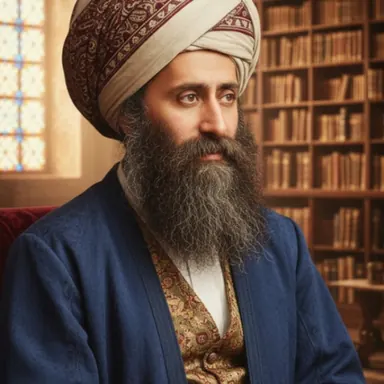
Rabbi Yosef Chaim of Baghdad
16 min read3,228 words
Summary
This survey presents the multifaceted figure of Rabbi Yosef Chaim of Baghdad, known as the "Ben Ish Chai," who led Babylonian Jewry in the nineteenth century. The text traces the course of his life, from his childhood within the rabbinic elite to his becoming a supreme halakhic and spiritual authority who combined in a unique way the plain meaning (peshat) with esoteric lore. Beyond his extensive literary activity, the source stresses his independent public leadership and his complex coping with the challenges of modernity and social justice. Ultimately, the work seeks to illuminate the living legacy of a sage who served as a cultural bridge between the ancient tradition and the transformations of the new age.
The Spiritual Summit of Babylon: The Work, Teaching and Leadership of Rabbi Yosef Chaim of Baghdad
The nineteenth century in Baghdad was marked by deep political, social and spiritual change for the oldest Jewish community in the Diaspora. At the heart of this change stood the monumental figure of Rabbi Yosef Chaim, known to the generations as the "Ben Ish Chai." His leadership, which spanned half a century, was not merely the continuation of a distinguished rabbinic dynasty but the establishment of a new religious paradigm that sought to bridge pure halakha and the depth of Kabbalah, and communal tradition and the challenges of modernity and rising capitalism. The following analysis will examine the layers of his life, his halakhic method, his social thought and the worldwide influence of the man regarded as the spiritual father of Sephardic and Eastern Jewry in the modern age.[1, 2, 3, 4]
The Roots of the Family Tree: Biography and Spiritual Growth
Rabbi Yosef Chaim was born on the 27th of Av 5595 (1835) in Baghdad, which was then under the rule of the Ottoman Empire.[1, 5] He was born into an entrenched rabbinic elite; his father, Hakham Eliyahu, was the spiritual leader of the community, and his grandfather, Hakham Moshe Chaim, served as the chief rabbi of Baghdad for about fifty years.[1, 6] The environment in which he grew up was saturated with intensive Torah study and with deep public involvement. His family, known as "Beit al-Hakham" (the House of the Hakham), held a symbolic and practical standing that shaped his early consciousness of the responsibility that rests on the shoulders of a Torah scholar.[7]
A formative event in his life occurred at the age of seven, when he fell into a deep well in the courtyard of his home while playing.[2, 8] The miraculous rescue from the pit was perceived by him not merely as a personal miracle but as a divine command to devote his life absolutely to the study of Torah.[2, 3] This vow led him onto a path of asceticism and intensive study that was hardly seen in the Baghdad of that time. He began his studies with his uncle, Hakham David Chai Meir Yosef Nissim Salman of Ma'tuk, and afterward went on to study at the "Midrash Beit Zilkha," the flagship yeshiva of Baghdad, under the leadership of Hakham Abdullah Somekh.[1, 2, 5] Despite his young age, he was soon recognized as a prodigy whose memory was likened to "a plastered cistern that does not lose a drop."[6]
Already at the age of fourteen his fame began to spread beyond the borders of Iraq. It is told that his father received a complex halakhic question from Rabbi Chaim Palaggi, rabbi of Izmir in the Ottoman Empire. The young Yosef Chaim wrote a detailed answer and sent it in his father's name. When his father's later answer arrived, Rabbi Chaim Palaggi discovered that the son had preceded him in precision and clarity, and prophesied that the boy would become a giant in Torah.[1, 2, 5]
Biographical Milestones
Leadership without an Official Crown
Upon the death of his father on the 7th of Elul 5619 (1859), Rabbi Yosef Chaim was appointed to lead the community of Baghdad.[1, 8] A central point in his leadership was his refusal to accept the official title of "Hakham Bashi" (rabbi appointed by the authorities) or any salary from the community.[2, 5] He chose the position of "darshan" (preacher) – a role that was traditional in his family – which enabled him maximum spiritual influence without the administrative dependence involved in an official post.[5, 6]
His livelihood came from a business partnership with his four brothers, who ran worldwide international trading businesses (from Baghdad to India).[1, 6, 7] This fact enabled him complete economic and moral independence. He took care that his business be conducted with strict halakhic exactitude, and at the same time used his personal wealth to fund the printing of his books and their distribution free or at cost to the poor.[1, 3, 7, 8] His economic independence gave him the ability to criticize even the wealthy of his community and to stand by his opinion on questions of social justice.[10, 11]
His leadership was expressed along two central axes: halakhic ruling for all the communities of the East and his weekly sermons. These sermons, which were delivered every Shabbat after Mincha Gedola in the Great Synagogue of Baghdad, became a formative cultural-religious event to which thousands of people flocked, men, women and children.[1, 2, 5] He was endowed with an exceptional rhetorical ability, and wove parables, folk tales, gematriot and Kabbalistic secrets into simple and heart-winning language.[5, 8, 12] These sermons formed the basis for his most famous book, "Ben Ish Chai."[13, 14]
Leadership Authority and the Model of the "Hakham"
The model set by Rabbi Yosef Chaim was that of a "Hakham" who is involved with people, yet maintains intellectual and spiritual autonomy. He refused to employ maidservants of certain ages in his home out of scrupulousness in piety and modesty, and some claim that this stemmed from his wish to eat unconsecrated food in a state of purity.[1] Despite his relative seclusion for study, his door was never locked to the needy, and his authority was so absolute that it was said of him in the rabbinic court of Baghdad: "If he says that right is left... we accept his words."[5, 12]
The Halakhic Methodology: A Synthesis of the Revealed and the Hidden
Rabbi Yosef Chaim's halakhic teaching represents one of the summits of the Sephardic-Kabbalistic approach. Unlike the approach that confines halakha to the four cubits of the "Shulchan Arukh," the Ben Ish Chai saw Kabbalah as a vital and inseparable layer of practical halakhic ruling.[3, 14, 15]
The Hierarchy of Authority in His Rulings
The Ben Ish Chai accepted the authority of Maran Rabbi Yosef Karo as a basis, but not as the final word. When there was a dispute between the plain meaning (the revealed halakha) and Kabbalah (the teaching of the Ari and the Rashash), he consistently inclined to decide according to the words of the Kabbalists, especially when it concerned a stringency.[1, 14] He believed that halakhic fulfillment of a commandment is not complete without the mystical intention and the spiritual rectification that it brings about in the upper worlds.[16]
This methodology created a distinctive style of "integrated halakhot":
- Presenting the simple ruling: a ruling according to the Beit Yosef and the Acharonim, taking into account the customs of the place.[8, 14]
- The Kabbalistic addition: citing the words of the holy Ari or the practices of the "Beit El" yeshiva in Jerusalem.[1, 7]
- The final decision: combining practical custom with Hasidic stringency, sometimes called "Chasdain Milya."[1, 14]
This ruling later stood at the center of a great controversy with Rabbi Ovadia Yosef, who advocated "restoring the crown to its former glory" by focusing exclusively on the Beit Yosef and abolishing the Kabbalistic stringencies that the Ben Ish Chai had instilled in the communities of the East.[1, 15] For the Ben Ish Chai, halakha is a living organism in which the "soul" (Kabbalah) and the "body" (the revealed) must operate in harmony.[16]
His Attitude toward the Sages of Ashkenaz and Their Sources
A surprising and fascinating aspect of his ruling is his openness and great esteem for the sages of Ashkenaz. In his books he cites the "Rema" frequently and at times even rules stringently in accordance with his view against the Beit Yosef.[14] He had special respect for the "Baal HaTanya" (Rabbi Shneur Zalman of Liadi), whom he fondly called "the Gaon Rabbi Zalman," and cited frequently from his book "Shulchan Arukh HaRav."[7] This openness stemmed from his conception that Torah truth can be found anywhere, and that the gaps between the communities must be bridged for the sake of the unity of Israel.[3, 8]
The Literary Corpus: A Panorama of Knowledge
Rabbi Yosef Chaim was one of the most prolific writers in Jewish history. He composed more than 100 works, of which about 53 were published, encompassing all areas of Torah creativity: halakha, responsa, Kabbalah, aggadah, homiletics, ethics and liturgical poetry.[1, 7] His speed of writing was phenomenal; it is told that he would finish a full page before the ink at its head had dried, and would spread the pages on special shelves so that they would dry.[5]
His Principal Works
Many of the names of his books are derived from the verse in the Book of Samuel that describes Benayahu ben Yehoyada: "And Benayahu the son of Yehoyada, the son of a living man (ben ish chai), of many deeds, from Kabzeel..."[18] The choice of these names is no coincidence; during his visit to the Land of Israel in 1869, Rabbi Yosef Chaim stayed at the grave of Benayahu ben Yehoyada in the Galilee and felt that his soul was bound by an unbreakable bond to this biblical figure, who represented a combination of physical valor, righteousness and wisdom.[1, 9]
"Torah Lishmah" and Hidden Humility
One of the fascinating episodes in his work is the publication of the book "Torah Lishmah." In this book he answered hundreds of difficult halakhic questions, but did not sign with his own name but with the pseudonym "Yechezkel Kachli."[1, 17] The gematria of the name "Yechezkel Kachli" is exactly equal to that of "Yosef Chaim." His motive was his wish to write "Torah for its own sake" truly, without the pomp and honor attached to his famous name, and also to allow himself to discuss his own words as though they were the words of another person.[17]
Coping with Modernity: Between Tradition and Progress
The Baghdad of the end of the nineteenth century was an arena of struggle between the forces of modernization, represented by the schools of the "Alliance" (Alliance Israélite Universelle) and European influences, and the traditional rabbinic world. The position of the Ben Ish Chai was complex and nuanced; he did not advocate complete separatism, but stood in the breach against any attempt to undermine the authority of the Torah and the identity of the community.[4, 15]
The Affair of Jacob Obermeyer and the Ban
The Ben Ish Chai's sharpest confrontation with modernity was embodied in the affair of Jacob Obermeyer, a Jewish-Bavarian scholar who lived in Baghdad and served as a language teacher in the home of the Sassoon family.[5, 19] Obermeyer publicly criticized, in the Jewish press in Europe, the customs of the Jews of Babylon and their unreserved belief in the Zohar and Kabbalah. He called for religious reforms and sought to introduce a spirit of reformist "Haskalah" into the community.[5, 15, 19]
The Ben Ish Chai's response was resolute: he proclaimed a ban (excommunication) against Obermeyer, a prohibition that was read in all the synagogues of the city.[19] This struggle was not merely personal but a defense of the traditional epistemology; the Ben Ish Chai saw in the "scientific" criticism of the Zohar a threat to the foundations of faith and to the social cohesion of the community.[5, 19]
His Attitude toward General Education and the Status of Women
Despite his opposition to reform, the Ben Ish Chai recognized the need for practical knowledge. He himself displayed great erudition in the sciences, astronomy, medicine and economics, and integrated this knowledge into his books.[1] He did not oppose secular studies for the sake of livelihood across the board, but insisted that they be subordinate to a hierarchy in which the Torah is at the center.[15]
An impressive expression of his conservative innovation is his book "Qanun al-Nisa" (The Laws of Women). The book was written in colloquial Judeo-Arabic, the language spoken by the women of Baghdad who did not know Hebrew.[5, 17, 19] The Ben Ish Chai was not content with dry halakhot but wrote a book of ethics and guidance for life, full of parables and stories, with the aim of giving women a rich and accessible spiritual world.[15, 17] He understood that in an age of change, the preservation of the Jewish home depends on the education and spiritual empowerment of the woman.[15]
Social Thought: Poverty, Wealth and Justice
Contemporary research, foremost that of Dr. Avi-Ram Tzoref, reveals a less known but fascinating aspect of the Ben Ish Chai's thought: his revolutionary socio-economic conception.[10] At the beginning of his career, as a partner in the business of the Sassoon family, the Ben Ish Chai was part of the colonial capitalist system. A dramatic event took place in 1879, a year of severe drought in Baghdad. The authorities forbade the export of grain to prevent famine, but Rabbi Yosef Chaim, as a representative of the trading company, used his connections with the British representative to circumvent the prohibition and to export wheat at high prices abroad.[10, 11] This action led to an outburst by poor families in the synagogue against him, with the claim that he "expounds well but does not act well."[10, 11]
Scholars argue that in the wake of this event, and of a personal economic collapse that followed it in the 1880s, the Ben Ish Chai underwent a deep intellectual turnaround.[10, 11] He began to formulate a theology of social compassion and a piercing criticism of the wealthy elite. In his later writings:
- Recognition of the worker: he developed an understanding that the worker is the true owner of his labor, and he came out against the exploitation of laborers.[10]
- Criticism of taxation: he attacked the attempts of the wealthy to place the burden of communal taxes (such as the "badal" tax for exemption from military service) on the lower classes.[10, 11]
- Ownership of the commandments: he argued that the poor are the "owners" of the commandment of charity, and that the rich man is only a temporary conduit. Without the poor man, the rich man cannot fulfill his spiritual purpose.[11]
This turnaround shows a dynamic figure attentive to the pain of the public, capable of self-criticism and of adapting the Torah to the changing social reality.[10]
The Connection to the Land of Israel and Jerusalem
Although he lived and worked in Baghdad, the heart of the Ben Ish Chai was given to Jerusalem. He saw in Babylon "the house of exile" and in Jerusalem the metaphysical center of the world.[7, 8]
The Visit of 1869 and Its Effects
In the year 5629 he set out on a journey to the Land of Israel.[8, 9] This visit was a spiritual summit meeting. He met the great Kabbalists of the "Beit El" yeshiva, foremost Rabbi Yedidya Raphael Chai Abulafia, who called him "a lion who has come up from Babylon."[6, 7] The meeting strengthened the bond between him and the teaching of the Rashash, which became a central component of his halakhic ruling.[1, 7] He brought with him from Baghdad enormous sums of money to support the poor of Jerusalem, and on his return to Baghdad he took with him a stone and earth from Jerusalem, which he fixed in the eastern wall of his synagogue in order to bring the holiness of the Land into the exile.[7, 8, 9]
The Founding of the "Porat Yosef" Yeshiva
His influence on the Land of Israel reached its peak with the establishment of the "Porat Yosef" yeshiva in the Old City. The magnate Yosef Avraham Shalom of Calcutta, one of his devoted supporters, consulted with him on how to commemorate his name. The Ben Ish Chai instructed him not to build a hospital or a charitable institution but a magnificent yeshiva opposite the site of the Temple, which would be a world center for the study of the revealed and the hidden Torah.[2, 6, 7] The yeshiva, which was named for the donor (Yosef) and inspired by the name of the Ben Ish Chai (Yosef Chaim), became the nursery of the great Sephardic rabbis in the twentieth century.[7]
Legacy and Eternal Life
Rabbi Yosef Chaim died on the 13th of Elul 5669 (1909) while on his way to a visit to the tomb of the prophet Ezekiel.[2, 3, 6] His funeral was the largest that Baghdad had ever known, and tens of thousands of Jews and Muslims alike took part in it, as a sign of reverence for a man who was a symbol of wisdom, kindness and integrity.[3, 6, 12]
His legacy continues to pulse to this day in three central channels:
The book "Ben Ish Chai" as a communal code: in many Sephardic homes, the book serves as a kind of "Kitzur Shulchan Arukh" that guides the way in daily life.[5, 8, 13]
- The world of prayer and liturgical poetry: his piyyutim, such as "Ve-Amartem Koh le-Chai" in honor of Rashbi, became an integral part of the world Jewish liturgy.[1, 7]
- The Sephardic-Eastern option: the Ben Ish Chai charted a model of rabbinate that combines Kabbalistic depth, social involvement, scientific erudition and religious firmness without extremism. He proved that one can be a "Kabbalist" and at the same time a practical communal leader.[4, 15]
In the final analysis, the figure of Rabbi Yosef Chaim of Baghdad is not merely a chapter in the history of Babylonian Jewry but a living bridge between an ancient past and a challenging future. He succeeded in preserving Jewish identity at the height of the period of transition, while granting his community the spiritual and social tools to survive and flourish even outside the physical borders of the "rivers of Babylon."[1, 4]
Sources19
- 1.רבי יוסף חיים מבגדאד – המכלול, hamichlol.org.il/רבי_יוסף_חיים_מבגדאד
- 2.יוסף חיים מבגדאד – ויקיפדיה, he.wikipedia.org/wiki/יוסף_חיים_מבגדאד
- 3.Rabbi Yosef Chaim of Baghdad (Ben Ish Hai) - Blue Fringes - Techeiles - Tekhelet, bluefringes.com/ts_author_bios/rabbi-yosef-chaim-of-baghdad-ben-ish-hai/
- 4.האירו פני המזרח : הלכה והגות אצל חכמי ישראל במזרח התיכון - מטח, kotar.cet.ac.il/kotarapp/index/Book.aspx?nBookID=95430508
- 5.Rabbi Yosef Hayim Chaim ben Eliyahu of Baghdad - Tzadikim, dailyzohar.com/tzadikim/613-Rabbi-Yosef-Hayim-Chaim-ben-Eliyahu-of-Baghdad
- 6.Hakham Yosef Hayim - Midrash BEN ISH HAI, midrash.org/articles/hyh/
- 7.הבן איש חי: רבי יוסף חיים מבגדאד כל המידע | הילולה ביום י"ג אלול - המאיר לארץ, hameir-laarets.org.il/hilulots/ben-ish-chay/
- 8.The Ben Ish Chai - Chacham Yosef Chaim of Baghdad - Chabad.org, chabad.org/library/article_cdo/aid/975828/jewish/The-Ben-Ish-Chai.htm
- 9.י"ג באלול התרס"ט, נפטר הבן איש חי, הרב הראשי של בגדאד - משב - מה שיהודי בישראל, mashav.tv/today/ben-ish-chai/
- 10.Provincializing European Jewry: R. Yosef Hayyim of Baghdad and ..., trafo.hypotheses.org/18112
- 11.התיקון של הבן איש חי - בית אבי חי, bac.org.il/blog/?postID=14789
- 12.RABBI YOSSEF HAYIM - Morashah, morasha.com.br/en/prophets-and-wise-men/rabbi-yosef-hayim.html
- 13.בן איש חי (ספר) - ויקיפדיה, he.wikipedia.org/wiki/בן_איש_חי_(ספר)
- 14.בן איש חי (ספר) - המכלול, hamichlol.org.il/בן_איש_חי_(ספר)
- 15.Syllabus - הבן איש חי: הלכה, קבלה ואתגרי המודרנה (14839) - סילבוס, shnaton.huji.ac.il/index.php/NewSyl/14839/1/2019/
- 16.יוסף חיים מבגדאד - ויקיציטוט, he.wikiquote.org/wiki/יוסף_חיים_מבגדאד
- 17.Ben Ish Hai | Jewish Women's Archive, jwa.org/encyclopedia/article/ben-ish-hai
- 18.ובניהו בן־יהוידע בן־איש־ - חי - חיל רב־פעלים מקבצאל הוא הכה את שני אראל מואב והוא ירד והכה את, mgketer.org/tanach/9/23/20
- 19.Yosef Hayyim - Wikipedia, en.wikipedia.org/wiki/Yosef_Hayyim