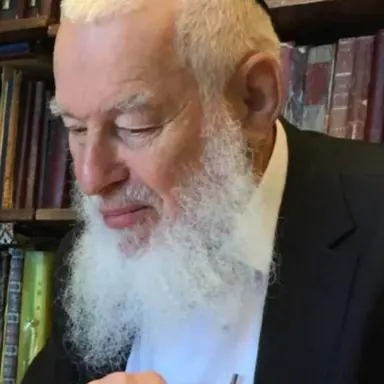
Rabbi Avraham Yehoshua Zuckerman, of Blessed Memory
13 min read2,640 words
Summary
This survey outlines the multidimensional portrait of Rabbi Avraham Yehoshua Zuckerman, a key figure in Religious Zionism who combined depth of thought with wide-ranging pioneering activity. The text details the course of his life, from his studies as a foremost disciple of Rabbi Zvi Yehuda Kook (the Ratziyah) to the founding of educational institutions and social movements such as "El Ami," while highlighting his personal principles of manual labor and refusal to earn a living from the Torah. On the plane of thought, the article clarifies his unique conception, which sees Judaism as "the nature of life" and the Divine as a dynamic force that renews creation, alongside his decisive pedagogical contribution as a "dictionary of concepts" that makes the teaching of Rav Kook (the Ra'ayah) accessible to the present generation. Finally, the source documents his international public influence, especially among French Jewry, and the books published at the end of his life, which today constitute a spiritual and educational foundation for thousands of his students and those who continue his path.
The Work, Torah Teaching and Thought of Rabbi Avraham Yehoshua Zuckerman, of Blessed Memory
Life Course and Personal Portrait: Combining Torah, Labor and Leadership
Rabbi Avraham Yehoshua Zuckerman, of blessed memory (1938–2021), was one of the most influential Torah and educational figures in Religious Zionism in the last decades of the 20th century and the beginning of the 21st century.[1, 2] He was born in Belgium to a family that had emigrated from Germany, was educated in a public school, and in his youth was a prominent activist in the Bnei Akiva movement.[1, 3] In the 1960s he immigrated to Israel and began his studies at the Mercaz HaRav yeshiva, where he became one of the foremost and closest disciples of the head of the yeshiva, Rabbi Zvi Yehuda HaKohen Kook (the Ratziyah).[3, 4] The Ratziyah recognized Rabbi Zuckerman's scholarly and educational qualities, and appointed him to serve as a ram (yeshiva lecturer) for army veterans at the yeshiva.[1, 3] This appointment reflected the great trust that the Ratziyah placed in him; the Ratziyah himself led the building of Mercaz HaRav into an educational and Torah empire that produced hundreds of rabbis and institutions, and succeeded in actually realizing the great vision of Rav Kook (the Ra'ayah) where earlier historical initiatives, such as the "Degel Yerushalayim" movement, had not reached full realization.[5]
One of the most distinctive features of Rabbi Zuckerman's personality and path was his consistent refusal to earn a living from Torah study or to receive financial support from Torah institutions during his years of study.[1, 3] He was careful to live from the labor of his hands and engaged in teaching and in various kinds of physical work, including working as a construction laborer.[1, 3] In addition, he owned a pomegranate orchard near Kibbutz Merav.[1, 3] This combination of profound spiritual toil with working the land and the physical building of the country shaped his figure as a role model for his students, in particular those who served in the IDF, who learned from him how to connect, tangibly and directly, the highest Torah idealism with practical and everyday life.[6] Rabbi Zuckerman, who was married and a father of children (among them Yair Zuckerman), led his family and his students in this spirit of simplicity, toil and devotion to the mission.[1, 3, 6]
Rabbi Zuckerman died of cancer on the night of 3 Elul 5781 and was buried in the cemetery on the Mount of Olives.[1, 3] The date of his death – the anniversary of the death of Rav Kook (the Ra'ayah) – was perceived by his students as having deep symbolic significance, given that a considerable part of his life was devoted to understanding the writings of the Ra'ayah, delving into them and making them accessible to our generation.[6]
His Thought and Torah Teaching: Dynamic Divinity, the Rectification of Evil and Conceptual Explanation
At the center of Rabbi Zuckerman's Torah teaching stood the conception that Judaism is not a ritual religious system detached from real life, but is "the nature of life" itself.[6] According to him, a person must live his life with authenticity and naturalness, and out of his natural and healthy existence he brings the divine presence into the world and as a matter of course fulfills the commandments organically.[3, 6] This approach rejected external mannerisms or forced religiosity and demanded of the learners deep inner reflection and devotion to the will of God flowing from their own selfhood.[3]
A unique and central aspect of his teaching on faith deals with defining the relationship between man and his Creator. Rabbi Zuckerman emphasized that the Holy One, blessed be He, should not be perceived solely as the Creator of the world in history, but as the One who renews creation every day and every moment.[8] This conception shifts the weight of religious life from an experience of static historical memory to a living, dynamic and active relationship, in which all of creation is in a constant process of development and divine elevation.
This development also includes coping with the forces of evil in the world. In his thought Rabbi Zuckerman presented the idea of "turning ra (evil) into re'a (a friend)," which constitutes a realization of man's natural sociability.[8] According to this approach, the process of spiritual rectification is not based on the destruction or suppression of the negative forces in reality, but on a pedagogy of transformation – turning evil into a companion and partner (re'a) by channeling its powerful forces into positive channels and building a broader social and cosmic harmony.
This spiritual teaching also demanded an educational methodology suited to the generation of redemption. Rabbi Zuckerman understood the repentance appropriate for our generation as repentance that stems from love, out of study, deepening and a deep inner connection.[4] Basing himself on the "Ma'amar HaDor" (Essay on the Generation) of Rav Kook, he held that the present generation is a generation of "great spirit," which desires and must hear great and meaningful things wherever it turns.[4] Therefore, one cannot be satisfied with narrow halakhic or religious demands, but must present to the generation the full breadth and depth of the Torah of the Land of Israel.[4]
Rabbi Zuckerman's outstanding pedagogical contribution to the dissemination of the teaching of Rav Kook was expressed in his ability to serve as a precise "dictionary of concepts" for the learners.[2] He was endowed with a sharp and lucid analytical capacity, which succeeded in translating the poetic and complex language of the Ra'ayah into sharp, systematic and clear definitions for the ordinary person.[2] Because of his striving for absolute precision, Rabbi Zuckerman refrained from writing books for most of his life, out of concern that any written formulation that did not hit the absolute truth might distort the idea.[2] His teaching was transmitted orally and built a whole cadre of rabbis and educators who became trailblazers in Religious Zionism.[2] Only in his last years, and at his explicit request, were some of his talks edited and published as books and booklets.[9]
Institutions of Torah and Teaching: A Wide Distribution Across the Land of Israel
Rabbi Zuckerman was a tireless ram and guide who influenced thousands of students in diverse study frameworks throughout the country.[2, 3] For more than thirty years he taught regular classes on faith at the "Ateret Yerushalayim" (Ateret Cohanim) yeshiva, located in the heart of the Old City of Jerusalem.[3] His classes were characterized by exceptional regularity and perseverance and were structured in a fixed weekly format, which included classes for the senior group on Tuesdays, dedicated classes for first-year students on Friday mornings, a general class for the whole yeshiva during Kabbalat Shabbat, and a more intimate class at his home in the Shaarei Chesed neighborhood on Shabbat morning.[3]
Over the years Rabbi Zuckerman taught in many other Torah institutions, among them the Mercaz HaRav yeshiva, where he served as a ram for Gemara and faith.[1, 3] In 1997, against the background of ideological and educational disagreements at the Mercaz HaRav yeshiva, Rabbi Zuckerman was among the prominent group of rabbis who left the yeshiva and founded the "Har HaMor" yeshiva, where he continued to teach classes on faith to army veterans.[1, 3] He also taught regularly at the Shavei Hevron yeshiva, at Machon Meir, and for a short period even at the Ma'ale Adumim yeshiva.[1, 3] His educational path was characterized by an uncompromising demand for textual depth in the foundational books of Jewish thought.[3]
The fixed foundational books in Rabbi Zuckerman's teaching:
- ├── Classical literature: Mesillat Yesharim ◄ Shemonah Perakim ◄ The Kuzari [3]
- └── The teaching of the Ra'ayah: Orot ◄ The Introduction to Olat Re'iyah ◄ Orot HaTeshuvah ◄ Orot HaTorah [3]
The Public Enterprise: The "El Ami" Movement and the Labor Settlement Movement
One of Rabbi Zuckerman's most important public enterprises was the founding and leadership of the "El Ami" movement for repentance and education, together with his partner on the path, Rabbi Elisha Wishlitzky, of blessed memory.[1, 4, 7] The movement was founded by disciples of the Ratziyah out of an aspiration to turn to the wider Israeli public, to spread the values of Judaism and faith and to connect the various parts of the people to their heritage.[4, 7] Under his guidance, the movement operated in many communities of the labor settlement movement, out of the understanding that the connection to Torah must grow out of the pioneering points of settlement.[1, 3]
The movement's branch in the north ("El Ami – El Atzmi"), which became an independent association employing some 150 workers and volunteers, illustrates the breadth of the educational enterprise that Rabbi Zuckerman laid out.[7] The association operates a wide network of young women in national service within the framework of "Zehut – the Association of Centers for Jewish Identity," which conducts experiential activities and identity content in state elementary schools and in communities.[7] The "El Atzmi" project, which began operating in 2002, includes structured programs on values and Jewish identity in middle schools and high schools, as well as focused programs of preparation for meaningful service in the IDF.[7] Another project of the movement is "Dapei Limud," which provides colorful study sheets for joint study by parents and children, which are also translated into French and English and sent to communities in the Diaspora.[7] In addition, the "Keshet" project (Kayitz shel Torah – a Summer of Torah), launched in 2014, gives an experience of Torah learning to tens of thousands of children during the summer vacation.[7]
Within the framework of the "El Ami" movement, Rabbi Zuckerman initiated in 1980 the establishment of a Torah nucleus in the city of Eilat, which began as a kollel for married scholars and a midrasha for Jewish studies, and from which the "Ayelet HaShachar" yeshiva later developed.[1, 3, 7] Alongside this activity for boys, Rabbi Zuckerman also initiated the establishment of "Midreshet HaRova" for girls in the Old City of Jerusalem, with the aim of giving women a profound education in Torah and faith.[1, 3]
Rabbi Zuckerman served as a prominent spiritual guide for the settlements in the Yamit region and in Gush Katif.[1, 3] He closely accompanied the Torah absorption of the newcomers in these areas, and was the principal spiritual guide of the settlement of Atzmona and of other settlements in the Yamit region.[1, 3] During the public struggle against the evacuation of the Yamit region, Rabbi Zuckerman was among the prominent rabbis who came physically to the place to strengthen the spirits of the residents and the protest activists, out of an uncompromising faith in the holiness of the Land and in the importance of settlement.[1]
A further expression of his direct striving to connect the parts of the people was his custom, which began in the 1980s, of holding the Yom Kippur prayers at Kibbutz Gonen in the Upper Galilee.[1, 3] Rabbi Zuckerman used to come to the kibbutz together with his family members and his many students, with the aim of holding the prayers together with the kibbutz members who were not religiously observant, creating bridges of mutual understanding and revealing to them the depth and beauty of the Days of Mercy and Selichot.[1, 3]
International Activity: The Interface with French Jewry and Leading Aliyah
Alongside his extensive activity in the country, Rabbi Zuckerman worked for decades among Diaspora Jewry, and especially in the French-speaking communities.[1, 3] The beginning of this connection was in 1968, when he traveled to France and gave a Religious Zionist seminar in Paris directed by Rabbi Yehuda Léon Askénazi (Manitou).[1, 3] This meeting laid the foundations for a long-term cooperation, within which Rabbi Zuckerman went on frequent missions, operated emissaries for Torah-Zionist activity among the communities in the Diaspora, and closely accompanied their aliyah initiatives.[1, 3]
Rabbi Zuckerman's aliyah enterprise was characterized by a strategic and structural vision.[6] He used to travel every few Sabbaths to seminars in France, with the aim of consolidating the local communities, giving them close spiritual accompaniment and building their resilience of faith even before their aliyah to the Land.[6] This approach ensured that the families and communities who immigrated under his guidance were absorbed in the country in the best possible way, settled there permanently and did not return abroad.[6] Assessments by his students indicate that the scope of the aliyah that Rabbi Zuckerman led personally exceeded that of official bodies, and left a permanent mark on the composition of the Religious Zionist communities in the country.[6]
His Torah Work and Writings
Although for most of his life Rabbi Zuckerman refrained from publishing his classes in writing because of his striving for absolute precision, in his last years and on his personal initiative several works were edited and published that gather his thought on faith and education.[2, 9] These works serve today as central aids for teaching his doctrine:
Summary
Rabbi Avraham Yehoshua Zuckerman, of blessed memory, represents a unique model of leadership in Religious Zionism, combining uncompromising intellectual rigor with wide-ranging pioneering and public activity.[2, 6] His educational path and his thought on faith did not remain abstract theory within the walls of the study hall, but were consistently translated into deeds on the ground: from the founding of Torah and educational institutions in Eilat, in Jerusalem and in the Yamit region, through leading the "El Ami" movement and educational projects for the entire Israeli public, to bringing whole communities from France on aliyah and their integration in the country.[1, 3, 6, 7]
Rabbi Zuckerman's consistent striving for conceptual precision, his deep faith in the naturalness of Jewish life and his conception of the Divine as an active force that renews creation every day enabled him to build firm bridges between different sectors of Israeli society and to shape the worldview of thousands of students, who continue to lead the educational and settlement institutions in the country.[3, 6, 8] His Torah legacy, made accessible today both through his many students and through his books and works that have been published, remains a foundational and living layer in the edifice of Torah and Jewish identity in the State of Israel.[2, 3]
Sources11
- 1.יהושע צוקרמן - ויקיפדיה, he.wikipedia.org/wiki/יהושע_צוקרמן
- 2.תלמידים וקרובים מספרים על הרב יהושע צוקרמן - מקור ראשון, makorrishon.co.il/judaism/article/273581
- 3.מו"ר הרב אברהם יהושע צוקרמן זצ"ל - ישיבת עטרת ירושלים, ateret.org.il/מור-הרב-אברהם-יהושע-צוקרמן-זצל/
- 4.לדמותו של הרב יהושע צוקרמן זצ"ל - ישיבת ההסדר בני-עקיבא מעלות, yesmalot.co.il/55754/
- 5.האיגרות ממחישות: "ההתנגדות אינה דרכו של הרצי"ה" - מקור ראשון, makorrishon.co.il/news/article/279016
- 6.בזכותו ראינו את האור - גילוי דעת, giluydaat.co.il/בזכותו-ראינו-את-האור/
- 7.אל עמי - ויקיפדיה, he.wikipedia.org/wiki/אל_עמי
- 8.יסודות באמונה | הרב יהושע צוקרמן זצ"ל Archives - ערוץ מאיר - אתר היהדות הגדול בעולם, meirtv.com/shiurim-series/22631/
- 9.שיח קודש- שיחות על המועדים - חוסן ישועות, hosen.harhamor.co.il/product/שיח-קודש-שיחות-על-המועדים/
- 10.הרב יהושע צוקרמן - חוסן ישועות, hosen.harhamor.co.il/product-category/m/
- 11.ספרי הרב יהושע צוקרמן - ספריית דרך חיים, derechaimss.co.il/product-category/רבנים-ואישים/ספרי-הרב-יהושע-צוקרמן/