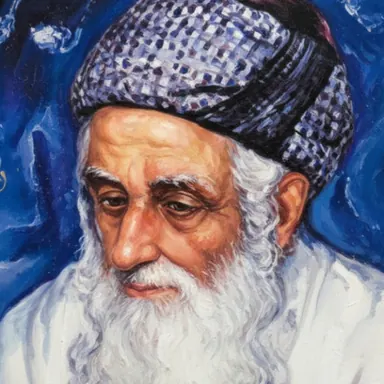
The Meta-Halakhic Work and Kabbalistic Teaching of Rabbi Shalom Mizrahi Sharabi (the Rashash)
12 min read2,407 words
Summary
This survey deals with the formative figure of Rabbi Shalom Mizrahi Sharabi (the Rashash), focusing on his remarkable life journey from Yemen to Jerusalem and his rise from a humble post as an attendant to the headship of the Beit El Yeshiva of Kabbalists. The text outlines the theological revolution he brought about through the "Siddur of Kavvanot," which turned prayer into an active operation of cosmic rectification and of unifying spiritual worlds. Alongside his mystical achievements, it highlights his decisive influence on practical halakha and on uniting diverse communities around a shared spiritual language and culture. The article sums up his extensive literary legacy, which continues to shape the world of Kabbalah and Jewish liturgy to this day.
Historical and Biographical Background: From Yemen to Jerusalem
Rabbi Shalom Mizrahi Dedi'a Sharabi, known as "the holy Rashash" or "Or ha-Shemesh," is counted among the most influential figures in the history of Jewish Kabbalah.[1, 2, 3, 4] The exact date of his birth falls between the year 5470 (1710) and the year 5480 (1720), in the town of Sharab in Yemen, which was a prominent Torah center known for its many sages and scribes.[4, 5, 6] A local tradition symbolically links the birth of the Rashash to the passing of the greatest of Yemen's poets and Kabbalists, Rabbi Shalom Shabazi, in the sense of "the sun also rises, and the sun goes down," and the Rashash was even named after him.[3, 4] The childhood of the Rashash was steeped in economic hardship; after the death of his father, Rabbi Yitzchak, the boy was forced to work as an itinerant peddler among towns and villages in order to support his family.[6, 7] Despite the enormous privation, he combined exceptional diligence in both the revealed and the hidden Torah, and whenever he had earned his basic living for that day, he immediately turned to the beit midrash and delved into the study of Kabbalah, which was widespread among the sages of Yemen.[6]
Since the acronym "Rashash" is frequently used in rabbinic literature, a precise bibliographic distinction is required between three central figures who bear this name, in order to avoid conceptual confusion in historical research:
The biographical turning point of the holy Rashash came after a dramatic miraculous rescue in the city of Sana'a.[4, 6] A wealthy Muslim woman tried to lure him from his moral path under threats of death, and he escaped through the window of the lavatory on the third floor.[6] The Rashash vowed that if he were saved, he would immediately go up to the Land of Israel; he landed unharmed and set out on a complex journey of wandering by land and sea.[6] His route passed through the port of Aden, and from there by ship to Bombay in India, Basra in Babylonia (Iraq), and Syria, until he reached Jerusalem.[1, 6] The geographical journey reflected the Jewish networks of trade and migration in the 18th century, and led the young Kabbalist to the heart of spiritual activity in the Holy Land.[1, 6]
His Revelation in Jerusalem and the Leadership of the Beit El Yeshiva
On arriving in Jerusalem, the Rashash chose to conceal his Torah stature and worked as a simple attendant at the "Beit El" Yeshiva of Kabbalists, which had been founded in the year 5493 (1733) by Rabbi Gedaliah Hayon.[1, 7, 9] At that time, when difficult questions arose in the yeshiva concerning the writings of the Ari for which no solution was found, the Rashash would secretly slip notes with precise and profound answers into the books of the head of the yeshiva.[7] After his true identity was discovered by Rabbi Gedaliah's daughter, he became a dominant figure in the yeshiva.[1, 7] Upon the death of Rabbi Gedaliah in the year 5510 (1750), the Rashash was appointed head of the yeshiva and served in this post until his death in the year 5537 (1777).[4, 7]
To understand the place of the Rashash in the chain of spiritual leadership in Jerusalem, the following is a succession table of the heads of the Beit El Yeshiva of Kabbalists across the generations:
Under the leadership of the Rashash, a strict code of conduct based on an uncompromising spiritual regimen was instituted in the yeshiva.[7] The order of study included rising regularly at midnight to recite Tikkun Chatzot, study and yichudim (unifications) in the morning watch, and in-depth study of the Ari's teaching through the book "Etz Chaim" of Rabbi Chaim Vital.[7, 9] The Rashash insisted that all studies and conversations in the yeshiva be conducted exclusively in the Hebrew language.[7] This custom was meant to bridge the language gaps between the different communities (Yiddish, Ladino, Arabic) and to prevent communal separatism, out of the conception that all Israel is one people.[7]
The Theological Revolution: The Rashash Siddur and the Structure of the Kavvanot
The meta-halakhic contribution of the Rashash lies in the transformation he brought about in the teaching of the Ari.[13] The Ari left a speculative Kabbalistic doctrine scattered across various writings, at times with structural contradictions or conceptual gaps.[13] The Rashash acted as a codifier and systematic organizer; he created the practical and orderly "map" of prayer – the "Rashash Siddur."[2, 10, 14]
In contrast to the basic halakhic kavvanah (intention), whose purpose is to arouse the worshipper's feeling and bring him to understand the literal meaning, the one who prays with kavvanot according to the method of the Rashash acts as a cosmic activist.[13] Every word of the prayer is perceived as an instrument for spiritual unification, raising the sparks of holiness that fell in the wake of the shattering of the vessels back to their source in the world of Atzilut.[13] This rectification is carried out through the four worlds (ABYA), as the one who prays with kavvanot works to rectify the spiritual "partzufim" (configurations) in each and every sefirah on three levels: the inner vessel, the middle vessel and the outer vessel.[13]
To allow maximal concentration and precision without the need to leaf through reference books during prayer, a complex visual system of color coding was developed in modern Rashash siddurim (such as the "Netivot Shalom" edition).[13] This system rests on the "doctrine of colors" of the Ramak in his book Pardes Rimonim, which holds that the colors serve as a metaphor for the spiritual operations of the sefirot and directly affect the elevation of the soul.[13]
The Meeting of Halakha and Kabbalah: The Writing of STaM and the Laws of Tagin
The teaching of the Rashash is not confined to the realm of prayer and kavvanot alone, but penetrates deeply into the world of practical halakha.[15] A clear example of this is his rulings on the writing of Torah scrolls, tefillin and mezuzot (STaM).[15] In the book "Etz Chaim" of Maharchu (Rabbi Chaim Vital) it is written that the letters bet, dalet, kuf, chet, yod, heh require one tag on each letter.[15] The Rashash, in his book "Nahar Shalom," set a strict halakhic boundary combining Kabbalah and the revealed Torah alike, and wrote that regarding the tagin, heaven forbid one should add to three tagin on the letters shin, ayin, tet, nun, zayin, gimel, tzadi and one tag on the letters bet, dalet, kuf, chet, yod, heh.[15] He warned against changes and ruled that "whoever adds detracts, and [causes] detractions, heaven forbid," thereby subordinating scribal practice to the precise cosmic structure received in the tradition of the Ari.[15]
The Literary Corpus and Kabbalistic Commentary
The Torah corpus left by the Rashash forms the central pillar of Kabbalistic literature in the modern era.[1, 10] His works are characterized by meticulous exegetical precision and deep conceptual analysis.[10]
His main books include the following works:
- Nahar Shalom ("River of Peace"): the foundational book that gathers his system of thought, including kavvanot and yichudim following the order of the prayers and the commandments, alongside halakhic and Kabbalistic responsa.[1, 10, 11]
- Emet ve-Shalom ("Truth and Peace"): a collection of systematic and brief glosses printed in the margins of the book "Etz Chaim" of Rabbi Chaim Vital, intended to reconcile contradictions and correct corrupt readings.[10]
- Rechovot ha-Nahar ("Rehoboth by the River"): a deep and comprehensive commentary on the introductions of the Ari.[10] The book's title derives from the verse in Genesis concerning Saul of Rehoboth by the River, a king of Edom who reigned before any king reigned over the children of Israel.[16] In Kabbalah, these verses allude to the processes of the "death of the kings" and the shattering of the vessels that preceded the creation of the world, and the commentary deals with the deep rectification of those broken worlds.[16]
- Perush ha-Shemesh: notes and glosses on all of the Ari's writings.[1, 2, 3]
The immense influence of the Rashash gave rise to an extensive literature of commentaries written by the great Kabbalists of the following generations, who explained his allusions, which are extreme in their brevity.[11, 12] Among the prominent works one may count the book "Torat Chacham" of Rabbi Chaim de la Rosa, who was one of his prominent disciples, and the book "Shemen Sasson" of Rabbi Sasson Persiado.[11, 12] In later generations the book "Eifa Shelema" was written by the great Kabbalist Rabbi Chaim Shaul Dweck HaKohen, who explained "Rechovot ha-Nahar," as well as the glosses of the "Leshem" by Rabbi Shlomo Elyashiv, one of the great Kabbalists of Lithuania, who combined the Kabbalah of the Rashash with the Kabbalah of the Gra.[11, 12, 17]
Unity and Social Kabbalah: The Bond of Association and the National Prayer
The uniqueness of the "Beit El" Yeshiva under the leadership of the Rashash was expressed in the combination of mystical rectification with social action.[7] The Rashash created the bond of association (shtar hitkashrut) of the "Ahavat Shalom" fellowship, a legal-Kabbalistic document in which the members of the yeshiva undertook to conduct themselves in complete unity, to love one another with a love of the soul, and to act together in body and soul for the sake of all Israel.[7, 10] This document was signed by Sephardic sages alongside key figures from the beginnings of Hasidism, such as Rabbi Gershon of Kitov (the brother-in-law of the Baal Shem Tov), which showed that the Kabbalah of the Rashash served as a bridge between opposing religious worlds.[7]
A further expression of this is the famous prayer of the Rashash, "Look down from heaven upon a perfect congregation."[3] This prayer, written out of deep pain over the sorrow of the Shekhinah in exile, was meant to be recited at midnight facing the Western Wall.[3] In this prayer the one who prays with kavvanot asks never to leave the Land of Israel or to go outside Jerusalem.[3] Following this prayer and the instructions of the Rashash, the Kabbalists who follow his path took great and devout care not to leave the borders of the Land, out of the belief that residence in the Land of Israel is vital for preserving the wholeness of the spiritual rectification and the flow of cosmic abundance.[3]
Inter-Communal Influence and Historical Reception
The teaching of the Rashash left an indelible mark on the liturgical world of the communities of Israel.[1, 14] This influence is particularly evident at two geographical and cultural poles: Yemen and Eastern Europe.[1, 18]
In Yemen, the homeland of the Rashash, the penetration of the Kabbalah of the Ari and the Rashash led to a deep internal controversy and to the division of the prayer rites in the Yemenite siddur (the "Tiklal") into two main streams:
- The Baladi (local) rite: an ancient rite that preserves the early customs of Yemen and the rulings of Maimonides.[18] This rite was consolidated and reinforced by the Maharitz (Rabbi Yichye Tzalach) in his book "Etz Chaim," with the aim of halting the adoption of the Sephardic-Kabbalistic customs that had arrived from the Land of Israel.[18]
- The Shami rite: a rite that broadly adopted the customs of the Land of Israel and of Kabbalah, and was directly influenced by the prayer rite and the kavvanot of the Rashash.[18]
At the same time, the teaching of the Rashash won immense esteem among Chabad Hasidism and the Kabbalists of Ashkenaz.[1] His book "Nahar Shalom" is cited and analyzed in the discourses of the Admor the Rashab (Rabbi Shalom Dovber) and in his notes to the siddur "Torah Or," as well as in the letters and talks of the Lubavitcher Rebbe.[1] This connection continued in the last generation as well; when the Kabbalist Rabbi Yitzchak Kaduri visited New York, the Lubavitcher Rebbe blessed him for disseminating books of Kabbalah, and even sent a special emissary to Rabbi Benayahu Shmueli to obtain the Rashash Siddur that had been printed from manuscript.[1]
The legacy of the Rashash continues to pulse in the twentieth and twenty-first centuries as well.[16, 19] The "Nahar Shalom" Yeshiva of Kabbalists in Jerusalem, founded by the elder of the Kabbalists Rabbi Mordechai Sharabi and named after the book of the Rashash, continues to train generations of practitioners of kavvanot in his precise way.[16, 19] Prayer with the siddur of kavvanot is not perceived as a historical matter, but as a living, daily spiritual service that forms the heart of Jewish mystical activity today.[13, 14]
Sources19
- 1.שלום מזרחי שרעבי - חב"דפדיה, chabadpedia.co.il/wiki/שלום_מזרחי_שרעבי
- 2.שרעבי, שלום בן יצחק מזרחי (1720-1777) - הספרייה הלאומית, nli.org.il/he/a-topic/987007308368505171
- 3.הרש"ש (שרעבי) – ויקישיבה, yeshiva.org.il/wiki/index.php/הרש"ש_(שרעבי)
- 4.שלום שרעבי – ויקיפדיה, he.wikipedia.org/wiki/שלום_שרעבי
- 5.ואז ראו עיניה את המשרת שלום נכנס בחשאי, כותב דבר מה על פתק, מביט לכל עבר ומטמינו בספרו של אביה… - דרשו, dirshu.co.il/203723-2/
- 6.הרב בניהו שמואלי שליט"א - תולדות הרש"ש - ישיבת המקובלים נהר שלום, naharshalom.co.il/מאמר/1894/תולדות-הרש"ש
- 7.הרש"ש הקדוש - ישיבת המקובלים בית אל, beitelym.co.il/הרשש-הקדוש/
- 8.השַׁמָשׁ שהיה לרש"ש: רבי שלום שרעבי, מגדולי המקובלים - Eyal Davidson - ד"ר איל דודסון, eyaldavidson.co.il/השַׁמָשׁ-שהיה-לרשש-רבי-שלום-שרעבי-מגד/
- 9.ישיבת המקובלים בית אל, beitelym.co.il/
- 10.הרש"ש הקדוש הרב שלום שרעבי - כל המידע, התפילות והסגולות - המאיר לארץ, hameir-laarets.org.il/hilulots/י-בשבט-רבי-שלום-מזרחי-שרעבי-הרשש-הקד/
- 11.ספר נהר שלום עם פרושים (מוקדסי) - אוצר הקבלה, ravarmonishop.com/product/ספר-נהר-שלום-עם-פרושים-מוקדסי/
- 12.ספר 'נהר שלום' / רש"ש - אוצר הספרים, sefer.org.il/items/3730690-ספר-נהר-שלום-רש-ש
- 13.סידור כוונות הרש"ש – ויקישיבה, yeshiva.org.il/wiki/index.php/סידור_כוונות_הרש"ש
- 14.מהו סידור הרש"ש - שער התפילה, shaartefila.co.il/מהו-סידור-הרשש/
- 15.פרק י' - דיני תגין • אתר הרב מרדכי אליהו, harav.org/books/stm10/
- 16.רחובות הנהר - ויקיפדיה, he.wikipedia.org/wiki/רחובות_הנהר
- 17.לשם שבו ואחלמה סט ד' כרכים / ר' שלמה אלישיב - אוצר הספרים, sefer.org.il/items/3729810-לשם-שבו-ואחלמה-סט-ד-כרכים-ר-שלמה-אלישיב-הוצאה-לאור-ברזני
- 18.תכלאל - ויקיפדיה, he.wikipedia.org/wiki/תכלאל
- 19.מרדרכי שרעבי | harav-hacohen - הרב אברהם הכהן, haravhacohen.com/mordechaysharabi