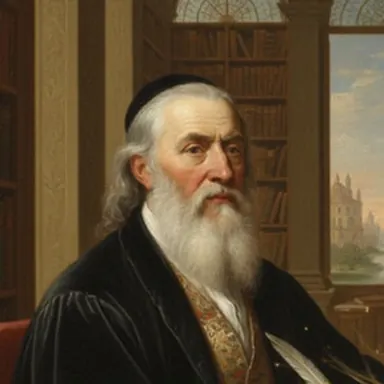
The Work, Torah Teaching and the Rationale of the Mystical Thought of Rabbi Moshe David Valle (the Ramad Valle)
15 min read2,956 words
Summary
The text surveys the multifaceted figure of Rabbi Moshe David Valle (the Ramad Valle), an 18th-century Italian kabbalist and physician who was a central figure in the circle of the Paduan kabbalists alongside the Ramchal. The source emphasizes his monumental literary contribution, which includes a comprehensive kabbalistic commentary on all twenty-four books of the Hebrew Bible, while maintaining the principle that the esoteric meaning does not cancel the plain meaning but reveals its inner depth. The thought of the Ramdu is described as combining scientific conservatism (a preference for classical medicine over modern chemistry) with a deep messianic consciousness, including the role of "the refining tzaddik" who descends into states of crisis and despair in order to redeem sparks of holiness. In summary, the text presents the modern relevance of his writings, which were hidden away for many years and today influence broad currents in the Torah world thanks to their candid engagement with the depths of the soul and with the processes of redemption.
Biography and Historical Background: Padua as a Meeting Point of Science and the Esoteric
Rabbi Moshe David Valle, known by his epithet the Ramad Valle (or the Ramdu), was born on 20 Iyar 5456 (1696) in the city of Padua in northern Italy, to his father Rabbi Shmuel Chaim [cite: 1, 2]. The Padua of the late seventeenth and early eighteenth century offered a unique intellectual space for the local Jewish community [cite: 3]. It combined a deep halakhic and kabbalistic tradition with openness to the general sciences, especially through the University of Padua, which was one of the only academic institutions in Europe that allowed Jews to acquire a formal medical education [cite: 2, 3].
The Ramad Valle worked within this cultural space, combining in his personal life rigorous Torah study—among other things, he was accustomed to study Torah standing [cite: 2]—with a comprehensive scientific education. He was certified as a physician at the University of Padua at the beginning of 5474 (1713) and earned his living throughout his life by treating the sick [cite: 2]. Alongside his scientific work, the Ramad bore the burden of communal leadership, served as a marvelous preacher and acted as cantor in the synagogue of the Sephardi community in Padua [cite: 2]. His public standing rested on his complete devotion to the members of his community; he was known as one who prayed for them often and would not go to sleep at night until he had made sure that every one of the city's Jews had returned home safely [cite: 2, 3]. The Ramad Valle died on Tuesday, 7 Tevet 5537 (17 December 1776), and was buried in the old Jewish cemetery in Padua [cite: 1, 2, 4].
Key Stations in the Life of the Ramad Valle
The Circle of the Paduan Kabbalists and the Complex Relationship with the Ramchal
The mystical awakening in Padua began to take shape in 5484 (1724) with the founding of the "Mevakshei Hashem" (Seekers of God) fellowship—an association of Torah scholars who delved into the revealed and the esoteric teaching, among them Rabbi Yisrael Chizkiya Treves, Rabbi Yaakov Chazak and the Ramad Valle [cite: 3, 7]. When the young Rabbi Moshe Chaim Luzzatto (the Ramchal) joined the fellowship, the members recognized his distinct mystical superiority and submitted to his authority [cite: 7].
The relationship between the Ramad Valle and the Ramchal was complex and dynamic. The Ramad Valle was about a decade older than the Ramchal, and according to the research of Yosef Almanzi, he even served as the Ramchal's teacher in Kabbalah at the beginning of his studies [cite: 1, 4, 6]. However, once the Ramchal was granted the revelation of an angel-maggid and founded his mystical fellowship in 5487 (1727), the Ramad Valle became his principal disciple and one of the heads of the fellowship [cite: 1, 3]. He was appointed, together with Rabbi Yekutiel Gordon, to oversee the order of the study hall and the observance of the strict regulations intended to bring about the rectification of the world and of the Shekhinah [cite: 2, 8].
When the Ramchal was forced to leave Padua for Amsterdam following the persecutions and bans of excommunication that his writings aroused, the Ramad Valle took his place as the spiritual and practical leader of the fellowship in Padua [cite: 2, 4]. In his later years as well, the Ramad continued to lead the local circle of kabbalists. Evidence of this appears in the poetry of Ephraim Luzzatto, which describes the order of the third Sabbath meal in Padua around 1750, at which the Ramad Valle sat together with his close friend Rabbi Yisrael Treves (author of the book "Razin Genizin," attributed to the Ramchal), and the two shared kabbalistic secrets every Sabbath [cite: 3].
The Interpretive Methodology: The Plain Meaning as the Bearer of the Kabbalistic Secret
The interpretive enterprise of the Ramad Valle is unique in its scope in kabbalistic literature. He is the only kabbalist who completed a continuous and comprehensive kabbalistic commentary on all twenty-four books of the Hebrew Bible, extending over some 15,000 manuscript pages [cite: 1, 3]. The commentary, printed in recent decades in dozens of volumes, presents a unique hermeneutical approach [cite: 4, 9].
At the center of his method stands the principle cited in his commentary on Proverbs: "the plain meaning shall not be stripped away" [cite: 10]. The Ramad Valle refused to accept approaches that divest the verses of their literal historical meaning. In his eyes, the revealed layer of the text always remains true and stable, and the esoteric meaning is not a substitute for the plain meaning but a revelation of the inner meaning of that very same matter [cite: 4]. As Rabbi Yosef Spinner, the founder of the project to print his writings, defined it, the Ramad's way is to connect verse to verse and matter to matter so closely that an entire book is interpreted as a single continuous and harmonious movement in which the plain meaning and the secret are interwoven without partitions [cite: 4].
The writing of the Ramad Valle is highly associative and does not bend to rigid systematic structures [cite: 1]. His commentaries show a combined influence of the Kabbalah of the Arizal, the basic concepts of the Ramchal, and prominent echoes of the ecstatic Kabbalah of divine names of Rabbi Abraham Abulafia [cite: 1, 8].
The Corpus of Books and Commentaries of the Ramad Valle
Classical Medicine versus the New Chemistry: The Epistemology of the Ramad Valle
The Ramad Valle held a conservative epistemological position in the midst of the age of Enlightenment and the scientific revolution [cite: 1, 3]. Although he studied at the modern university and earned his living as a practicing physician, he refused to adopt the new medical and chemical discoveries of his time [cite: 1, 2]. In his view, the sciences and branches of wisdom of ancient times are based on absolute truth, whereas the modern sciences ("the new wisdoms") are mostly falsehood and error [cite: 4].
The Ramad Valle supported the theory of the four humors and preferred the medical methods of Galen, Hippocrates and Avicenna [cite: 1, 4]. He defined classical medicine as that which is "beneficial in essence and harmful by accident" (that is, its essential effect is positive, and its harms are an incidental by-product), as opposed to modern chemical medicine, which is "harmful in essence, and sometimes beneficial by accident" [cite: 1, 4].
In his "Sefer HaLikkutim," the Ramad dealt with the claim that the change in the temperament and the weakness of nature of the people of recent generations requires the development of a new medicine suited to their time [cite: 1]. He rejected this dynamic approach and called it "a crooked way," out of the conception that scientific and physiological truth is eternal and unchanging [cite: 1]. The only change to be applied in later generations is merely quantitative (reducing the dosage of medicines because of the weakness of the body) but not qualitative [cite: 1].
A Comparison of the Medical Paradigms in the Thought of the Ramad Valle
The Messianism of the Padua Circle: A Theology of Refinements and Falls
The mystical fellowship in Padua operated under a deep and extraordinary messianic consciousness [cite: 3, 5, 23]. The members of the fellowship saw the events of their lives as part of a cosmic divine plan for the rectification of the historical sins of the people of Israel [cite: 8]. Within the messianic structure of the fellowship, the Ramchal was identified as the Messiah son of Joseph, whose role is to undergo suffering and harsh refinements in the husks (kelipot), while the Ramad Valle saw himself as the Messiah son of David—the messianic leader destined to complete the process of redemption [cite: 3, 5, 23, 24].
The messianic conception of the Ramad Valle is characterized by a deep psychological focus. In his commentary on Psalms, he identifies himself with King David and refers to himself in the third person by the title "the refining tzaddik" [cite: 3]. The role of the refining tzaddik is to descend into the depths of impurity and the withdrawal of the light in order to extract from there the sparks of holiness that were taken captive [cite: 3].
Out of this conception the Ramad Valle developed a daring explanation of the nature of crises and sufferings. He discusses at length states of spiritual "smallness" (katnut), despair and self-doubt, which he calls by the Italian term "dispiratione" (Disperazione) [cite: 3, 25, 26]. The Ramad explains that the dispiratione does not indicate disconnection from God, but is a necessary stage of crushing and refinement (like an olive, which yields its best oil only when it is crushed) that ultimately leads to states of "greatness" (gadlut) and spiritual illumination [cite: 3, 25].
The Ramad Valle also offered a revolutionary explanation of the spiritual falls of the messianic figure. In his commentary on the Scroll of Esther he writes that the Messiah is required to contend with the most difficult work of refining the character traits in history [cite: 27]. Because of the weight of the task and the incessant proximity to the forces of evil, the Messiah may in fact fall into iniquities and sins; however, the Holy One, blessed be He, does not count these iniquities against him at all, since everything stems from the greatness of the cosmic work imposed upon him for the sake of refining the sparks [cite: 27].
This conception is closely connected with the rectification of the sin of the sale of Joseph. The Ramad Valle saw the sale of Joseph as an enormous cosmic flaw at the root of the souls of Israel, requiring continuous rectification throughout the generations through harsh historical events such as the Ten Martyrs [cite: 2, 27]. As part of this process of rectification, Jacob our father was required to buy the birthright from Esau [cite: 27]. The Ramad explains that Jacob was supposed to beget the Messiah son of Joseph, while Esau was supposed to beget the Messiah son of David [cite: 27]. The moment Esau chose to connect himself with the forces of impurity, Jacob bought the birthright from him and thereby transferred the root of the soul of the Messiah son of David to the seed of Jacob forever [cite: 27].
Political and Geographical Kabbalah: Decoding World History
The Ramad Valle saw esoteric wisdom as a tool for decoding not only the individual soul but also the political geography and world history of his time [cite: 3]. He refused to separate geopolitical processes from spiritual movements in the upper worlds.
A prominent example of this is his kabbalistic interpretation of the discovery of the American continent [cite: 3]. The Ramad Valle explained that America's geographical distance from the Land of Israel represents the degree of paganism and spiritual concealment of that region [cite: 3]. The arrival of Jews in America in recent generations was not, in his eyes, a random migratory movement, but a deliberate divine move intended to bring the refining forces of the people of Israel to the most remote places, in order to extract from there the sparks of holiness that remained captive within the sitra achra (the "other side") at the end of the world [cite: 3].
The Ramad Valle also engaged in political analysis of the leadership of his time. He rejected the concept of secular "politics" (which he called in the vernacular "polatica") detached from the laws of morality and the Torah [cite: 10]. In his commentary on Proverbs he explained that the sin of Jeroboam son of Nebat began at the moment he began to think thoughts of "polatica," thereby opening an opening for the external forces to entice him and bring him to idolatry and the destruction of his kingdom [cite: 10].
In addition, the Ramad Valle integrated into his thought insights about European historical events, military secrets and other religions [cite: 3]. At the age of 25 he composed the comprehensive anti-Christian work in Italian, "The Seven Days of Truth" (I Sette Giorni della Verità), in which he set out a sharp intellectual and philosophical response to the claims of the Christian mission, with the intention of defending the members of his community and strengthening their faith [cite: 1, 3, 4].
Anticipating the Thought of Later Generations and the Modern Renaissance
The writings of the Ramad Valle, which remained hidden away for hundreds of years, constitute a theological transitional link of great importance in Jewish history [cite: 3, 23]. The scholar of Kabbalah Isaiah Tishby proved that the messianic ideas of the Padua circle, including the writings of the Ramad Valle, spread in Eastern Europe and had a profound influence on the formation of the spiritual teaching of the Hasidism of the Baal Shem Tov [cite: 23]. The Hasidic emphasis on "worship through corporeality," on finding merit in sinners, and on descent for the sake of ascent bears a clear stamp of the thought of the Ramad Valle [cite: 3].
At the same time, the thought of the Ramad Valle clearly anticipated the teaching of Rav Kook (the Raayah) and the conceptions of Religious Zionism [cite: 3]. The Ramad interpreted the establishment of the earthly kingdom, the building of the Land and the division of the tribal inheritances as a rectification of the upper worlds [cite: 3]. Thus, for example, he interpreted the words of the Holy One, blessed be He, to Joshua son of Nun after the defeat in the battle of Ai, "Get up" (kum lekha)—not as a call of despair, but as an active command to rise and establish the kingdom, since the awakening from below ("itaruta de-letata") is what activates and arouses the divine abundance from above [cite: 28].
Today the teaching of the Ramad Valle enjoys an unprecedented revival and popularity [cite: 3]. After having been hidden away, dozens of his volumes have been printed by various publishers (among them "Machon Pitchei Megadim" and "Ateret Soferim"), and they are studied fervently both in Haredi study halls and in leading Religious-Zionist yeshivot [cite: 3, 20, 29]. His figure as a physician and kabbalist who offered a personal, candid and open discourse, dealing with the difficulties of the soul and with crises at eye level, makes him a distinctly relevant spiritual teacher for the people of the modern generation [cite: 3].
Sources29
- 1.רבי משה דוד ואלי | Family Wiki | Fandom, danielventura.fandom.com/he/wiki/רבי_משה_דוד_ואלי
- 2.המקובל רבי משה דוד ואלי - MyTzadik, mytzadik.com/tzadik.aspx?id=900
- 3.רבי משה דוד ואלי: המקובל שזוכה לאחרונה לפופולריות לא אופיינית - מקור ראשון, makorrishon.co.il/judaism/article/302453
- 4.משה דוד ואלי - ויקיפדיה, he.wikipedia.org/wiki/משה_דוד_ואלי
- 5.רשימות חווייתיות וחזיוניות של ר' משה דוד ואלי (רמד"ו), המשיח המיועד בחבורת רמח"ל | מאמר | RAMBI990000353330705171 | הספרייה הלאומית, nli.org.il/he/articles/RAMBI990000353330705171/NLI
- 6.מחבר:משה דוד ואלי - ויקיטקסט, he.wikisource.org/wiki/מחבר:משה_דוד_ואלי
- 7.מינקות לבחרות – הרמחל - קהילת הרמח"ל, ramhal.net/קורות-חיי-הרמחל/מינקות-לבחרות/
- 8.סערה גדולה בעיר קטנה – על הרמח“ל המקובל מהעיר פדובה - באיטליה, initalia.co.il/post/big-storm-in-a-small-town-on-the-ramchal-from-the-city-of-padua
- 9.רבי משה דוד ואלי - אישי ישראל - WordPress.com, isheiisrael.wordpress.com/2017/12/23/רבי-משה-דוד-ואלי/
- 10.משה דוד ואלי - ויקיציטוט, he.wikiquote.org/wiki/משה_דוד_ואלי
- 11.כתבי רמ"ד וואלי - סט על הנ"ך כא' (21) כרכים - אוצר הספרים, sefer.org.il/items/7728369-כתבי-רמ-ד-וואלי-סט-על-הנ-ך-כא-21-כרכים
- 12.Rabbi Moshe David Valle (1697-1777) – Page 2 - My Sefer, mysefer.com/collections/rabbi-moshe-david-valle-1697-1777?page=2
- 13.כתבי רמ"ד וואלי - הסט המלא והשלם לה' (35) כרכים - אוצר הספרים, sefer.org.il/items/7728385-כתבי-רמ-ד-וואלי-הסט-המלא-והשלם-לה-35-כרכים
- 14.Moses David ben Samuel Valle (1696-1777) | The National Library of Israel, nli.org.il/en/a-topic/987007305583205171
- 15.Rabbi Moshe David Valle - Moshia Chosim (Shmuel 1 & 2) / רבי משה דוד ו - My Sefer, mysefer.com/products/rabbi_moshe_david_valle__moshia_chosim_shmuel_1_-_2
- 16.באורי אגדות מגילה - מכון הלכה ברורה, halachabrura.org/agada/meg6-9.htm
- 17.באורי אגדות פסחים - מכון הלכה ברורה, halachabrura.org/agada/psachim.htm
- 18.כתבי רמ''ד וואלי - עת לחננה - בענייני גאולה - 3 כרכים - Eichlers.com, eichlers.com/kitvei-ramad-vali-et-lechenena-beinyanei-geula-3-vol-hs39366.html
- 19.עת לחננה בעניני הגאולה ג' כרכים / כתבי רמ"ד וואלי - אוצר הספרים, sefer.org.il/items/3732240-עת-לחננה-בעניני-הגאולה-ג-כרכים-כתבי-רמ-ד-וואלי
- 20.כתבי רמ''ד וואלי - אוצר הקונטרסים / במעגלי השנה ובענינים שונים, sefer.org.il/items/7912727-כתבי-רמ-ד-וואלי-אוצר-הקונטרסים-במעגלי-השנה-ובענינים-שונים-הוצאה-לאור-עטרת-סופרים-פייגנבוים-
- 21.כתבי רמ"ד וואלי - סט שונות ו' כרכים - אוצר הספרים, sefer.org.il/items/7728372-כתבי-רמ-ד-וואלי-סט-שונות-ו-כרכים
- 22.Rabbi Moses David Vali (or Valle) was an Italian Jewish rabbi and doctor; born at Padua and died there - Tzadikim, dailyzohar.com/tzadikim/1075-Rabbi-Moses-David-Vali
- 23.חקרי קבלה ושלוחותיה: מחקרים ומקורות - ישעיה תשבי, Isaiah Tishby - Google Books, books.google.com/books/about/חקרי_קבלה_ושלוחותיה.html?id=XZJPAQAAIAAJ
- 24.באורי אגדות ברכות - מכון הלכה ברורה, halachabrura.org/agada/brachot19-64.htm
- 25.אילמה LIVE מס 7 – ללמוד לגדול מתוך הסבל – ראיון עםהרב דניאל רוזנטל, elima.org.il/magazine/growing-through-suffering/
- 26.באורי אגדות בבא קמא - מכון הלכה ברורה, halachabrura.org/agada/babakama.htm
- 27.פסח חד גדיא ח"א - הרב עופר ארז, ofererez.co.il/פסח-חד-גדיא-חא/
- 28.יהושע הביא את עכן לחיי עולם הבא | בני ציון - בונים קומה בתנ"ך, bneyzion.co.il/מאגר-השיעורים-והמאמרים/נביאים/יהושע/מפי-כהן-על-ספר-יהושע/יהושע-הביא-את-עכן-לחיי-עולם-הבא
- 29.Rabbi Moshe David Valle - Chamesh Megillot / רבי משה דוד ואלי – חמש מג - My Sefer, mysefer.com/products/rabbi_moshe_david_valle__chamesh_megillot