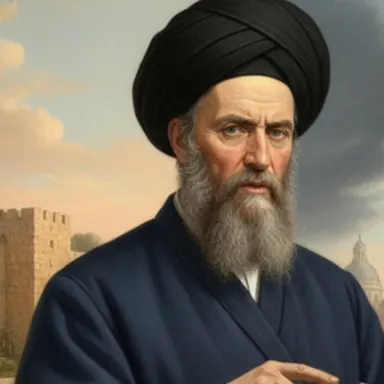
The Work and Torah Teaching of Rabbi Moshe Hagiz: Guardian of the Walls of Tradition in an Age of Change
13 min read2,619 words
Summary
This article surveys the life and teaching of Rabbi Moshe Hagiz (the Maniach), an influential rabbinic figure who was active in the 18th century and served as a cultural bridge between the Land of Israel and the communities of Europe. The text portrays him as a resolute defender of halakhic conservatism, who waged stubborn struggles against Sabbateanism and conducted complex polemics with figures such as the Ramchal, out of deep anxiety for the integrity of the Jewish community. Alongside his stormy public activity, the source highlights his rich intellectual world and his varied works, which combine deep religious commitment with a surprising openness to the general sciences and a critical approach to traditional texts. Ultimately, the article presents a fascinating paradox of leadership that uses modern tools and global thinking to fortify the walls of tradition against the changes of the modern era.
Family Roots, Years of Upbringing and the Move to the Diaspora
Rabbi Moshe Hagiz (5432, 1672 – around 5510, 1750), known in Torah literature by the acronym the Maniach (Moshe ben Yaakov Hagiz, where the letter final nun stands for the Arabic word "ibn," meaning "son of"), represents one of the most fascinating and stormy figures in the Jewish leadership of the early modern period.[1, 2, 3] Hagiz was born in Jerusalem to a distinguished family of sages.[1, 2] His father, Rabbi Yisrael Yaakov Hagiz, was one of the great rabbis of Jerusalem, head of the "Beit Yaakov" yeshiva and one of the first to fight against Shabbetai Tzvi, against whom he even issued an explicit ban in 5426 (1666).[1, 2] The father's death when Moshe was only about three years old cut short their life together, and the child passed into the education and care of his maternal grandfather, Rabbi Moshe Galante, who was the rabbi of Jerusalem and the first Rishon LeZion.[2, 4] Hagiz studied with his grandfather in the "Beit Yaakov" yeshiva founded by his father, and absorbed from him the foundation of his halakhic learning.[2] He received another decisive spiritual influence from his principal teacher, Rabbi Avraham Yitzchaki, who was one of the leaders of the fight against Sabbateanism after Shabbetai Tzvi's conversion to Islam.[1] Through marriage to the daughter of the kabbalist Rabbi Raphael Mordechai Malkhi, Hagiz also became the brother-in-law of the author of "Pri Chadash," Rabbi Chizkiya da Silva, and thereby became embedded in the heart of the scholarly and kabbalistic elite of Jerusalem.[1]
The death of Rabbi Moshe Galante in 5449 (1689) left the young Hagiz without economic and institutional support in Jerusalem.[2] This reality forced him to leave the Land of Israel as a shadar (emissary of the rabbis) to Italy and from there to Amsterdam.[2] This mission, which began as a temporary economic duty, became a long life journey in the Diaspora.[2] Hagiz, who had no children, moved the center of his activity to the city of Altona in Germany, where he lived and worked until 5498 (1738).[1] In his last years he returned to the Land of Israel, settling first in Sidon and afterwards in Safed and Beirut, where he died at an advanced age.[1, 2] His wanderings between the Ottoman East and the European West gave him a unique global perspective, which influenced the character of his writing and his methods of struggle.[1, 2]
The Maniach's Literary Enterprise: Halakha, the Land of Israel and the Defense of Tradition
The Torah works of Rabbi Moshe Hagiz span diverse genres and reflect his rich intellectual world, which ranges between meticulous halakhic precision and moral thought and early Zionist ideology.[2, 4] His writing moves between addressing the public of scholars and attempts to reach as wide a readership as possible at the ends of the earth.[1, 4]
One of his most prominent works is the book "Sefat Emet," first printed in Amsterdam in 5467 (1707).[2, 4] This unique work is devoted entirely to the virtue and holiness of the Land of Israel, emphasizing the halakhic privilege and duty to settle in it.[4] The book reflects a high social and political awareness; it consists of essays and homilies analyzing why the Land of Israel is distinguished from other lands, and at its head appears a bilingual introduction in Hebrew and Portuguese.[4] The choice of the Portuguese language was not accidental, but was aimed directly at the community of conversos returning to Judaism in Amsterdam and Western Europe, with the aim of strengthening their attachment to the land of their forefathers and arousing economic and moral support for the old Jerusalem community.[2, 4]
Alongside his engagement with the Land of Israel, Hagiz produced a series of classic halakhic works.[1, 2] His book of responsa "Shtei HaLechem" and his book "Mishnat Chakhamim" were both first printed in Wandsbek in 5493 (1733).[2] The name of the responsa "Shtei HaLechem" corresponds to the unique communal meal-offering of the festival of Shavuot in the Temple, which was made of leavened dough and baked from new wheat grown in the Land of Israel.[5] Hagiz's choice of this name for his book of questions and answers alludes to the combination and synthesis he considered necessary between the Torah center of the Land of Israel and that of the Diaspora, and between the dimension of halakha and the dimension of faith.[2, 4] His book "Mishnat Chakhamim" deals with the forty-eight qualities through which the Torah is acquired, and it is an educational manifesto outlining the proper way to shape the personality of the Torah scholar.[2] The book achieved wide circulation and repeated editions, among them the Czernowitz edition (5624, 1864), printed with the enthusiastic approbations of great Hasidic leaders such as the "Divrei Chaim" of Sanz and Rabbi Yitzchak Isaac of Komarno, and it also won great esteem from later Jerusalem figures such as "the rabbi of the prisoners," Rabbi Aryeh Levin.[6]
Hagiz also saw enormous importance in preserving the Torah legacy of his father.[3] He edited and published his father's book of responsa, "Halakhot Ketanot," and added to it extensive glosses and expansions of his own under the heading "Amar HaMeniach."[3] This act draws a clear line of dynastic continuity and of the transfer of rabbinic authority from father to son, emphasizing the son's commitment to fortifying the standing of the family's halakhic rulings.[1, 3]
The International Campaign Against the Sabbatean Sect and Its Offshoots
The central strength of Rabbi Moshe Hagiz found expression in his role as a public polemicist and a resolute defender of the halakhic authority of the rabbinate against erosion.[1] Hagiz, who was educated in the shadow of the Jerusalem struggle against Sabbateanism, identified the Sabbatean movement not only as a theological error but as a social cancer threatening to dismantle the communal structure of the Jewish people.[1] This position made him one of the leaders of the anti-Sabbatean campaign in Eastern and Western Europe during the 1720s and 1730s.[1]
A considerable part of his efforts was directed against Nehemiah Chiya Hayun (c. 1668–1730), a prominent Sabbatean leader who was active in Europe and sought to spread the teaching of the Sabbatean theologian Abraham Michael Cardozo.[7] Hayun tried to insert these ideas under the guise of legitimate Kabbalah.[7] Hagiz, in cooperation with the kabbalist Rabbi Yosef Ergas, went to war to the bitter end against Hayun and mockingly called him "the serpent" (an Aramaic wordplay on his name "Chiya" and his family name "Hayun"—chivya).[7] Hagiz joined forces with Rabbi Tzvi Hirsch Ashkenazi, the "Chacham Tzvi," in this struggle.[4]
In the course of the polemic, Hagiz displayed sharp critical thinking combining broad general knowledge with profound rhetoric.[1, 8] He analyzed Hayun's writings and argued that this was a work seeking to abolish all religions altogether.[8] To illustrate the absurdity of Hayun's teaching, Hagiz used a pseudo-anthropological argument that shows his familiarity with the geographical trends and modern discoveries of his time: he determined that Hayun's ideas were so devoid of logic that they would not be accepted even by the worshippers of the sun and moon in Africa or in the East and West Indies.[8]
Hagiz understood that the only way to prevent the continuation of Sabbatean influence was to prevent access to uncontrolled mysticism.[4] As part of this conservative-defensive outlook, he proposed a radical solution: to impose a sweeping prohibition on the study of Kabbalah, both in the Land of Israel and in the communities of the Diaspora, in order to prevent impostors from using the secrets of esoteric teaching for false messianic purposes.[4]
The Ramchal Polemic and the Opposition to Underground Messianism
The second prominent campaign in which Rabbi Moshe Hagiz played a decisive historical role was the great polemic surrounding the figure of the young kabbalist from Padua, Rabbi Moshe Chaim Luzzatto (the Ramchal).[1, 9] Hagiz, who was then acting from his seat in Altona, was the first to ignite the fire of the controversy by means of a letter of warning that he sent to the rabbis of Italy, and thereby became the central driving force of the persecution of the Ramchal.[4, 9]
Hagiz and his partners in the struggle, among them the rabbis of Venice and Rabbi Yaakov Emden, identified in the Ramchal's spiritual activity an existential danger of the first order.[4, 9] The Ramchal engaged in practical eschatological activity and tried to hasten the redemption, and his disciples saw him as a figure with a messianic affinity.[9] In the eyes of the opponents this affinity was proven by a letter from the Ramchal's disciples that came to light, in which supernatural revelations were described.[9] At the heart of the post-Sabbatean trauma of the 18th century, Hagiz interpreted the Ramchal's practices as a direct and dangerous continuation of the Sabbatean messianism that had destroyed entire communities a generation earlier.[1, 9]
Alongside the messianic fear, the Ramchal received harsh criticism from the sages of the period for his personal practices [9]:
- Not immersing in mikva'ot: the Ramchal refrained from immersion in a mikveh, a Lurianic-kabbalistic practice that all the kabbalists of the generation observed devoutly. This avoidance drew incisive criticism from the kabbalist Rabbi Yosef Ergas.[9]
- Shaving the beard: the Ramchal was accustomed to shave his beard, an act that the kabbalists of the period perceived as a serious deviation from what befits a teacher of Kabbalah, and which drew a forceful condemnation from Rabbi Yonatan Eybeschütz.[9]
- Accusations of arrogance: the Ramchal was accused of excessive arrogance for having claimed for himself direct spiritual authority through heavenly maggidim.[9]
The heavy pressure exerted by Hagiz and the rabbis of Venice led to the imposition of severe restrictions on the Ramchal.[1, 9, 10] The Ramchal was compelled to sign an oath in which he undertook to cease composing books from the mouth of the "maggid" and to refrain from studying Kabbalah.[10] The Ramchal himself regarded this oath as an act done under extreme coercion and therefore lacking true halakhic validity, but he took care to keep it scrupulously so as not to give his persecutors any further pretext.[10] This oath led to four years of relative calm, during which the Ramchal concentrated on routine study with his disciples and ceased writing works from the mouth of the maggid.[10] Hagiz continued to maintain contact with Rabbi Yaakov Emden and to assist him in his subsequent campaigns, out of the belief that compromise in this area would bring disaster upon the people of Israel.[4]
The Intellectual Paradox: Between Conservative Zealotry and Scientific Openness
The historical assessment of Rabbi Moshe Hagiz reveals a complex personality full of apparent contradictions. While in the public arena he was perceived as a harsh religious zealot who fought uncompromisingly against any deviation from the accepted norm and sought to prohibit the study of Kabbalah [1, 4, 9], in his personal life and in his writings he displayed an intellectual openness that was surprising and exceptional in relation to his contemporaries.[1]
The Christian bibliographer Johann Christoph Wolf, who knew Hagiz personally during his stay in Altona, testified that he was a broad-minded man who understood several languages and had considerable knowledge of general modern history.[1] This erudition is well reflected in his book "Mishnat Chakhamim" (sections 627 and 682).[1] Moreover, Hagiz saw no contradiction between Torah study and the acquisition of a general education; in his work "Mishnat Chakhamim" (section 114) he openly defended the importance of studying the sciences and secular subjects, and saw them as an essential tool for broadening a person's mind and understanding the world.[1]
The most surprising aspect of Hagiz's intellectual openness concerns his attitude to the literature of the Zohar.[1] Although he was a religious conservative and a kabbalist himself, he openly admitted in his book "Mishnat Chakhamim" (section 108) that over the generations changes had occurred and later supplements had been added to the text of the book of the Zohar by copyists and printers.[1] This critical determination anticipated modern historical research and testified to a sober and scientific view of the history of Hebrew literature.[1]
This duality in Hagiz's personality was reflected in the contradictory assessments he received from his contemporaries; some saw him as a man of strife and contention, an aggressive and belligerent polemicist who sought out disputes, while others described him as a leader of deep and pure fear of Heaven, acting solely out of sincere zeal for the honor of the Torah and the integrity of the nation.[1]
Summary and Conclusions
The figure of Rabbi Moshe Hagiz, the Maniach, constitutes a fascinating bridge between different cultural and geographical worlds in the Judaism of the 18th century.[1, 2] His Torah teaching and his public work present a model of leadership that does not shut itself off, but uses modern tools and global awareness to defend the world of halakha and tradition against the changes of the time.[1, 8]
- The cohesion of rabbinic authority: Hagiz identified the geographical dispersion of the Diaspora as a weakness, and sought to use his standing as a shadar and as an author to create a network of communal connections that would unite the world of Torah under a central and uniform rabbinic authority.[1, 2]
- Conservatism as a response to trauma: his stubborn struggles against Sabbateanism (through Nehemiah Hayun) and messianism (through the Ramchal) are explained against the background of the deep public anxiety about another spiritual catastrophe.[1, 9] Hagiz held that it was better to restrict temporarily the freedom of mystical creativity (the study of Kabbalah) than to risk the internal destruction of the communities.[4]
- The modern paradox: his openness to the general sciences, his command of languages and his critical historical understanding prove that the struggle against Sabbateanism and religious deviation did not stem from ignorance or fear of the outside world.[1] On the contrary, Hagiz demonstrated that broad education can and should serve the defense of Orthodoxy and halakha.[1]
Hagiz's long-term influence is evident in the reception of his books, such as the responsa "Shtei HaLechem," "Sefat Emet" and "Mishnat Chakhamim," which continued to be printed and studied among diverse groups within the Jewish people—from Hasidim in Eastern Europe to rabbis in the Land of Israel—as exemplary symbols of scholarship, ethics and love of the Land.[4, 6]
Sources10
- 1.Moses Hagiz - Wikipedia, en.wikipedia.org/wiki/Moses_Hagiz
- 2.משה חגיז - ויקיפדיה, he.wikipedia.org/wiki/משה_חגיז
- 3.הלכות קטנות | ספריית ספריא, sefaria.org.il/Halakhot_Ketanot
- 4.דפוס ראשון, שפת אמת למהר"ם חאגיז. אמשטרדם, תס"ז - ווינרס מכירות פומביות, winners-auctions.com/items/דפוס-ראשון-שפת-אמת-למהרם-חאגיז-אמשטרד/
- 5.שתי הלחם - ויקיפדיה, he.wikipedia.org/wiki/שתי_הלחם
- 6.משנת חכמים. מהדורה קדומה. הקדשה נאה בכתי"ק רבי אריה לוין - ווינרס מכירות פומביות, winners-auctions.com/items/משנת-חכמים-מהדורה-קדומה-הקדשה-נאה-בכתי/
- 7.נחמיה חייא חיון - ויקיפדיה, he.wikipedia.org/wiki/נחמיה_חייא_חיון
- 8.מכאן, כתב־עת לחקר הספרות והתרבות היהודית והישראלית, bgu.ac.il/media/rmmjuoqc/mikan_fullcopy23.pdf
- 9.פולמוס רמח"ל – ויקיפדיה, he.wikipedia.org/wiki/פולמוס_רמח"ל
- 10.רמח"ל - ויקיפדיה, he.wikipedia.org/wiki/רמח"ל