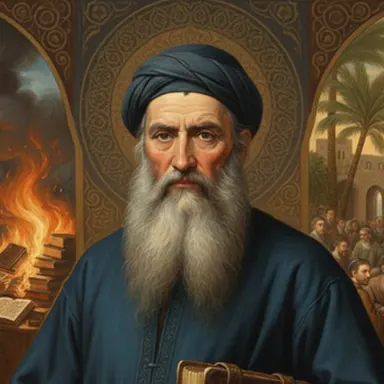
Rabbi Yechiel of Paris
14 min read2,847 words
Summary
The work surveys the life and activity of Rabbi Yechiel of Paris, one of the prominent spiritual leaders of French Jewry in the 13th century, focusing on his confrontation with religious persecution and on the rebuilding of the world of Torah. The first part of the text is devoted to the Paris trial (1240), in which Rabbi Yechiel defended the Talmud against the accusations of the Church by developing an innovative halakhic and theological line of defense that distinguished between the ancient idolaters and the Christians of his own day. Next, the article describes the acute crisis that followed the burning of the Talmud and Rabbi Yechiel's formative decision to emigrate to the Land of Israel. Finally, it explains how he re-established his yeshiva in Acre, known as "Midrash ha-Gadol de-Parish," and thereby laid the foundations for the institution of emissaries (shadarut) and for the economic and spiritual connection between the diaspora and the Jewish community in the Land.
The Work, Torah Teaching and Historical Influence of Rabbi Yechiel of Paris
The Institutional and Social Background in Thirteenth-Century France
During the first half of the thirteenth century, the Torah center in northern France faced one of the most decisive and difficult crises in its history. At the head of the spiritual and public leadership at that time stood Rabbi Yechiel of Paris Rabbi Yechiel of Paris , one of the great Tosafists and one of the heads of the central yeshiva in the capital of France.[1, 2] The work of Rabbi Yechiel of Paris Rabbi Yechiel of Paris extends over two different geographical and historical arenas: the first is Catholic France, where he waged the struggle in defense of the Oral Torah at the famous "Paris trial" in 1240 [2, 3]; and the second is the Land of Israel, to which he emigrated at a later stage of his life in order to rebuild the world of Torah that had been destroyed, re-creating the French institution of the yeshiva on the soil of Acre.[1, 4]
The figure of Rabbi Yechiel of Paris combines the brilliant scholarship characteristic of the school of the Tosafists, the capacity of a leader to stand firm against hostile authorities, and an exceptional ability for theological adaptation in situations of duress. An examination of his work and teaching tells us not only about his personal and communal confrontation with the decrees of the hour, but also about the broad historical transition of Western European Jewry from a stage of institutional flourishing and relatively stable relations with the Christian environment to a stage of institutionalized persecution and a profound change in the mutual view of the two religions.[3]
The Paris Trial (1240): Background, Dynamics and Theological Struggle
The Historical Background and the Intensification of Ecclesiastical Hostility
The first half of the thirteenth century was marked by a sharp change of direction on the part of the Catholic Church toward the Jewish minority. The Fourth Lateran Council (1215) set a hard line that included restrictions on the employment of Jews in public offices and the obligation to wear a special identifying garment: a badge in red and white.[3] Alongside this, the rise of the mendicant orders (the Franciscans and the Dominicans) led to an intensification of religious preaching and to an uncompromising war against what the Church defined as "heresy."[3]
As part of this process, Christian scholars, relying on information supplied by Jewish converts, began to examine the literature of the Talmud and the baraita.[3] The Christian interest in the Talmud stemmed from the understanding that whereas the Christian tradition respects the Hebrew Bible (and so the Jews could not be judged on its basis), the Talmud represents an internal religious work containing, so they claimed, views contrary to the Bible, words of heresy, the attribution of corporeality to God, and a hostile and degrading attitude toward Christianity and its founders.[3]
The Initiative of Nicholas Donin and the Intervention of the Pope
The direct crisis with which Rabbi Yechiel of Paris had to contend was initiated by his former student, the convert Nicholas Donin.[2, 3] In 1225 Donin was excommunicated by Rabbi Yechiel because of his denial of the Oral Torah.[2, 3] Eleven years later, in 1236, Donin sent a letter to Pope Gregory IX in which he gathered severe accusations against the Talmud.[3] Following this appeal, in 1239 the pope issued an order to confiscate the books of the Jews and hand them over for examination.[2, 3] While most of the rulers of Europe ignored this directive, the king of France, Louis IX, agreed to cooperate, but made the confiscation of the books conditional on allowing the Jewish representatives to defend their position.[2, 3]
The Composition of the Tribunal and the Participants in the Disputation
The trial, called in the Jewish sources "the Disputation of Paris" or "the Disputation of Rabbeinu Yechiel of Paris," was held in the king's palace in Paris in June 1240 (beginning on 12 June, or according to other sources on 25–27 June).[3] The legal dynamics were tilted against the Jews from the outset, as the panel of judges was composed of Christian clergy with hard-line positions, headed by Queen Blanche of Castile, alongside the bishops of Paris and Sens, the inquisitor of Cologne, the head of the University of Paris and Nicholas Donin himself.[3] A delegation of four of the sages of the generation, headed by Rabbi Yechiel of Paris, stood up in defense of the Talmud.[2, 3]
The Legal Line of Defense and the Conceptual Turn Regarding Christians
During the trial Rabbi Yechiel of Paris was required to answer complex accusations presented by Donin, which were based on Talmudic quotations that ostensibly indicated permission to deceive, rob and kill gentiles (such as the saying "the best of the gentiles, kill"), as well as expressions speaking harshly of Jesus.[3] In view of the limits on freedom of expression and the real threat to the existence of the books and of the community, Rabbi Yechiel developed a sophisticated and multidimensional line of defense, whose main points are presented in the following table:
1. The Halakhic Distinction Between "Gentiles" and Christians
One of Rabbi Yechiel's central and most influential arguments was the distinction between the "gentiles" or "Cutheans" mentioned in the Talmud and the Christians living in the Europe of his day.[3] Rabbi Yechiel argued that the negative laws and the prohibitions of contact laid down in the Talmud were directed solely at the ancient worshippers of stars and constellations, who were not bound by the ways of morality and religion.[3] As practical proof of this, he pointed to the daily conduct of the Jews, who trade with the Christians even on their festivals, are alone with them, and even teach them Torah.[3] This argument was not merely a momentary defense, but reflected a social and halakhic reality that was steadily developing among the Jewry of Ashkenaz and France.
2. The Conception of the Salvation of the Gentile and the Christian
As part of the discussion of the spiritual fate of non-Jews, Rabbi Yechiel presented a well-founded theological position according to which the gates of heaven are not locked before the Christians.[3] He stressed that according to Jewish thought, every descendant of Noah, including the Christians, who observes the seven Noahide commandments merits a share in the World to Come and salvation.[3] The presentation of this position was intended to refute the claim that Judaism holds a conception of spiritual superiority that denies the humanity and the salvation of the religious other.[3]
3. The Question of the Identity of "Yeshu" in the Talmud
In order to neutralize the gravest accusation, the insult and disgrace of the founder of Christianity, Rabbi Yechiel adopted a historiographical-chronological argument.[3] He argued that the figure of "Yeshu" mentioned negatively in some passages of the Talmud is not the Christian Jesus sacred to Christians, but another figure with the same name, who lived several generations earlier and was a disciple of Yehoshua ben Perachya.[3] This distinction made it possible to separate the Christian religious narrative from the internal polemical passages of the Sages in the Second Temple period.
Physical and Spiritual Destruction: The Burning of the Talmud and Its Consequences
Despite the impressive defensive efforts of Rabbi Yechiel and his colleagues, the outcome of the trial was known in advance. The Christian panel of judges found the Talmud guilty and condemned it to destruction.[3] Numerous attempts at intercession by the Jewish community to prevent the decree failed.[3] In 1242 (or 1244 according to some sources), all the volumes of the Talmud and the manuscripts that had been confiscated from the study halls were gathered and burned in the city square of Paris over two consecutive days.[2, 3] According to the testimony of the Maharam of Rothenburg, who was an eyewitness to the event and even composed the famous lament about it, "Sha'ali Serufa ba-Esh" ("Ask, O you who were burned in fire"), 24 wagons laden with precious manuscripts of the Babylonian and Jerusalem Talmud were burned on that occasion.[3]
The consequences of the Paris trial and the burning of the Talmud reverberated far beyond the borders of France of that time, and marked a profound historical transformation along several axes:
- A change in Church policy: for the first time in history, the Church departed from the traditional Augustinian doctrine, which recognized the right of the Jews to physical and religious existence as witnesses to the truth of Scripture.[3] The Church's direct intervention in the internal content of Jewish faith and in the literature of the Oral Torah constituted a dangerous precedent that prepared the ground for the persecutions that followed.[3]
- The intensification of institutionalized antisemitism: the destruction of the books created a wide public resonance and heightened antisemitic agitation in Western Europe in the late Middle Ages, presenting the Jewish religion as a religion corrupt and heretical at its root.[3]
The development of a formal religious tolerance on the Jewish side: many scholars, foremost among them the historian Jacob Katz, point out that the need to defend Jewish existence in this public confrontation forced the sages to formulate and shape more tolerant and complex views of Christianity.[3] This tendency, which began as an apologetic defense at the trial of Rabbi Yechiel, was internalized over the years and became a systematic halakhic position, which found its full expression some fifty years later in the writings of Rabbi Menachem HaMeiri, who defined the Christians as "nations bound by the ways of religions."[3] The trial therefore represents a double turning point: a transition of the Church from relative tolerance to persecution, and on the other side, a push of Jewish halakha toward the formation of a view of religious tolerance.[3]
Documentation and commemoration: the course of the disputation and the arguments raised in it were collected and committed to writing, and in 1873 they were published in the city of Thorn under the title "Vikuach Rabbeinu Yechiel mi-Paris" ("The Disputation of Rabbeinu Yechiel of Paris").[5] This work became a foundational text for understanding the Jewish-Christian polemic in the Middle Ages.
The Enterprise of Rebuilding in the Land of Israel and the Yeshiva of Acre
The burning of the Talmud in Paris dealt a mortal blow to the French Torah center.[3] The absence of the fundamental books made it difficult for the enterprise of the Tosafot and the traditional method of study to continue. Rabbi Yechiel's response to this crisis was not surrender or despair, but a turn toward a course of rebuilding by moving the spiritual center of gravity to the Land of Israel.[1, 4]
The Wave of Immigration of the Tosafists and the Messianic Motive
In 1258 (according to scholars' estimates), Rabbi Yechiel decided to leave France and emigrate to the Land of Israel together with his household and his disciples.[1] This immigration was not an isolated event, but part of a broader movement of activity and immigration on the part of the Torah sages in France and Spain.[1, 6] The immigrants were driven not only by the persecutions in Europe, but also by a deep belief that the settlement of the Land of Israel and the restoration of Torah in it would bring the redemption nearer and hasten the coming of the Messiah.[1]
Historical and Torah scholarship points to an internal complexity in the terminology of the waves of immigration. Although the waves of immigration of the thirteenth century were collectively called "the immigration of the Tosafists," from a precise historical standpoint some of their leaders were not formally counted among this school.[1, 6] Thus, for example, Rabbi Yehonatan of Lunel, one of the key figures of the early immigration, is not considered part of the Tosafists.[6] These ties are well documented in the responsa literature, as can be seen in the practical halakhic responsa that Rabbi Yitzchak ben Avraham (the Ritzba) sent to Rabbi Yehonatan of Lunel upon his immigration, which appear in the book Or Zarua, part 1 (sections 251 and 352).[6] This documentation sheds light on the complex halakhic infrastructure that accompanied the enterprise of immigration and rebuilding, and that directly influenced the later decision of Rabbi Yechiel of Paris to follow a similar path.[1, 6]
The Founding of the Yeshiva of Acre: "Midrash ha-Gadol de-Parish"
Upon his arrival in the Land of Israel, Rabbi Yechiel settled in the port city of Acre, which was at that time the political and economic center of the second Crusader Kingdom of Jerusalem. In Acre Rabbi Yechiel re-established his yeshiva, which earned the fascinating historical name "Midrash ha-Gadol de-Parish" (the Great Midrash of Paris).[4]
The name of the yeshiva carries a deep symbolic and historical significance:
- Preservation of the tradition: the choice to keep the name "Paris" on the soil of Acre expressed the aspiration to be a direct continuation of the glorious Torah center that had been destroyed in France, and to preserve the distinctive method of study of the Tosafists.[4]
- The number of students: the historical sources state that the yeshiva numbered some 300 students.[4] Although some scholars tend to see this number as an exaggeration, considering that the Jewish community in Acre at that time was very small and too limited to contain a learning community of such size, the very use of this number attests to the enormous reputation of the yeshiva and to its being a magnet for students from all over the Jewish world.[4]
The Economic Challenge and the Institution of the Emissaries
Maintaining a large yeshiva in the Land of Israel confronted Rabbi Yechiel with enormous economic challenges. The poor local community could not bear the burden of supporting tens and hundreds of students. In order to solve this hardship, Rabbi Yechiel developed one of the most important instruments for the existence of the Jewish community in the Land of Israel throughout the generations: the institution of the public mission of emissaries (shadarut).[4]
Rabbi Yechiel sent one of his close disciples and members of his circle, Rabbi Yaakov (called in some sources "Rabbi Yaakov ha-Nazir"), as an emissary (shadar) from the Land of Israel back to the communities of the diaspora in Europe.[4] Rabbi Yaakov's task was to travel among the communities, to stir hearts on behalf of the fate of the Land of Israel, and to raise funds and designated donations for financing and maintaining the yeshiva "Midrash ha-Gadol de-Parish" in Acre.[4] This early enterprise of emissaries laid the foundations for the two-way network of economic support that connected the communities in the diaspora with the spiritual center in the Land of Israel.[4]
Summary and Conclusions
The work and Torah teaching of Rabbi Yechiel of Paris sketch the figure of a spiritual leader who knew how to act within a narrow room for maneuver under conditions of extreme pressure, while preserving a halakhic and conceptual backbone. His standing at the head of the Jewish delegation at the Paris trial in 1240 is a model of wise apologetic defense, which paved the way for a profound conceptual change in the attitude of halakha toward the Christian world and its moral definition.[3]
When his Torah world in France collapsed with the burning of the Talmud, Rabbi Yechiel demonstrated an exceptional capacity for renewal.[3] The transfer of the yeshiva to Acre, the revival of Torah study in the Land of Israel under the name "Midrash ha-Gadol de-Parish," and the laying of the foundations for the institution of the emissaries highlight his understanding that the survival of the tradition depends on the ability to move the geographical centers of gravity and to build sustainable communal and economic institutions.[4] The legacy of Rabbi Yechiel of Paris remains engraved in the annals of the people of Israel as a bridge between the destruction of the Torah center in Europe and the beginning of its renewed growth in the Land of Israel.
Sources6
- 1.עליית בעלי התוספות - ויקיפדיה, he.wikipedia.org/wiki/עליית_בעלי_התוספות
- 2.יחיאל מפריז - ויקיפדיה, he.wikipedia.org/wiki/יחיאל_מפריז
- 3.משפט פריז – ויקיפדיה, he.wikipedia.org/wiki/משפט_פריז
- 4.יעקב (שליח יחיאל מפריז) – ויקיפדיה, he.wikipedia.org/wiki/יעקב_(שליח_יחיאל_מפריז)
- 5.Yechiel of Paris - Wikipedia, en.wikipedia.org/wiki/Yechiel_of_Paris
- 6.פרק 72 • עליית שלוש מאות הרבנים • בעלי התוספות בארץ ישראל - קדמא Kedma, kedma.xyz/2025/07/72.html