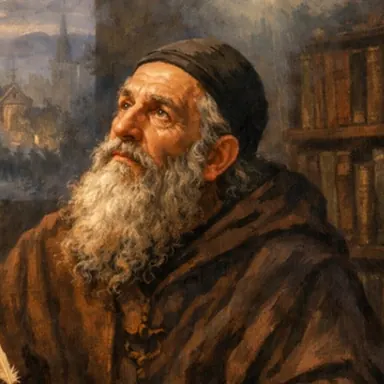
The Spiritual World, Work and Torah Teaching of the Ritzba: Rabbeinu Yitzchak ben Avraham of Sens and Dampierre
14 min read2,720 words
Summary
This text surveys the many-sided figure of the Ritzba, one of the Tosafists of twelfth-century France, presenting him as a vital link between different traditions of study and between diverse worlds of content. The survey stresses his distinguished family lineage and his ties with the great figures of the generation, such as Ri the Elder and Rabbeinu Tam, which paved his way to leading the yeshiva at Dampierre and to a decisive influence on the shaping of the printed Tosafot. Beyond his talmudic and halakhic contribution, the article highlights his exceptional openness of mind, expressed in his admiration for Maimonides and in a unique combination of talmudic rationalism with mystical visions and esoteric teaching. In sum, the text portrays him as a spiritual leader who raised leading disciples and left a legacy of intellectual harmony, uniting the revealed and the concealed and the centers of Torah in France and in Spain.
The Torah of the Tosafists in the twelfth and thirteenth centuries constitutes one of the most formative and dramatic chapters in the history of Jewish thought. At the center of this vibrant world, marked by sharp dialectic, intellectual openness and total commitment to tradition, stands the many-sided figure of Rabbeinu Yitzchak ben Avraham, known by the acronym Ritzba.[1] The Ritzba, who was given various epithets such as "Ri the Young" (Ri HaBachur), "Ri of Dampierre" and "Ri of Tranel," was not only a scholar of the first rank but a bridging figure who connected the founding generation of the Tosafists with the teachings of the sages of Spain, and the pure logic of the study hall with the worlds of mysticism and vision.[1, 2] His figure reflects the zenith of northern French Jewry, a period in which the Babylonian Talmud became a living laboratory of thought and halakhic ruling, while confronting internal and external challenges alike.
Genealogical Roots and the Formation of Torah Leadership
The spiritual growth of the Ritzba cannot be separated from the family and social context in which he grew up. He was born in France into a family deeply rooted in the intellectual leadership of the generation.[1] His father, Rabbi Avraham the Pious of Sens, was described as a well-known benefactor and a man of virtue, a figure who joined the material world to the spiritual world in Sens.[1] The Ritzba's lineage ties him directly to the golden dynasty of the sages of France: his grandfather (or his father's father-in-law) was Rabbi Shimshon the Elder of Plaisance, who was not only one of the great Tosafists but also the brother-in-law of Rabbeinu Tam, the grandson of Rashi.[1] This family connection gave the Ritzba direct access to the interpretive and halakhic traditions of Rashi and his descendants, and laid the foundations of his self-confidence within the talmudic maze.
In his youth, the Ritzba was sent to study in Troyes, in the study hall of Rabbeinu Tam, who was for him not only a great-uncle but the great teacher who shaped the first generation of the Tosafists.[1] There the Ritzba was first exposed to the method of pilpul and critical analysis, which strives to resolve contradictions between different talmudic passages by drawing fine conceptual distinctions. After the death of Rabbeinu Tam, the Ritzba moved to the yeshiva of his principal teacher, Ri the Elder (Rabbeinu Yitzchak ben Shmuel of Dampierre), who was regarded as the spiritual heir of Rabbeinu Tam and the principal shaper of the Tosafist method as we know it today.[1, 2] The bond between the Ritzba and Ri the Elder was so deep that the Ritzba was called "Ri the Young" to distinguish him from his teacher, and later even succeeded him as head of the yeshiva at Dampierre.[1, 2]
The dynamics within the Ritzba's own family were a critical component of his work. His younger brother was Rabbi Shimshon of Sens (the Rash), a formidable figure in his own right, known for his commentaries on the Mishnah and for his uncompromising rulings.[1] The relationship between the two brothers was marked by deep mutual esteem and constant Torah dialogue; the Ritzba even took upon himself the task of editing and summarizing his brother's commentaries, as attested by the work "Abridgment of the Tosafot of Sens" on tractate Bekhorot.[1] This collaboration created a strong intellectual axis between Dampierre and Sens, an axis that influenced the entire generation.
The Structure of the Ritzba's Family and Educational Ties
Study Methodology: Between Tradition and Innovation
The Ritzba's method of study represents the maturity of the Tosafist movement. Unlike the sages of his generation, who at times tended to defer to the formidable authority of Ri the Elder, the Ritzba displayed marked intellectual independence.[1] He did not hesitate to disagree with his principal teacher and to propose alternative explanations for the most complex passages, combining phenomenal erudition with exposure to sources that were not always the common possession of France.[1] Clear evidence of this is his own statement, in which he noted that he had examined the entire Jerusalem Talmud in order to reach a particular halakhic or interpretive conclusion.[1] The intensive use of the Jerusalem Talmud alongside the Babylonian characterized the later sages of France and served as a powerful tool for broadening the halakhic horizon.
The Ritzba's literary contribution is scattered throughout the Talmud, but it forms the skeleton on which the later collections of Tosafot were built. He wrote Tosafot on many tractates, among them Eruvin, Yoma, Moed Katan, Yevamot, Ketubot, Kiddushin, Nedarim, Bava Kamma and Zevachim.[2] These Tosafot, characterized by brevity and relative clarity in contrast to the convoluted give-and-take of Ri the Elder, served as the main raw material for Rabbi Eliezer of Touques, the editor of the "Tosafot" as they are printed today on the pages of our Gemara.[1] Hence the Ritzba's influence is not merely historical; it is present every day in every study hall where the Talmud is studied.
Beyond editing the Tosafot, the Ritzba engaged extensively in halakhic ruling and in practical matters. He composed a detailed work on the laws of the night of Passover, wrote many halakhic responsa (She'elot u-Teshuvot) that were cited at length by the later authorities, and even engaged in Jewish astronomy and mathematics.[1] His work "Luah Sa-Rashim" ("Table of Sixty-One Heads") was intended for calculating the fixing of the years in the Hebrew calendar over a cycle of 19 years, an essential tool for managing communal life at that time.[1] There is also strong evidence that he wrote a commentary on the Torah, since his words in this field are frequently quoted in the commentaries of the sages of France on Scripture.[1, 2]
The Maimonidean Controversy: The Ritzba as Cultural Mediator
One of the formative moments in Jewish history in which the Ritzba was required to display his leadership was the first "Maimonidean controversy" at the beginning of the thirteenth century. The controversy broke out when Rabbi Meir HaLevi Abulafia (the Ramah) of Toledo sent letters to the sages of France asking them to join his criticism of Maimonides' words in the "Book of Knowledge" (Sefer HaMadda) on the subject of the resurrection of the dead.[1] While many of the sages of France, including his brother the Rash of Sens, tended to criticize Maimonides for deviating from the tradition accepted in Ashkenaz, the Ritzba took a unique and fascinating position of respect and admiration.[1]
According to the testimony of Nahmanides (Ramban, who was a disciple of the Ritzba's disciple), the Ritzba referred to Maimonides' books with the expression "he finds blessing in them."[1] He saw Maimonides as "a great lion" and greatly appreciated his clear style and his halakhic power. Instead of joining the bans or the sharp criticism, the Ritzba used Maimonides' words as legitimate evidence in his own rulings, especially on subjects connected with the commandments dependent on the Land.[1] This stance of the Ritzba attests to his breadth of vision and to his ability to recognize the greatness of sages even when their method differs fundamentally from his own. The Ritzba served as a kind of spiritual bridge that allowed Maimonides' teaching to penetrate the centers of Torah in France and Ashkenaz, thereby contributing to the unity of the Torah world in a period of deep divisions.[1, 3]
The Positions of the Ritzba Compared with the Rash in the Maimonidean Controversy
The Mysticism of the Ritzba: Visions and the Revelation of Secrets
The figure of the Ritzba is not complete without reference to the mystical and transcendent side of his personality. In many respects, the Ritzba represents the close connection that at times existed between the Tosafists of France and the mystical movement of the Pietists of Ashkenaz (Rabbi Yehuda HeChasid and his circle) in Germany.[2] Contemporary sources describe the Ritzba as a "visionary" (Visionary), a man who experienced extraordinary spiritual experiences and was versed in esoteric teaching.[2]
The Ritzba's disciple, Rabbi Elhanan ben Yakar of London, wrote a commentary on the "Book of Creation" (Sefer Yetzirah) that was based on a series of lectures the Ritzba gave on the subject.[2, 4] This fact shows that in the study hall at Dampierre not only issues of damages and sacred things were studied, but also the secrets of creation, matters of the Account of the Chariot (Ma'aseh Merkavah) and the Measure of the Divine Stature (Shi'ur Komah).[2] Dramatic evidence of this is found in the descriptions of the Ritzba's "ascents to heaven" and of his hearing a voice speak to him from within a cloud, like Moses our teacher.[2] Great sages of his generation, among them Rabbi Elazar of Worms (author of the "Rokeach"), attested to the truth of his visions and saw in them proof of his supreme holiness.[2]
This combination of sharp rational scholarship with an inclination to prophecy and vision is fascinating. It shows that the Ritzba saw no contradiction between talmudic inquiry and direct religious experience. For him, the Torah was a single entity that includes within it the revealed and the concealed, and pilpul on a passage was a way of drawing near to the Divine no less than prayer or engagement with the secrets of creation.[2]
Prominent Halakhic Rulings and Pietistic Practices
The Ritzba's Torah was marked by a striving for uncompromising halakhic truth, together with scrupulous personal piety. His immense erudition enabled him to decide complex questions that occupied his generation. A prominent example is his position on relying on physicians. While some of the sages of his generation hesitated to place full trust in the medical knowledge of their time, the Ritzba tended to accept the words of physicians as "certain reliance" in matters of danger to life, a position later cited in the work "Or Zarua" and in other books of halakhic ruling.[5]
The Ritzba's personal practices also became a source of inspiration. It is told of him that he would rise every day before dawn to engage in Torah, conducting himself with asceticism and piety.[1] He was a co-signatory of the enactments of the sages of Ashkenaz, those communal enactments intended to protect the social and moral structure of the Jewish community in medieval Europe.[1]
An interesting episode concerning his conduct took place precisely at the moment of his death. A question arose among the sages whether to bury him in a tallit with tzitzit, a custom that was disputed between the sages of France and of Ashkenaz at that time.[1] Rabbi Tuvia, one of the sages of the generation, ruled that he should be buried with tzitzit. The dispute was resolved when one of his disciples testified that the Ritzba had once said in his lesson: "Would that I knew the day of my death, and I would command that I be buried in a tallit with tzitzit as prescribed by halakha."[1] This testimony was accepted as a spiritual will, and the burial was carried out as he requested, which later became an accepted custom in many communities.
The Ritzba's Disciples: Cross-Continental Influence
The success of a Torah leader is often measured by his ability to raise disciples who will continue and develop his teaching. In this sense, the Ritzba was one of the most prolific teachers of his period. His disciples formed the spearhead of the Torah world in Europe in the thirteenth century, and they spread the Torah of Dampierre in every direction.
The most important of his disciples was Rabbi Yehuda bar Yakar, who later became the principal teacher of Nahmanides in Girona, Spain.[1] Through this channel, the Torah of the Ritzba and the Torah of the Tosafot in general passed to the Torah centers of Spain, and deeply influenced the synthesizing style of Nahmanides. Another prominent disciple was Rabbi Yechiel of Paris, the great head of the yeshiva who defended the Talmud in the famous Paris disputation in 1240.[1] Other figures such as Rabbeinu Baruch, author of Sefer HaTerumah, the brothers of Évreux and Rabbi Moses of London, attest that the Ritzba's yeshiva was the intellectual center to which seekers of Torah flocked from France, England and Germany.[1]
List of the Ritzba's Prominent Disciples and Their Influence
The Question of Historical Identification and His Death in Sanctification of the Name
One of the challenges in studying the figure of the Ritzba is distinguishing him from other sages with similar names who were active in the same period. At times he is confused with Rabbi Yitzchak ben Asher HaLevi (the first Riva), a disciple of Rashi who lived generations earlier, or with the Riva's grandson, Rabbi Yitzchak ben Asher the Second, who was murdered in sanctification of the Name in Speyer in 1196 following a blood libel.[6, 7] While the second Riva was indeed killed in sanctification of the Name, the Ritzba (Rabbi Yitzchak ben Avraham) apparently died at a good old age in his community in Dampierre, around the years 1199-1210.[1, 2]
Nevertheless, the Ritzba's period was saturated with persecution and hardship for the Jews of France. Many sages of his generation experienced the terrors of the Crusades and the hostility of the Church, which deepened the inclination to piety and to sanctification of the Name within his circle. The figure of the Ritzba remains a symbol of firm standing and holiness within a changing world.[2] The fact that great figures such as Rabbeinu Shimshon and Rabbi Tuvia came to pay him honor at his death attests to his undisputed standing as the foremost of the sages of his generation.[1]
His Legacy and the Significance of His Work for Generations
From a historical perspective, the Ritzba constitutes the "missing link" that joined the early dynamism of the Tosafists with the organized halakhic and kabbalistic structure of later generations. His Torah teaching was not merely a collection of commentaries and rulings but a comprehensive worldview seeking to find harmony between different sources: the Jerusalem and the Babylonian, France and Spain, the revealed and the concealed.[1, 2]
His ability to embrace Maimonides on the one hand, and to engage in mystical visions on the other, attests to a broad-minded personality that did not surrender to narrow sectarian dictates. For the modern student, the Ritzba is present on every page of the Gemara through the Tosafot that he edited and that his disciples sharpened in his method. He remains an exemplary figure of a scholar who combines intellectual sharpness with deep piety, a man who lived within the dialectics of Abaye and Rava, yet whose eyes were always turned toward the secrets of the Chariot.[2]
The legacy of the Ritzba is testimony to the vitality of French Jewry in the twelfth century, a period that, despite physical and political hardships, managed to raise giants of the spirit who shaped the face of Judaism to this day. His figure reminds us that the Torah is not merely a text for analysis but a space of holiness, inquiry and public responsibility, in which every halakhic detail is part of a much larger, spiritual picture.
Sources7
- 1.ריצב"א – ויקיפדיה, he.wikipedia.org/wiki/ריצב"א
- 2.Isaac ben Abraham of Dampierre - Wikipedia, en.wikipedia.org/wiki/Isaac_ben_Abraham_of_Dampierre
- 3.פולמוס הרמב"ם - ויקיפדיה, he.wikipedia.org/wiki/פולמוס_הרמב"ם
- 4.אלחנן בן יצחק - ויקיפדיה, he.wikipedia.org/wiki/אלחנן_בן_יצחק
- 5.אור המשפט - Gov.il, gov.il/BlobFolder/legalinfo/orhamishpat1/he/אור המשפט - הלכה ורפואה מתוקן.pdf
- 6.Disambiguations of Rishonim - Halachipedia, halachipedia.com/index.php?title=Disambiguations_of_Rishonim
- 7.יצחק בן אשר הלוי - ויקיפדיה, he.wikipedia.org/wiki/יצחק_בן_אשר_הלוי