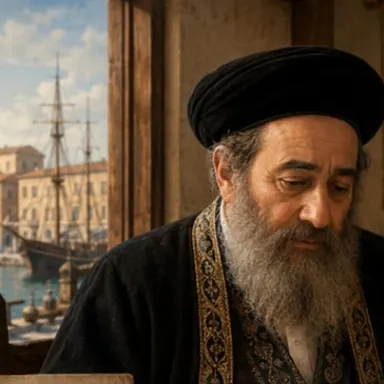
Rabbi Yehuda Coriat: A Bridge Between the Tradition of the Maghreb and Modern Thought
11 min read2,101 words
Summary
This text is a historical-biographical essay on Rabbi Yehuda Coriat, an outstanding 19th-century Moroccan Kabbalist whose activity became an intellectual bridge between the mystical traditions of North Africa and European modernity in Italy. The author describes in detail his principal work, "Maor va-Shemesh," which served as a unique synthesis of various Kabbalistic schools and made it possible to rescue rare medieval manuscripts from oblivion. Particular attention is paid to the continuity of generations, in particular to Coriat's role as the mentor of his nephew Eliyahu Benamozegh, who turned traditional Kabbalah into a universal philosophical system. The text stresses that Coriat's legacy revolutionized the understanding of the Oral Torah, establishing it as the metaphysical foundation of the Jewish faith, open to dialogue with world thought.
The Work and Torah Teaching of the Kabbalist Rabbi Yehuda Coriat: A Bridge Between the Tradition of the Maghreb and Modern Thought
Biographical Horizon, Lineage and the Geographical-Historical Context
Rabbi Yehuda Coriat (who sometimes appears in the sources as Curiat) represents a key figure in the cultural and spiritual transition of North African Jewry to the Torah centers of Italy during the 19th century.[1, 2] He was born in Morocco to a large and distinguished family of sages, deeply rooted in the halakhic and Kabbalistic tradition of the Jewry of the Maghreb. His father was Rabbi Avraham, and his illustrious family lineage reaches, on his mother's side, to his grandfather, one of the greatest sages of Fez and of all Morocco, Rabbi Yehuda ben Attar the First.[1, 2] This lineage gave him not only high social standing and authority, but also access to rare manuscripts and to oral Kabbalistic traditions that had passed from generation to generation within the leading ben Attar family.[1]
Rabbi Yehuda Coriat's Torah activity extended over two different geographical and cultural centers: his native land, Morocco, and the center of his later activity in Livorno (Leghorn) in Italy.[1, 2] This Italian port city served at that time as a cosmopolitan crossroads and a safe haven for Jews of Spanish and North African origin, and it excelled in developed Hebrew printing houses that made possible the dissemination of Torah manuscripts that had not previously seen the light. This geographical movement of Rabbi Yehuda Coriat is not accidental; it reflects a broader trend of migration of a spiritual elite from North Africa to Italy, which carried with it the esoteric treasures of the Kabbalah of the Maghreb and brought them into contact with the intellectual horizons of modern Europe.
The family and spiritual legacy of Rabbi Yehuda Coriat continued to strike deep roots even after his death, which took place on 17 Adar II and led to his burial in the historic Jewish cemetery of Livorno, located on Viale Ippolito Nievo.[2] This continuity found expression in two parallel paths: his sons, Rabbi Avraham Coriat (author of the book "Brit Avot") and Rabbi Yitzchak Coriat (author of the book "Ma'aseh Rokem"), continued the family's line of halakhic and homiletic writing [2], while the son of his sister Clara (who married Rabbi Avraham Benamozegh) and his foremost disciple, Rabbi Eliyahu Benamozegh, became one of the most important philosophers and Kabbalists of Italian Jewry in the modern era.[2, 3, 4]
The Literary Work "Maor va-Shemesh" as a Synthetic Enterprise and the Rescue of Manuscripts
Rabbi Yehuda Coriat's splendid work, the book "Maor va-Shemesh" ("Light and Sun"), was printed in a first and only edition in Livorno in 5599 (1839).[1, 5] Bibliographically and culturally, this book is clear testimony to the efforts to preserve the knowledge of the sages of Spain and Morocco. The work does not present a one-dimensional Kabbalistic doctrine, but is built as a sophisticated synthetic enterprise that combines and balances four principal Kabbalistic and exegetical schools [1]:
- The Kabbalah of Nahmanides (Rabbi Moshe ben Nachman), representing the early Spanish Kabbalistic school, conservative and closely tied to the biblical text.[1]
- The Kabbalah of the Ari (Rabbi Yitzchak Luria), presenting a dynamic and complex cosmological system of partzufim, sefirot and cosmic tikkunim.[1]
- The teaching of the Kabbalist Rabbi Avraham HaLevi, which serves as a hermeneutic mediating link between the generations of Kabbalists.[1]
- The teaching and traditions of Rabbi Yehuda ben Attar, which express the practical and local application of the esoteric wisdom as it developed among the Spanish exiles in Fez.[1]
The scholarly value of the book rises dramatically thanks to the incorporation of an "ancient Spanish manuscript" within the body of the work.[1] The rescue of this manuscript, which probably originated in the period before the expulsion from Spain and survived in the private libraries of the sages of Morocco, illustrates Rabbi Yehuda Coriat's role as an archivist and preserver of the classical esoteric teaching. Instead of allowing these texts to disappear in the vicissitudes of time, he chose to incorporate them into his work, and thereby to give them a modern garb and accessibility to the public of learners in Europe.
The following fascinating finding testifies to Rabbi Yehuda Coriat's extraordinary spiritual standing in North Africa: the book is adorned with a rare approbation by Rabbi Chaim Pinto the First, one of the great Kabbalists and tzaddikim of Moroccan Jewry.[1] The importance of this approbation is heightened in light of the historical fact that throughout his long and esteemed life, only one other approbation that Rabbi Chaim Pinto gave to a Torah work is known.[1] Rabbi Chaim Pinto's unequivocal support for "Maor va-Shemesh" testifies to the broad and deep recognition of Rabbi Yehuda Coriat's doctrinal authority and of the necessity of the work.[1]
The Transmission of the Esoteric Teaching to Rabbi Eliyahu Benamozegh and Its Metaphysical Influence
The most important historical channel through which Rabbi Yehuda Coriat influenced modern Jewish thought was his disciple and nephew, Rabbi Eliyahu Benamozegh (the Ra'aba).[2, 4] Benamozegh, who was orphaned of his father at a young age in Livorno, found in Rabbi Yehuda Coriat not only a supportive uncle but above all a spiritual father and a foremost guide.[2, 4] This close bond enabled Benamozegh to receive the "secret doctrine" authentically and directly from the mouth of a Kabbalist connected by a direct chain of transmission to the great sages of Morocco.[4]
As a first and brilliant expression of this spiritual bond, Rabbi Benamozegh, when only 19 years old, composed a rich and wide-ranging introduction in Hebrew and Aramaic to his uncle's book "Maor va-Shemesh."[4] In this introduction, which is his debut text in the world of print, Benamozegh declares with enormous pride that he is a descendant and continuer of a long line of sages and Kabbalists from Morocco.[4] The historical importance of the introduction lies in the fact that it lays the foundations for Benamozegh's entire later life's work, which is based on a defense, at once zealous and scholarly, of the reliability, antiquity and originality of the Kabbalah and the Oral Torah.[3, 7]
Theologically, the Kabbalah that Benamozegh absorbed from Rabbi Yehuda Coriat did not remain with the disciple as an outdated or frozen wisdom, but underwent a fascinating process of development and integration with the currents of thought of the 19th century.[4] Benamozegh developed the doctrine he had received from his uncle in three innovative directions that distinguished him from his predecessors:
First, he created a bold metaphysical bridge between Kabbalah and general philosophy, especially Western philosophy. In his famous work "Spinoza and Kabbalah," Benamozegh demonstrated how Baruch Spinoza's panentheistic conception - according to which the divine is immanent in the world - is nothing but a modern philosophical formulation of ancient Kabbalistic ideas that had proclaimed their dogmas long before Spinoza demonstrated them rationally.[4]
Second, he proposed an extraordinary universal Kabbalistic conception regarding all of humanity. In his writings in French, foremost among them "Israel and Humanity," Benamozegh argued, inspired by the Kabbalistic principles of tikkun, that all the mythologies and religions of the nations of the world must be rectified by means of a unified integration.[3, 6] In his view, the various myths scattered among the seventy nations since the Tower of Babel are nothing but "holy partzufim" and fragments of a single divine truth that were scattered in the world, and the role of Judaism is to help in their reorganization and their cosmic rectification.[6]
Third, Coriat's Kabbalah provided Benamozegh with the tools to carry out a deep and ambivalent comparative analysis of the great monotheistic religions, Christianity and Islam.[3, 4] From a broad Kabbalistic position, he applied a metaphysical distinction between these two religions: according to him, Islam adopted from Judaism mainly the transcendent social and political element, and therefore transferred the desires of this world to the world to come in a material form, whereas Christianity preferred to cleave to the inner religious and metaphysical element but abolished the Torah in a way that led to moral anarchy.[3, 4]
The Conceptual Revolution of the Oral Torah and Kabbalistic Universalism
At the foundation of the intellectual encounter between Rabbi Yehuda Coriat and Rabbi Eliyahu Benamozegh stands a revolutionary redefinition of the concept of the "Oral Torah."[3, 4] Within the framework of defending the truth of the Oral Torah against the winds of Reform and the Haskalah that shook Europe at that time, the two brought about a tremendous upheaval in the conception of the relationship between the two parts of the Torah.[3, 4] Under their thought, the Oral Torah ceased to be a secondary interpretive derivative or a late addition to the Written Torah.[3, 4] On the contrary, they presented it in its full force as the metaphysical and historical source from which the Written Torah was created and without which it has no place or existence.[3, 4]
This conception draws directly on the Kabbalah, which sees the Oral Torah as the aspect of Malkhut and the Shekhinah - the receiving and actualizing vessel that enables the Written Torah (the aspect of Tiferet) to be revealed in the world. Therefore Rabbi Benamozegh worked energetically to give the Kabbalah a status completely equal to the revealed parts of the Torah, such as Scripture and the Talmud, stressing that the edifice of Judaism is flawed and incomplete without the Kabbalah.[7] His method was unique in that it combined absolute fidelity to tradition with a critical methodology based on meticulous examination of diverse historical sources.[7]
The implications of this conceptual revolution find clear expression in Benamozegh's monumental exegetical work, "Em la-Mikra," printed at his own printing house in Livorno in 1862–1863.[3] This bold and original commentary presents a religiously pluralistic Jewish commitment, which tries to address all of humanity out of confidence in the supreme status of the Oral Torah.[3] Rabbi Yehuda Coriat's influence here is decisive: he provided Benamozegh with the traditional anchor and the Torah confidence needed to present such a bold and influential interpretation without fear of excommunication or of compromising his fidelity to halakha.[4, 7]
Summary and Conclusions
An examination of the work and Torah teaching of Rabbi Yehuda Coriat reveals the figure of an extraordinary sage and Kabbalist, whose role in the history of Jewish thought far exceeded the scope of his direct printed works.[1, 4] By writing the synthetic work "Maor va-Shemesh" and incorporating ancient Spanish manuscripts into it, Coriat made an enormous contribution to the preservation and rescue of the esoteric treasures of the Jewry of Spain and Morocco and to making them accessible to the modern public of learners in Italy and throughout Europe.[1, 5]
Moreover, his role as the spiritual teacher and transmitter of the "secret doctrine" to Rabbi Eliyahu Benamozegh gave birth to one of the most fascinating philosophical revolutions of the modern era.[4] The deep-rooted Kabbalistic education that Benamozegh received from his uncle served as a solid foundation on which his universal thought was built, which sought to give the Kabbalah a central place in the edifice of Judaism, to defend the Oral Torah as the source of the Written Torah, and to rectify the world's mythologies into a holy monotheistic unity.[3, 4, 6, 7] Rabbi Yehuda Coriat will remain engraved in Torah memory as a living bridge between the ancient esoteric tradition of North Africa and the modern and universal Jewish philosophy of Europe.[1, 2, 4]
Sources7
- 1.מאור ושמש. מהדורה ראשונה ויחידה, ליוורנו, תקצ"ט [1839] - ווינרס מכירות פומביות, winners-auctions.com/items/מאור-ושמש-מהדורה-ראשונה-ויחידה-ליוורנ/
- 2.רבי יהודה קוריאט - MyTzadik, mytzadik.com/m/tzadik.aspx?id=502
- 3.אליהו בן-אמוזג - ויקיפדיה, he.wikipedia.org/wiki/אליהו_בן-אמוזג
- 4.אליהו בן-אמוזג - הרב הגאון שכנראה לא שמעתם עליו - Q-Israel, q-israel.com/post/אליהו-בן-אמוזג-הרב-הגאון-שכנראה-לא-שמעתם-עליו
- 5.מאור ושמש (PB) [E#152006] - Lulu, lulu.com/shop/publish-your-sefer/%D7%9E%D7%90%D7%95%D7%A8-%D7%95%D7%A9%D7%9E%D7%A9-pb-e152006/paperback/product-1kwjq6q6.html
- 6.המושגים "פרטיקולריות" ו"אוניברסליות" במשנתם של הרב אלי בן אמוזג ושל עמנואל לוינס - מכללת ליפשיץ, lif.ac.il/המושגים-פרטיקולריות-ואוניברסליות-במ/
- 7.המקובל האיטלקי שהרבנים דנו את ספרו לגניזה ושריפה - מקור ראשון, makorrishon.co.il/judaism/article/284562