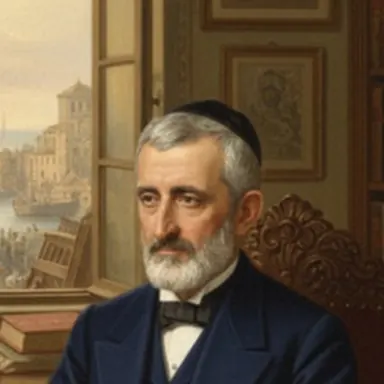
The Work, Torah Teaching, and Philosophy of Scripture and of the Esoteric of Rabbi Eliyahu Benamozegh
13 min read2,600 words
Summary
This text surveys the many-sided figure of Rabbi Eliyahu Benamozegh, a 19th-century Italian thinker who combined the tradition of Israel with Western philosophy and modern research. The article presents his revolutionary conception, which gives primacy to the Oral Torah as a living foundation that constitutes the written text, alongside a vigorous defense of Kabbalah and the promotion of a universal vision of a Noahide religion for all humanity. The author describes the Rabbi's public activity as a printer of books in Livorno and the stormy religious controversy aroused by his bold works, which were burned in certain places because of their combination of biblical criticism and faith. Ultimately, the source seeks to emphasize the relevance of his original teaching as a cultural bridge that offers a unique response to the crises of modernity and secularization.
Introduction: His Life, Family Lineage and the Shaping of His Personality
Rabbi Eliyahu Benamozegh (the Ra'aba), who was active in the 19th century in Livorno, Italy, represents a unique philosophical and theological voice in the landscape of Jewish and halakhic thought.[1, 2] Benamozegh was born in Livorno on 24 April 1823 (13 Iyar 5583) and died in the same city on 6 February 1900 (7 Adar I 5660).[2] His family origins show a fusion of the profound traditions of Maghrebi Jewry with the cultural openness of Italian Jewry; his father, Avraham ben Shem Tov, was a native of Fez in Morocco who remained childless until the age of 70, and married Clara at that age with the consent of his first wife.[2] Benamozegh was born to his father when he was 71.[2] His mother, Clara, was the daughter of the kabbalist judge Rabbi Avraham Raphael Coriat, who was born in Tetouan and was active in Mogador and Livorno.[2]
Eliyahu was orphaned of his mother at the age of four and of his father at the age of five, and was raised by his uncle, the great judge and kabbalist Rabbi Yehuda Coriat, who served as his spiritual father and principal teacher.[2] In his youth Benamozegh was required to engage in commerce, and worked in a local cotton warehouse.[1, 2] He described this period as a kind of spiritual house arrest: he used to hide behind the piles of cotton to read the writings of Baruch Spinoza in secret, or to conceal the books of the Italian Catholic thinker Vincenzo Gioberti under the work counter.[2] Many years later he wrote that at that time he felt imprisoned, and that again and again he set aside the account books in order to take hold of the books of Torah and science.[2]
In the end he abandoned the world of commerce and devoted himself entirely to Torah study and thought.[1] At the age of only 18 he was ordained as a rabbi, and served as head of the rabbinic court and as rabbi of the Livorno community for some fifty years.[1, 2] His general education went considerably beyond what was customary in his generation; he mastered some twenty languages, among them Hebrew, French, Italian, Latin, Arabic, Persian and English.[2] His oral mastery of the Torah sources was combined with expertise in Western philosophy, from the pre-Socratic philosophers to Eduard von Hartmann.[2] Most of his manuscripts, comprising some 40,000 pages, were studied by Rabbi Dr. Eliyahu Rachamim Zini, who had to go through some 10,000 books in order to decipher and explain them.[2]
The Printing Enterprise in Livorno and Its Influence on the World of the Torah Book
In parallel with his spiritual leadership, Benamozegh established in Livorno an independent printing house that served as a center for the dissemination of sacred books by the sages of East and West.[1, 2] This enterprise enabled him to publish his own books, and also to build cultural bridges between the Jewish communities of the Mediterranean basin.[1, 2, 3] The press printed, among others, the books of the sages of Morocco, Aleppo (Aram Tzova), Syria and Baghdad, and thereby contributed to the preservation of the Torah creativity of the lands of Islam.[2]
Besides producing books of halakha, the press served as a platform for printing communal works, sermons and eulogies, such as the eulogy Benamozegh wrote in 1873 on the death of Cesare Castelli (Parole pronunciate nel cimitero israelitico sulla salma di Cesare Castelli), as well as his Italian work on the emissaries of the Holy Land (Le missioni di Terra Santa).[2, 4]
The Revolution of the Oral Torah and the Reversal of Hermeneutical Dependence
In his works devoted to the defense of the Oral Torah, foremost among them "Mavo la-Torah she-be-al Peh" (Introduction to the Oral Torah, based on a series of articles he published in the newspaper "Ha-Levanon") and "Masoret – ve-hi Torah she-be-al Peh" (Tradition, Which Is the Oral Torah, originally published in French under the title De la Tradition), Benamozegh brought about a profound ontological and conceptual revolution.[2, 5] In the prevailing scholarly conception, the Written Torah is perceived as the primary text, while the Oral Torah is defined as a secondary interpretation derived from it.
Benamozegh reversed the direction of hermeneutical dependence.[2] In his view, the oral tradition is itself the primary, living and creative source, while the Written Torah is no more than a partial and limited representation of it.[2] This reversal can be described through the relation between the Written Torah (T
W
) and the Oral Torah (T
O
). Instead of the accepted formula, which assumes that the Oral Torah is derived from the written:
- T
- W
- ⟶T
- O
- Benamozegh posited a reversed equation, according to which the Written Torah draws its validity and its very existence from the broad space of the Oral Torah:
- T
- O
- ⟶T
- W
- orT
- W
- ⊂T
- O
The Oral Torah is not an external commentary or a later addition to the biblical text, but the constitutive foundation without which the Written Torah has no practical or theological meaning at all.[2] Benamozegh was deeply influenced by the European Romantic conceptions of the time, which gave primacy to unwritten folk tradition over dry written documents.[2] This approach served him as a sophisticated apologetic tool against biblical scholars and the Reformers, who tried to undermine the authority of the Sages by means of biblical philology alone.[2]
The Metaphysics of the Infinite and the Apologetic Defense of Kabbalah
Rabbi Benamozegh is considered the foremost defender of the esoteric teaching in the modern era.[1, 2] His defense found expression against two main centers of criticism: the rationalist criticism of Samuel David Luzzatto (Shadal), to which he responded in his book "Ta'am le-Shad" (which uses a play on the letters of Shadal: "a transposition of the name Shadal"), and the earlier criticism of Rabbi Yehuda Aryeh of Modena in the book "Ari Nohem," to which he responded in his work "Eimat Mafgi'a al Ari."[2, 3, 6, 7]
The uniqueness of Benamozegh's defense lies in his epistemological approach: he argued that understanding Kabbalah, like higher mathematics or a work of art, requires a special inner talent and a deep spiritual affinity for the subject.[2] In his view, Modena's rationalist criticism stemmed from a consciousness devoid of sympathy and lacking an appropriate spiritual sense, and not from valid objective arguments.[2] In his book "Ta'am le-Shad," Benamozegh shaped the debate as a hermeneutical dialogue between two figures: "Chofni" (who presents Shadal's objections) and "Pinchas" (who responds and represents the author's view), using the very linguistic and philological tools that Shadal himself employed in order to prove the antiquity of the Zohar.[2]
On this foundation, Benamozegh developed a metaphysical thought that bridges the kabbalistic concept of "Ein Sof" (the Infinite) and modern philosophical thinking.[2] He argued that man's intellectual helplessness is the clearest proof of the existence of the Infinite, since human cognition always senses a limit, a mystery and shadows that testify to the existence of an infinite space beyond them.[2] In his work "Spinoza and the Kabbalah," he sought to prove that Western philosophy and German idealism owe a deep debt to Jewish Kabbalah through the mediation of Spinoza.[2] In his view, while the Kabbalah sings its metaphysical dogmas in symbolic and poetic language, Spinoza tried to demonstrate them in a rational and dry manner.[2]
Cosmic Universalism: Israel, Christianity and Islam
At the center of Benamozegh's late thought stands the aspiration to the unity of humankind, formulated in his monumental book "Israel and Humanity" (in the French original: Israël et Humanité).[2] Benamozegh carefully distinguished between Jewish national distinctiveness (particularism) and global moral obligation (universalism).[2] In his view, while the people of Israel are bound by the 613 commandments by virtue of the covenant of Sinai, the other nations of the world are bound by the seven Noahide commandments.[2] He did not aspire to mass conversion, but to the correction of mythological beliefs and their integration into the universal Noahide religion, and thereby to restore the divine sparks that were scattered among the seventy nations after the crisis of the Tower of Babel.[2, 8]
His book "Jewish Ethics versus Christian Ethics" (published in 1867) rests on a structure of 12 chapters, which maintain the following thematic relation:
Chapters of the work=10
Christianity
+2
Islam
=12
In these chapters Benamozegh presents a comparative and ambivalent analysis of these two religions [2]:
- Christianity: Benamozegh credits it with a historical contribution to the spread of monotheism, but sharply criticizes its ethics.[2] In his view, Christianity clung to the metaphysical and religious side of Judaism while the practical law was abolished by Paul, which led to moral anarchy and to contempt for the body and the material world.[2] Since reality requires political government, there arose in Christianity a dangerous mixture of church and state (religion and politics), which gave birth to predatory phenomena such as the Inquisition.[2]
- Islam: In contrast to Christianity, Islam adopted from Judaism mainly the social and political aspects.[2] Nevertheless, Benamozegh criticizes Islam for transferring the desires of the body and the pleasures of this world to the world to come, and for turning the concept of reward and the resurrection of the dead into a materialistic continuation of the life of the flesh.[2] He summed this up with the statement that Islam preferred the political-social side of Judaism, while Christianity preferred its religious-metaphysical side.[2]
His book "Israel and Humanity" was originally published by his non-Jewish assistant, Aimé Pallière, who edited and completed the book but omitted entire passages of the original manuscript from it.[2] Rabbi Dr. Zini translated the book anew on the basis of the complete manuscripts in order to present Benamozegh's teaching without these omissions.[2]
The "Em la-Mikra" Controversy and the Rabbinic Campaign Around It
Rabbi Benamozegh's central exegetical work, "Em la-Mikra," printed in five volumes in 1862–1863, aroused a wide-ranging religious and rabbinic controversy.[1, 3, 4] The book sought to defend the tradition against biblical criticism by using the findings of modern research, but it included three bold claims that were perceived as problematic in conservative circles [3, 4, 9]:
- The theory of ancient scrolls: Benamozegh agreed with the view that before Moses there existed books or scrolls that recorded the deeds of the patriarchs, and from which some of the stories of the Torah were collected: "We have permitted ourselves to agree with the opinions of those who say that before Moses there were books or scrolls... and from them the stories of the Torah were collected."[9]
- Comparing Kabbalah with Platonic philosophy: Benamozegh pointed to a clear correspondence between the ideas of the Book of the Zohar and the teaching of Plato, and determined that the masters of the esoteric and Plato had aimed at the same spiritual source.[9]
- Similarity to the laws of ancient Egypt: he rejected Shadal's separatist approach, and argued that there is great similarity between the laws of the Torah and the laws of ancient peoples, although he stressed that the Torah refined the truth ("the food") out of the pagan falsehood ("the waste").[9]
These positions aroused fierce opposition among the Jewish communities of the Mediterranean basin.[2, 9] Three years after the book was printed, in 5625 (1865), the rabbis of Aleppo turned in a letter to the sages of Jerusalem demanding that the Pentateuchs in which the commentary was printed be burned, after the book had already actually been burned in the community of Damascus.[2, 9]
In response to the attacks, Benamozegh turned to the rabbis of Jerusalem in a letter that combined florid Hebrew with deep irony, in which he compared himself to an old man married to two wives – a young one and an old one – who hate each other.[2] The young one (representing modernity) plucks out his black hairs, and the old one (representing conservatism) plucks out his white hairs, until he is left bald on both sides.[2] He summed this up with the statement: "I am neither an assimilationist nor one who waits for the Messiah, neither Shammai nor Hillel, neither day nor night."[2]
When the sages of Libya sought to excommunicate him because of what they perceived as an inclination toward biblical criticism, he answered them with indignation: "Why do you excommunicate only me? You must excommunicate Ibn Ezra too. What do you want from me?!"[9] He stressed that the investigation of historical truth does not contradict faith, and that his path rests on foundations laid by the greatest of the Rishonim.[2, 9] In recent generations his figure has been reappraised; in his weekly lesson on Hanukkah 5783, the Gaon Rabbi Meir Mazuz cited a segulah (spiritual remedy) for unmarried people to find a match (jumping over a bonfire of Hanukkah oils on the eighth day), which he attributed to Benamozegh, while praising his commentaries and defining him as a philosopher and a great sage on whom one may rely.[9]
Summary and the Significance of His Teaching for the Generations
The legacy of Rabbi Eliyahu Benamozegh offers a model for the encounter between an absolute halakhic and metaphysical tradition and the free and critical use of modern research tools.[1, 3, 4] His culture-bridging writing, which was born out of a deep existential and intellectual duality, was ahead of its time and offered original solutions to the crises of modernity and secularization.[2] By reversing the relations of dependence between the Written Torah and the Oral Torah, by building a universal Noahide theology, and by a philosophical defense of the esoteric teaching, Benamozegh sought to secure the spiritual supremacy of Judaism in the world arena.[2]
Although he was pushed to the margins of collective memory in the wake of the fierce controversies that accompanied his life, the study of his writings in the last generation and their publication in graded, annotated editions are bringing his work to the forefront of the intellectual stage of Jewish thought, and present him as one of the most original and courageous theologians to have emerged from Italian Jewry and the Sephardi Torah world in the modern era.[2, 5, 9]
Sources9
- 1.אליהו בן-אמוזג | מקורות מתוך ספריית ספריא, sefaria.org.il/topics/elijah-benamozegh
- 2.אליהו בן-אמוזג - הרב הגאון שכנראה לא שמעתם עליו - Q-Israel, q-israel.com/post/אליהו-בן-אמוזג-הרב-הגאון-שכנראה-לא-שמעתם-עליו
- 3.אליהו בן-אמוזג - ויקיפדיה, he.wikipedia.org/wiki/אליהו_בן-אמוזג
- 4.אם למקרא | ספריית ספריא, sefaria.org.il/Em_LaMikra
- 5.סדרת כתבי הרב אליהו בן-אמוזג זצ"ל - אור וישועה חנות ספרי קודש, orvishua.com/product-category/ספרי-הלכה-והגות/haravbenamozeg/
- 6.אימת מפגיע (מהדורה מתוקנת) - אור וישועה חנות ספרי קודש, orvishua.com/product/eimas_mafgia/
- 7.חיבור ספר הזוהר - ויקיפדיה, he.wikipedia.org/wiki/חיבור_ספר_הזוהר
- 8.המושגים "פרטיקולריות" ו"אוניברסליות" במשנתם של הרב אלי בן אמוזג ושל ..., lif.ac.il/המושגים-פרטיקולריות-ואוניברסליות-במ/
- 9.הסגולה המיוחדת לרווקים - מהפילוסוף השנוי במחלוקת | כיכר השבת, kikar.co.il/haredim-news/434664