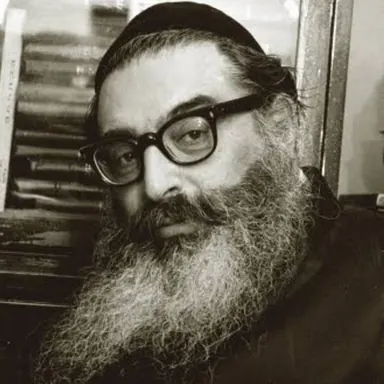
The Work, Torah Teaching and Leadership of the Gaon Rabbi Yitzchak Hutner, Author of Pachad Yitzchak
14 min read2,813 words
Summary
This text surveys the many-sided figure of Rabbi Yitzchak Hutner, one of the greatest thinkers and leaders of Haredi Judaism in the twentieth century. The source describes how Rabbi Hutner created a daring intellectual synthesis combining analytical Lithuanian scholarship with the depth of the worlds of Hasidism and mussar, chiefly through his monumental series of books, Pachad Yitzchak. Special emphasis is placed on his existentialist educational method, which stresses that a person's falls and crises are not obstacles but the necessary ground for his spiritual growth. Beyond the intellectual aspect, the text outlines his public work as head of the Rabbeinu Chaim Berlin Yeshiva in the United States, where he displayed a unique combination of ideological conservatism and practical openness toward the challenges of modernity. The work closes with a description of his legacy, which continues to pulse in Jerusalem and in America through his disciples and institutions, who pass on his conception of "the greatness of man" and the conceptual precision of matters of the heart and mind.
Introduction and Historical Context
Rabbi Yitzchak Hutner, known in the world of Torah and thought by the name "the Pachad Yitzchak" after his monumental series of books, was among the most influential and original Orthodox leaders of the Jewry of the United States and of the Land of Israel in the twentieth century.[1, 2, 3] His unique figure reshaped the world of Haredi learning and outlook, creating a daring synthesis among diverse Lithuanian, mussar, Hasidic and philosophical schools.[1, 4] His work went beyond the bounds of traditional institutional leadership; he offered a religious pedagogy combining practical openness to modernity with rigid conservatism of outlook, and an intellectual method that turned the aggadic portions and Jewish thought into a precise conceptual system parallel to analytical halakhic scholarship.[1, 4]
Biography and Formative Stations of Life
Rabbi Yitzchak Hutner was born in the city of Warsaw in Poland in the month of Adar 5666 (1906).[1, 5] Already in his youth he was recognized as an exceptional "prodigy" (illui) and went to study at the renowned Slobodka Yeshiva in the city of Kovno, Lithuania.[1, 3] In this yeshiva he became a close and outstanding disciple of "the Alter (Elder) of Slobodka," Rabbi Nosson Tzvi Finkel, who instilled in him the foundations of "the greatness of man" of the Mussar movement.[3, 6] In 5685 (1925) Rabbi Hutner was sent, together with a select group of students, to strengthen the branch of the yeshiva that had been established in the Land of Israel, in the city of Hebron.[1, 3] His stay in the Land of Israel brought him into a close and formative encounter with the Chief Rabbi of the Land of Israel at that time, the Ra'ayah (Rabbi Abraham Isaac HaKohen) Kook.[1, 3] Rabbi Hutner, who was a cousin of the wife of Rabbi Tzvi Yehuda Kook, became very close to Rav Kook and was deeply influenced by his ideological, spiritual and historiosophical teaching.[1, 3] Rabbi Hutner's admiration for Rav Kook found distinct expression in his addressing him with rare superlatives: "His Honored Eminence, our master, the great Gaon, the crown of Israel and its holy one."[1]
In the winter of 5689 (1929), only a few months before the terrible Hebron massacre, Rabbi Hutner returned to Warsaw and from there moved for a short time to study philosophy at the University of Berlin.[1] These studies gave him direct acquaintance with Western and philosophical tools of thought, which were later woven, by allusion and indirectly, into his philosophical writings.[4] In 5692 (1932) he published his first scholarly book, Torat HaNazir, containing profound novellae on tractate Nazir.[1] The book received warm approbations from the great sages of the generation, among them the leader of the Lithuanian yeshiva world Rabbi Chaim Ozer Grodzinski of Vilna, Rabbi Avraham Dov Kahana Shapira of Kovno, and Rav Kook of the Land of Israel.[1] However, in later editions of the book these approbations were omitted, a testimony to the ideological tensions that arose in the Haredi world around the figure of Rav Kook.[1] Although Rabbi Chaim of Brisk died in Rabbi Hutner's childhood, his analytical scholarly method laid a central conceptual foundation for his intellectual path, and the biographical sources count him among his influential teachers.[1] His Torah stature won wide recognition already in his youth; Rabbi Shlomo Wolbe, who was only eight years younger than Rabbi Hutner and later became the greatest of the masters of mussar, wrote words of extravagant esteem about him and recognized his exceptional greatness in both halakha and aggadah.[3]
In 5695 (1935), after another short stay in the Land of Israel, Rabbi Hutner emigrated to the United States and settled in Brooklyn, New York.[1, 3] This move marked the beginning of a glorious chapter of leadership, when in 5699 (1939) he was appointed head of the Rabbeinu Chaim Berlin Yeshiva, located in Brooklyn.[1, 3, 5] Alongside leading the yeshiva, he served as a member of the Council of Torah Sages in the United States, and became one of the leading spokesmen and most influential figures in shaping the character of Haredi Judaism on the American continent after the destruction of Europe.[1, 5]
Yeshiva Leadership, Education and Ideological Controversies
Under Rabbi Hutner's charismatic leadership, the Rabbeinu Chaim Berlin Yeshiva flourished and prospered, becoming world-renowned and not falling short in its level and Torah standing of the great yeshivas of Eastern Europe.[1] The yeshiva's distinctiveness stemmed from Rabbi Hutner's decision to integrate deep Hasidic motifs into the rigid Lithuanian scholarly milieu.[1] This combination found special expression on Sabbaths and festivals, when he used to conduct a Hasidic "tish" accompanied by devoted and uplifting song, weaving into it a complex scholarly and philosophical discourse.[1]
In 5700 (1940) Rabbi Hutner founded a yeshiva institution for young high-school graduates (a "Mesivta"), which attracted hundreds of students.[1] His educational approach was marked by pragmatism and sober openness to the conditions of life in the United States; he supported combining secular studies with sacred studies, encouraged students to integrate into the general world of work, and even tried to establish a special college that would allow professional certificate studies alongside yeshiva studies.[1] This openness met with fierce opposition from conservative rabbis in the Lithuanian world, foremost among them the head of the Lakewood Yeshiva, Rabbi Aharon Kotler, who utterly rejected any inclusion of secular content in the yeshivas and championed complete separation for the sake of exclusive Torah study.[1]
In contrast to his practical openness to working and economic life, Rabbi Hutner was careful to keep uncompromising ideological boundaries against religious streams that he perceived as a deviation from traditional Orthodoxy. This found sharp expression in the sweeping prohibition he imposed on his students against going to hear the lectures and discourses of Rabbi Yosef Dov Soloveitchik of Boston, the spiritual leader of Modern Orthodoxy.[1] This prohibition was strictly enforced even though the brother of Rabbi Yosef Dov Soloveitchik, Rabbi Aharon Soloveichik, taught as a senior lecturer (ram) in Rabbi Hutner's yeshiva.[1] This distinction sharpens his educational teaching: a readiness for the individual's practical adjustment to modern economic life, out of confidence in his spiritual strength, alongside an absolute refusal to grant theological or intellectual legitimacy to compromising approaches in matters of faith.
His Philosophical Method and the Structure of the Pachad Yitzchak Series
The Pachad Yitzchak series of books is Rabbi Hutner's philosophical life's work, based on his discourses, which were originally delivered in Yiddish and translated into a rich, florid and poetic Hebrew.[4] Most of the essays were recorded from hearing, translated and edited by his only daughter, Rebbetzin Bruria David.[4] Rabbi Hutner himself proofread and edited the essays meticulously, and together with his daughter and her husband, Rabbi Yonasan David, they were brought to press and published by the Gur Aryeh Institute.[4, 8] The series consists of eight books, seven volumes devoted to the festivals of the year and a special volume collecting letters and writings.[4, 8]
Rabbi Hutner's teaching is based on a unique combination of diverse sources, foremost among them the teaching of the Maharal of Prague and of the Gra (the Vilna Gaon), alongside deep influences from the Hasidic movement, Kabbalah and historiosophy.[4] Ideas from general philosophy were also woven into his books, but mostly by allusion and without explicit mention of their source.[4] Rabbi Hutner saw his work as a methodological revolution parallel to the contribution of Rabbi Chaim Soloveitchik of Brisk to Talmudic scholarship.[4] Just as Rabbi Chaim applied analytical and conceptual tools to halakha, so Rabbi Hutner aspired to place the aggadic portions and "the laws of character traits and the duties of the heart" on a precise and systematic conceptual foundation.[4]
This methodological innovation is explained in the fixed introduction that appears at the opening of each of the volumes of the series.[4] In this introduction Rabbi Hutner analyzes the essential difference between practical halakhic study and the study of matters of the mind and the heart.[4] Whereas the study of practical laws (such as the laws of the sukkah or of tzitzit) takes time and affects a person's physical action only at a later stage, the study of the duties of the heart works immediately and changes the intellectual and emotional state of the learner in the very course of study.[4] Therefore, the study itself is already the stage of the fulfilment and realization of the commandment.[4]
A distinct example of Rabbi Hutner's conceptual scholarship can be found in the volume Pachad Yitzchak: Shavuot (Essay 1).[10] In this essay he analyzes Maimonides' (Rambam's) ruling in the Mishneh Torah (Laws of Kings 9:1) concerning the six commandments that Adam, the first man, was commanded.[10] Through the conceptual analysis of these commandments, he explains the foundation of divine revelation and of the Sinai event.[10] Rabbi Hutner explains that faith in the prophecy of Moses our teacher does not rest on the miracles he performed, since these leave room for doubt and second thoughts.[10] The absolute and only testimony that confirms his prophecy forever is the Sinai event itself, in which the whole people experienced the revelation directly.[10] He bases this on the verse "Behold, I come to you in a thick cloud, so that the people may hear when I speak with you, and may also believe in you forever" (Exodus 19:9), and explains that before this event faith was subject to doubt and second thoughts, and only the experience of Sinai turned it into an eternal and unshakable foundation.[10]
Educational Existentialism: "The Letter of the Falls" (Letter 128)
In the book Pachad Yitzchak: Letters and Writings appears Letter 128, known as one of the most influential educational works in the modern Torah world.[6, 11] The letter was written to a student who was in a deep spiritual crisis because of his failures and falls, and who felt that he had no chance of attaining Torah greatness.[6] In response, Rabbi Hutner presents a revolutionary psychological and educational approach that dismantles the educational myth accepted in traditional societies.[6]
Rabbi Hutner comes out sharply against the tendency to present the great sages of Israel as perfect figures, free of struggle, who were created from the outset at the peak of their spiritual stature.[6] Omitting the inner struggles and the falls from the biographies of the great, in his view, causes enormous educational damage to the young generation.[6] When a youth with a lively soul and spiritual aspirations encounters within himself impulses, declines and falls, he compares himself to that perfect and fictitious image of the great.[6] This leads him to deep despair, to a sense of inferiority and to the mistaken thought that he is not worthy of growing in the house of God.[6]
To resolve this failure, Rabbi Hutner makes clear that the root of the soul is not measured by a state of tranquillity or by the absence of struggle with the evil inclination, but precisely by the unceasing war of the good inclination against the obstacles.[6] He uses the military metaphor of losing individual battles for the sake of victory in the overall campaign (Lose a battle and win the war), and stresses that one must not be alarmed by the fact that a person fails and will fail again and again, since it is precisely out of the failures that the victor grows.[6]
The climax of the letter is its novel and profound interpretation of the verse "For a righteous man falls seven times and rises up" (Proverbs 24:16).[6] Rabbi Hutner distinguishes between two understandings of the verse [6]:
The understanding of the masses ("the foolish"): they think that the purpose of the verse is to show the strength of the righteous man, who manages to rise even though he falls seven times.[6]
The understanding of those with depth ("the wise"): they understand that the falls are not an incidental obstacle on the way, but are themselves the ground and the material from which the rising is built.[6] That is, the very essence of the righteous man's greatness and stature is made possible and shaped precisely by virtue of the seven falls and the struggle with them.[6]
Rabbi Hutner anchors this conception also in the historical context of the redemption of Israel.[6] He points to the verses at the end of the portion of Shemot, in which the first mission of Moses our teacher at God's command apparently leads to a crushing failure, to the worsening of the bondage and to harsh complaints from the officers of the Children of Israel (Exodus 5:21: "May the Lord look upon you and judge, because you have made our savor abhorrent in the eyes of Pharaoh...").[6] Even the wonders of the staff turned into a serpent and the first plagues of Egypt did not bring about immediate change, and the process seemed a complete retreat.[6] This course demonstrates that the general redemption, as well as the personal growth of the individual, does not advance in a straight and monolithic line, but is built of deep crises that constitute a necessary preparation for the next stage of rising and salvation.[6]
His Legacy, His Disciples and His Activity in the Land of Israel
In his last years Rabbi Hutner divided his time between the United States and the Land of Israel.[5] In 5730 (1970) he began to live intermittently in the Land of Israel, and became a key figure in the Torah institutions of Jerusalem.[3, 5] He served as president of the "Jerusalem Institute" (Machon Yerushalayim), a large-scale Torah publishing enterprise [3], and founded in the Har Nof neighborhood the Pachad Yitzchak Yeshiva, which bears his name and passes on his philosophical teaching.[3, 7] Alongside the yeshiva the Ohr Eliyahu kollel, based on his legacy, was also established.[7]
Rabbi Hutner died on 20 Kislev 5741 (1980) and was buried in the Land of Israel.[1, 5] After his death, his son-in-law and foremost disciple, Rabbi Yonasan David, was appointed to head the Pachad Yitzchak Yeshiva in Jerusalem.[7] Rabbi David was married to Bruria, Rabbi Hutner's only daughter and a senior partner in the writing and editing of his books, until her death on the festival of Passover 5783 (April 2023).[4, 7]
Rabbi Hutner's educational and scholarly method was passed on to the following generations through a series of prominent disciples who deeply influenced the yeshiva world in the United States and in the Land of Israel.[1, 3, 5]
Summary
The Gaon Rabbi Yitzchak Hutner left behind a wide-ranging Torah and educational legacy, which forms a unique bridge between different spiritual worlds.[1, 4] Through his series of books Pachad Yitzchak, he rescued Jewish thought from the simplistic homiletic portion and turned it into a precise analytical-philosophical language, parallel to the scholarly methodology of the world of halakha.[4] His educational vision, reflected in "The Letter of the Falls," inspired thousands of students to cope with the difficulties of life and of the spirit, out of the understanding that crisis is not a contradiction of ascent but its true engine.[6] His institutions and his many disciples continue to spread his synthetic teaching, which combines Lithuanian depth, Hasidic devotion, mussar greatness and respect for the place of practical life.[1, 4, 7]
Sources11
- 1.יצחק הוטנר – חב"דפדיה, chabadpedia.co.il/wiki/יצחק_הוטנר
- 2.פחד יצחק - ויקיפדיה, he.wikipedia.org/wiki/פחד_יצחק
- 3.חטיפתו של הרב יצחק הוטנר זצ"ל ושחרורו - מעשים ומשמעויות / הרב אוריאל בנר - מכון שלמה אומן, machonso.org/hamaayan/?gilayon=60&id=1778
- 4.פחד יצחק (ספר) - ויקיפדיה, he.wikipedia.org/wiki/פחד_יצחק_(ספר)
- 5.רבי יצחק הוטנר - אישי ישראל - WordPress.com, isheiisrael.wordpress.com/2017/11/27/רבי-יצחק-הוטנר/
- 6.להתגבר על הכישלונות | חיבורים בספריא, sefaria.org.il/sheets/459891
- 7.יצחק הוטנר – ויקיפדיה, he.wikipedia.org/wiki/יצחק_הוטנר
- 8.פחד יצחק על המועדים סט ו' כרכים / הרב יצחק הוטנר זצ"ל - אוצר הספרים, sefer.org.il/items/8885473-פחד-יצחק-על-המועדים-סט-ו-כרכים-הרב-יצחק-הוטנר-זצ-ל-הוצאה-לאור-א-חסיד
- 9.פחד יצחק מאמרי פסח הוטנר - ספרי אור החיים, sifreiorhachaim.co.il/product/פחד-יצחק-מאמרי-פסח-הוטנר/
- 10.פחד יצחק שבועות מאמר א מראה מקומות - ספריא, sefaria.org.il/sheets/402368
- 11.ספר פחד יצחק - אגרות וכתבים - הספרייה הלאומית, nli.org.il/he/books/NNL_ALEPH990011640300205171/NLI