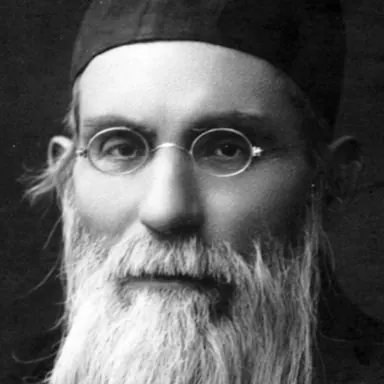
The Doctrine of "the Greatness of Man" and the Institutional Work of Rabbi Nosson Tzvi Finkel: The Spiritual and Educational Architecture of the Slabodka Yeshiva
15 min read3,079 words
Summary
The text surveys the revolutionary work of Rabbi Nosson Tzvi Finkel, "the Alter of Slabodka," who reshaped the Lithuanian yeshiva world through the doctrine of "the greatness of man." The article traces his personal and institutional development, from his roots in the Mussar movement to the founding of the "Knesset Yisrael" yeshiva and its wanderings from Europe to the city of Hebron. The heart of the method presented lies in the conception that man is an exalted and regal being, and that his spiritual work must therefore flow from an awareness of his own worth, a weighty moral responsibility, and the cultivation of an outward aesthetic as an expression of inner splendor. Ultimately, the essay emphasizes how his pedagogical vision became the educational foundation of the modern yeshivot, replacing the approach of submission and self-mortification with the cultivation of a refined individuality and a striving for excellence.
The nineteenth century and the beginning of the twentieth century were a period of unprecedented upheaval for European Jewry in general and for the Lithuanian Torah world in particular. Amid the storm of modernization, the Haskalah and the revolutionary movements, there arose the figure of Rabbi Nosson Tzvi Finkel, known by his epithet "the Alter of Slabodka," as one who brought about a quiet but profound revolution in the conception of the yeshiva student's personality. He did not merely found an institution of learning; he shaped a new person – a "man" in the fullest sense of the word, combining scholarly depth with self-respect, aesthetic refinement and metaphysical responsibility for every deed and utterance.[1, 2] The work of the Alter, spanning five decades and several continents, laid the foundation for the modern yeshiva world, and his Torah and moral teaching continues to resonate in the halls of the yeshivot of Hebron, Slabodka-Bnei Brak and Lakewood to this day.[3, 4]
Chapter 1: The Roots of Growth – From Raseiniai to Kelm
Rabbi Nosson Tzvi Finkel was born in the year 5609 (1849) in the town of Raseiniai (Rasein) in Lithuania, a town known for its distinctive intellectual and Torah atmosphere. The beginning of his life was marked by heavy personal loss; he was orphaned of his parents, Moshe and Miriam, at a very tender age and grew up in the home of his uncle in Vilna.[1, 2] The Vilna of that period was the nerve center of Lithuanian scholarship, and the encounter of the orphaned boy with the spiritual power of the "Jerusalem of Lithuania" left an indelible mark on him. Already in his youth he became known as a prodigy and an original thinker, and at the age of 15 he married Gittel Wolpert, the granddaughter of Rabbi Eliezer Gutman, the rabbi of the town of Kelm.[1, 5]
The first years after his marriage, during which he was supported at his father-in-law's table, were a period of intellectual formation. He did not shut himself up in the beit midrash alone, but went out to preach in the surrounding towns, where he stood out for his rhetorical skill and his ability to analyze the psychology of his listeners. The significant turning point in his life came when he arrived in his native town, Raseiniai, and met Rabbi Alexander Moshe Lapidus. Rabbi Lapidus, who was close to the Mussar movement founded by Rabbi Israel Salanter, recognized in the young man the potential to become a spiritual leader and sent him with a letter of recommendation to Rabbi Simcha Zissel Ziv, "the Alter of Kelm."[1, 5]
The Period of Study in Kelm and Its Influence on the Conception of Order
The Alter of Kelm was known for his meticulous educational method, which stressed "order" (seder) and self-discipline as central tools in the service of God. In Kelm, Rabbi Nosson Tzvi learned the art of precision in every detail, from the ordering of one's thoughts to the cleanliness of one's dress. He became one of the senior students and assisted his teacher in running the famous "Beit HaTalmud" and in running the "Beit HaMussar" in Grobin.[5] Nevertheless, already at this stage the first buds of his independent method began to sprout in him. Whereas Kelm advocated a gradual and prolonged education based on strict discipline, Rabbi Nosson Tzvi began to believe that maximal aspirations should be set before the student from the very beginning of his path, in order to awaken in him an inner motivation stemming from the recognition of his own worth.[5]
Chapter 2: Building the Mussar Empire in Slabodka
In the year 5637 (1877) Rabbi Nosson Tzvi moved to Slabodka, a suburb of the city of Kovno. At first he worked to establish a "kollel" for married scholars, which received the support of the "Ovadia Lachman Fund," but his true vision was the establishment of a yeshiva that would constitute a new model of education. The yeshiva he founded, "Knesset Yisrael," was named after Rabbi Israel Salanter, and thereby the Alter declared his loyalty to the roots of the Mussar movement while intending to renew its character.[6, 7]
At that time the yeshiva world underwent an upheaval with the closing of the Volozhin yeshiva. Many of the students of Volozhin found their way to Slabodka and brought with them the tradition of incisive scholarship and independence of thought.[7] The Alter wisely combined this scholarship with the study of mussar, creating an institution in which the work of refining one's character traits is not an appendix to the study of the Gemara but its beating heart.
The Split of 1897: "Knesset Yisrael" versus "Knesset Beit Yitzchak"
The growth of Slabodka did not go unopposed. Within the yeshiva a tension arose between the supporters of the Mussar method and those who saw it as a dangerous innovation or a waste of time meant for Torah study. In 1897 the tension reached its peak, and the yeshiva split in two:
- Knesset Beit Yitzchak: headed by Rabbi Tzvi Rabinowitz and Rabbi Moshe Danishevsky (and later by Rabbi Baruch Dov Leibowitz), which advocated traditional Torah study without an obligation to study mussar.[6]
- Knesset Yisrael: headed by the Alter of Slabodka and Rabbi Moshe Mordechai Epstein, which became the fortress of mussar and identified itself with the method of "the greatness of man."[1, 6]
This split was a formative moment for the Alter. It allowed him to shape the yeshiva as he saw fit, without any need for pedagogical compromises. He appointed key figures such as Rabbi Yitzchak Blazer and Rabbi Avraham Shinker as teachers, and created a spiritual leadership team without equal.[6]
Chapter 3: The Metaphysics of "the Greatness of Man" – An Analysis of the Thought
The concept most identified with the Alter of Slabodka is "the greatness of man" (gadlut ha-adam). In contrast to other Mussar approaches, and especially the approach of Novardok, which advocated "the lowliness of man" and the breaking of pride, the Alter believed that the only way to reach spiritual perfection is through the recognition of man's infinite worth.[5, 8] In his view, man is the crown of creation, chosen to serve the Creator not out of being trampled but out of royalty.[8, 9]
The Spiritual Origin of Matter according to "Or HaTzafun"
In his book "Or HaTzafun" ("The Hidden Light"), which was edited from his talks, the Alter explains that the first man was created "in the image of God," and that his physical body was originally a refined spiritual substance.[10] The sin caused the "materialization" of reality, but this is only an outer shell. As proof the Alter cites the words of the Sages about Rabbi Bena'ah, who saw the heels of Adam and they shone like two orbs of the sun.[10] The insight that emerges from this is that if the heels – the lowest organ – possess a cosmic light, then the soul of man and his inner essence possess an incomprehensible divine power.[10]
"The Hidden Power" and Moral Responsibility
The Alter coined the concept of "the hidden power" (koach ha-ne'elam) – that inner spiritual potential found in every person.[10] This power is the source of the might of our father Jacob, who rolled the stone off the mouth of the well as easily as uncorking a flask, not by physical strength but by the power of "the unification of the heart."[10] The implications of this conception for morality are far-reaching:
- Precision in deeds: since man is so exalted a being, every one of his deeds, even the smallest, is of infinite value. There are no "light deeds"; every action affects the cosmic "hidden."[10]
- Broadening the concept of transgression: robbery, for example, is not merely the taking of money. In the Slabodka method, even keeping silent where one should have defended the honor of another is considered a kind of robbery (robbery of honor), as is learned from Sarah's claim against Abraham, "My wrong be upon you."[10]
- Conscious thought: the method rejected instinctive behavior. A person must weigh every action and every utterance in the awareness that he is standing "before the King."[9]
Chapter 4: Aesthetics as a Religious Expression – The Figure of the "Slabodker"
One of the most distinctive phenomena of the Slabodka yeshiva was its insistence on outward appearance. Whereas in the yeshiva world of the time it was customary to see poverty and a slovenly appearance as a sign of abstinence and holiness, the Alter instructed his students to dress in the best of modern fashion.[5]
The students wore light-colored, pressed suits and straw hats (canotiers) and carried walking sticks, like students at the most prestigious universities in Europe.[5] The Alter held that a dignified appearance is an inseparable part of "the greatness of man." When a student sees himself as a prince, he will be ashamed to behave in a base manner or to commit transgressions unbefitting his station. Aesthetics was not empty externality but an educational tool for fortifying self-respect and personal responsibility.[5, 8]
The Differences between the Educational Approaches in the Mussar Movement
Chapter 5: The Pedagogical Reversal of 1905 – From Severity to Gentleness
The Alter's image as a leader was not static. At the beginning of his path he advocated strict discipline and "casting gall" (zerikat marah) into the students in order to stir them to the refinement of their character traits.[1] However, the stormy events of the 1905 revolution in Russia brought about a dramatic change in his outlook.
When the revolutionaries, some of them former students, burst into the yeshiva and threatened its order, the Alter did not respond with force. In one of the most charged encounters, the Alter looked straight at the head of the revolutionaries and said to him with deep sorrow: "See what has become of you...". These words of his, spoken out of pain at the loss of the potential of the "man," weakened the revolutionaries' resolve and they left the place.[1] In the wake of these events, the Alter understood that in an era of freedom and rebelliousness, the only way to preserve the Torah world is through gentleness, the encouragement of independence and an emphasis on the luminous sides of mussar.[1, 5] He became a fatherly figure, caring for all the material and spiritual needs of the student, out of the belief that only in an atmosphere of love and esteem could the student grow to his true stature.
Chapter 6: The Upheavals of the First World War and the Wanderings
The outbreak of the First World War in 1914 brought about the dispersal of the Slabodka yeshiva. The Alter, who was staying in Germany for medical reasons, was immediately arrested as a Russian subject and was held in detention for about half a year.[1, 5] After his release he joined Rabbi Moshe Mordechai Epstein in Minsk, where they re-established the yeshiva amid the flames of the war.
As the front approached Minsk, the yeshiva wandered to Kremenchug in Ukraine. This period was full of hardships and persecutions, but the Alter succeeded in preserving the cohesion of the body of students. The yeshiva survived not only the war but also the Bolshevik revolution that followed it, and in 1920 it returned to Slabodka in independent Lithuania.[1, 5] The years after the war were the yeshiva's years of greatest flourishing, and it became a magnet for students from all over Europe, among them figures who would later lead the entire Torah world.[1, 2]
Prominent Students of the Alter and Their Future Influence
Chapter 7: The Move to the Land of Israel and the Founding of the Hebron Yeshiva
In 1924 the Slabodka yeshiva faced a new threat: a Lithuanian law that obligated the yeshivot to teach secular studies and threatened to conscript the students into the army.[7, 11] The Alter, in a bold and far-sighted step, decided to bring the yeshiva up to the Land of Israel. He sent his student, Rabbi Yechezkel Sarna, to prepare the ground, and over the years 1924-1925 most of the students and rabbis immigrated to Hebron.[1, 7]
The choice of Hebron was not accidental. The Alter sought to establish a Torah center far from the political centers of Jerusalem and Tel Aviv, in the place where the Patriarchs were born – the primal symbols of the nation's "greatness."[1, 5] Despite his old age and weakness, the Alter invested all his energy in the yeshiva in Hebron. He encouraged song and melodies (niggunim) as part of spiritual elevation, a tradition that continued in Hebron even after his passing.[4]
At the end of 1926, because of his health, which had deteriorated as a result of the cold climate in Hebron, he moved to live in Tel Aviv.[1, 5] He passed away on 29 Shevat 5687 (1927) in Jerusalem and was buried on the Mount of Olives, leaving behind him a mighty enterprise of Torah and mussar.[1, 2]
Chapter 8: The Institutional Legacy in Bnei Brak – The New Slabodka
While the Hebron yeshiva continued the Alter's path in Jerusalem (after the riots of 5689), another branch of the yeshiva was established in Bnei Brak in 1947 by his son-in-law, Rabbi Yitzchak Isaac Sher, and the latter's son-in-law, Rabbi Mordechai Shulman.[3, 11] The establishment of the yeshiva in Bnei Brak, on Givat Rokach, was carried out with the encouragement of the "Chazon Ish," who sought to strengthen the developing Haredi community in the city.[11]
The distinctive building of the yeshiva in Bnei Brak, octagonal in shape, was originally designed to be open to the surrounding orchards, as an expression of the spirit of freedom and spiritual space that characterized Slabodka.[11] The yeshiva in Bnei Brak became the center of many institutions that continue the legacy of the Alter:
- Kollel Kovno: a central kollel for married scholars headed by Rabbi Chaim Yitzchak Shulman.[3, 12]
- Yeshivot for younger students: "Knesset Mordechai" in Modiin Illit and in Beit Shemesh, and a yeshiva for younger students in Bnei Brak that adopts a format of study similar to that of a senior yeshiva.[3]
- Kollelim for rabbinic judges: such as the "Chemdat Yisrael" kollel and further institutions in Elad and in Afula.[3]
Chapter 9: A Literary Analysis of "Or HaTzafun" as a Moral Codex
The book "Or HaTzafun" is the main source for understanding the Alter's theoretical teaching. The book is not merely a collection of sermons but an attempt to build a philosophy of "development through the elevation of individuality."[10]
Central Themes in the Book
- Torah and action: the view that study must lead to an essential change in the personality, and not remain merely intellectual information.[10]
- Jewish loving-kindness (chesed): the Alter sees loving-kindness as one of the most exalted expressions of "the greatness of man." A person who does good to his fellow acts as a partner of the Creator in the work of creation.[10]
- The subtlety of the Torah's demands: the higher a person rises in his level, the more subtle and precise the moral demand upon him becomes. An act considered permitted for a simple person may be considered a "sin" for a son of Slabodka because it does not befit his stature.[10]
- The eternity of man: the belief that through the work of mussar and Torah a person acquires for himself an eternal existence that transcends the limitations of matter.[10]
The book is arranged according to the weekly Torah portions, which allows the learner to accompany the cycle of the year with moral insights that complement one another into a complete worldview.[10] It is considered a relatively moderate book within the Mussar stream, since it does not demand that a person give up his selfhood, but rather that he refine it.[10]
Chapter 10: Summary and Long-Term Influence
The Alter of Slabodka was not merely a rosh yeshiva; he was an engineer of the human soul. At a time when Orthodox Judaism felt attacked and humiliated, he restored to the yeshiva students their upright stature. He taught that a ben Torah need not be poor and wretched in order to be holy, and that inner splendor must also be reflected in outer splendor.[1, 5]
The legacy of the Alter lives today not only in the institutions that bear his name but within the DNA of the Lithuanian Torah world. The concepts of "the honor of the Torah," "the greatness of man," and the striving for perfection of character through intellect and awareness are all fruits of the Sisyphean labor and the revolutionary vision of Rabbi Nosson Tzvi Finkel. He succeeded in bridging between meticulous Kelm and bursting modernity, and between ruined Lithuania and the Land of Israel being built, and thereby secured the continuity of the chain of mussar for the generations to come.[2, 4, 7]
Sources12
- 1.רבי נתן צבי פינקל- הסבא מסלובודקה - remember.bio, remember.bio/he/remember_pages/הרב-נתן-צבי-פינקל/
- 2.נתן צבי פינקל – ויקיפדיה, he.wikipedia.org/wiki/נתן_צבי_פינקל
- 3.ישיבת סלבודקה (בני ברק) - ויקיפדיה, he.wikipedia.org/wiki/ישיבת_סלבודקה_(בני_ברק)
- 4.ישיבת חברון כנסת ישראל - ויקיפדיה, he.wikipedia.org/wiki/ישיבת_חברון_כנסת_ישראל
- 5.רבי נתן צבי פינקל – ויקישיבה, yeshiva.org.il/wiki/index.php/רבי_נתן_צבי_פינקל
- 6.ישיבת כנסת ישראל (סלבודקה) - ויקיפדיה, he.wikipedia.org/wiki/ישיבת_כנסת_ישראל_(סלבודקה)
- 7.ישיבת סלבודקה - גנזך קידוש השם, ganzach.org.il/ישיבת-סלבודקה/
- 8.10 עובדות שלא ידעתם על הסבא מסלבודקה, הרב נתן צבי פינקל זצ"ל - הידברות, hidabroot.org/article/190676
- 9.גדלות האדם - ויקיפדיה, he.wikipedia.org/wiki/גדלות_האדם
- 10.אור הצפון | ספריית ספריא, sefaria.org.il/Ohr_HaTzafun
- 11.סיבוב בישיבת סלבודקה בבני ברק - חלון אחורי - WordPress.com, michaelarch.wordpress.com/2024/10/19/סיבוב-בישיבת-סלבודקה-בבני-ברק/
- 12.ישיבת סלבודקה כנסת ישראל (ע"ר) | גיידסטאר - אתר התאגידים של ישראל | משרד המשפטים, guidestar.org.il/organization/580027605