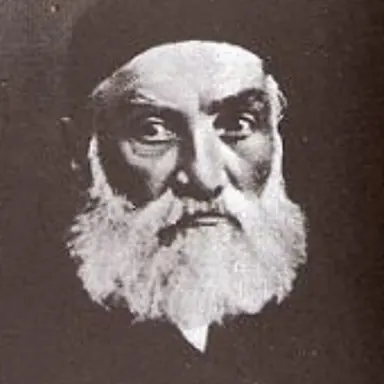
The Torah Teaching, Philosophical Thought and Scientific Work of Rabbi Shem Tov Gefen: A Comprehensive Analysis of a Polymath at the Crossroads of Modernity
12 min read2,385 words
Summary
This survey sketches the portrait of Rabbi Shem Tov Gefen as a Renaissance polymath who worked at the crossroads between the tradition of Israel and modernity, presenting his distinctive thought, which combines Kabbalah, higher mathematics and neo-Kantian philosophy. The core of the text deals with his revolutionary "theory of dimensions", which interprets theological concepts such as prophecy and providence as actions taking place within an infinite multidimensional reality that eludes the limited human senses. Alongside an analysis of his scientific and linguistic work, the article examines his deep ties with Rav Kook (the Ra'ayah) and his family, who saw in him a rare intellectual bridge uniting the sacred and the secular. Finally, the source describes the modern controversy surrounding his daring views on the composition of the Book of Genesis, an affair that led to the suppression (genizah) of his writings and illustrates the constant tension between freedom of thought and religious conservatism.
Rabbi Kalman (Kalonymus) Shem-Tov Gefen (1856–1927) represents an exceptional intellectual figure, a kind of "Renaissance humanist" transplanted into the complexity of Jewish thought at the turn of the twentieth century. He was not merely a traditional Torah scholar in the accepted sense of the word, but a thinker who sought to construct a total system uniting modern mathematics, theoretical physics, neo-Kantian philosophy and the esoteric Kabbalistic teaching into a single coherent fabric.[1, 2] His approach was characterized by a daring attempt to bridge the abyss between empirical science and religious-mystical experience, using logical and mathematical tools to validate metaphysical truths that until then had been regarded as given to faith alone.[2, 3]
Chapter 1: Intellectual Biography and Historical Context
The life of Rabbi Shem Tov Gefen spanned a period of radical transformations in the Jewish people. He was born on 27 Nisan 5616 (1856) in Brivis in Ukraine, in the very heart of the Russian Empire, in an era when Eastern European Jewry was beginning to grapple with the challenges of the Haskalah (Enlightenment) and modernity.[1, 2] Most of his broad education in the exact sciences (mathematics, chemistry, physics and geology) he acquired as an autodidact, a fact that gave him a rare freedom of thought and released him from the shackles of rigid academic schools.[4]
His immigration to the Land of Israel and his activity at the focal points of the "Old Yishuv" and the "New Yishuv" gave him the standing of a living bridge. He lived in Jerusalem as a polymath who did not shy away from engaging in chemistry or linguistics, while remaining deeply rooted in the world of Kabbalah and Hasidism.[1, 4] His death in 1927 marked the end of an era in which individual thinkers could still hold such comprehensive encyclopedic knowledge, organically uniting the sacred and the secular.[2]
Chapter 2: The Philosophy of Dimensions and Cognition
The core of Gefen's thought lies in a revolutionary conception of physical reality, as expressed in his early work "Torat ha-Memadim le-Ein Sefurot" (The Theory of Countless Dimensions) (1897).[2, 7] At the basis of his theory stands the claim that the universe is not limited to the three dimensions perceived by the human senses, but is composed of countless ontological dimensions.[2]
The Perception of Reality as a Sensory Illusion
Gefen adopted a radical neo-Kantian position, under the influence of thinkers such as Hermann Cohen, but charged it with Kabbalistic meaning.[3] He argued that three-dimensional space is not a property of reality as it is in itself, but a structure imposed by human cognition. The human mind functions as a filtering mechanism that translates an infinite multidimensional reality into the meager language of length, width and height in order to make orientation in space possible.[2] This perception, in his view, is "mistaken" in the metaphysical sense, since it hides from man the overwhelming majority of existing reality.[2]
Gefen used a brilliant mathematical analogy to explain the relationship between the revealed and the hidden dimensions. He compared "the thing in itself" (the divine essence or the hidden reality) to imaginary numbers in mathematics:
- x
- 2
- +1=0⟹x=
- −1
- =i
Just as the number i is necessary for solving complex equations and forms an inseparable part of mathematical logic, even though it has no representation as a tangible quantity in nature, so too the higher dimensions are necessary for understanding the universe, even though they elude direct sensory experience.[2] This insight enabled him to argue that miracles, prophecy and providence are not a "breaking" of the laws of nature, but the operation of higher laws in dimensions that are inaccessible to ordinary cognition.[3, 8]
The Dimensions and the Concept of the Infinite
In his work "Torat ha-Nevuah ha-Tehorah, o ha-Filosofiah ha-Matematit shel ha-Ein Sof" (The Pure Theory of Prophecy, or the Mathematical Philosophy of the Infinite) (1923), Gefen deepened this analysis.[2] He defined prophecy as a crossing of the threshold of human cognition toward the infinite dimensions. In his view, the prophet is a person who has reduced his sensory "illusion" and succeeded in grasping fragments of the multidimensional reality. Gefen did not see this as a magical event, but as a process that can be described with the tools of "mathematical philosophy".[2]
Chapter 3: Integrating Torah with the Natural Sciences and Geology (Admatanut)
Gefen's contribution was not limited to abstract philosophy but extended into the applied sciences of his time. He engaged in chemistry, theoretical physics and geology (which he called "admatanut"), out of the belief that knowledge of the laws of nature is a religious commandment of the first order.[2, 4]
"Ma'aseh Bereshit veha-Admatanut" (The Work of Creation and Geology)
In his monumental article "Ma'aseh Bereshit veha-Admatanut", Gefen proposed a harmonious model for resolving the conflict between the biblical order of creation and the geological findings pointing to an age of the world of millions of years.[2] Unlike other conservative thinkers who rejected science, Gefen accepted the geological findings but gave them a Kabbalistic interpretation. He argued that the six days of creation represent stages in the development of the physical forces and of the dimensions, each "day" being a cosmic era in which a different layer of reality came into being.[2]
Chemistry and Theoretical Physics
Gefen saw in the structure of matter a reflection of the supernal sefirot. His attraction to chemistry stemmed from his desire to understand the divine mechanism within the material "shell" (kelippah).[4] He wrote scientific articles in which he tried to link chemical interactions with concepts from the esoteric teaching, on the assumption that a uniform lawfulness governs all levels of being, from the atom to the infinite.[4]
Chapter 4: Linguistics and the Renewal of the Hebrew Language
Rabbi Gefen was an active participant in the revival of the Hebrew language, but his approach was distinctive: he sought to make Hebrew a language capable of expressing complex philosophical and scientific concepts without losing its Torah depth.[2]
- Philology and research: he engaged in linguistic research on the books of the Bible, with an emphasis on Job and Isaiah, using comparative tools to clarify the meaning of rare words.[2]
- Coining words: Gefen coined many scientific terms. He was not content with loan translations, but sought Hebrew roots that express the inner essence of the scientific concept.[2]
- "Ben-ha-Kotz": a famous example of his linguistic and ideological sharpness is his naming of Baruch Spinoza "Ben-ha-Kotz" ("son of the thorn", a translation of the word Spinoza). With this he expressed both appreciation for the philosopher's wit and reservation about the thorns of the pantheism that threatened accepted belief.[2]
- The color tekhelet: in his article "Tola'at Tekhelet" (The Tekhelet Worm), Gefen combined knowledge of marine biology with biblical philology in an attempt to identify the source of the original tekhelet (blue) dye, a subject with weighty halakhic implications.[2]
Chapter 5: The Connection with Rav Kook's Circle and His Influence on the Ratziyah
Rabbi Gefen's place within the world of thought of Religious Zionism derives to a large extent from his deep connection with Rabbi Abraham Isaac HaKohen Kook and his family. He was a prominent member of a group of thinkers (which also included Rabbi Shmuel Alexandrov and Rabbi Pinchas Lintop) who sought to create a synthesis between Kabbalah and modern thought.[3]
The Ra'ayah and Neo-Kantianism
Rav Kook (the Ra'ayah) found in Gefen an echo of his own positions on the limits of human cognition. In their letters, the two discussed how modern philosophy (especially that of Kant and Hermann Cohen) could serve as a tool for understanding the concept of "Malkhut" (Kingship), the last sefirah, which has nothing of its own and is only a vessel receiving supernal lights.[3] Gefen provided Rav Kook with the "scientific" and mathematical infrastructure for his metaphysical claims.[5]
The Ratziyah as Disciple and Admirer
Gefen's most impressive influence was on the Ra'ayah's son, Rabbi Zvi Yehuda HaKohen Kook. The Ratziyah saw in Gefen an exemplary figure of a "sage", a man whose Torah genius was combined with uncompromising originality of thought.[5] He called Gefen by the title "Maran" (our master), an extraordinary title that expressed his deep admiration for the man who had opened for him a window onto the world of science and philosophy from within the sacred.[5] It was the Ratziyah who for decades encouraged the printing of Gefen's writings, out of the belief that they contain "lights" needed by the generation of redemption.[5]
Chapter 6: The Modern Controversy and the Suppression of the Book
Despite the esteem he received from the Kook family, Rabbi Gefen's teaching has remained controversial to this day. In 5777 (2017), with the publication of the book "Rabbi Shem Tov Gefen: Chapters of Life, Letters and Articles", edited by Rabbi Yedidya Wengrover, a fierce controversy erupted that led to the suppression (genizah) of the book.[4, 5]
The Thesis on the Writing of the Book of Genesis
In his article "Sifrei ha-Torah: Sidram u-Shemoteihem" (The Books of the Torah: Their Order and Their Names), Gefen presented a radical conception of the origin of the Book of Genesis.[5] He interpreted the Talmudic saying "the Torah was given scroll by scroll" in a far-reaching way, and argued that:
- The first chapters of Genesis are ancient "scrolls" originally composed by primeval figures (such as Adam, Enoch or Noah) by virtue of divine inspiration.[5]
- Moses our teacher acted as the editor and compiler of these traditions at Sinai, through the holy spirit, and united them into one book.[5]
The account of the "Work of Creation" is not necessarily a chronological factual report by Moses, but the preservation of an "age-old song" that expressed the spiritual experience of early humanity.[5]
The Rabbinic Response and the Suppression
This view was perceived as too close to the methods of "biblical criticism", even though Gefen used it precisely to defend the antiquity of the Torah and to show that its sources are divine-prophetic and not of a later date, as the critics claim.[5] Rabbi Zvi Tau, president of the "Har HaMor" yeshiva, ordered the book to be suppressed, out of concern that its contents would undermine the students' faith in the sanctity of the Torah and in the tradition of its writing.[5] The suppression aroused puzzlement among scholars, since the Ratziyah himself had known these writings and encouraged their publication, which attests to a gap in the interpretation of Gefen's figure between the Ratziyah's generation and the leadership of "Har HaMor" today.[5]
Chapter 7: A Bibliographical Survey of His Writings
Rabbi Gefen's writings are characterized by a dense style, rich in mathematical and logical concepts, and pose a reading challenge even for Torah scholars and educated readers.[2, 9]
Chapter 8: Summary and Conclusions on His Figure and Work
Rabbi Shem Tov Gefen remains an enigmatic figure in Jewish historical memory. He became neither a classic head of a yeshiva nor a university professor, but remained in between: a "neo-Kantian Kabbalist" who sought to prove the existence of God through mathematical equations.[1, 3]
- Originality without fear: Gefen's approach teaches a rare intellectual courage. He was not afraid to adopt the tools of Kant, Cohen and Spinoza and to use them to build a new storey within the world of Kabbalah.[2, 3]
- Prophecy as a logical category: his most important contribution was to take the concept of prophecy out of the unexplained "miraculous" realm and make it part of a multidimensional physical theory. In this way he opened a door for religious scientists to find a common language between their professional world and their faith.[2]
- Hidden influence: his influence on the Kook family, and especially on Rabbi Zvi Yehuda, instilled within Religious Zionism the recognition of the importance of science and of the value of this world, even if this was done in indirect ways.[5]
- Constant tension: the controversy surrounding the suppression of his writings illustrates that Gefen still represents the dangerous "seam line" between tradition and radical innovation. His ideas on the writing of the Torah have remained in the category of "hidden teaching" even in an age of open information, because of their unsettling power.[5]
In historical perspective, Rabbi Shem Tov Gefen is a pioneer of the "theology of science" in the modern era. He showed how mathematics is not only a tool for calculating quantities, but a language through which one can peer behind the curtain of three-dimensional reality and discover the infinite.[2] His thought is a call to contemporary thinkers not to settle for apologetics, but to strive for a deep and unified understanding of the laws of nature and the laws of the Torah as different expressions of the same multidimensional divine essence.
Sources9
- 1.מחבר:שם טוב גפן - ויקיטקסט, he.wikisource.org/wiki/מחבר:שם_טוב_גפן
- 2.שם טוב גפן – ויקיפדיה, he.wikipedia.org/wiki/שם_טוב_גפן
- 3.“Modern Kabbalistic Critiques of Materialism”, Sefer Center's 25th International Annual Conference on Jewish Studies, Moscow, February 2018 (Abstract & Video) - Academia.edu, academia.edu/36917450/Modern_Kabbalistic_Critiques_of_Materialism_Sefer_Centers_25th_International_Annual_Conference_on_Jewish_Studies_Moscow_February_2018_Abstract_and_Video
- 4.ר' שם טוב גפן : פרקי חיים איגרות ומאמרים / ערך, ההדיר והוסיף מבוא והערות ידידיה ונגרובר | ספר, nli.org.il/he/books/NNL_ALEPH990041024970205171/NLI
- 5.ר' שם טוב גפן - הספר שהוחרם » ﬣקיבוץ ﬣקדוש (האתר של משה נחמני), hakibbutz.org.il/7856
- 6.Shem-Tov Gefen - Wikidata, wikidata.org/wiki/Q6992366
- 7.תורת הממדים לאין ספורות/מבוא – ויקיטקסט, he.wikisource.org/wiki/תורת_הממדים_לאין_ספורות/מבוא
- 8.Untitled, academia.edu/36917450/Modern_Kabbalistic_Critiques_of_Materialism_Sefer_Center_s_25th_International_Annual_Conference_on_Jewish_Studies_Moscow_February_2018_Abstract_and_Video
- 9.ארכיון הרב שם טוב גפן - הקיבוץ הקדוש, hakibbutz.org.il/product-category/ר-שם-טוב-גפן