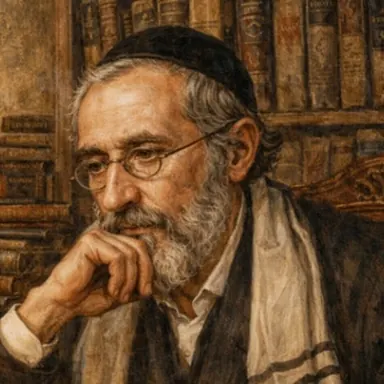
Rabbi Nachman Krochmal (Ranak) in the Light of Modernity
20 min read3,954 words
Summary
This text is an in-depth analysis of the intellectual legacy of Rabbi Nachman Krochmal (Ranak), an outstanding 19th-century thinker who sought to reconcile Jewish tradition with the European Enlightenment. The author examines his principal work, "Moreh Nevukhei ha-Zman" (Guide for the Perplexed of Our Time), in which Krochmal applies the methods of critical historical analysis and German idealism to demonstrate the continuity and eternity of the Jewish spirit. At the center of the account is his original conception of the cyclical nature of history, according to which the Jewish people, unlike other nations, possesses a unique capacity for spiritual renewal after periods of decline thanks to its connection with the "Absolute Spirit." The text emphasizes that Ranak's work laid the foundation for the scholarly study of Judaism and had a decisive influence on the formation of modern national self-consciousness and cultural Zionism.
Between Philosophy and Historiosophy: The Torah Teaching and Scholarly Work of Rabbi Nachman Krochmal (Ranak) in the Light of Modernity
The appearance of Rabbi Nachman Krochmal (1785–1840) on the stage of Jewish thought in the 19th century marked one of the quietest yet most profound revolutions in the history of the nation. Ranak, who lived and worked in the heart of Galicia, then under the rule of the Austrian Empire, was not merely a scholar or an abstract philosopher; he was the living bridge that connected the world of Torah tradition, Talmudic scholarship and the secrets of the Kabbalah with the modern currents of thought of German idealism and critical historical research.[1, 2] His only work, "Moreh Nevukhei ha-Zman" ("Guide of the Perplexed of the Time"), published only after his death, became the cornerstone of the "Wissenschaft des Judentums" (Chokhmat Yisrael) movement and a source of inspiration of the first order for the growth of modern national and Zionist consciousness.[3, 4] The figure of Ranak, the autodidact from Żółkiew who raised generations of influential disciples, represents the boldest attempt to resolve the spiritual perplexity of the modern Jew in the face of the discoveries of science and philosophy, while maintaining deep fidelity to the foundations of faith and halakha.[5, 6, 7]
Chapter 1: Historical and Biographical Context – The Growth of a Thinker in the Heart of Galicia
Nachman HaKohen Krochmal was born on 17 February 1785 in the city of Brody, which was at that time one of the most important commercial and cultural centers in eastern Galicia.[3, 5] Brody served as a kind of "inland port" through which passed not only goods but also ideas that arrived from western Europe and from Berlin, the center of the Jewish Haskalah.[3] His father, R. Shalom Krochmalnik, was a well-to-do merchant with international connections, which allowed his son Nachman to be exposed already in his youth to general literature and to the writings of the Berlin maskilim, such as Moses Mendelssohn and Yehuda Leib Ben-Zeev.[3]
Ranak's life unfolded within the complex reality of Galician Jewry, which was torn between the influences of rising Hasidism and conservative rabbinic scholarship.[6, 8] In keeping with the custom of the generation, Ranak was married at the age of 14 (some say 16) to Sarah née Haberman, and moved to live in his father-in-law's house in the town of Żółkiew near Lviv.[3, 5] The move to Żółkiew marked the beginning of a period of intensive study that lasted about a decade, in which Ranak developed his distinctive autodidactic method. In his relative isolation he immersed himself not only in the depths of the Talmud and the halakhic decisors, but also in the investigations of Maimonides (Rambam) (especially the "Guide of the Perplexed") and the commentaries of Ibn Ezra, who became his guides in thought.[3, 9]
Ranak's need to bridge the worlds led him to learn many languages on his own: German (in order to read Kant and Hegel), Latin, French, Arabic and Syriac.[3, 6] He was not content with superficial knowledge; his disciples testified that he was "at home" in every field of the spirit, from ancient Hebrew poetry to physics and astronomy.[3] His meeting in Lviv in 1808 with Shlomo Yehuda Rapoport (Shir) was a turning point for both of them. Shir became Ranak's principal disciple, and together they laid the foundations for the historical-critical study of rabbinic literature.[3, 4] Despite being a central figure in Haskalah circles, Ranak remained a devoutly observant Jew, which did not prevent the Hasidim from accusing him of Karaite leanings because of his contacts with the Karaite sages in Kukizów in 1815.[3, 10]
Chapter 2: Moreh Nevukhei ha-Zman – The Structure and the Intellectual Project
Ranak's only book, "Moreh Nevukhei ha-Zman" (Monaz), is a fragmentary and unfinished work that saw the light only in 1851, 11 years after the author's death, edited by Yom-Tov Lipmann Zunz in Lviv.[1, 11, 12] The title given to the book (Ranak had originally planned to call it "Sha'arei Emunah Tzerufah," "Gates of Pure Faith") reflects Ranak's ambition to be the "Maimonides of the 19th century."[5, 13] Just as Maimonides sought to resolve the contradictions that the medieval Jew felt between the Torah and Aristotelian philosophy, so Ranak sought to offer a solution to the modern perplexity arising from the encounter with science, critical historiography and German idealism.[5, 7, 14]
The book is built of 17 "gates" (chapters), which can be divided conceptually into four main sections, expressing the transition from the abstract to the concrete, and from philosophy to history [9, 15]:
Section 1: The Foundations of Thought and Faith (Gates 1–6)
In these gates Ranak lays down the philosophical-religious foundation. He uses metaphorical concepts such as "elixir of life" (correct faith) as opposed to "elixir of death" (extremism in faith), and preaches the "golden mean" in thought.[14, 15] Ranak argues that Jewish faith is not based on blind obedience alone, but on the recognition of the "spiritual sign," the ability to identify the divine presence within concrete reality.[15]
Section 2: The Philosophy of History and Nationhood (Gates 7–10)
This is the core of the book, in which Ranak develops the doctrine of the "national spirit" (Volksgeist) and an analysis of the history of Israel.[6, 7] In Gate 7, "The Nations and Their Gods," he compares the conception of the divine in Israel with polytheistic conceptions, and explains why Israelite monotheism is the highest level of "the Absolute Spirit."[7]
Section 3: Critical Historical and Literary Research (Gates 11–15)
Here Ranak moves to the "scientific" study of the Jewish sources. He discusses questions of biblical criticism (such as the identity of Second Isaiah), investigates the apocryphal literature and the figure of Philo of Alexandria, and analyses the development of the Oral Torah and the aggadah.[10, 16] Gate 15, "The Way of the Outsiders," is devoted to the complex connections between the Kabbalah and ancient Gnostic sects.[15, 16]
Section 4: Metaphysical Synthesis (Gates 16–17)
The last gates deal with the connection between logic and philosophy and the wisdom of faith. Here Ranak offers a summary of a doctrine of the divine influenced by Hegel and by Ibn Ezra, and tries to show how Jewish metaphysics anticipates modern discoveries.[2, 9, 10]
Chapter 3: Ranak's Philosophy – "The Absolute Spirit" in a Hebrew Version
The key to understanding Ranak's teaching lies in his complex relationship to the philosophy of Georg Wilhelm Friedrich Hegel. Ranak is sometimes regarded as a "Jewish Hegelian," but a thorough analysis shows that he did not adopt Hegel's system as it was, but reworked it in order to rescue Judaism from the Hegelian critique.[2, 6, 13]
The National Spirit and the Absolute Spirit
According to Hegel, history is a process of the development of "the Absolute Spirit" (Weltgeist) striving for self-consciousness.[17, 18] Each nation in history represents a particular "national spirit" (Volksgeist), which contributes its share to the general development and then disappears ("is annulled") in favour of a higher stage.[2, 7, 17] Hegel argued that Judaism had been a stage of "the religion of sublimity" that characterized the young spirit, but that it was replaced by Christianity, which represents a more mature stage.[6, 19]
Ranak made a bold "reverse move": he argued that the God of Israel is none other than "the Absolute Spirit" itself.[2, 6, 9] Whereas all the nations have a partial "god" (that is, a national spirit limited to art, law or philosophy), the people of Israel cleaves to the source of all spirits, to the absolute spiritual that has no limit.[6, 7] In this way Ranak solved the problem of the eternity of the people of Israel: since the people is connected to the Absolute, it is not subject to the compulsory laws of history, of annihilation and death, that apply to other nations.[2, 7, 16]
Creation as Self-Contraction
Ranak combines idealist philosophy with Kabbalistic concepts in an original way. He explains the transition from the infinite Spirit to the finite world by means of the concept of "tzimtzum" (contraction).[9] Unlike classical Lurianic Kabbalah, for Ranak tzimtzum is a logical-metaphysical process of God's self-definition.[9] He identifies the "nothing" from which the world was created with the Godhead itself, and thereby comes close to a pantheistic-idealist conception in which the world is a manifestation of the divine essence.[9, 16]
Religion as a Representation of Philosophy
Under Hegel's influence, Ranak saw religion and philosophy as two forms of the same content of truth. Whereas philosophy expresses the Absolute by means of "pure concepts," religion expresses it by means of "representations" (Vorstellung), imagination and narrative.[6, 16, 17] Therefore the task of the Jewish thinker in modernity is to "decode" the religious symbols and the biblical narratives in order to uncover the philosophical kernel hidden in them.[2, 6, 16] This approach allowed Ranak to remain faithful to religious ritual (as a necessary representation for the masses) while holding a thoroughly rationalist world view.[2, 7]
Chapter 4: The Doctrine of Cycles – The Historiosophy of an "Eternal People"
Ranak's most influential contribution to later generations was his cyclical historical analysis. Ranak rejected the traditional conception that saw Jewish history as a static sequence of sin and punishment, and in its place proposed a dynamic model of growth, flowering and decline.[7, 13, 16]
Every nation, according to Ranak, passes through three organic stages [6, 7]:
- The days of ascent and growth: the consolidation of the national and religious forces.
- The days of strength and dominion: the peak of the nation's spiritual and political creativity.
- The days of withering and end: the disintegration of social structures and the decline of the creative spirit.
Unlike the other nations, which disappear from the stage of history once they reach the stage of decline (such as Greece and Rome), the people of Israel is endowed with the capacity for "wondrous renewal."[6, 7, 13] Because the spirit of the people of Israel is the Absolute Spirit, it is able to begin a new cycle of growth out of the ashes of the previous decline.[6, 7, 13] Ranak identified three such complete cycles in Jewish history up to his time [6, 10, 13]:
The First Cycle: From the Patriarchs to the Destruction of the First Temple
- Growth: the period of the Patriarchs, the Exodus from Egypt and the wanderings in the wilderness (the consolidation of monotheism).
- Flowering: the days of David and Solomon (the establishment of the Temple and the kingdom).
- Decline: the division of the kingdom, the descent into idolatry and the destruction of the First Temple.[4, 6]
The Second Cycle: From the Return to Zion to the Bar Kokhba Revolt
- Growth: the days of Ezra and Nehemiah and the establishment of the Men of the Great Assembly.
- Flowering: the early Hasmonean period and the development of the Oral Torah.
- Decline: fratricidal war, the Roman conquest, the destruction of the Second Temple and the failure of the Bar Kokhba revolt (135 CE).[4, 6]
The Third Cycle: From the Sealing of the Mishnah to the Expulsion from Spain
- Growth: the days of the Amoraim in Babylonia and the Land of Israel and the sealing of the Talmud.
- Flowering: the "Golden Age" in Spain (the combination of halakha, poetry and philosophy).
- Decline: the decrees of 1391, the persecutions of the Inquisition and the expulsion from Spain (1492).[4, 6, 10]
Ranak did not formally define the "fourth cycle," but it is clear from his writings that he saw in the age of the Haskalah and in the Emancipation the beginning of a new period of growth.[6, 7, 13] This conception gave great hope to the people of his generation; it explained the spiritual crisis of the 19th century not as a final destruction, but as the "birth pangs" of a higher stage in the spirit of the nation.[7, 13, 16]
Chapter 5: The Study of the Oral Torah and the Aggadah – Between Halakha and History
Beyond his philosophical contribution, Ranak was a pioneer in the scholarly study of rabbinic literature. In chapters 13 and 14 of "Moreh Nevukhei ha-Zman," he offers an analysis of the development of halakha and aggadah that was perceived in its day as bold and even revolutionary.[15, 16]
The Evolution of the Oral Torah
Ranak rejected the conception that the Oral Torah was given at Sinai as a closed and finished code of laws.[7, 16] In its place he proposed a developmental model: the Oral Torah began as "popular traditions" and customs transmitted orally, which took on the form of binding law in response to changing conditions.[16] He stressed the role of the "Soferim" (scribes) in the Second Temple period as those who worked these customs into legal expositions, and of the Tannaim as those who refined halakhic logic.[16] In this Ranak anticipated the modern scholars of halakha who saw Jewish law as a living and developing entity, influenced by social and political contexts.[16]
The Nature of the Aggadah and the Ways of the Midrash
In Gate 14, Ranak analyses the aggadic literature as an educational and philosophical tool.[15] He offers several fundamental distinctions:
Separating halakha from aggadah: whereas halakha requires practical precision, aggadah is a space of freedom in which the sages used exaggerations, parables and rhetorical figures to teach morality and faith.[15]
"One does not raise objections against a homily": Ranak adopts the rule that one should not challenge the aggadah from simple logic, since it was meant "to bring good teaching into the ear of the listener" and not to establish historical or scientific facts.[15]
Aggadic midrash as "poetic figure": he explains that many of the extravagant homilies (hyperboles) were said before the common people in the synagogues on Sabbaths in order to stir their hearts, and are not to be accepted as a realistic description of reality.[15]
His analysis of the aggadah was meant to defend the honour of the Sages against the radical maskilim who mocked the aggadot of the Talmud as nonsense and vanity.[6, 13, 15] Ranak showed that beneath the pictorial shell lie profound philosophical ideas consonant with "pure reason."[2, 6, 15]
Chapter 6: Gate 15 and the Secret of "The Way of the Outsiders" – The Study of Kabbalah
One of Ranak's most original contributions, which has been highly valued in modern scholarship (including by Gershom Scholem), is his discussion of the roots of the Kabbalah in Gate 15.[15, 20] Ranak approached the question of "the antiquity of the Zohar" by a roundabout route: instead of discussing when the book was written, he investigated the sources of the ideas found in it.[15]
He identified a deep structural similarity between the world of Kabbalistic concepts and the doctrines of Gnosticism (the sect of "those who know") that flourished in the first centuries CE.[15, 16] Ranak argued that concepts such as "Ein Sof," "emanation," "ten sefirot" and "partzufim" (countenances) are not a late invention of the Middle Ages, but a transformation of ideas that existed among Jewish-sectarian groups ("minim") in the period of the Mishnah and the Talmud.[15] He suggested that the Kabbalah preserved these ancient ideas while "making them kosher" and cleansing them of the dangerous dualistic elements of the Gnosis.[15]
This research was revolutionary because it used early Christianity and the writings of the Church Fathers (who documented the Gnostic sects) to shed light on the history of Jewish mysticism.[15] Ranak succeeded in showing that the Kabbalah is an organic part of the intellectual history of the nation, even if its roots lie in "the way of the outsiders."[15, 16]
Chapter 7: Biblical Criticism and the Revival of Hebrew Scholarship
Ranak is considered one of the pioneers of modern biblical criticism in Hebrew, while succeeding in preserving the religious authority of the Torah.[3, 16] His approach was based on a combination of meticulous philology and a broad historical perspective.
The Question of Second Isaiah and Daniel
Ranak accepted the position of scholarship (which was then widespread in Germany) that the book of Isaiah is not the work of a single prophet, but contains the prophecies of a "Second Isaiah" who was active at the end of the Babylonian exile.[16] He reached this conclusion from an analysis of the style and historical background of the chapters. He also discussed the late date of some of the books of the Bible, such as Ecclesiastes and Daniel, and attributed them to the Second Temple period.[16]
The Book of Psalms and the Hasmonean Period
Unlike the tradition that attributes all of Psalms to King David, Ranak argued that the psalms were written over hundreds of years, and that a large part of them reflects the struggles of the Hasmoneans against the Greeks.[16] He saw in these psalms "the song of the national spirit" responding to the events of the time.[6, 16]
For Ranak, scholarly criticism was not a contradiction of faith in revelation. He believed that "the Absolute Spirit" acts through human beings within history, and therefore it does not matter whether the words were written by David or by a Hasmonean poet: both express the divine truth as it appeared at that time.[2, 6, 7] This approach allowed him to be "a radical critic and a devout believer" at one and the same time, a model that greatly influenced later modern religious thought.[6, 7]
Chapter 8: Ranak's Attitude to Modernity and to Jewish Society
Although he was an abstract thinker, Ranak was deeply involved in the problems of his time. He saw Galician Jewry as caught in a double perplexity: on the one hand, religious and Hasidic zealotry that disdained science and enlightenment; and on the other, the radical Haskalah that disdained tradition and led to assimilation.[3, 6, 7]
The Critique of Hasidism
Ranak was a sharp critic of the Hasidic movement, which he saw as an expression of an "elixir of death" in faith: a mixture of superstitions, excessive attachment to tzaddikim and disdain for rational scholarship.[6] He saw in Hasidism a retreat from the achievements of the third cycle of Judaism (the period of medieval philosophy) toward benighted mysticism.[6] His conflict with the Hasidim in Żółkiew was personal and bitter, and they regarded him as a heretic and an inciter.[3, 6, 10]
The Struggle over Education and Emancipation
As the leader of the maskilim of Galicia, Ranak supported reforms in Jewish education, including the study of sciences and foreign languages.[3, 6] He believed that the Emancipation (the granting of civil rights to the Jews) was a historical necessity, but feared that it would lead to the loss of national identity.[8, 13] Therefore the whole project of "Moreh Nevukhei ha-Zman" was meant to provide the enlightened Jew with a spiritual foundation that would allow him to be "a man in the street and a Jew at home," but in a deeper version: a philosophical person whose Jewish identity is the highest level of his humanity.[13, 21]
Chapter 9: Influence and Legacy – From Ranak to Zionism
Ranak died in relative solitude and destitution, but his influence after his death was immense. "Moreh Nevukhei ha-Zman" became a foundational book for everyone who sought to engage with Judaism in a modern way.[1, 4, 7]
The Birth of "Chokhmat Yisrael"
Ranak's disciples, and especially Zunz and Shir, turned his ideas into a scholarly program of work. "Chokhmat Yisrael" (Wissenschaft des Judentums) adopted Ranak's conception that Judaism is a historical entity to be investigated with philological and historical tools.[1, 4, 20] The great enterprises of the 19th century in the study of the Talmud, Hebrew poetry and Jewish philosophy draw directly on the methodology that Ranak developed in Żółkiew.[4, 16, 20]
Ranak as the Father of Spiritual Zionism
Ranak's influence on the national movement was decisive, although he himself did not preach a physical return to Zion. His concept of "the national spirit" (or "the spirit of the nation") became a key concept for thinkers such as Peretz Smolenskin and Ahad Ha'am.[7, 22, 23]
- Ahad Ha'am: saw in Ranak his great teacher. He adopted the conception that Judaism is a living national culture, and not only a religion of commandments.[22, 23, 24] Ahad Ha'am's idea of the "spiritual center" is in fact an application of Ranak's conception of "the Absolute Spirit" to a new political reality.[22, 23]
- Cultural Zionism: Ranak gave Jewish nationalism a metaphysical basis: the Jewish people is not merely an ethnic group, but the bearer of an eternal world idea.[7, 13]
Summary and Conclusions
Rabbi Nachman Krochmal was the great "guide" of the transitional period in modern Judaism. His greatness lay not only in his encyclopaedic knowledge, but in his ability to create a synthesis between worlds that seemed utterly contradictory. In "Moreh Nevukhei ha-Zman," he succeeded in turning history, the tool that the critics of religion had used to undermine Judaism, into the main tool for proving its eternity.[2, 6, 13]
Ranak's deepest insight was that Judaism is not afraid of time. Since it cleaves to "the absolute spiritual," every historical crisis is nothing but an opportunity for renewal.[6, 7, 13] He gave the modern Jew the possibility of being critical without being a heretic, and of being national without being narrow-minded.[7, 13] His legacy continues to resonate in everyone who seeks to understand Judaism not only as a set of laws, but as a living, vibrant and infinite spiritual process working in the heart of human history.[4, 7, 13] Ranak remains, in the words of his disciples, the "western lamp" of Galicia, which lit the way from the old tradition toward the national and scholarly future of the people of Israel.[3, 4]
Sources24
- 1.נחמן קרוכמל | מקורות מתוך ספריית ספריא, sefaria.org.il/topics/nachman-krochmal
- 2.Krochmal, Nachman (1785–1840) - Routledge Encyclopedia of ..., rep.routledge.com/articles/biographical/krochmal-nachman-1785-1840/v-1/sections/moreh-nevukhei-ha-zeman
- 3.נחמן קרוכמל – ויקיפדיה, he.wikipedia.org/wiki/נחמן_קרוכמל
- 4.Nachman Krochmal - Wikipedia, en.wikipedia.org/wiki/Nachman_Krochmal
- 5.Nachman Krochmal | Jewish Thought, Poetry & Mysticism - Britannica, britannica.com/biography/Nachman-Krochmal
- 6.Krochmal, Na?man | Encyclopedia.com, encyclopedia.com/environment/encyclopedias-almanacs-transcripts-and-maps/krochmal-nahman
- 7.Nachman Krochmal - New World Encyclopedia, newworldencyclopedia.org/entry/Nachman_Krochmal
- 8.Exegesis and Politics Between East and West: Nachman Krochmal, Moses Mendelssohn, and Modern Jewish Thought | Harvard Theological Review | Cambridge Core, cambridge.org/core/journals/harvard-theological-review/article/exegesis-and-politics-between-east-and-west-nachman-krochmal-moses-mendelssohn-and-modern-jewish-thought/C4FCBFDBF0A7B1A766A34A6FB6FF6174
- 9.Nachman Krochmal | Encyclopedia.com, encyclopedia.com/people/philosophy-and-religion/judaism-biographies/nachman-krochmal
- 10.KROCHMAL, NACHMAN KOHEN - JewishEncyclopedia.com, jewishencyclopedia.com/articles/9524-krochmal-nachman-kohen
- 11.מורה נבוכי הזמן / נחמן קרוכמל - פרויקט בן־יהודה, benyehuda.org/read/47208
- 12.מורה נבוכי הזמן - ויקיפדיה, he.wikipedia.org/wiki/מורה_נבוכי_הזמן
- 13.Nachman Krochmal and the revival of Jewish identity | The Jerusalem Post, jpost.com/opinion/nachman-krochmal-and-the-revival-of-jewish-identity-485811
- 14.Moreh Nevukhei HaZeman | Sefaria Library, sefaria.org/Moreh_Nevukhei_HaZeman
- 15.מורה נבוכי הזמן | ספריית ספריא, sefaria.org.il/Moreh_Nevukhei_HaZeman
- 16.Krochmal, Naḥman - YIVO Encyclopedia, encyclopedia.yivo.org/article.aspx/Krochmal_Nahman
- 17.גאורג וילהלם פרידריך הגל - ויקיפדיה, he.wikipedia.org/wiki/גאורג_וילהלם_פרידריך_הגל
- 18.THE ROLE OF ABSOLUTE SPIRIT IN HEGEL'S PHILOSOPHY O PAPEL DO ESPÍRITO ABSOLUTO NA FILOSOFIA DO HEGEL* - Dialnet, dialnet.unirioja.es/descarga/articulo/10101472.pdf
- 19.The hidden God of the Jews: Hegel, Reb Nachman, and the aqedah (Chapter 10) - Hidden Divinity and Religious Belief - Cambridge University Press, cambridge.org/core/books/hidden-divinity-and-religious-belief/hidden-god-of-the-jews-hegel-reb-nachman-and-the-aqedah/13958187CA02E7C9EB87B489B3EA2C31
- 20.Philosophy and Kabbalah in Wissenschaft des Judentums: Rethinking the Narrative of Neglect. - UCLA Department of History, history.ucla.edu/wp-content/uploads/2023/09/philosophy_and_kabbalah.pdf
- 21.Jewish Thought and Philosophy: Modern Thought | Encyclopedia.com, encyclopedia.com/environment/encyclopedias-almanacs-transcripts-and-maps/jewish-thought-and-philosophy-modern-thought
- 22.Ahad Ha-Am - YIVO Encyclopedia, encyclopedia.yivo.org/article.aspx/ahad_ha-am
- 23.אחד העם – ויקיפדיה, he.wikipedia.org/wiki/אחד_העם
- 24.Ahad Ha'am - Jewish Virtual Library, jewishvirtuallibrary.org/ahad-ha-rsquo-am