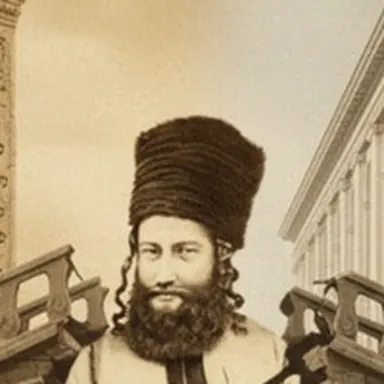
The Scholarly Work and Torah Teaching of Maharatz Chajes: Orthodoxy, Haskalah and Method in an Age of Transformation
20 min read3,952 words
Summary
This source surveys the life and teaching of Rabbi Zvi Hirsch Chajes (Maharatz Chajes), an exceptional rabbinic figure of the 19th century who strove to establish a harmonious synthesis between conservative halakhic commitment and modern critical-scientific research. The text presents him as a bridge between worlds, combining deep Torah scholarship with mastery of historical and philological methodologies, with emphasis on his monumental work "Mevo ha-Talmud" (Introduction to the Talmud), which became an enduring asset of the yeshiva world and the academy alike. Through an analysis of halakhic and polemical questions, such as the prohibition of using the organ on Shabbat or the debate over offering sacrifices in the present time, the source demonstrates the halakhic rationalism of Maharatz Chajes and his willingness to distinguish between the fundamentals of religion and historical customs. In conclusion, the text describes Maharatz Chajes as a distinct representative of the "middle way," who succeeded in preserving the eternity of the Jewish tradition precisely through a scientific understanding of its development, and thereby left an indelible mark on the character of Orthodoxy in an age of transformation.
Rabbi Zvi Hirsch Chajes (Maharatz Chajes; 1805–1855) stands as one of the most complex and unique figures in the religious and intellectual historiography of Eastern European Jewry in the first half of the nineteenth century [cite: 1, 2]. At a time when the struggle between conservative Orthodoxy and the Haskalah (Jewish Enlightenment) movement was growing ever sharper, Maharatz Chajes represented a pioneering and bold attempt to create a harmonious synthesis between conservative halakhic commitment and modern critical-scientific research [cite: 2, 3]. He combined deep Torah scholarship and the halakhic authority of a head of a rabbinic court (av beit din) with methodological and philological mastery of the tools of historical research of the "Wissenschaft des Judentums" (Chokhmat Yisrael) movement [cite: 1, 2]. His various works, foremost among them "Mevo ha-Talmud," reflect a systematic conception that seeks to ground the eternity of the Oral Torah precisely in an understanding of its historical development [cite: 1, 2, 3].
Stations of Life and Socio-Cultural Background: The Prodigy of Brody and a Leader Between Two Worlds
Maharatz Chajes was born on 28 Cheshvan 5566 (20 November 1805) in the city of Brody in Galicia, which was then under the rule of the Austrian Empire [cite: 2, 4]. He grew up in an especially wealthy and distinguished family environment; his father, R. Meir Chajes, was a rich merchant and banker, and the family traced its descent to an illustrious rabbinic dynasty that included the Rema, the Bach, the Taz, the Shach and Rabbi Yitzchak Chajes (author of "Zera Yitzchak") [cite: 2, 5]. On his grandfather's side, the family traced its descent to the Torah giants among the pious of Provence of the thirteenth century [cite: 6].
Already in his childhood the Maharatz stood out for his sharpness and his phenomenal memory, and it is related that at the age of five he knew the entire Bible by heart [cite: 2, 5]. Clear evidence of the first buds of his early genius is found in a manuscript of his Torah novellae, which he composed when he was only fifteen, while studying at the famous Kloiz in Brody [cite: 7, 8]. In these early novellae, which discuss at length matters of Hanukkah and the Megillah, the Maharatz presents a deep scholarly analysis and engages directly with the great sages of his generation who were active in Brody, among them Rabbi Shlomo Kluger, Rabbi Efraim Zalman Margaliot (author of "Beit Efraim," from whom he later received rabbinic ordination) and Rabbi Elazar Landau (author of "Yad ha-Melekh") [cite: 5, 8].
Alongside his diligence in Torah, Maharatz Chajes received a broad-minded general education that was highly unusual in his environment [cite: 2]. Under his father's guidance he trained in modern and classical European languages (German, French, Italian and Latin), and acquired comprehensive knowledge of the natural sciences, geography, history and philosophy [cite: 1, 2, 5]. He studied with prominent figures of the early Haskalah movement in Galicia, such as Isaac Baer Levinsohn (Ribal) and Solomon Judah Rapoport (Shir) [cite: 5].
In 1828, at the age of twenty-three, he was appointed av beit din in Zolkiew, an appointment supported by the rabbi of Lviv, Rabbi Yaakov Meshulam Ornstein (author of "Yeshuot Yaakov"), who was a staunch fighter against the Haskalah [cite: 1, 2, 5]. In Zolkiew the Maharatz associated with Rabbi Nachman Krochmal (Ranak), one of the leaders of the maskilim in Galicia, and with Samson Bloch of nearby Kulikow [cite: 2, 5]. These ties, together with his research-oriented approach, aroused the wrath of the local Hasidim against him [cite: 2, 5].
In 1832 Maharatz Chajes competed for the rabbinate of Prague, a competition that led to a bitter rivalry and to the end of his friendship with Shir, who ran against him and ultimately won the post [cite: 2, 5]. Shir claimed that the Maharatz's position in Zolkiew had been bought with his wealthy father's money, while the Maharatz warned that Shir tended toward a dangerous accommodation with the spirit of modern times [cite: 2, 5].
In 1846, following an imperial law in Austria that required rabbis to hold an academic degree, Maharatz Chajes was examined at the University of Lviv and received the degree of "Magister" in philosophy after excelling in psychology, logic, metaphysics and ethics [cite: 1, 2, 5]. In 1852 he moved to serve as rabbi of Kalisz in Poland, but there too he was persecuted by the Hasidim of the city, led by the Hasidim of Kotzk [cite: 1, 2, 5]. In 1855 the Maharatz and his wife fell ill in a cholera epidemic [cite: 2, 5]. After a journey to the healing springs of Marienbad and a return to Zolkiew, the Maharatz traveled to seek medical help in Lviv, and there he died on 30 Tishrei 5616 (12 October 1855) [cite: 2, 4, 5]. His scholarly and halakhic legacy was carried on, among others, by his grandson, Prof. Zvi Peretz Chajes, who served as chief rabbi of Vienna and was a scholar of the Bible and Semitic languages [cite: 2, 6].
His Halakhic Teaching and Rulings: Methodical Distinctions and Confronting Modernity
The halakhic rulings of Maharatz Chajes reflect a rational analysis that systematically distinguishes between the divine and eternal halakhic core and historical customs and local practices that are subject to the changes of time [cite: 2, 9]. As the scholar Yisrael David Beit-Halevi noted, the Maharatz strove for a refined Judaism, distinguishing between "vital halakha," which determines the character and fate of the nation, and unimportant customs whose observance need not be insisted upon in certain circumstances [cite: 9].
The Controversy over Delaying Burial and the Correspondence with the Chatam Sofer
One of the stormiest controversies in eighteenth- and nineteenth-century Europe concerned the order of the civil authorities to delay the burial of the dead for three days, for fear of burying people while still alive (apparent clinical death) [cite: 10]. Most conservative halakhic decisors firmly forbade this because of the biblical prohibition "his body shall not remain all night" [cite: 10, 11].
In his book "Darkhei Hora'ah" (section 6), Maharatz Chajes presented an original and lenient position [cite: 9, 10, 12]: he argued that the Torah prohibition of leaving the dead unburied overnight originally applied only to those executed by a rabbinic court who were hanged [cite: 10, 11]. For the rest of the dead, it is a prohibition originating in the words of the Sages (a rabbinic prohibition), and the Sages did not uphold their words where there is great loss or a forceful decree of the government [cite: 10].
Rabbi Moshe Sofer (the Chatam Sofer) firmly rejected this approach, arguing that a lone expression of opinion of this kind weakens the walls of religion and allows the maskilim to treat halakha lightly [cite: 10]. Despite the sharp controversy, deep mutual esteem prevailed between the two; the Chatam Sofer corresponded at length with the Maharatz and valued his book "Torat Nevi'im," although the extremist disciples of the Chatam Sofer claimed that he drew the Maharatz close only to prevent his complete defection to the camp of the maskilim [cite: 2, 3, 5].
Scholarly Topics and Legal Analyses
The Talmudic teaching of Maharatz Chajes is characterized by a sharp legal conceptualization of Talmudic terms [cite: 13]. In his halakhic analyses he presented sophisticated solutions combining straightforward reasoning with textual precision:
The mechanism of the handwritten note in "Imrei Binah": in the laws of deeds and loans, Maharatz Chajes investigated whether a document written in the borrower's own handwriting operates by force of the legal mechanism of a full "deed" (which creates a lien on property) or only by force of the mechanism of a "litigant's admission," a distinction with a direct effect on the collection of debts from encumbered property [cite: 13].
The walls of a round sukkah: in discussing the laws of the sukkah, the Maharatz investigated whether the Torah insisted on the existence of geometrically defined flat walls, or whether the requirement is that the sukkah be enclosed and surrounded on its sides, an investigation with a direct bearing on the validity of a round sukkah that has no distinct walls but is enclosed on all sides [cite: 13].
The freeing of a slave for a tooth and an eye: in tractate Gittin, Maharatz Chajes raised a difficulty against the view of Rabbi Meir: if the freeing of the slave because of an injury to his tooth or eye by his master is considered a liability for the master, why does the Torah penalize the slave by sending him out to freedom [cite: 14]? He resolved this by examining the concept of legal right and obligation and by defining going out to freedom as an objective and subjective right of the slave [cite: 14].
A discussion of temporal life versus eternal life: in tractate Eruvin (21b), the Maharatz analyzed the view of Maimonides (Rambam) regarding the duty of self-sacrifice, and proposed a fundamental distinction between "temporal life" (chayei sha'ah) and "eternal life" (chayei olam), while explaining the conduct of Rabbi Akiva, who was about to be executed by the government [cite: 15].
The treatise "Avodat ha-Mikdash" and the offering of the Passover sacrifice: in this work Maharatz Chajes discusses the halakhic question of renewing the offering of the Passover sacrifice in the present time, without a rebuilt Temple [cite: 5]. This engagement connected him with Rabbi Zvi Hirsch Kalischer, one of the pioneers of religious Zionism and of the Return to Zion [cite: 5, 16]. Maharatz Chajes was among the rabbis who gave approbations to Kalischer's halakhic books, alongside various and diverse figures such as Rabbi Yisrael Yehoshua Trunk of Kutno, Rabbi Yitzchak Meir Alter (the "Chiddushei ha-Rim" of Gur) and Rabbi Dov Ber Meisels of Krakow [cite: 16].
Defending the Tradition and the Reform Controversy: Intellectual Zeal and the Middle Way
In modern studies, such as the study by Efraim Chamiel, Maharatz Chajes is described as a distinct representative of the "middle way," which later divided into the German Neo-Orthodoxy of Samson Raphael Hirsch on the one hand, and the positive-historical stream of Shadal on the other [cite: 17, 18]. This way combined an uncompromising war against religious reform with sharp criticism of the intellectual stagnation of the generation's leadership [cite: 2, 17].
The Organ Controversy in "Minchat Kenaot"
In his work "Minchat Kenaot," which came out against the resolutions of the Reform Braunschweig Conference of 1844, the Maharatz sharply attacked the changes introduced into the liturgy and the order of the synagogue [cite: 2, 5, 19]. He focused on the prohibition of using the organ on Sabbaths and festivals [cite: 19]:
The prohibition of the statutes of the gentiles: relying on Maimonides (Rambam) (Laws of Idolatry, chapter 11), Maharatz Chajes ruled that since the organ is specific to worship in Christian churches, playing it in the synagogue constitutes a Torah prohibition of "neither shall you walk in their statutes" [cite: 19]. On this question he confronted the words of Rabbi Abraham Sutro in his book "Milchamot Hashem" (Hanover, 1836), who tended to be lenient about playing the organ on weekdays [cite: 19].
- Strengthening the hands of transgressors: beyond the substantive prohibition, the Maharatz forbade the use of the organ because it imitates the customs of the Reformers [cite: 19]. He relied on the Talmudic rule that one must not strengthen the hands of heretics and apikorsim, lest they think that we agree with their ideological position [cite: 19].
- The integrity of the blessings: the Maharatz insisted that changing the internal structure of the blessings or changing a formula fixed by the Sages invalidates the fulfillment of the commandment, a discussion that also occupied Rabbi Menachem Mendel Schneersohn (the "Tzemach Tzedek," in his responsa, Orach Chayim section 56) [cite: 20].
Self-Criticism of Conservative Orthodoxy
Alongside his war against Reform, Maharatz Chajes leveled harsh criticism at the conservative Orthodox leadership in Galicia [cite: 2, 17]. He argued that many rabbis were unfit to lead the new generation because of their utter ignorance of the sciences, history and languages [cite: 2, 17]. With biting sarcasm he wrote that the rabbinic establishment recommends candidates who lack even the most basic historical knowledge, and do not even know that King David reigned after Saul [cite: 2, 17]. In his view, it was the lack of education and rational tools among the religious leadership that led to the abandonment of the young generation and the rise of Reform [cite: 17].
The Methodology of the Oral Torah and the Study of Aggadah: Rationalization and Scientific Interpretation
The greatest methodological achievement of Maharatz Chajes lies in his book "Mevo ha-Talmud," which constitutes the first Orthodox attempt to present a historical and methodical analysis of the Oral Torah and of the aggadot of the Sages [cite: 1, 2].
Defining Aggadah and Explaining "Excessive Exaggeration" (Hyperbole)
In chapters 18 and 19 of "Mevo ha-Talmud," Maharatz Chajes outlines a systematic path to understanding the world of aggadah [cite: 21, 22]: he determines that just as there are thirteen hermeneutical rules by which the Torah is expounded in halakha, so the thirteen rules of Rabbi Yishmael, and alongside them the thirty-two rules of Rabbi Eliezer the son of Rabbi Yosei the Galilean, serve to expound matters of aggadah [cite: 21].
Maharatz Chajes explains that the Sages used the method of "excessive exaggeration" (hyperbole and pedagogical exaggeration) and tremendous glorification in order to arouse people to practice the good virtues all the more [cite: 21]. He presents a series of examples of this interpretive mechanism [cite: 21]:
- The virtue of charity: the statement that "one who gives charity in secret is greater than Moses our teacher" (Bava Batra 9b) or that "great is charity, for it brings the redemption near" (Bava Batra 10a) [cite: 21].
- Hospitality: the saying that hospitality is greater than "receiving the Divine Presence" (Shabbat 127a) [cite: 21].
- Supporting Torah scholars: the image that whoever fills the throats of Torah scholars with wine is "as if he poured a libation of wine upon the altar" (Yoma 71a) [cite: 21].
- Observing the Sabbath: the saying that whoever observes the Sabbath according to its laws, "even if he worships idols like the generation of Enosh, he is forgiven" (Shabbat 118b) [cite: 21].
- Torah study and honoring parents: the saying that whoever teaches his grandson Torah is as if "he received it from Mount Sinai" (Kiddushin 30a), or the reward Pharaoh received for accompanying Abraham four steps, in consequence of which Israel was enslaved in his land for four hundred years (Sotah 46b) [cite: 21].
All of these, in his view, are not historical or halakhic descriptions in their plain sense, but literary and educational tools intended to illustrate the greatness of the moral virtues [cite: 21].
Freedom of Opinion and the Limits of Authority: The Question of the Rebellious Elder
One of the boldest foundations in the teaching of Maharatz Chajes concerns the definition of the limits of controversy and freedom of expression within the world of Torah [cite: 23]. Relying on the laws of the "rebellious elder" (zaken mamre), Maharatz Chajes explains that Judaism respects the right of a sage to express opinions that dispute the majority [cite: 23]: the elder is not punished or defined as a sinner for the mere fact that he teaches or thinks differently from the ruling of the Great Court; the grounds for his punishment exist only if he instructs people to act in practice against the agreed ruling [cite: 23].
From this the Maharatz proves that the Jewish tradition grants the sages a very broad freedom of thought and opinion, and respects minority opinions that were rejected as halakha, as long as the uniform framework of practical halakhic observance is maintained [cite: 23].
A Systematic Analysis of the Corpus of His Works
Analysis of Test Cases: Method Versus Practice
- Test case 1: introducing the organ into the synagogue [cite: 19]
- The halakhic source and the analysis: Maimonides (Rambam) (Laws of Idolatry, chapter 11) [cite: 19].
- The methodical argument of Maharatz Chajes: it is an instrument specific to Christian worship in churches, and therefore the Torah prohibition of "neither shall you walk in their statutes" applies to it [cite: 19]. In addition, the prohibition of "strengthening the hands of transgressors" applies with regard to the Reformers [cite: 19].
- The opposing position in his generation: Rabbi Abraham Sutro ("Milchamot Hashem") permitted playing the organ on weekdays by men [cite: 19].
- Test case 2: the decree of delaying burial (postponing interment) [cite: 10]
- The halakhic source and the analysis: the prohibition "his body shall not remain all night upon the tree" (Deuteronomy 21:23) [cite: 11].
- The methodical argument of Maharatz Chajes: the Torah prohibition is limited only to those sentenced by a rabbinic court [cite: 10, 11]. For the rest of the dead it is only a rabbinic prohibition, which is set aside in the face of great loss or a government decree [cite: 10].
- The opposing position in his generation: the Chatam Sofer firmly forbade it, arguing that the accepted burial customs must be preserved at all costs and that the disclosure of a lenient opinion damages the walls of the tradition [cite: 10].
- Test case 3: the validity of a round sukkah [cite: 13]
- The halakhic source and the analysis: the definition of a "partition" in the laws of the sukkah [cite: 13].
- The methodical argument of Maharatz Chajes: an investigation into whether the Torah requires flat, countable walls, or whether the essence is the creation of a space enclosed and surrounded on all its sides [cite: 13].
- The opposing position in his generation: various decisors who required a clear geometric definition of flat walls (the law of minimal partitions) [cite: 13].
- Test case 4: the status of a borrower's handwritten note [cite: 13]
- The halakhic source and the analysis: the laws of deeds and instruction in Choshen Mishpat [cite: 13].
- The methodical argument of Maharatz Chajes: an investigation into whether the writing operates under the law of a "deed" (which creates a lien on property that was sold) or under the law of a "litigant's admission" (which does not seize encumbered property) [cite: 13].
- The opposing position in his generation: the Maharam of Lublin (who holds that its law is that of a full deed in every respect) [cite: 13].
- Test case 5: renewing the Passover sacrifice in the present time ("Avodat ha-Mikdash") [cite: 5]
- The halakhic source and the analysis: offering sacrifices without a Temple and the building of a lone altar [cite: 16].
- The methodical argument of Maharatz Chajes: support in principle for the halakhic possibility of offering the Passover sacrifice on the Temple Mount even without a rebuilt Temple, subject to defined halakhic conditions [cite: 5, 16].
- The opposing position in his generation: many conservatives who forbade any practical initiative to ascend or to offer sacrifices before the coming of the Messiah [cite: 16].
Summary and Conclusions
Rabbi Zvi Hirsch Chajes stands in Jewish history as a distinct symbol of the tragedy and the hope of the transitional generation in Eastern Europe [cite: 2, 3]. On the one hand, he was persecuted unceasingly by conservative and Hasidic elements who saw in his ties with the leaders of the Haskalah and in his academic studies a direct threat to the boundaries of religion [cite: 2, 5]. Key figures of the extreme conservative camp, such as Rabbi Akiva Yosef Schlesinger, came out against him with great vehemence [cite: 5]. On the other hand, the secular scholars of the "Wissenschaft des Judentums" sometimes saw him as an overly apologetic figure because of his refusal to step beyond the bounds of binding halakha [cite: 2, 3].
Yet, in the test of the generations, the work of Maharatz Chajes won broad and exceptional recognition:
His glosses and novellae on the Babylonian Talmud (Hagahot Maharatz Chajes) were permanently incorporated into the accepted editions of the Talmud (foremost among them the Vilna Shas of the Romm press), and became an inseparable part of traditional yeshiva study throughout the Jewish world [cite: 2, 24, 28].
His book "Mevo ha-Talmud" remains to this day one of the few foundational works accepted both in the Orthodox Torah world and in the world of academic research for understanding the methodology of the Talmud and the aggadah [cite: 1, 2].
Maharatz Chajes proved that it is possible to hold to uncompromising scholarly integrity, to make judicious use of modern scientific tools, and to analyze the history of halakha without undermining the foundations of faith and the absolute commitment to the Torah from Sinai [cite: 1, 2, 3]. His figure has remained an exemplar and an inspiration to streams that seek to combine deep halakhic fidelity with intellectual and scientific openness to general culture [cite: 2, 17, 18].
Sources28
- 1.Zvi Hirsch Chajes - Wikipedia, en.wikipedia.org/wiki/Zvi_Hirsch_Chajes
- 2.צבי הירש חיות - ויקיפדיה, he.wikipedia.org/wiki/צבי_הירש_חיות
- 3.Bruria Hutner David - Columbia University, cs.columbia.edu/~spotter/david-chajes.pdf
- 4.Category:Zwi Hirsch Chajes - Wikimedia Commons, commons.wikimedia.org/wiki/Category:Zwi_Hirsch_Chajes
- 5.רבי צבי הירש חיות – ויקישיבה, yeshiva.org.il/wiki/index.php/רבי_צבי_הירש_חיות
- 6.פרופדור צבי פרץ חיות - Encyclopedia of the Founders and Builders of Israel, tidhar.tourolib.org/tidhar/view/15
- 7.חידושי מהר"ץ חיות - כתב יד - Tiferes Judaica, tiferesjudaica.eu/products/חידושי-מהרץ-חיות-כתב-יד
- 8.חידושי מהר"ץ חיות / מכתב יד הוצאת קולמוס ספרים - אוצר הספרים, sefer.org.il/items/8017745-חידושי-מהר-ץ-חיות-מכתב-יד-הוצאה-לאור-קולמוס
- 9.ר' צבי הירש חיות - Rabbi Tovia Preschel, toviapreschel.com/he/ר-צבי-הירש-חיות/
- 10.איסור בל תוסיף: מתי אסור להוסיף על התורה? - דין | שאל את הרב, din.org.il/2015/08/01/איסור-בל-תוסיף-מתי-אסור-להוסיף-על-התורה/
- 11.ניתוח המת – ויקישיבה, yeshiva.org.il/wiki/index.php/ניתוח_המת
- 12.י, א - חוקות הגויים בלוויית המת | הרב אורי שראל - הרחבות לפניני הלכה, ph.yhb.org.il/plus/20-28-10-01/
- 13.קובץ יסודות וחקירות/לקט חקירות - ויקיטקסט, he.wikisource.org/wiki/קובץ_יסודות_וחקירות/לקט_חקירות
- 14.באורי אגדות גיטין - מכון הלכה ברורה, halachabrura.org/agada/gitin.htm
- 15.ט – תשובות הרב קוק לרב שלמה זלמן פינס | הרב אורי שראל - הרחבות לפניני הלכה, ph.yhb.org.il/plus/20-04-09/
- 16.Scales of Justice by Rabbi Zvi Hirsch Kalischer: From Rabbinic Tradition to Public Participation - MDPI, mdpi.com/2077-1444/14/2/218
- 17.Defenders of the Faith: Studies in Nineteenth- and Twentieth-Century Orthodoxy and Reform, jewishaction.com/books/reviews/review-of-defenders-of-the-faith-studies-in-nineteenth-and-twentieth-century-orthodoxy-and-reform/
- 18.Review Essay: The Middle Way by Ephraim Chamiel - Tradition Online, traditiononline.org/review-essay-the-middle-way/
- 19.ז - הכנסת עוגב וכלי נגינה לבית הכנסת | הרב נועם ברנפלד - הרחבות לפניני הלכה, ph.yhb.org.il/plus/20-28-07/
- 20.בטאון למחשבת חב״ד, daat.ac.il/daat/kitveyet/pardes/pardes17.pdf
- 21.ר' צבי הירש חיות ח"ב, daat.ac.il/chazal/maamar.asp?id=300
- 22.ר' צבי הירש חיות ח"א, daat.ac.il/chazal/maamar.asp?id=299
- 23.Authority and Dissent: A Discussion of Boundaries | jewishideas.org, jewishideas.org/article/authority-and-dissent-discussion-boundaries
- 24.צבי הירש חיות | מקורות מתוך ספריית ספריא, sefaria.org.il/topics/zvi-hirsch-chajes
- 25.כל ספרי מהר"ץ חיות | ספר | חיות, צבי הירש, 1805-1855 - הספרייה הלאומית, nli.org.il/he/books/NNL_ALEPH990005211860205171/NLI
- 26.אמונת חכמים - נאמני תורה ועבודה, toravoda.org.il/אמונת-חכמים/
- 27.דרשה עתיקה לחג השבועות / יונתן רבינוביץ - מכון שלמה אומן, machonso.org/hamaayan/?gilayon=81&id=3017
- 28.Biography - Talmud - Philosophy, thephilosopher.net/talmud/