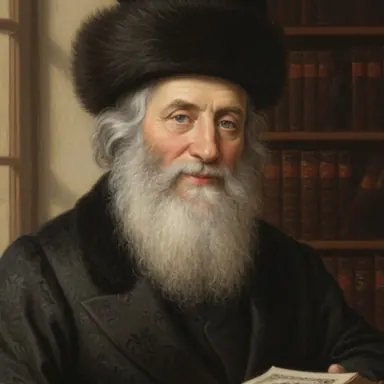
Rabbi Moshe Sofer: Shaping the Character of Orthodox Judaism in the Modern Era
16 min read3,180 words
Summary
The text surveys the revolutionary teaching of Rabbi Moshe Sofer, the "Chatam Sofer", who shaped the face of Orthodox Judaism as an active and militant response to the challenges of modernity and Reform in the 19th century. The article describes his life from Germany to the establishment of the Torah center in Pressburg, highlighting his central ideology, "the new is forbidden by the Torah", which sanctifies traditional custom as a spiritual protective wall. Alongside his extreme conservatism, the source reveals a complex leadership figure who combined phenomenal halakhic erudition with a positive attitude toward the sciences that serve the sacred and a deep attachment to the settlement of the Land of Israel. In conclusion, the work outlines the long-term legacy of the architect of Jewish conservatism, who raised generations of disciples and descendants who continue his institutional and intellectual path to this day.
The Teaching, Work and Thought of Rabbi Moshe Sofer: Shaping the Character of Orthodox Judaism in the Modern Era
The Historical and Cultural Background to the Rise of the Chatam Sofer
The second half of the 18th century and the first half of the 19th century were one of the stormiest and most formative periods in the history of the Jewish people in Europe. It was a period of sharp transition from the Middle Ages to the modern era, a time when the old communal structures began to crumble under the pressures of emancipation, the Haskalah movement and the beginnings of religious Reform.[1, 2] In the midst of this whirlpool stood Rabbi Moshe Sofer, known by his appellation the "Chatam Sofer" after the series of his monumental works, as a central figure who succeeded not only in preserving what existed but in reinventing Jewish conservatism as an active and militant force.[1, 3]
The Chatam Sofer worked at the meeting point between the old world, represented by the autonomous communities and unchallenged tradition, and the new world, which promised equal rights in exchange for giving up a distinct religious identity.[1, 2] In this period, called the period of "the first fruits of emancipation", the physical and spiritual walls that had separated the Jews from their gentile surroundings were broken.[1] The changes were not only political but also of consciousness; the Haskalah movement placed human reason at the center, and thereby undermined the absolute authority of halakha and tradition.[2] The Chatam Sofer identified the danger inherent in these processes not only on the practical plane of the observance of the commandments, but on the deeper plane of the national and religious identity of the Jewish people.[2]
The Formative Years in Frankfurt and the Influence of His Teachers
Moshe Sofer was born in the year 5523 (1762) in Frankfurt am Main, one of the most important and traditional communities in Germany.[1] His family held a tradition of being scribes of STaM (Torah scrolls, tefillin and mezuzot), a profession that gave him his family name, although in the vernacular languages he was registered as "Schreiber".[1] His family lineage was impressive and included key figures in the history of Jewish literature, such as the author of the "Yalkut Shimoni" and Rashi, as well as Rabbi Shmuel Shotten Katz, known as the Maharshashakh.[1] This lineage gave him a basis of inherited authority, but it was his personal genius that stood out already in his childhood. At the age of seven he was already regarded as one who produced original Torah novellae, a quality that accompanied him throughout his life as a decisor and preacher.[1]
The most decisive influence on the Chatam Sofer came from his teachers in Frankfurt, foremost Rabbi Natan Adler. Rabbi Natan was an extraordinary figure who combined traditional Talmudic scholarship with deep engagement in Kabbalah and in Hasidic-ascetic customs, which aroused fierce opposition among the communal establishment in Frankfurt.[1] The bond between the Chatam Sofer and Rabbi Natan Adler was so deep that when the rabbi was forced to leave his city because of the community's persecutions, his young disciple accompanied him in his wanderings.[1] This experience of devotion to the teacher in the face of a hostile establishment shaped in the Chatam Sofer the conception of the spiritual leader as one who stands firm against external pressures, and the importance of preserving distinctive customs even when they seem strange to the surroundings.[1, 2] Another teacher who influenced him was Rabbi Pinchas Horowitz, author of the "Hafla'ah", who was an exemplary figure of classical Ashkenazi scholarship combined with the mussar movement and early Hasidism.[1]
The Rabbinic Career and the Move to Pressburg
After years of study and wandering, the Chatam Sofer began to serve in official rabbinic posts. He served as rabbi in Dresnitz and afterwards in Mattersdorf, one of the "Seven Communities" in Burgenland.[4] In these periods his name began to precede him as a sharp decisor of great stature, and as a head of yeshiva who drew many students.[1] In 1806 (5566) came the great turning point in his career with his election to the rabbinate of the city of Pressburg (Bratislava), a post he held for 33 years until his death in 1839.[1, 2, 5]
Pressburg was at that time a vibrant and important Jewish center in the Kingdom of Hungary, and it gave the Chatam Sofer the fitting stage for the dissemination of his teaching.[5] Under his leadership, the community experienced an unprecedented spiritual flowering. He was not only a halakhic authority but also a public leader who dealt with dramatic historical events, such as the siege of the city during the Napoleonic Wars.[1] In his work "Sefer Zikaron", he describes in detail the troubles that the members of the community suffered and his leadership intervention to save them, which attests to his deep involvement in the daily life of his flock.[1]
The Pressburg Yeshiva: The Pedagogical and Organizational Revolution
One of the Chatam Sofer's most important enterprises was the founding and establishment of the Pressburg Yeshiva as the leading Torah center in Europe.[5] The yeshiva, which at first numbered only dozens of students, grew rapidly under his leadership to about 250 students, and later even more under the leadership of his descendants.[5] The importance of the Pressburg Yeshiva lay not only in the number of students, but in the educational and organizational method that the Chatam Sofer laid down, which became a model for many yeshivot throughout Hungary and Slovakia.[5, 7]
The Method of Study: "Learning on the Page" and "According to the Halakha"
The Chatam Sofer firmly opposed the method of empty pilpul that was widespread in some yeshivot, in which the emphasis was placed on intellectual acuity without a binding connection to the plain meaning of the text.[1] In its place, he instituted a method of "learning on the page" (limmud al daf), in which each tractate was studied from beginning to end with deep penetration to the root of the Talmudic problems through the words of the Rishonim.[5] The ultimate goal of study in the yeshiva was "le-asukei shemateta aliba de-hilkheta" – that is, to arrive at knowledge of the settled halakha through understanding its sources in the Talmud and the commentators.[7, 8]
The students in the yeshiva studied at a pace of about two pages of Gemara with commentators a week, with Wednesdays devoted to review and Thursdays to oral examinations with the head of the yeshiva.[9] In addition, there was a faster study for breadth (bekiut) that included Rashi and Tosafot, as well as the study of Shulchan Arukh and Chumash with commentators in the evening hours.[9] On Friday the Chatam Sofer would give a special lecture on the weekly Torah portion, in which he combined the plain meaning with ideas of faith and outlook.[9]
The Yeshiva as an Autonomous Institution That Shaped a Generation
The Pressburg Yeshiva operated as an autonomous institution, without interference from the local community, which allowed the Chatam Sofer to set high standards of admission and study.[5] The students who were admitted were usually 18–19 years old and had already studied in other yeshivot, and thus the yeshiva became an institution of higher Torah education that produced the next generation of leadership of European Jewry.[5, 9] The Chatam Sofer demanded that those of his students who were appointed to the rabbinate establish a yeshiva in their new community, and so an extensive network of yeshivot in the "Pressburg method" was created that preserved Orthodox identity.[2, 7]
"The New Is Forbidden by the Torah": The Conservative Ideology
The principle most identified with the teaching of the Chatam Sofer is "the new is forbidden by the Torah" (chadash assur min ha-Torah).[2, 10] This expression, whose halakhic origin is the prohibition against eating new grain before the Omer offering, was borrowed by the Chatam Sofer to express sweeping opposition to any change in religious customs and in the tradition of Israel.[2, 5] This was not merely a specific halakhic ruling, but a whole worldview intended to protect Judaism against the processes of modernity and Reform.[2, 10]
The Struggle against Reform and against Changes in Prayer
The Chatam Sofer saw in the slightest changes in the order of prayer or in synagogue customs a dangerous breach that could lead to the collapse of the entire system.[2] He argued that the Reform movement was not seeking mere religious improvements, but was undermining the very existence of the Jewish people as a distinct people that observes the commandments of God.[3, 11] Therefore, he led an uncompromising line against any "reform" of religion, even if it has no direct halakhic prohibition in the Shulchan Arukh.[2, 12] A notable example of this is his opposition to moving the bimah from its place in the center of the synagogue or to the use of vernacular languages in prayer.[2]
The Sanctity of Custom and Its Standing
A central innovation in the teaching of the Chatam Sofer was raising the value of custom to the highest standing, at times even above written halakha.[13] He believed that the custom accepted among the Jewish people generation after generation is the living expression of the Torah, and that the validity of halakha itself derives from the force of living tradition.[13] In his view, custom is "the ultimate weapon" against modernity, since it anchors Judaism in a historical continuity that cannot be undermined by passing rationalism.[13] The meticulous preservation of customs, including those that apparently have no deep foundations, became a hallmark of the Hungarian Orthodoxy that he shaped.[12, 13]
His Halakhic Teaching and His Works
The Chatam Sofer is regarded as one of the greatest decisors of all time, and his name became renowned in all the communities of Israel.[1] His rulings were accepted without challenge, and even gentile judges turned to him with questions concerning Jewish law.[1] His halakhic work is characterized by a combination of phenomenal erudition in all parts of the Torah together with a realistic approach connected to the realities of life.[1, 7]
Responsa Chatam Sofer
His principal work in the field of halakha is "Responsa Chatam Sofer", which comprises seven parts containing 1,225 responsa.[1] The responsa deal with all areas of life – from monetary and marital law to questions arising from the technology and science of his time.[1] The Chatam Sofer used experiments and scientific tests to clarify halakhic issues; for example, he investigated the anatomy of animals to determine their kashrut and examined measurements that appear in halakha.[1]
His Principal Books
- Chiddushei Chatam Sofer: Analytical novellae on the Talmud, which form the basis of study in many yeshivot to this day.[1]
- Torat Moshe: A broad commentary on the Torah and the Five Scrolls, in which he combines homiletics, aggadah and ideas of outlook.[1]
- Derashot Chatam Sofer: A collection of the sermons he delivered in Pressburg, containing the essentials of his teaching on matters of faith, ethics and public leadership.[1]
- Tzava'at Moshe: A short but powerful ideological document, in which he commands his sons and descendants to continue on the path of extreme conservatism and to keep away from any influence of the Reform movement.[1, 13]
- Shirat Moshe: Poems and liturgical poems written according to the secrets of Kabbalah.[1]
The Attitude to the Sciences, External Wisdoms and Work
Despite his image as an extreme conservative, the Chatam Sofer's attitude to external wisdoms and to the practical world was complex and in part surprising.[1, 11] He did not reject science as such, but its use as a tool for undermining religion.[11]
- Science in the service of halakha: The Chatam Sofer saw science as an essential auxiliary tool for understanding the Torah. He encouraged the study of anatomy, mathematics and astronomy to the extent that they are needed for understanding complicated halakhic issues.[1] In his view, the "wisdoms" are "perfumers and cooks" for the Torah.[11]
- Attitude to work and livelihood: He expressed a positive attitude to work and to learning trades, especially in the Land of Israel, where he saw this as part of the commandment of settling the Land.[11] He opposed new initiatives only when they came from Reform tendencies toward assimilation, but did not reject involvement in economic life as such.[11]
- Opposition to secular studies in schools: His struggle against secular studies in educational institutions stemmed from the fear that such integration would lead to diminishing the importance of Torah study and to the penetration of foreign modern values into the hearts of the students.[2, 11]
Love of the Land of Israel and Redemption
The Chatam Sofer is regarded as one of the greatest "lovers of the Land" in his period, and his conception of the Land of Israel was revolutionary and innovative.[2, 11] He believed that the essential fulfillment of the Torah and the commandments is in the Land of Israel, and likened life abroad to existence inside a "grave".[11]
According to his teaching, work in the Land of Israel, and especially agricultural work, is a supreme religious commandment.[11] He argued that the Divine Presence rests in the Land through the concrete work of its children, and not only through theoretical Torah study.[11] This influence was evident among his disciples, some of whom went up to the Land of Israel and established the Old Yishuv in Jerusalem on the basis of these principles.[2] He saw emancipation in Europe as a worrying sign that the Jews might forget the hope of national redemption in Zion and settle down in exile, and therefore he regarded it with ambivalence.[2] His famous parable of the "king's son" who weeps when his father builds him a palace in exile illustrates the fear that material benefits in foreign lands would distance the people from the vision of the return to the Land.[2]
The Legacy and the Sofer-Schreiber Dynasty
The passing of the Chatam Sofer in 1839 did not mark the end of his influence, but the beginning of a rabbinic and spiritual dynasty that led Orthodoxy in Central Europe for more than a hundred years.[6, 7] The communal and educational structure he established in Pressburg survived and expanded, as his descendants and disciples carried the torch of his teaching.[5, 6]
The Continuers of His Path in Leadership
Rabbi Avraham Shmuel Binyamin Sofer (the "Ktav Sofer"): The eldest son of the Chatam Sofer, who took his father's place in the rabbinate of Pressburg and at the head of the yeshiva.[6] He succeeded in preserving the yeshiva's standing as a world Torah center and even in increasing the number of its students to about 400.[5] Under his leadership, the yeshiva was recognized by the Austro-Hungarian authorities as a higher school for the rabbinate.[5]
- Rabbi Shimon Sofer (the "Michtav Sofer"): His second son, who served as rabbi of Krakow and was a key figure in the rabbinic leadership in Poland and Galicia, combining his father's teaching with the needs of the large communities in the East.[6]
- Rabbi Akiva Sofer (the "Da'at Sofer"): A great-grandson of the Chatam Sofer, who continued the dynasty in Pressburg until the outbreak of the Second World War, when he went up to the Land of Israel and re-established the Pressburg Yeshiva in Jerusalem, thereby ensuring the continuity of the enterprise even after the destruction of European Jewry.[6]
A List of Prominent Descendants and Disciples (Sample)
Long-Term Influence: The Invention of Orthodoxy as a Movement
The Chatam Sofer did not merely preserve traditional Judaism; he reshaped it as "Orthodoxy" – a self-aware movement standing in confrontation with modern alternatives.[2] In his period the poles emerged in Hungarian Jewry that marked the way for the rest of Europe: the Orthodox, who were meticulous about custom, on the one hand, and the Neologs, who sought reform, on the other.[2] The process of the separation of the communities, which began under his inspiration, enabled the Jewry faithful to halakha to survive as a cohesive group with independent institutions, which was essential to its ability to withstand the currents of secularization.[2]
His teaching became the cornerstone of broad streams in the Haredi world of today, which adopt his slogan "the new is forbidden by the Torah" as a guiding principle in all areas of life.[10] Nevertheless, the analysis of his work teaches that alongside his conservatism, the Chatam Sofer had a broad vision that also encompassed the revival of the people in its land, the importance of knowledge and science for the needs of the Torah, and the need for active and realistic public leadership.[1, 11] His figure remains to this day a bridge between ancient Ashkenazi scholarship and the challenges of the modern world, and his legacy continues to resonate in the study halls and in the spiritual leadership of the Jewish people.[1, 7]
Summary
Rabbi Moshe Sofer, the Chatam Sofer, was an exemplary figure who succeeded in combining uncompromising religious zeal with a broad historical and leadership vision.[7] He built a fortified wall around the world of Torah and custom, but at the same time prepared the ground for the continued existence of the Jewish people under the conditions of a new era.[1, 7] His work in the Pressburg Yeshiva, his halakhic rulings in the responsa, and his spiritual testament all constitute central layers in the edifice of Orthodox Judaism.[1, 5, 13] The Chatam Sofer was not only the decisor of his generation, but an architect of generations, who shaped with his own hands the face of the Judaism faithful to tradition in the face of the ills of the time.[1, 7]
Sources13
- 1.החתם סופר - ויקיפדיה, he.wikipedia.org/wiki/החתם_סופר
- 2.1.ב - השפעת החתם סופר על הקהילה האורתודוקסית, sefaria.org.il/sheets/355268
- 3.משה סופר | טקסטים ודפי מקורות מן התורה, התלמוד וספריית המקורות של ספריא., sefaria.org.il/topics/moses-sofer
- 4.ספר תולדות החתם סופר ותקופתו - Google Books, books.google.com/books/about/ספר_תולדות_החתם_סופר_ו.html?id=YI_9DAEACAAJ
- 5.ישיבת פרשבורג | חיי הדת בקהילה היהודית בברטיסלווה - Yad Vashem, wwv.yadvashem.org/yv/he/exhibitions/communities/bratislava/pressburg_yeshiva.asp
- 6.משפחת סופר - ויקיפדיה, he.wikipedia.org/wiki/משפחת_סופר
- 7.על הישיבות בהונגריא הנרחבה / הרב צבי יעקב אבראהאם, daat.ac.il/daat/chinuch/mosdot/al-2.htm
- 8.אנציקלופדיה יהודית דעת - ישיבת פרשבורג ;, daat.ac.il/encyclopedia/value.asp?id1=2498
- 9.ישיבת פרשבורג - ויקיפדיה, he.wikipedia.org/wiki/ישיבת_פרשבורג
- 10.ונשמרתם מאוד מחרדותיכם: חשבון הנפש הנדרש במגזר החרדי - מכון הרטמן, heb.hartman.org.il/a-time-for-reflection-at-the-ultra-orthodox-sector/
- 11.בדרכו של ה'חתם סופר' - ישיבת הר ברכה, yhb.org.il/shiurim/revivim-859/
- 12.האם לזרום עם הזרמים? היהדות האורתודוקסית ויחסה לזרמים המחדשים וליהדות התפוצות / הרב ד"ר רונן לוביץ, toravoda.org.il/האם-לזרום-עם-הזרמים-היהדות-האורתודוקס/
- 13.בֶּרְק פינת חתם סופר - צריך עיון, iyun.org.il/article/judaism-and-conservatism/rabbi-moshe-sofer-and-edmund-burke/