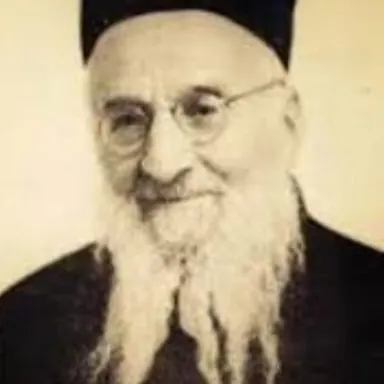
Rabbi Ovadia Hadaya: Between the Revealed and the Hidden at the Threshold of Redemption
13 min read2,503 words
Summary
The text surveys the life and teaching of Rabbi Ovadia Hadaya, who was one of the senior halakhic decisors and kabbalists of the twentieth century and served as a bridge between the old Torah world of Aleppo and the renewing Israeli reality. The author emphasizes the unique structure of his central work, "Yaskil Avdi," which synthetically combines the revealed Torah with the mystical depth of Kabbalah, while addressing technological and modern questions. The chapters of the article describe his public activity as a judge on the Great Rabbinical Court and as the one who restored the kabbalists' yeshiva "Beit El" after the destruction of the Old City, thereby ensuring the continuity of the line of spiritual leadership. Finally, the source highlights his Zionist-kabbalistic conception, which saw the establishment of the State of Israel as an essential stage in the process of redemption, and explains how his legacy continues to influence the character of the Sephardi rabbinate today.
The Torah Teaching and Public Work of Rabbi Ovadia Hadaya: Between the Revealed and the Hidden at the Threshold of Redemption
Processes of Formation and Growth: The Roots of the Hadaya Family and the Aleppo-Jerusalem Connection
The figure of Rabbi Ovadia Hadaya represents one of the most impressive and significant chapters in the history of the Sephardi rabbinate and of halakhic-kabbalistic thought in the twentieth century. Investigating his work requires a deep understanding of the cultural and spiritual space in which he grew up, a space that combines the strict and precise tradition of the sages of Aram Tzova (Aleppo) with the mystical depth of the kabbalists of the Beit El yeshiva in Jerusalem. The Rabbi was born in the month of Kislev 5650 (late December 1889) in the city of Aleppo in the Ottoman Empire, to a family steeped in generations of Torah and rabbinic judgeship.[1, 2] His father, Rabbi Shalom Hadaya, was an exemplary figure who served as a critical connecting link between the old world and the new; he was known as a giant in both the revealed and the hidden Torah, and although he was struck with blindness, he continued to serve as a judge in Jerusalem and later as head of the Beit El kabbalists' yeshiva.[3]
The family's move to the Land of Israel in 5658 (1898) was not accidental, but stemmed from a combination of medical need and religious longing. His father first went to Alexandria for an operation on his eyes, but the journey ended in immigration to Jerusalem, a step that shaped the future of the young Rabbi Ovadia.[1] In Jerusalem, Rabbi Ovadia was absorbed into the educational institutions of the Sephardi community, from the "Doresh Zion" Talmud Torah to the "Chesed Avraham" and "Tiferet Yerushalayim" yeshivot.[1, 2] His early education was characterized by a synthesis between the study of the plain meaning and the esoteric tradition, as his father hired for him the kabbalist Rabbi Shalom Buhbut as a private tutor in the foundations of Kabbalah already at the age of 17.[1, 2] His spiritual development was also greatly influenced by the kabbalists Rabbi Yitzchak Sharim and Rabbi Yitzchak Alfiya, who instilled in him the unique approach of the sages of the East: an inseparable combination of practical halakha and kabbalistic depth.[1]
The family foundations of Rabbi Hadaya offer a rare view of the Torah network of connections of that period. On his mother's side, Rabbanit Sarah, he was the grandson of Rabbi Yitzchak Labaton, and on his father's side the grandson of Rabbi Moshe Chaim Hadaya.[2] These connections were expanded through his marriage to Rabbanit Tzalcha (Shulamit), daughter of Rabbi Ezra Sharim, a step that linked him to the families of the Torah elite of Aleppo émigrés in Jerusalem.[1, 2] During the First World War, the Rabbi found himself in a complicated political reality; to avoid conscription into the Turkish army, he fled back to his native city of Aleppo for four years, where he continued to delve into Torah far from the din of the battles in the Land of Israel.[1]
Key Milestones in His Life
Torah Leadership in the Porat Yosef Yeshiva and in the Petah Tikva Community
With the founding of the "Porat Yosef" yeshiva in the Old City in 5683, Rabbi Hadaya became one of the dominant figures in teaching the revealed and the esoteric. His role as a ram (yeshiva lecturer) was not limited to transmitting knowledge alone, but included comprehensive spiritual guidance in the spirit of the sages of the East. He was especially active in the "Oz ve-Hadar" yeshiva, which operated within the framework of Porat Yosef, where he led the prayers according to the kavanot (mystical intentions) of the Ari.[1] Evidence of his spiritual asceticism and devotion can be found in reports of his service as prayer leader on Yom Kippur, when he stood on his feet from sunrise until the Neila prayer without a break, wholly concentrated on the intentions of prayer and detached from bodily fatigue.[2]
In 5699 (1939), the field of his public activity expanded with his appointment as Sephardi Chief Rabbi of Petah Tikva. His tenure in this city, which lasted some 12 years, was a period that tested his ability to lead a community undergoing processes of modernization and secularization within the New Yishuv.[1, 2] In Petah Tikva the Rabbi acted not only as a halakhic decisor, but as a communal leader who preached in the synagogues and drew the public closer to tradition. His success in this role paved his way to the Council of the Chief Rabbinate and to the Great Rabbinical Court of Appeals in Jerusalem, to which he was appointed in 1951.[1, 6] His role on the Great Rabbinical Court placed him at the forefront of the halakhic decisions of the young state, where he was required to apply his immense expertise in the Talmud and the decisors to complex social and personal questions.
Public Roles and Judicial Powers
Halakhic Phenomenology: The Responsa "Yaskil Avdi" as a Junction of the Revealed and the Hidden
Rabbi Hadaya's monumental literary enterprise centers on the eight volumes of questions and answers (responsa) "Yaskil Avdi." This work is not merely a collection of halakhic rulings, but an expression of a unique methodology that combines the various fields of Torah knowledge. In each volume the Rabbi made a point of adding a section called "Da'at ve-Haskel," devoted to questions and answers in the esoteric teaching, which underscores his conception that halakha and Kabbalah draw from the same divine root.[2, 3] His rulings are characterized by independent thinking and wide-ranging knowledge, which made him an address for questioners from all over the Jewish world, including Ashkenazi communities in Poland, Lithuania and Hungary.[2]
In his books Rabbi Hadaya addressed many technological and modern questions, among them questions concerning electricity, radio and innovative medical equipment. His approach was probing and thorough; he did not rush to forbid or permit, but analyzed the new physical reality on the basis of the sources of the Talmud and the decisors.[7] In addition to the responsa, he composed the books "Eved ha-Melekh" on Maimonides (Rambam), "Avda de-Rabbanan" on the Talmud, and "Va-Yikach Ovadyahu" on homiletics, titles that express his worldview as a "servant of God" who devotes his entire being to clarifying the truth of the Torah.[2] In 5728 he received official recognition of his enterprise when he was awarded the Israel Prize for Torah literature, after having won the Rav Kook Prize in 5719.[1]
The Beit El Yeshiva: Preserving the Tradition Amid Destruction and Revival
The story of the kabbalists' yeshiva "Beit El" under the leadership of Rabbi Hadaya is a parable of the revival of the Jewish spirit in Jerusalem. The yeshiva, which was originally founded in the Old City and was a center for the greatest kabbalists (among them the Rashash and the Chida), underwent a severe upheaval in the War of Independence. With the fall of the Jewish Quarter in 5708, the yeshiva building was destroyed and Rabbi Hadaya was forced to find alternative ways to continue its activity.[2, 3] After his father's death in 5705, he was appointed head of the yeshiva, and in 5714 (1954) he began the operation of restoring it in the New City of Jerusalem.[3, 4]
At first the institution operated in the "Midrash Mattalon" synagogue, but in 5718 (1958) the Rabbi dedicated the yeshiva's new building on the roof of his private house in the Yegia Kapayim neighborhood (Rashi Street). The building, adorned with an impressive dome, became a spiritual center in which the mekhavnim (those who pray with mystical intentions) continued to pray and study according to the tradition of "Beit El."[3, 4] To secure the future of the Torah world, he also established in the same place the "Shalom Avdo" yeshiva for the study of the revealed Torah, out of the understanding that Kabbalah cannot exist without a firm foundation of plain meaning and halakha.[3, 6] After his death in 5729, the yeshiva continued to operate under the leadership of his son, Rabbi Shalom Mordechai Chaim Hadaya, and his grandson, Rabbi Refael Hadaya.[3]
The Line of Leadership in the Beit El Yeshiva
His Zionist-Kabbalistic Teaching: The State as the Beginning of Redemption
One of the most fascinating aspects of Rabbi Hadaya's personality was his positive and active attitude to the Zionist movement and to the establishment of the State of Israel. Unlike some of his colleagues on the Council of Torah Sages or in certain circles in Jerusalem, Rabbi Hadaya saw the modern Return to Zion as an event of deep mystical significance. He argued that the success of the Zionist enterprise, despite its being mostly secular, is proof of "help from Heaven," since nothing comes into being in the lower world without approval and consent in the upper worlds.[6] In his view, the Holy One, blessed be He, showed Adam the first man the entire history of Israel, including the establishment of the state and its leaders, and therefore they should be seen as instruments in the overall divine plan.[6]
The Rabbi defined the period as "Atchalta de-Geula" (the beginning of the redemption), a concept he used to encourage immigration to the Land and to strengthen the hands of the settlers. He boldly confronted the question of the "Three Oaths" (a midrash forbidding active immigration and rebellion against the nations), and argued – relying on the Zohar and on the words of the Chida – that the validity of the oaths expired after a thousand years of exile.[6] Therefore, in the kabbalist's generation, there was a religious obligation to act actively for the sake of redemption. He even proposed an original interpretation of the sins of the generation: relying on the words of Rabbi Avraham Azulai, he argued that one whom the Land does not vomit out is considered righteous in a certain sense, and therefore the tens of thousands of immigrants merit spiritual rectification by the very fact of their dwelling in the Land.[6]
The Connection with Chabad Hasidism and the Lubavitcher Rebbe
Another facet revealed in recent studies is the deep Torah connection between Rabbi Hadaya and the Lubavitcher Rebbe, Rabbi Menachem Mendel Schneerson. The connection found expression in an exchange of letters and in tremendous mutual esteem. In a letter from 5719 (1959), the Rebbe thanked Rabbi Hadaya for sending the fifth volume of "Yaskil Avdi" and praised the combination of the revealed and the hidden, a combination consistent with the method of Hasidism.[3] The Rebbe encouraged Rabbi Hadaya to establish regular classes in books of Hasidism, relying on the words of the Arizal that in these generations it is a commandment to reveal the esoteric wisdom.[3]
The use of lofty titles such as "great in deeds, who sits in judgment" on the part of the Rebbe testifies to the international standing of Rabbi Hadaya as a decisor and a kabbalist.[3] The exchange of books and of Torah comments in the margins of the pages reflects a dialogue between two kabbalistic schools – the Sephardi-Jerusalem and the Hasidic-Chabad – which found a common language in the struggle to spread the wellsprings of the Torah outward and to hasten the redemption.
Legacy and Disciples: Shaping the Face of the Sephardi Rabbinate in the Next Generation
The influence of Rabbi Ovadia Hadaya was not limited to his books alone, but was spread through his disciples, who became central spiritual leaders. The two most prominent disciples are Rabbi Mordechai Eliyahu, later the Rishon LeZion and Chief Rabbi of Israel, and Rabbi Meir Yehuda Getz, who was the rabbi of the Western Wall.[1, 6] These disciples imbibed from him the unique combination of halakhic precision with kabbalistic depth and unconditional love of Israel. Rabbi Eliyahu, for example, continued his teacher's path in rulings that incorporate the words of the kabbalists, while Rabbi Getz continued the task of restoring the Beit El yeshiva in the Old City after the Six-Day War.[4, 8]
The Rabbi's spiritual figure was portrayed as one that unites opposites: a firm judge on the Great Rabbinical Court together with a pious and humble man in his prayer.[2] His death on the Sabbath, 20 Shevat 5729, at the time of Mincha – a time considered in Kabbalah to be a time of ra'ava de-ra'avin (the will of wills) – was perceived by his followers as a symbolic conclusion to the life of a man who cleaved to the upper worlds while acting in this world.[2] He was buried on Har HaMenuchot in Jerusalem, leaving behind him a legacy of a complete Torah, uniting plain meaning and the esoteric, state and holiness.
His Main Torah Works
Summary and Assessment of His Work
Rabbi Ovadia Hadaya was a bridging figure in a period of tremendous historical change. He succeeded in preserving the distinctiveness of the Sephardi-halakhic and Jerusalem-kabbalistic tradition, while giving it a modern face relevant to the reality of a sovereign state. His Zionist-kabbalistic approach provided deep religious legitimacy to the national movement, and his halakhic rulings in the responsa "Yaskil Avdi" remain to this day an inexhaustible source for scholars and decisors. His work in restoring the Beit El yeshiva and training the future generation of the rabbinate in Israel ensure that his name will be remembered as one of the great figures of Torah and spirit who arose for the Jewish people in the generation of revival. In his writing and in his leadership, the Rabbi realized his aspiration to be "the servant of the King" – faithful to his sources, devoted to his people, and looking toward a future of complete redemption.
Sources9
- 1.עובדיה הדאיה – ויקיפדיה, he.wikipedia.org/wiki/עובדיה_הדאיה
- 2.mytzadik.com,
- 3.mytzadik.com/m/tzadik.aspx?id=664
- 4.חב״ד און ליין - COL מרכז התקשורת החב״די - קבלה, מלחמה וחורבן: הקשר בין ..., col.org.il/news/146118
- 5.ישיבת המקובלים בית אל - ויקיפדיה, he.wikipedia.org/wiki/ישיבת_המקובלים_בית_אל
- 6.הגאון המקובל רבי עובדיה הדאיה זצ"ל - ערוץ מאיר - אתר היהדות הגדול בעולם, meirtv.com/alon-1700/
- 7.הרב עובדיה הדאיה – משנתו הציונית קבלית – שערים, shearim.org.il/הרב-עובדיה-הדאיה-משנתו-הציונית-קבלית/
- 8.הרב עובדיה הדאיה – ויקישיבה, yeshiva.org.il/wiki/index.php/הרב_עובדיה_הדאיה
- 9.ישיבת המקובלים בית אל – ויקישיבה, yeshiva.org.il/wiki/index.php/ישיבת_המקובלים_בית_אל