מסמך 1/2
The Theological and Educational Legacy of Rabbi Chaim of Volozhin: Nefesh HaChaim, the Yeshiva Movement, and the Mitnagdic-Hasidic Dialectic
14 דק׳ קריאה2,866 מילים
תקציר
מקור זה סוקר את פועלו של רבי חיים מוולוז'ין, דמות המפתח שעיצבה את עולם הישיבות הליטאי ותפקדה כגשר תיאולוגי ומבני בעידן של תמורות רוחניות. הטקסט מציג את משנתו המטפיזית המופיעה בספר "נפש החיים", שבו הוא מגדיר את לימוד התורה כציר מרכזי המשפיע על העולמות העליונים ומציע פתרון ייחודי לסוגיית נוכחות האל במציאות המקדש את ההלכה. לצד ההגות, המאמר מפרט את המהפכה המוסדית שחולל בייחוד דרך הקמת ישיבת וולוז'ין, שהפכה לאב-טיפוס לאקדמיות תורניות עצמאיות ומקצועיות המגדלות דורות של מנהיגים. לבסוף, המקור עומד על גישתו המתונה בעימות עם החסידות ועל מורשתו ההלכתית והחינוכית הממשיכה להדהד ולהגדיר את פני היהדות האורתודוקסית בת זמננו.
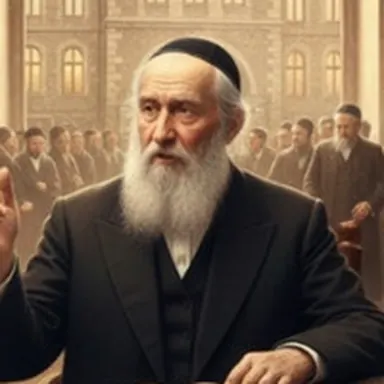
Rabbi Chaim of Volozhin (1749–1821), born Chaim Itzkovich, stands as the principal intellectual and structural architect of the Lithuanian yeshiva world.[1, 2] Over a prolific life of seventy-two years, he fundamentally altered the course of Eastern European Jewish history.[1, 3] Trained by some of the greatest rabbinic minds of his era—including Rabbi Raphael Ziskind Hakohen of Hamburg, Rabbi Aryeh Leib Gunzberg (the Sha'agat Aryeh), and his ultimate mentor, the Vilna Gaon (the Gra)—Rabbi Chaim synthesized elite rabbinic scholarship with a highly organized institutional framework.[2] Operating during a period of deep communal and spiritual crisis, marked by the rapid expansion of the Hasidic movement, Rabbi Chaim developed a sophisticated response that was both intellectually robust and practically constructive.[2, 4] Rather than relying solely on the fierce excommunications championed by his teacher, he formulated a grand theological system in his masterpiece, Nefesh HaChaim, written between 1780 and 1820, which re-established classical Talmud study as the ultimate channel of divine communion and cosmic preservation.[2, 5, 6] His monumental life's work culminated in the founding of the Volozhin Yeshiva in 1802, a revolutionary institution that redefined Jewish education and served as the prototype for all subsequent Lithuanian academies.[4, 7, 8]
The Cosmological Metaphysics of Nefesh HaChaim
In Nefesh HaChaim, Rabbi Chaim outlines a highly complex cosmological system that synthesizes Lurianic Kabbalah with classic rabbinic thought.[5, 6] Central to this system is the role of the human being as a potent cosmic actor.[9] Rejecting any notion of human insignificance, Rabbi Chaim posits that every thought, word, and physical deed of a Jew reverberates throughout the celestial hierarchy.[9] Human behavior serves as the ultimate regulator of the flow of divine abundance; constructive actions fortify the spiritual worlds, while transgression damages the cosmic channels.[9]
This cosmological framework is vividly illustrated in his exposition on the metaphysics of sorcery (keshafim) in Gate III, Chapter 12 of Nefesh HaChaim.[10] According to Rabbi Chaim, God established a parallel hierarchy of impure spiritual forces, referred to as the "impure chariot" (merkava tameiah), which possesses the ability to override natural laws and the astrological arrangements (mazalot) set at the time of creation.[10] The Sanhedrin was historically required to study these arts to recognize and counteract their influence.[10]
Rabbi Chaim analyzes the talmudic narrative of Rabbi Hanina, who remained entirely immune to a sorceress attempting to cast a spell on him.[10] When the sorceress attempted to gather soil from beneath his feet, Rabbi Hanina encouraged her, declaring that her efforts would fail because "it is written: 'There is none else besides Him' (Ain Od Milvado)".[10] The Talmud objects that sorcery is named such because it "denies the heavenly retinue" (makhchishin pamalia shel ma'alah), and suggests that Rabbi Hanina was only safe because "his merit was great".[10] Rabbi Chaim refines this by providing a profound psychological interpretation: Rabbi Hanina did not arrogantly rely on his own righteous deeds.[10] Rather, Rabbi Hanina had achieved such an absolute, unshakeable internal alignment with the truth of divine unity that, in his mind, the impure forces were completely nullified.[10] Because he recognized that these forces possess no independent power outside of the divine will, his consciousness physically dissolved their influence.[10]
The Dialectic of Tzimtzum and the Nature of Divine Presence
This metaphysical structure rests upon a delicate resolution of the kabbalistic concept of Tzimtzum (the divine contraction).[11, 12] Since the revelation of the teachings of the Ari (Rabbi Isaac Luria) by Rabbi Hayyim Vital, Jewish thinkers grappled with whether this contraction was literal (kifshuto)—implying a physical withdrawal of God's essence to make space for the universe—or metaphorical (lo kifshuto)—implying a concealment of divine light from the perspective of creation.[12, 13, 14]
To resolve the philosophical contradictions of this stance, Rabbi Chaim introduced a dual-perspective framework distinguishing between the divine reality "from His side" (Mitzado), where God's presence remains a simple, absolute, and unchanged unity, and "from our side" (Mitzadenu), where the material world appears real and divided.[11, 16]
Within this framework, Rabbi Chaim introduces the concept of the Kav (the divine line of light).[11, 16] According to Rabbi Chaim, the Kav is the breakthrough of the divine perspective (Mitzado) directly into our bounded consciousness (Mitzadenu).[16] This breakthrough is nothing other than the Torah itself.[16] The Torah is the direct manifestation of God's simple, unified reality within the fragmented human mind.[16] This theological position allowed Rabbi Chaim to validate the Hasidic claim that "there is no place empty of Him" (leit atar panui minei) [13, 14], while simultaneously defending the strictures of Halakha.[2] Since the material world and its impurities exist "from our side," the halakhic prohibitions against praying in physically unclean spaces remain fully binding.[12]
This view creates a sharp contrast with Chabad: Rabbi Shneur Zalman of Liadi viewed Torah study as a means to achieve bittul (nullification of the self) to reveal the divinity within the physical world.[16, 17] By contrast, Rabbi Chaim of Volozhin used the Torah to nullify the physical world itself, exposing the divine reality already residing within the human soul.[16]
Torah Lishmah and the Economy of Fear
The most prominent ideological battleground between Lithuanian Mitnagdim and Hasidism centered on the definition of Torah Lishmah (Torah study for its own sake).[2, 4] Norman Lamm's landmark study, Torah Lishmah in the Thought of Rabbi Chaim of Volozhin and the Thought of the Generation (1972), highlights how Rabbi Chaim redefined "Torah Lishmah" as an intellectual, cognitive discipline.[18] To Rabbi Chaim, studying "for its own sake" does not mean studying to achieve a warm, emotional state of mystical attachment (devekut).[17, 19] Instead, it means studying "for the sake of the Torah itself"—with the singular cognitive goal of understanding, clarifying, and mastering the text and its laws.[17, 19] For Rabbi Chaim, the intellectual act of understanding a page of the Talmud is, in itself, the highest form of devekut.[17] Because the Torah and the Divine Will are ontologically one, a student who grasps the intellectual mechanics of a law literally incorporates the divine wisdom within their mind.[17] This academic focus was not limited to legal codes (Shas and Poskim); Rabbi Chaim integrated all theological fields, including Kabbalah and Jewish philosophy, into his intellectual framework, seeking to expand study beyond the narrow four cubits of practical Halakha.[20]
Rabbi Chaim recognized that studying with pure, selfless intent is a high spiritual rung that cannot be forced at the outset.[21] Citing the talmudic dictum that "from [learning] shelo lishmah (not for its own sake), one arrives at lishmah," he explained that starting with ulterior motives—such as intellectual pleasure, social prestige, or peace of mind—is not only acceptable but is the necessary starting point.[21] One must climb this ladder sequentially rather than attempting to skip essential developmental stages.[21]
While Rabbi Chaim agreed that the fear of God (Yir'ah) is an essential container to preserve Torah knowledge [19], quoting classical sources such as Yoma 72b, Shemot Rabbah 40:1, and the Zohar to establish that fear is the essential gate and container for wisdom, he cautioned against spending excessive time reading ethical or devotional treatises.[19] A student who is fully immersed in Torah study does not need to spend valuable time reading ethical manuals (sifrei yirah).[19] The intellectual sweetness of the Torah itself naturally implants the fear of God in the heart, acting as its own moral and spiritual preservative.[19]
Mitnagdic Moderation and the Hasidic Dispute
Unlike the fierce excommunications and absolute opposition to Hasidism demonstrated by the Vilna Gaon, Rabbi Chaim adopted a highly moderate and constructive stance.[2, 3] He recognized that a purely negative campaign would fail, choosing instead to establish a positive intellectual alternative.[2, 3] When a relative of his showed inclinations toward Hasidism, Rabbi Chaim did not excommunicate him but gave him three strict boundaries:
- Gemara study must remain his absolute primary focus.[2]
- He must never transgress any halakhic rulings derived from the Gemara.[2]
- He must never speak disparagingly of Torah scholars, particularly the Vilna Gaon.[2]
This moderate attitude is highlighted by a historical anecdote involving Rabbi Chaim's great-grandson, Rabbi Chaim Halevi Soloveitchik, and the fifth Lubavitcher Rebbe, Rabbi Sholom Dovber (the Rashab).[17] During a Shavuot festival meal, the Rashab asked Rabbi Chaim Halevi to share a Torah teaching.[17] He expounded on Psalm 19:8, "The Torah of Hashem is perfect (temimah), restoring the soul (meshivat nefesh)".[17] Citing a midrashic debate on whether the Torah is perfect because it restores the soul or vice versa, he explained that the Torah's capacity to restore the soul—drawing the student back to spiritual health—depends entirely on the Torah being studied in its "perfection" (temimah).[17] This perfection requires that the study is unblemished by foreign motivations and that the student carries no yoke other than the yoke of Heaven and the commandments.[17]
The Architectural and Educational Model of Etz Chaim
To ground his theological vision of Torah study as the cosmic engine of creation, Rabbi Chaim established the Volozhin Yeshiva (known as Etz Chaim) in 1802.[7, 8, 19] In his founding circular, he lamented the contemporary decline in Torah study and the physical hardships faced by young scholars.[8] Prior to Volozhin, advanced Jewish education was highly decentralized; local communities hosted small groups of students who relied on the charity of local householders for daily meals (a practice known as "eating days" or teg essen).[8] The testimonies of his students noted that before Volozhin was founded, the yeshiva system was virtually nonexistent, and the Jewish educational world lay in desolation and chaos.[8]
Rabbi Chaim introduced a series of revolutionary reforms that transformed the yeshiva from a local academy into a national, and eventually global, institution.[8] He established a centralized fundraising network modeled after the collections for the Jewish community in the Land of Israel, allowing the yeshiva to remain financially independent of the town of Volozhin.[8] The degrading practice of "eating days" was abolished, and the yeshiva provided students with a reliable weekly stipend, allowing them to lease private rooms and buy hot meals, thereby fostering a sense of professional dignity.[8] Embodying the belief that constant study prevents the universe from collapsing into chaos, the yeshiva operated without formal semesters (zmanim) or vacations, and study continued day and night.[8, 19]
Micha Josef Berdyczewski's vivid account describes the physical space of the yeshiva as a grand, multi-story brick palace with a vast study hall resting on four massive central pillars.[8] It contained a Gemach room, an office for distributing tractates, and a dedicated smoking room to enforce a strict ban on smoking in the sacred study hall.[8] Under the leadership of the Netziv (Rabbi Naftali Zvi Yehuda Berlin), a structured daily lecture on the Pentateuch was introduced immediately after morning prayers, which laid the foundation for his classic commentary, Ha'amek Davar.[8]
The yeshiva faced a tragic closure in 1892.[7] The Tsarist Ministry of Education demanded that more than half of the study hours (from 9 AM to 3 PM) be dedicated to secular subjects, that evening studies be banned, that total study hours be limited to ten, and that all staff possess official state diplomas.[7] Refusing to compromise the purity of the yeshiva's spiritual mandate, the directors chose to close the institution rather than yield to state coercion.[7] Although the building was vacated and no Jewish community remains in Volozhin today, the structure is still preserved as a monument of Jewish national heritage.[8]
Halakhic Authority and Liturgical Praxis in Chut HaMeshulash and Keter Rosh
Beyond his metaphysical and educational achievements, Rabbi Chaim's daily practices and legal rulings were meticulously documented by his disciples, providing a comprehensive framework for Mitnagdic religious life.[22, 23] This practical guidance is preserved in texts such as Keter Rosh (also known as Orchot Chaim) [22, 24] and the responsa volume Chut HaMeshulash ("The Threefold Cord").[25, 26]
The responsa in Chut HaMeshulash focus almost entirely on Yoreh Deah, Even HaEzer, and Choshen Mishpat, containing almost no discussion of Orach Chaim.[25] This indicates that the questions sent to Volozhin from all over Europe were not about basic daily rituals, but about highly complex communal, financial, and family law, reflecting the yeshiva's status as a global supreme court of halakhic authority.[25]
Conversely, the ritual guidance in Keter Rosh details Rabbi Chaim's daily liturgical practices and personal stringencies.[22, 24] He maintained a strict adherence to congregational prayer (b'Tzibbur), never praying alone from the moment he reached intellectual maturity, even hiring villagers to travel to his inn while on journeys to ensure a minyan.[24]
This liturgical precision is illustrated by a narrative from his son Rabbi Yosef's wedding in Radashkovich.[24] When a Torah scroll was unavailable for the weekly reading, Rabbi Chaim insisted on traveling to find one.[24] An older rabbi dismissed the need, and Rabbi Chaim reluctantly deferred to his seniority.[24] Upon returning to Volozhin, Rabbi Chaim discovered that his personal Torah scroll was missing a sheet—specifically, the exact weekly reading that had been skipped during the wedding.[24] Viewing this as a measure-for-measure divine punishment (mida knegad mida), he isolated himself in prayer and confession, subsequently finding that while the scroll had been recovered, that specific sheet was indeed physically lost.[24]
In his liturgical philosophy, Rabbi Chaim compared prayer without concentration (kavanah) to a minchah (meal) offering, which lacks a living soul, while prayer with concentration was compared to the tamid (continual) animal offering.[24] He stressed that when reciting "Amen," one must fully concentrate on its meaning ("may it be so"), and warned that an "Amen" muttered without focus possesses no spiritual merit.[24]
He dismissed swaying during prayer (nenu'im) as a tool originally intended only to prevent sleep (as cited in the Shelah), though spontaneous swaying born of genuine spiritual ecstasy was praised.[24] He preferred praying directly facing a wall, though praying behind another person was acceptable if space was limited.[24] He clarified that the talmudic instruction to evaluate one's concentration before praying applies only when a person has already prayed once without concentration and is considering a second, voluntary prayer, but it should not be used to delay or skip the primary, obligatory prayer.[24]
Institutional Progeny and the Continuity of the Volozhin Tradition
The intellectual environment created by Rabbi Chaim of Volozhin served as the breeding ground for the most influential figures of modern Orthodox Judaism, religious Zionism, and the Lithuanian yeshiva movement.[7]
Theoretical Synthesis and Modern Echoes
The synthesis achieved by Rabbi Chaim of Volozhin represents one of the most resilient structures in modern Jewish history. By constructing a sophisticated metaphysical system in Nefesh HaChaim, he elevated the study of the Talmud from an intellectual exercise into a cosmic, redemptive act.[5, 16] By grounding this theology in the physical reality of the Volozhin Yeshiva, he created an institutional blueprint that preserved rabbinic Judaism through the storms of modernity, secularization, and political upheaval.[7, 8]
His balanced approach—incorporating deep kabbalistic insights while maintaining strict fidelity to classic halakhic frameworks, and choosing moderation over hostile excommunication in his dealings with Hasidism—cemented his status as the true father of the modern yeshiva world.[2, 3, 5] The ripples of his educational and theological revolution continue to define the parameters of traditional Jewish thought and practice to this day.[8]
מקורות28
- 1.מחבר:חיים מוולוז'ין - ויקיטקסט, he.wikisource.org/wiki/מחבר:חיים_מוולוז'ין
- 2.חיים מוולוז'ין - ויקיפדיה, he.wikipedia.org/wiki/חיים_מוולוז'ין
- 3.רבי חיים מוולוז'ין - י"ד סיון » ברסלב סיטי, breslevcity.co.il/הילולת-הצדיקים-יד-סיון-רבי-חיים-מוולוז/
- 4.ר' חיים מוולוז'ין והפולמוס עם החסידות על פי נפש החיים וספרות השאילתות - אוניברסיטת אריאל, ariel.ac.il/wp/moreshet-israel-jurnal/2020/11/03/ר-חיים-מוולוזין-והפולמוס-עם-החסידות-ע/
- 5.נפש החיים – ויקיפדיה, he.wikipedia.org/wiki/נפש_החיים
- 6.נפש החיים | ספריית ספריא, sefaria.org.il/Nefesh_HaChayim
- 7.ישיבת וולוז'ין – ויקישיבה, yeshiva.org.il/wiki/index.php/ישיבת_וולוז'ין
- 8.ישיבת עץ חיים בוולוז'ין בשפלותה – יבי"ן - יוחנן בן יעקב, yavin.co.il/?p=1694
- 9.נפש החיים/שער א - ויקיטקסט, he.wikisource.org/wiki/נפש_החיים/שער_א
- 10.נפש החיים, שער ג י״ב:ג | ספריית ספריא, sefaria.org.il/Nefesh_HaChayim,_Gate_III.12.3
- 11.נפש החיים/שער ג/פרק ז - ויקיטקסט, he.wikisource.org/wiki/נפש_החיים/שער_ג/פרק_ז
- 12.צמצום הראשון - חב"דפדיה, chabadpedia.co.il/wiki/צמצום_הראשון
- 13.צמצום לא כפשוטו - הרב מיכאל אברהם, mikyab.net/שות/צמצום-לא-כפשוטו-2/
- 14.צמצום (קבלה) – ויקישיבה, yeshiva.org.il/wiki/index.php/צמצום_(קבלה)
- 15.מעיינותיך. פולמוס הצמצום בין גדולי המחשבה, toratchabad.com/פולמוס-הצמצום-בין-גדולי-המחשבה
- 16.המתמיד: מ"נפש החיים" ועד ר' חיים - צריך עיון, iyun.org.il/sedersheni/rabbi-chaim-kanievsky-and-nefesh-hachaim/
- 17.לקשר נפשו לה'" או "להוסיף לקח ופלפול"? - מעיינותיך, toratchabad.com/לקשר-נפשו-לה-או-להוסיף-לקח-ופלפול-2
- 18.נחום לאם, "תורה לשמה במשנת רבי חיים מוולוז"ין ו, bookreader.nli.org.il/NliBookViewer/?ie_pid=IE47486755
- 19.נפש החיים/שער ד - ויקיטקסט, he.wikisource.org/wiki/נפש_החיים/שער_ד
- 20.תורת וולוז'ין: האמנם ד' אמות של הלכה בלבד? - צריך עיון, iyun.org.il/sedersheni/the-torah-of-volozhin/
- 21.אני מברך אותך שתזכה ללמוד תורה שלא לשמה! - דרשו, dirshu.co.il/220559/
- 22.כתר ראש - סט – מכון ירושלים - Machon Yerushalayim, machon-y.com/product/כתר-ראש-סט/
- 23.כתר ראש - הנהגות רבינו הגר"ח מוואלאזין / הוצאה חדשה ומפוארת - אוצר הספרים, sefer.org.il/items/7444435-כתר-ראש-הנהגות-רבינו-הגר-ח-מוואלאזין-הוצאה-חדשה-ומפוארת-הוצאה-לאור-קולמוס
- 24.ארחות חיים (כתר ראש) - ויקיטקסט, he.wikisource.org/wiki/ארחות_חיים_(כתר_ראש)
- 25.חוט המשולש - ויקיפדיה, he.wikipedia.org/wiki/חוט_המשולש
- 26.חיים מוולוז'ין - איגוד יוצאי וילנה והסביבה בישראל, vilna.co.il/היסטוריה-ומורשת/אישים/רבנים-ואנשי-דת/חיים-מוולוזין/
- 27.רוח חיים - אבות - חיים בן יצחק, מוולוז'ין, 1749-1821 (page 2 of 125) - HebrewBooks, hebrewbooks.org/pdfpager.aspx?req=5303&st=&pgnum=2
- 28.מסכת אבות - ויקיפדיה, he.wikipedia.org/wiki/מסכת_אבות