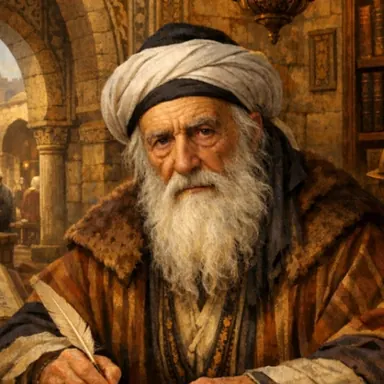
The Life and Intellectual Legacy of Rabbi Saadia Chouraqui: A Synthesis of Science, Rabbinics, and Rationalism in 17th-Century Tlemcen
11 דק׳ קריאה2,299 מילים
תקציר
הטקסט סוקר את דמותו הרב-גונית של רבי סעדיה שוראקי, מנהיג רוחני ואיש אשכולות שפעל בעיר תלמסאן שבאלג'יריה במהלך המאה ה-17. חיבור זה מדגיש את השילוב הייחודי בין עולם ההלכה למדע הרציונלי, כפי שבא לידי ביטוי בספרו המתמטי "מנה מספר" אשר שימש ככלי פדגוגי ללימודי חול וקודש כאחד. המחבר מנתח כיצד שוראקי שימר את מורשת ספרד המדעית בצפון אפריקה, תוך שהוא נאבק בתקיפות בתנועת השבתאות כדי להגן על יציבותה המסורתית של הקהילה. לסיכום, המקור מציג את פועלו כגשר אינטלקטואלי הממזג לוגיקה, שירה ואמונה, ומותיר חותם תרבותי עמוק המהדהד עד לשושלת משפחתו בעת המודרנית.
The seventeenth century in the Maghreb represented a period of profound cultural transition, where the remnants of the Sephardic Golden Age integrated with the local traditions of North African Jewry under the umbrella of Ottoman governance. At the epicenter of this intellectual fusion stood Rabbi Saadia Chouraqui (1603–1704), a figure whose life and work provide a comprehensive window into the "Jerusalem of the West"—the Jewish community of Tlemcen, Algeria.[1, 2] Rabbi Saadia was not merely a local communal leader; he was a polymath who bridged the gap between the rigorous demands of rabbinic law and the systematic beauty of the mathematical sciences. His work, Mone Mispar, stands as a landmark in the history of Jewish education in the Maghreb, representing one of the earliest instances of a formal mathematics treatise written in Hebrew for the specific purpose of religious and communal instruction.[2] Furthermore, his staunch opposition to the Sabbatean movement during its peak in the mid-seventeenth century underscores a commitment to a rationalist, traditionalist framework that defined the Algerian rabbinate for generations.[1]
Historical Foundations of Tlemcen Jewry: The Jerusalem of the West
To understand the scope of Rabbi Saadia Chouraqui’s work, the socio-cultural environment of Tlemcen must be analyzed in its historical depth. Tlemcen earned its moniker as the "Jerusalem of the West" not merely for its piety but for its role as a sanctuary for Jewish scholarship following the successive upheavals of the Iberian Peninsula.[2] The community’s character was fundamentally transformed by the arrival of Spanish refugees (Megorashim) following the persecutions of 1391 and the final expulsion in 1492.[2, 3] These exiles brought with them the high Sephardic culture, characterized by a unique integration of Torah study with philosophy, medicine, and the sciences.
The most influential figure of this transition was Rabbi Ephraim Encaoua (Anqāwa), a physician and theologian from Toledo who arrived in Tlemcen in 1391.[2, 3] Encaoua’s legacy established the community as a bastion of Sephardic rationalism. He is credited with obtaining the right for Jews to live inside the city walls; previously, they were relegated to Agardir.[2] By the time Saadia Chouraqui was born in 1603, the community had successfully integrated the Megorashim (exiled) and the Toshavim (autochthonous Jews), with the Spanish influence remaining dominant in liturgy and rabbinic methodology.[2] This dual heritage provided the fertile soil in which Chouraqui’s polymathic interests could grow.
The socio-political dynamics of the seventeenth century, during which Rabbi Saadia lived nearly in its entirety, were characterized by relative stability under Ottoman rule, punctuated by moments of local volatility. The Jewish community enjoyed a degree of autonomy, yet they were subject to the whims of local governors and the broader Mediterranean geopolitical struggle. For instance, in 1517, Ottoman pirate raids had led to the loss of Jewish property and the imposition of restrictive clothing.[2] However, by the 1600s, the community had established a robust internal structure. This environment necessitated leaders who could defend the community not only from external threats but also from internal theological fissures. Rabbi Saadia’s education, which combined traditional Talmudic mastery with philosophy and mathematics, was a direct response to the need for a well-rounded, rational leadership that could navigate these complexities.[1]
The Mathematical Contribution: Mone Mispar
The most distinct element of Rabbi Saadia Chouraqui’s legacy is his contribution to the mathematical sciences. In an era where secular studies were often viewed with suspicion in many parts of the Jewish world, the Maghrebi tradition—inherited from the Spanish Golden Age—maintained that mathematics was an essential tool for the religious scholar.[2, 4] His treatise, Mone Mispar (The Calculator of Numbers), written in Hebrew, was designed as a pedagogical tool for Jewish students in Tlemcen.[2]
Structure and Pedagogical Purpose
The title Mone Mispar is evocative of the biblical scribe or the "counter" of Israel, yet its content was rigorously technical and practical. The work was not merely a theoretical exploration of number theory; it was a manual intended to equip students with the arithmetic skills necessary for both commercial life and the complex calculations required by Jewish law.[2] In the 17th-century Maghreb, Jewish communal life required sophisticated mathematical applications in several areas:
- Estate Division: Calculating inheritance according to the complex ratios prescribed in the Talmud.
- Calendar Calculations: Determining the Molad (lunar birth) and the intercalation of leap years.
- Commerce: Managing the arithmetic of trade in a Mediterranean hub where Jews often served as intermediaries.[2]
The impact of this work was significant enough to warrant a modern critical edition by Gad B. Sarfatti in 1973.[4] Sarfatti’s analysis highlights that while Chouraqui was not a "professional mathematician" in the modern sense, his work shows how elementary arithmetic had become an established, integrated component of even a purely religious education in the North African context.[4] The use of Hebrew for these concepts was a deliberate choice to ensure that the "wisdom of the nations" remained accessible within the framework of holy study, reinforcing the Maimonidean idea that understanding the physical world is a precursor to understanding the Creator.[1]
Mathematical Methodology and Content
Mone Mispar covers various aspects of arithmetic, including operations with integers and fractions. Chouraqui’s approach reflects the seepage of scientific knowledge from professional circles to the educated laity.[4] For example, the text explores the division and ratio of fractions, such as:
- 5
- 4
- ÷
- 3
- 2
- =
- 5×2
- 4×3
- =
- 10
- 12
- =1
- 5
- 1
The treatise also addresses more complex ratios and the "Rule of Three," which was essential for mercantile calculations.[4] The technicality of the work suggests that the "educated laity" of Tlemcen possessed a high degree of quantitative literacy.
The Struggle Against Sabbateanism
Rabbi Saadia Chouraqui’s career coincided with one of the most tumultuous episodes in Jewish history: the rise of Sabbatai Zevi. In 1666, Zevi’s claim to be the Messiah swept through the Jewish world, creating a crisis of authority and belief. The movement was characterized by mystical fervor, the abandonment of traditional fast days, and a radical departure from established rabbinic norms.
Rationalist Opposition to Messianic Fervor
Chouraqui’s opposition to the Sabbatean movement was not merely a matter of communal policy; it was deeply rooted in his philosophical and mathematical training.[1] As a follower of the rationalist tradition, he viewed the messianic hysteria as a violation of the logical and legal structures of Judaism. While many communities in North Africa were initially swept up in the excitement, Chouraqui remained a bulwark of skepticism.[1]
His struggle against the movement can be understood through three distinct lenses:
- Legal Rationalism: Chouraqui demanded empirical and legal proof for any claim of messianic status. The mystical justifications provided by Zevi’s followers—often involving Gematria (numerical values) and Kabbalistic visions—were viewed by Chouraqui as insufficient and dangerous deviations from normative Halakha.[1]
- Communal Stability: Tlemcen’s status as a stable religious center (the "Jerusalem of the West") was at risk if the community succumbed to the antinomian tendencies of the Zevists, which included the suspension of certain religious prohibitions.
- Intellectual Pedigree: As a scholar who lived to the age of 101, Chouraqui represented a direct link to the pre-Sabbatean traditions of Tlemcen.[1] His longevity allowed him to witness the rise, peak, and eventual collapse of the movement, providing him with a long-term perspective that younger, more excitable leaders lacked.
The fact that Chouraqui is remembered specifically for this struggle indicates that his role was pivotal in ensuring that the Tlemcen community remained anchored in traditional practice.[1] His rationalist approach filtered the messianic claims through the lens of established rabbinic wisdom, effectively inoculating a significant portion of the community against the radicalism of the era.
Liturgical and Poetic Contributions
Beyond his roles as a mathematician and communal defender, Rabbi Saadia was a gifted poet and liturgist. The creation of Piyyutim (liturgical poems) was a hallmark of the rabbis of Tlemcen, who often incorporated these works into the distinct Tlemcen rite.[2]
Characteristics of the Tlemcen Piyyut
The Jewish community of Tlemcen maintained a repertoire of poems that were chanted during religious services, often reflecting the unique history and hardships of the community.[2] Chouraqui’s contributions to this genre are noted for their linguistic precision and philosophical depth.[1] The Tlemcen liturgical tradition, influenced by the Sephardic school, utilized strict meter and rhyme, often embedding philosophical or mathematical truths within the devotional text.
The lists of Piyyutim associated with the North African and broader Jewish tradition highlight themes of divine praise, national longing, and the search for wisdom.[5, 6] In the specific context of Tlemcen, these poems served as a "communal memory," preserving the Hebrew language and Sephardic poetic meters in an environment where Arabic was the daily tongue.[2]
Philosophy and Torah Outlook: The Meshnatoh HaToranit
The "Torah Path" (Meshnatoh HaToranit) of Rabbi Saadia Chouraqui was one of deliberate synthesis. He did not see a contradiction between the study of Euclid and the study of the Talmud. Rather, he viewed them as complementary facets of a single, unified truth.[1]
The Influence of the Spanish Rationalists
As a scholar in the Maghreb, Chouraqui was a spiritual heir to the works of Maimonides and Ibn Ezra. This tradition held that science is a "handmaid to theology"—one cannot fully grasp the intricacies of the law, such as the measurements of the Tabernacle or the timing of the holidays, without a firm grounding in geometry and astronomy. Reason served as a filter; mystical experiences had to be measured against the standard of human reason and the received law. This explains his rigorous rejection of the Sabbatean movement.[1]
His long life (1603–1704) allowed him to mentor several generations of students, instilling in them this balanced approach.[1] This intellectual lineage would eventually reach into the modern era, influencing descendants and later scholars who sought to reconcile Jewish identity with the broader world of knowledge.
The Physical and Spiritual Center: The Synagogue de la Rue Marmol
The physical embodiment of the Tlemcen community's spirit was found in its synagogues. While Rabbi Saadia would have prayed in the older quarters of the city, the legacy of his community was preserved in structures like the Synagogue de la Rue Marmol.[2] Built between 1830 and 1940, this synagogue served as a bridge between the medieval history of Tlemcen and the modern era.
During times of anti-Semitic discrimination, particularly under the Vichy regime in the 1940s, the synagogue functioned as more than a house of prayer; it became a private secondary school for Jewish students who were barred from public education.[2] This continues the pedagogical tradition established by Chouraqui—using communal spaces to provide a holistic education, including both religious and secular subjects. The synagogue's eventual collapse in 1941 marked a symbolic end to an era of Jewish presence that had lasted for a millennium.[2]
The Chouraqui Lineage and Modern Legacy
The name Chouraqui (or Shoraki) remained prominent in Algerian Jewish history long after Saadia’s death. The continuity of the family’s intellectual engagement—from the seventeenth-century rabbi writing math treatises in Hebrew to modern philosophers—highlights a persistent theme in Tlemcen Jewry: the commitment to universal knowledge within a deeply Jewish framework.[2, 7]
One of the most notable modern figures in this lineage is André Chouraqui (1917–2007), a renowned translator of the Bible and communal leader.[7] André Chouraqui’s education mirrored the polymathic nature of his ancestor; he studied law in Paris while simultaneously pursuing Hebrew and Aramaic studies at the Ecole Rabbinique de France.[7] His life, spanning the resistance during World War II and a prominent career in Israel, represents the ripple effects of the Tlemcen intellectual tradition in the 20th century.
Conclusion: The Centenarian of Reason
Rabbi Saadia Chouraqui’s life spans the distance between the post-Renaissance era and the dawn of the Enlightenment. In the specific context of the Ottoman Maghreb, he represented the peak of Sephardic rabbinic culture. By authoring Mone Mispar, he democratized mathematical knowledge for the Jewish youth of Tlemcen, ensuring that their religious education was grounded in the realities of the physical world.[2, 4] By standing against the Sabbatean movement, he preserved the legal and rational integrity of his community during a time of global Jewish crisis.[1]
His legacy is one of synthesis: a scholar who was as comfortable with the "count of numbers" as he was with the "count of the commandments." For the "Jerusalem of the West," Rabbi Saadia Chouraqui was not just a leader, but a living bridge between the lost glory of Spain and the enduring resilience of the North African tradition. His work ensures that the intellectual history of Tlemcen is remembered not only for its piety but for its commitment to the universal language of mathematics and the rational pursuit of truth.
מקורות7
- 1.סעדיה שוראקי - ויקיפדיה, he.wikipedia.org/wiki/סעדיה_שוראקי
- 2.Synagogue de la Rue Marmol at Tlemcen, Algeria | Archive | Diarna ..., archive.diarna.org/site/detail/public/625/
- 3.Histoire des Juifs en Algérie - Wikipédia, fr.wikipedia.org/wiki/Histoire_des_Juifs_en_Algérie
- 4.Saadia Chouraqui. Mone Mispar. An Arith- metical Treatise. Edited, with an Introduc- tion by Gad B. Sarfatti. (Texts and Studies - Chicago Journals, journals.uchicago.edu/doi/pdf/10.1086/351407
- 5.דרור יקרא – מילים, פירושים וביצועים | ר' דונש בן לברט | פיוט | הספרייה הלאומית – אתר הפיוט והתפילה, nli.org.il/he/piyut/Piyut1song_010004400000005171/NLI
- 6.פיוט ותפילה: כל המאמרים - הספרייה הלאומית, nli.org.il/he/discover/music/jewish-music/piyut/articles/articles-index
- 7.1917-1949 - André Chouraqui, andrechouraqui.com/chronologie-2/1917-1949/