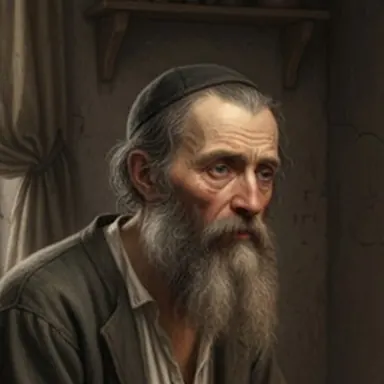
Rabbi Avraham Abele HaLevi Gombiner: The "Magen Avraham"
16 min read3,199 words
Summary
This text surveys the influential figure of Rabbi Avraham Abele HaLevi Gombiner, known by the epithet the "Magen Avraham," who was active in 17th-century Poland and reshaped the world of halakha. The article traces the course of his life, full of hardships, from his wanderings as a refugee from persecution to his becoming a decisive halakhic authority whose concise writings became pillars of the Shulchan Arukh. The central importance of the text lies in presenting his revolutionary innovations, with an emphasis on his stringent method of calculating the times of the day and on the incorporation of esoteric teaching and Kabbalah into everyday halakhic practice. Beyond the legal aspect, the work highlights the rabbi's social sensitivity and personal humility, and explains how he became a spiritual compass guiding Jewish communities to this very day.
The Halakhic Teaching, Public Work and Literary Contribution of Rabbi Avraham Abele HaLevi Gombiner: The "Magen Avraham"
The second half of the 17th century marked one of the most formative and complex periods in the history of the Jews of Poland and Eastern Europe. In a world of political fractures, religious persecution and a desperate need to consolidate a uniform halakhic code, the figure of Rabbi Avraham Abele HaLevi Gombiner, known by the epithet "the Magen Avraham," stood out.[1, 2] His Torah enterprise was not limited to mere local commentary, but reshaped the foundations on which Ashkenazi halakha rests to this very day. Through an in-depth analysis of the history of his life, his style of writing, his innovations in the field of the times of the day, and the integration of esoteric teaching into the fabric of halakhic life, there emerges the figure of a decisor who combined conservatism regarding custom with interpretive daring and mathematical-astronomical precision.[3, 4, 5]
Biographical Foundation: From the Straits of Gombin to the Judge's Seat in Kalisz
Rabbi Avraham Abele was born in the town of Gombin in Poland around 5397 (1635).[1, 6] This period was characterized by a relative flourishing of the Torah centers in Poland, but this was cut short at once with the outbreak of the decrees of Tach ve-Tat and the events that followed in their wake. His father, Rabbi Chaim HaLevi, who served as a judge and spiritual leader in the community, was murdered by the Cossacks in 5415 (1655), an event that marked the end of Rabbi Avraham's childhood and his becoming a destitute refugee.[1, 6, 7]
The move from the town of Gombin to the neighboring communities was not only geographical but also spiritual. Rabbi Avraham wandered to Lissa, where he studied with his relative Rabbi Yaakov Yitzchak of Gombin, and afterwards to Posen, where his character as a Torah scholar of the first rank was shaped under the influence of Rabbi Yitzchak the Great, the chief rabbi of Poland at that time.[1, 8] The connection with Rabbi Yitzchak of Posen was decisive; the rabbi's esteem for his young disciple is evident in his responsa and novellae, printed later in the book "Be'er Yitzchak," where he mentions Rabbi Avraham with respect and admiration.[8]
His final settlement in Kalisz marked the beginning of his significant public activity, but in his own unique and modest way. At first he engaged in teaching young men, and only after his greatness was revealed to the great sages of the generation, such as Rabbi Shabtai HaKohen (the Shach), was he appointed to the post of moreh tzedek (halakhic authority) and judge in the rabbinic court of Rabbi Yisrael Shapira.[1, 3, 9] Despite his rising Torah standing, Rabbi Avraham refused to oust other rabbis from their posts and contented himself with the role of an "assistant" or secondary judge, a fact that testifies to the depth of his humility, which also seeped into his halakhic writings.[1, 9] Poverty accompanied him throughout all his years of creative work; tradition relates that the lack of paper forced him to write down his revolutionary novellae on the walls of his house or on flour sacks, a fact that was corroborated by later testimonies of residents of the house who found writing beneath the layers of whitewash.[1, 8]
"Magen Avraham": A Literary and Halakhic Revolution on Shulchan Arukh Orach Chaim
The central work on which the bulk of Rabbi Avraham's reputation rests is his work on the Orach Chaim section of the Shulchan Arukh. This book, which he began writing in 5425 (1665) and completed in 5431 (1671), is not merely a commentary but a new codification of everyday halakha.[3, 11] The Magen Avraham worked within a certain vacuum created after the rulings of the Rema; while the Rema brought the customs of Ashkenaz to the table of Rabbi Yosef Karo, the Magen Avraham sought to re-examine the talmudic sources, to weigh the Polish customs that had arisen since then, and to incorporate esoteric teaching into practical halakhic ruling.[2, 3, 11]
The Style of Vigorous Brevity and Its Methodological Influence
The style of the Magen Avraham is considered one of the most difficult and condensed in halakhic literature. He avoided lengthy pilpul and in a large proportion of cases contented himself with a short reference to a source or with the statement of a dry halakhic fact.[5, 8] This style is not accidental, but stems from a combination of economic hardship (the lack of paper) and a Torah outlook that strives for a final and swift clarification of the halakha.[1, 8]
This linguistic compression created an urgent need for commentators who would decipher his words. Books such as "Machatzit HaShekel" by Rabbi Shmuel Kelin and "Pri Megadim" (especially in its "Eshel Avraham" part) by Rabbi Yosef Teomim were written first and foremost to expand on the sources to which the Magen Avraham alluded in his few words.[8, 12] This fact testifies that the scholarly community saw his words as a kind of "foundational text" requiring an internal commentary of its own, similar to the standing of the Mishnah or the Gemara.
The Printing History and the Struggle over the Manuscript
The book did not see the light of day in the author's lifetime, which led to a veritable saga after his death. His brother, Rabbi Yehuda, traveled to Amsterdam to print it but died on the way, and the book was temporarily lost.[3, 11] The author's son, Rabbi Chaim, devoted his life to redeeming the manuscript from strangers' hands that refused to return it, enlisting the Council of Four Lands to impose bans of excommunication on those holding the writings.[8, 11]
The name of the book as we know it today, "Magen Avraham," was set by his son in order to create harmony with the commentary of the "Turei Zahav" (the Taz), which was called "Magen David."[3, 8, 11] The two of them together were first printed under the title "Maginei Eretz" in Dyhernfurth in 5452 (1692), by the famous printer Rabbi Shabtai Meshorer Bass.[3, 11] It is interesting to note that the author himself, out of extreme humility, wished to call the book "Ner Yisrael" (an acronym of his name and lineage), but the name set by his son is the one that was accepted throughout the Jewish diaspora.[3, 7]
The Method of the Times of the Day: Mathematical Precision in the Service of the Commandment
Perhaps the part with the greatest influence on the daily life of the observant Jew is the ruling of the Magen Avraham on the subject of "proportional hours" (sha'ot zemaniyot).[4, 13] This concept defines the division of the day into 12 equal units of time, whose length varies according to the length of the daylight hours in the seasons of the year.
The Essential Dispute: When Does the Day Begin?
The famous dispute between the Magen Avraham and the Gra (the Vilna Gaon) is not about the division of the hours itself, but about the span of time being divided. Whereas the Gra (and, following him, the Rambam and the Graz) held that the day should be counted from sunrise to sunset, the Magen Avraham introduced a method according to which the day begins at dawn (alot ha-shachar) and ends at the emergence of the stars (tzeit ha-kochavim).[4, 14]
The halakhic logic of the Magen Avraham rests on the talmudic sources that define the day as the time when there is light, even if the sun itself is not visible above the horizon.[15, 16] Mathematically, the calculation of the Magen Avraham produces a longer proportional hour than that of the Gra, because the total span of time divided by 12 is greater (about 15 hours in an average summer compared with about 12 hours).[14]
T
zmanit
=
12
T
nightfall
−T
dawn
Practical Implications for the Recitation of the Shema and Prayer
The result of this method is a significant stringency in the morning times. Because the count begins earlier (from dawn), the latest time for the recitation of the Shema (which is at the end of the third hour) falls much earlier than according to the method of the Gra.[15] Although the hour of the Magen Avraham is longer, the gap created by the earlier start is not entirely closed, with the result that most calendars list two times, where "the Magen Avraham time" is the earlier and more stringent marker.[13, 14]
Many of the decisors of Ashkenaz and of Hasidism adopted this method as a basis for stringency in commandments of Torah law, on the basis of the ruling of the Magen Avraham himself, who determined that "a doubt in a Torah law is resolved stringently."[13] The use of this method became a hallmark of the calendars of the Eastern communities and of those of Yemenite origin, as well as within the Hasidic stream, whereas in the Lithuanian yeshiva world the practice often follows the method of the Gra.[4]
Kabbalah and the Zohar as Guides in Halakhic Ruling
The uniqueness of the Magen Avraham also lies in his unprecedented approach to integrating esoteric teaching into the halakhic code. He was the first major decisor in the Ashkenazi sphere to grant the writings of the Arizal and the book of the Zohar the status of a deciding authority wherever there is no explicit dispute in the Talmud.[3, 17]
Internalizing the Teaching of Safed in Poland
Through extensive quotations from the book "Shnei Luchot HaBrit" (the Shelah), the Magen Avraham introduced into "Orach Chaim" kabbalistic practices that became common property. For example:
- Caution against an evil spirit: the obligation to wash the hands three times alternately in the morning, or after leaving the lavatory, is based on kabbalistic sources that he incorporated into the ordinary laws.[18]
- Practices of prayer: he cites laws concerning the intentions (kavvanot) in the divine names and the arrangement of the prayer according to the secrets of Kabbalah, something that had previously been the preserve of a select few only.[17]
- The attitude to the Zohar: in cases of apparent conflict between custom and the words of the Zohar, the Magen Avraham will often seek a way to reconcile them or will decide according to the words of the Zohar if this entails a fitting stringency.[17, 18]
This influence was decisive in the later development of the Hasidic movement. Hasidic Rebbes and decisors saw in the Magen Avraham the legal basis for integrating their practices into the rigid halakhic framework.[17] The Shulchan Arukh HaRav of Rabbi Shneur Zalman of Liadi, which constitutes the halakhic backbone of Chabad, was built to a great extent around the rulings and considerations of the Magen Avraham.[4, 19]
Social Rulings, Custom and Community
The teaching of Rabbi Avraham Abele was not detached from the life context of the Jewish community in Poland. He gave enormous weight to "the custom of the place" (Minhag), out of an understanding that custom reflects a profound religious intuition of the public that had received the approval of the rabbis of earlier generations.[3, 11]
The Standing of the Individual in the Community versus the Scholar
One of his interesting rulings concerns the order of priorities in the synagogue. The Magen Avraham determined that preference in calling up to the Torah should be given to people marking significant life events (such as a bridegroom, the father of a newborn son, or the anniversary of a death) over regular Torah scholars.[3] This ruling testifies to social sensitivity and to a desire to connect the whole community to the Torah, not only the scholarly elite.
In addition, he discussed subjects that were modern for his time, such as:
Employing gentiles on the Sabbath for public needs: he found permissions for employing gentile workers under contract for cleaning streets or other communal works on the Sabbath, relying on the principle of "the needs of the many."[3]
- Women and the observance of commandments: the Magen Avraham noted that although women are exempt from time-bound positive commandments, such as the counting of the Omer, they have accepted it upon themselves as a full obligation, and thereby he gave halakhic validity to the custom of women to participate more actively in the system of commandments.[3]
- Criticism of popular customs: despite his respect for customs, he did not hesitate to criticize customs that seemed to him baseless or detrimental to the honor of the Torah. For example, he opposed the excessive use of fireworks and firecrackers on Simchat Torah, arguing that this was an expression of "the common masses" that diverted the focus from the true joy of the Torah.[3]
Additional Works: Beyond the Shulchan Arukh
Although the name of Rabbi Avraham Abele is identified almost exclusively with the "Magen Avraham," he left behind an impressive body of work in the fields of Midrash, homiletics and the Tosefta, which illuminate further aspects of his Torah personality.
"Zayit Ra'anan" and "Shemen Sasson"
The book "Zayit Ra'anan" is a systematic commentary on the Yalkut Shimoni. This work is especially important because it shows the author's complete mastery not only of decided halakha but also of the world of Midrash and aggadah.[6, 20] As with his commentary on the Shulchan Arukh, here too the original commentary was broad and profound, whereas in the editions of the Yalkut found today only an abridgment of it is printed.[20] "Zayit Ra'anan" is considered one of the foundational books for the study of Midrash.[20]
The book "Shemen Sasson" contains homilies on the Torah. Unfortunately, only a small part of the writings has survived (up to the portion of Chayei Sarah), but even in this part his method is evident, combining astonishing erudition with sharp analysis of questions of faith and thought.[6, 8]
His Contribution to the Tosefta and to Legal Documents
The Magen Avraham composed a commentary on the order of Nezikin in the Tosefta, which was first printed by his grandson together with his son-in-law's book "Lechem HaPanim."[3, 8] This commentary is characterized by a philological approach and an understanding of the early Tannaitic structure.[19] He also dealt extensively with the correction and emendation of names in gittin (divorce documents), a subject that demanded linguistic precision and broad historical knowledge of the way names were written in different communities, in order to prevent challenges to the validity of the get.[3, 6]
The Meta-Halakhic Standing of the Magen Avraham in the Tradition of Israel
It is hard to find in the history of halakha a decisor who won so broad a consensus so soon after his death. "The greatest of the Acharonim," the title given to him by Rabbi Akiva Eiger and the Chatam Sofer, is not merely an honorific but a description of the reality on the ground: almost everywhere there is a dispute between the Magen Avraham and other decisors of his generation (such as the Taz or the author of "Olat Tamid"), the halakha tends to be decided according to his opinion.[5, 8]
Influence on the "Mishnah Berurah" and Contemporary Halakhic Ruling
In the 19th and 20th centuries, when Rabbi Yisrael Meir HaKohen (the Chofetz Chaim) wrote the "Mishnah Berurah," he built the entire work around the rulings of the Magen Avraham.[12, 19] In effect, the "Mishnah Berurah" acts as a mediator of the Magen Avraham to later generations: it cites his decisions, explains his terse language, and rules according to them in most cases.
The influence of the Magen Avraham is also evident in the later Sephardi methods of halakhic ruling. Decisors such as the author of the "Ben Ish Chai" adopted his method for the times of the day (especially the calculation from dawn) as a basis for the vatikin prayer (at sunrise) and for the other times of the day, out of appreciation for the integration he created between the revealed teaching and Kabbalah.[4]
Summary and Conclusions
Rabbi Avraham Abele HaLevi Gombiner succeeded, out of the ruins of Poland after the decrees, in building a Torah edifice that has stood firm for centuries. His figure represents the delicate balance between:
- Lithuanian/Ashkenazi scholarship: a striving for the depth of the talmudic passage and precision in the smallest details.[1, 8]
- Communal sensitivity: the defense of popular custom and the finding of a halakhic basis for the way of life of the general public.[3]
- Spiritual openness: the adoption of esoteric teaching as a living and active tool within the system of Jewish law.[17]
The fact that his central book was written in poverty, preserved by a miracle and printed only through the tremendous efforts of his family members adds a layer of inspiration to his enterprise. The "Magen Avraham" is not merely a book on the shelf; it is the foundation on which the modern Shulchan Arukh rests, and it is the compass by which the times of prayer, holiness and Jewish life are determined to this day throughout the world.[2, 14, 15] His legacy teaches that even in periods of physical and economic darkness, Torah precision and devotion to tradition can create a light that will shine for generations.[9]
Sources20
- 1.אברהם אבלי גומבינר – חב"דפדיה, chabadpedia.co.il/index.php/אברהם_אבלי_גומבינר
- 2.GOMBINER RAV, ABRAHAM ABELE BEN HAYYIM HALEVI (c1637-1683) - Zchor.org, zchor.org/GOMBINER.HTM
- 3.Avraham Gombiner - Wikipedia, en.wikipedia.org/wiki/Avraham_Gombiner
- 4.זמני היום בהלכה - ויקיפדיה, he.wikipedia.org/wiki/זמני_היום_בהלכה
- 5.אברהם אבלי הלוי גומבינר – ויקיפדיה, he.wikipedia.org/wiki/אברהם_אבלי_הלוי_גומבינר
- 6.ABRAHAM ABELE GOMBINER - JewishEncyclopedia.com, jewishencyclopedia.com/articles/370-abraham-abele-gombiner
- 7.Gombin, Poland (Pages 53-73, 89-93) - JewishGen, jewishgen.org/yizkor/gombin/gom060.html
- 8.ג' תשרי: רבי אברהם אבלי הלוי גומבינר - המגן אברהם - הרב יורם אברג'ל ובנו הרב ישראל | המאיר לארץ, hameir-laarets.org.il/hilulots/ג-תשרי-רבי-אברהם-אבלי-הלוי-גומבינר-המג/
- 9.Today in History: The Passing of the "Magen Avraham" - Hidabroot, ennewsite.hidabroot.org/article/15706
- 10.מגן אברהם - ספריא, sefaria.org.il/Magen_Avraham
- 11.מגן אברהם - ויקיפדיה, he.wikipedia.org/wiki/מגן_אברהם
- 12.פרי מגדים על אורח חיים - ספריא, sefaria.org.il/Peri_Megadim_on_Orach_Chayim
- 13.הלכה ב - השעות הזמניות וחשבון זמני הבוקר | פרק ח - תפילת שחרית והדינים שלפניה, ph.yhb.org.il/03-08-02/
- 14.כל מפיק לוח שנה המכבד את עצמו, דואג לציין בכל יום את סוף זמן קריאת שמע לפי המגן אברהם, ואת סוף זמן קריאת שמע לפי הגר"א, על מה ולמה נוצרו שני זמנים לקריאת שמע - דרשו, dirshu.co.il/407410-2/
- 15.הלכה י - השעות הזמניות ודיניהן | פרק פרק יא - זמן ק"ש ותפילת שחרית | פניני הלכה, ph.yhb.org.il/02-11-10/
- 16.מגן אברהם קנ״ז, sefaria.org.il/Magen_Avraham.157
- 17.מגן אברהם ומגן דוד - זוהר לך לך אות ק"כ - שיעור 43 - הרב גוטליב - YouTube, youtube.com/watch?v=UNK7OhC5sBk
- 18.מגן אברהם ז׳, sefaria.org.il/Magen_Avraham.7
- 19.אברהם אבלי הלוי גומבינר – ויקיפדיה, he.wikipedia.org/wiki/אברהם_אבלי_הלוי_גומבינר#ספריו
- 20.זית רענן לבעל ה'מגן אברהם'. מהדורה ראשונה. דעסוי, תס"ד - ווינרס מכירות ..., winners-auctions.com/items/זית-רענן-לבעל-המגן-אברהם-מהדורה-ראשונ/