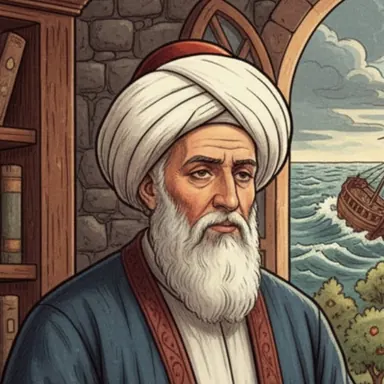
The Work and Torah Teaching of Rabbi Avraham Azulai: A Synthesis of the Revealed and the Hidden, Geographic-Metaphysical Thought and the Chain of Generations
20 min read3,947 words
Summary
The text surveys the many-sided figure of Rabbi Avraham Azulai, a 17th-century kabbalist and thinker who served as a connecting link between the traditions of the Maghreb and the spiritual centers in the Land of Israel. The source outlines his turbulent life story, from his flight from Morocco and his miraculous rescue from drowning at sea to his settlement in the cities of Gaza and Hebron, where he composed his monumental works. At the heart of his teaching stands a harmonious synthesis between the Kabbalah of the Ramak and the Kabbalah of the Ari, alongside a distinctive line of thought that gives metaphysical meaning to the holiness of dwelling in the Land of Israel and to the spiritual transformation of those who immigrate to it. His famous work "Chesed le-Avraham" is presented as a foundational text that deeply influenced the world of Hasidism thanks to its systematic structure and to the way it makes the secrets of the Torah accessible. Finally, the article closes with a description of the illustrious chain of generations of the Azulai family and with the mystical story of his entry into the Cave of Machpelah, an event that marked his passing and heightened his standing as a wondrous figure in the history of the Jewish community in the Land of Israel.
Introduction and Biographical Background: From the Castilian Exile to Fez and His Arrival in the Holy Land
The history of Jewish thought in the early modern period is marked by profound geographic and spiritual transformations, shaped to a great extent by the waves of migration that followed the expulsion from Spain. One of the distinct representatives of this period, in which the traditions of Maghrebi Jewry merged with the emerging mystical centers in the Land of Israel, is the kabbalist and halakhic decisor Rabbi Avraham Azulai.[1, 2]
Rabbi Avraham Azulai was born in the year 5330 (1570) to Mordechai Azulai in the city of Fez in Morocco, into a family with an illustrious tradition of lineage originating in the region of Castile in Spain.[1, 2, 3] His father, Rabbi Mordechai Azulai, was a recognized Torah scholar in Fez, which was then a bustling Torah center, though one beset by hardships.[2, 4] Already in his youth the boy Avraham showed special signs of greatness and pursued his studies with tremendous diligence, while the sages of the city of Fez nurtured him and handed down to him from the treasures of their Torah.[2] At first he concentrated on the revealed Torah, delving deep into the sea of the Talmud and the books of the halakhic decisors, and only after he had filled himself with the Talmud and the decisors did he turn to the teaching of the hidden.[2]
Life in Fez was hard for the Jews at that time because of decrees and persecutions by their Muslim neighbors, along with famine and plagues that struck the city.[1, 2, 3] These harsh living conditions, together with the age-old longing to go up to the Holy Land, led Rabbi Avraham to make a fateful decision in the year 5366 (1606): to leave Morocco and set out for the Land of Israel.[1, 2, 3]
Rabbi Avraham's journey to the Land of Israel was not merely a physical passage but a formative event that shaped his mystical and personal consciousness. During the voyage across the Mediterranean, while the ship was anchored in the port of Damietta in Egypt, a violent storm broke out that caused the ship to sink.[1, 2, 3] While his considerable property and most of the theoretical manuscripts he had labored over in Fez went down to the depths, Rabbi Avraham himself was saved by a wondrous miracle.[1, 2, 3] The Chida described the circumstances of the miracle in his book "Shem ha-Gedolim" and noted that the ship broke apart and all the property sank, but they escaped with their lives.[3] Rabbi Avraham himself was grateful to the Holy One, blessed be He, that he was not on deck at those critical moments of the sinking.[5] As an everlasting expression of gratitude for his metaphorical and physical rescue from the water, Rabbi Avraham adopted the unique custom of shaping his signature in the form of a ship – a custom that passed like a genetic-cultural code among his descendants for generations, among them his great-grandson, Rabbi Raphael Yitzchak Zerachia Azulai, and his great-great-grandson, our master the Chida.[1, 2, 3]
Wanderings in the Holy Land: His Settlement in Hebron, Jerusalem and Gaza
Upon his arrival in the Land of Israel, Rabbi Avraham made his home in the city of Hebron, because of its metaphysical proximity to the Cave of Machpelah, which he regarded as a gate to the world of souls.[2, 3] In Hebron he joined the great kabbalists of the generation and began to delve into the teaching of the hidden, combining the principles of the Maghrebi Kabbalah he had acquired in his youth with the new currents of Safed Kabbalah.[1, 2] He was privileged to study Kabbalah with Rabbi Chaim Vital (the foremost disciple of the holy Ari) and also with his son, Rabbi Shmuel Vital, and he was deeply influenced by the Kabbalah of the Ramak.[1, 2]
Wandering continued to be an inseparable part of the biography of his creative work. In the year 5379 (1619) a deadly plague broke out in Hebron, which forced him to move his residence to Jerusalem.[1, 2, 3] But the plague pursued him to the capital as well, and Rabbi Avraham was forced to wander again to the outskirts of Hebron, where he made an explicit religious vow: if he were privileged to return in peace to his city of Hebron, he would devote his life to spreading and publishing the Torah novellae he had written with diligence and deep study over the years.[1, 2]
The deliverance and the temporary stability he had hoped for were found precisely in the city of Gaza, where he settled on 19 Av of that same year, after the plague there had ceased.[1] Gaza of the early 17th century served as a vibrant Jewish communal center and as a refuge for those fleeing the plagues of Jerusalem and Hebron.[1, 2, 3] Under the spiritual leadership of the community's rabbi, the renowned poet Rabbi Yisrael Najara, Gaza became a spiritual hothouse for Rabbi Avraham.[1, 2, 3, 4] In these few years of relative calm in Gaza, around the years 1618–1622, Rabbi Avraham was granted an extraordinary burst of creativity and composed the most famous of his books, chief among them "Chesed le-Avraham" and "Ba'alei Brit Avram".[1, 2, 3, 4, 6] Rabbi Yisrael Najara even composed a short poem in honor of one of Rabbi Avraham's books.[1, 3, 4] When the plague in Hebron subsided, Rabbi Avraham returned to his city with his family, and there he worked and taught for the rest of his life.[1, 3, 4]
A unique and highly significant chapter in his mystical activity took place during a joint journey he made with his companion, the kabbalist Rabbi Yaakov Tzemach, to Damascus in Syria, the burial place of Rabbi Chaim Vital.[1, 2] According to the well-known account in the introduction to the book "Otzrot Chaim", the two performed kabbalistic unifications (yichudim) and prayers at the grave until they received spiritual permission from the soul of the Rachu (Rabbi Chaim Vital) to dig in his grave and retrieve from it the hidden manuscripts of the Kabbalah of the Ari.[1, 2] This retrieval led to the discovery and dissemination of the foundational work "Otzrot Chaim" (which constitutes a final recension of "Etz Chaim"), and thereby Rabbi Avraham contributed dramatically to laying the foundations for the spread of the Kabbalah of the Ari in the Jewish world.[1, 2]
The Literary Enterprise: Mapping the Works of Rabbi Avraham Azulai
The writing of Rabbi Avraham Azulai is broad in scope and extends over all parts of PaRDeS – from commentaries on Scripture and the Mishnah, through halakhic glosses, to systematic kabbalistic works that became treasured classics of the world of the hidden.[1, 2]
In his monumental commentary on the Zohar, the book "Or ha-Chamah", Rabbi Avraham presented a methodology of textual synthesis based on the comparison of sources.[1] He based his work on four interpretive pillars that preceded him, and thereby made the book the leading anthology for understanding the Zohar in his generation [1]:
The Systematic Structure of "Chesed le-Avraham" and Its Influence on Hasidism
Rabbi Avraham Azulai's most famous and widespread book in the field of Kabbalah is "Chesed le-Avraham".[1, 2, 10] This book, which flows directly from the wellsprings of Kabbalah and draws on the teaching of the Ramak and of the "Lion Cubs of the Ari", presents a complete cosmological and moral structure based on a meticulous methodical division.[1, 2, 8] The book includes wonderful introductions and commentaries in the way of PaRDeS and contains explanations of the foundations of the inner dimension of the Torah and the wisdom of Kabbalah, while it explains sayings of the Sages scattered throughout the Talmud and emphasizes the excellence of the Torah and of those who study it.[7]
The general structure of the book is based on a foundational gate called "Even ha-Shetiyah" (the Foundation Stone), divided into seven secondary gates called "Eyes" (or Springs), with each spring branching into dozens of "Rivers" dealing with defined kabbalistic and halakhic topics.[8, 9]
"Chesed le-Avraham" had an enormous influence on the development of Hasidic thought.[7, 12] The great figures of Hasidism saw it as a foundational book that makes the difficult concepts of Kabbalah accessible in a vital way that stirs the heart to the refinement of character traits and to cleaving to God.[7] Clear evidence of its centrality is the existence of the book "Chesed le-Avraham ha-Mevo'ar" (Chesed le-Avraham Explained), composed by the kabbalist Rabbi Avraham Yissachar Ber ha-Kohen of Radomsk, son of the author of "Tiferet Shlomo".[12] This edition, which was printed again and again with glosses, source references and a precise division into sections, attests to the way in which the teaching of the kabbalist from Hebron became an inseparable part of the bookshelf of the Hasidism of Poland and Eastern Europe.[12]
The Metaphysics of the Land of Israel and Textual Interpretation
Rabbi Avraham Azulai's most important theoretical contribution lies in his ability to carry out a harmonious synthesis between the two great and seemingly opposed kabbalistic schools of 16th-century Safed: the Kabbalah of the Ramak (Rabbi Moshe Cordovero) and the Kabbalah of the Ari (Rabbi Yitzchak Luria).[1, 2, 7, 8] He showed that the two systems do not contradict each other but describe different levels of the same divine reality: the Kabbalah of the Ramak deals mainly with the external and general structure of the divine cosmos, whereas the Kabbalah of the Ari penetrates to the innermost, dynamic layer of the partzufim (divine configurations) in the governance of the unification.[1, 2, 8]
Alongside this synthesis, Rabbi Avraham developed a profound geographic-metaphysical doctrine regarding the excellence of dwelling in the Land of Israel.[1, 11] In "Chesed le-Avraham" (Third Spring – the Spring of the Land, River 12), he explains the essential difference between the souls of Jews abroad and those of the Jews who dwell in the Holy Land [11]:
Souls outside the Land: The soul of the Jews who dwell abroad flows from the world of the angel Sandalphon, which is the world of the Ofanim of the World of Action (Asiyah).[11] These souls are called "the House of Jacob" and "servants", and are termed "a Hebrew servant" (eved ivri).[11] Here Rabbi Avraham applies a unique gematria calculation, according to which the numerical value of the term "eved ivri" (Hebrew servant) is exactly equal to the value of the word "nachash" (serpent) [11]:
- Eved ivri = 70+2+4+70+2+200+10=358
- Nachash = 50+8+300=358
- This calculation reflects the conception that outside the Land, the soul is subject to the dominion of the forces of the kelipah and the Sitra Achra, represented by the metaphysical serpent.[11]
- Souls of the Land of Israel: The Jews who dwell in the Land of Israel draw their nourishment from the ten sefirot of the World of Formation (Yetzirah).[11] These souls are called "the Children of Israel", "sons", and "children of the living God".[11]
- The mechanism of transformation: When a person goes up from abroad to the Land of Israel, a new soul (nefesh) from the World of Formation clothes itself within his old soul.[11] On the first night that he sleeps in the Land of Israel, both souls ascend on high during sleep, but only the new soul from the World of Formation returns to the body.[11] Since this soul is new and has not yet sinned, the person is not liable to punishment for his past, and this is the secret of the Sages' statement that whoever walks in the Land of Israel has his sins forgiven.[11]
From this conception, Rabbi Avraham lays down a bold theological definition: everyone who dwells in the Land of Israel is metaphysically called "righteous" (tzaddik), even if outwardly he appears to have the status of a wicked man.[11] The proof of this is cosmic: had he not been righteous at the inner level, the Land would have spewed him out, as it is said, "and the land vomited out its inhabitants".[11] Since the Land tolerates him and does not spew him out, there is surely an inner holiness in him that defines him as righteous.[11]
On the other hand, he warns that one who dwells in the Land of Israel and goes down to live in Egypt causes the angelic prince of Rahab (Egypt) to rule over him, whereas for one who takes it upon himself to dwell in the Land all his days and not to go down to Egypt, it is reckoned as though he had been careful all his days and had proclaimed the kingship of the Holy One, blessed be He, in His unity.[11] Likewise, he clarifies the laws of atonement in the Land: the Land does not atone for deliberate sins committed in it, but only for unintentional ones; the sins committed in the Land are purified only through suffering, while grave transgressions (rebellious sins) in the Land have no forgiveness except through repentance and Torah study.[11]
In the philological field, Rabbi Avraham led the project of emending the text of the Zohar in his book "Or ha-Levanah".[1, 5] He understood that textual corruptions that had crept in over generations of manual copying create "darkness and errors" that hinder the attainment of the secrets.[1] The meticulous comparison of versions that he carried out was intended to reopen the gates of understanding to students by cleansing the Zoharic text of late additions.[1]
The Family Chain of Generations and the Chida's Historical Discovery
The chain of generations that descended from Rabbi Avraham Azulai is considered one of the most distinguished and influential dynasties in the history of the Jewish community in the Land of Israel and of Sephardic leadership.[1, 2] Rabbi Avraham married Simcha, who was the sister of Rabbi Nechemia Danino (head of the rabbinic court of Hebron).[1]
A moving and extraordinary historical connection between the Chida and his great-grandfather came to light during the Chida's travels in Europe as an emissary (shadar) on behalf of the Hebron community – the community in which his great-grandfather had settled and attained holiness.[3] In the month of Nisan 5537 (1777), during the Chida's stay in the city of Reggio Emilia in northern Italy, he was a guest in the home of the city's rabbi, Rabbi Yisrael-Binyamin Bassan.[3] While examining documents and ancient manuscripts in the community archive, the Chida found an original receipt for funds sent from Hebron in the year 5403 (1643) – 134 years earlier.[3]
On that ancient document the rabbis of Hebron of that period had signed, among them Rabbi Eliezer ben Arha, Rabbi Yosef Abuhav, and also his great-grandfather – Rabbi Avraham Azulai.[3] The Chida, who knew the family history, immediately recognized Rabbi Avraham's unique signature shaped in the form of a ship, intended to commemorate the miracle of his rescue from drowning in the Mediterranean Sea in 1606.[1, 3] Finding this document thousands of kilometers from their common home in the Land of Israel moved the Chida deeply.[3] This historical document survived the ordeals of the wars and the Holocaust in Europe, and eventually reached Jerusalem, where it is kept today in the Yad Yitzhak Ben-Zvi library as part of the archive of the scholar of the history of Italian Jewry, Prof. Isaiah Sonne.[3]
His Mystical Passing and the Legend of the Pasha's Sword in the Cave of Machpelah
The passing of Rabbi Avraham Azulai on 24 Cheshvan 5404 (1643) (some give 21 Cheshvan) was sealed by one of the most dramatic and wondrous stories in the history of the Jews of Hebron.[1, 2, 10] Although the Chida does not mention this episode in his works, the legend is widespread and very well accepted in the literature of the generations, foremost in the book "Zikaron Yerushalayim".[1, 4]
According to the story, in that year a high-ranking pasha came from Istanbul on an official visit to the Cave of Machpelah in Hebron.[1, 2, 4] As part of the custom of the Ishmaelites, he went to pray at the site on Friday.[4] Out of curiosity to gaze into the depths of the tombs of the Patriarchs, he bent over the narrow opening leading to the underground cave, and suddenly his precious gold-plated sword fell from its sheath into the deep cave.[1, 2, 4, 13] The pasha ordered his men to go down on ropes and bring back the sword, but every servant or soldier who was lowered inside died on the spot in a mysterious manner, his soul departing before he reached the ground.[1, 2, 13, 14]
When the pasha saw the mysterious death of his men, he was seized with dread and decreed upon the Jews of Hebron that they must go down into the depths of the cave and bring back the sword, and that if they did not do so, they would be destroyed.[2, 13, 14] The Jewish community was thrown into deep consternation and proclaimed a fast, and after they cast lots to choose the emissary for the dangerous mission, the lot fell on the kabbalist Rabbi Avraham Azulai.[1, 2, 13, 14]
A deep kabbalistic meaning is attributed to this episode in Rabbi Avraham's book [13]: the sword represents the aspect of Esau.[13] The children of Ishmael (the local Muslims) and the children of Esau (the pasha's Turkish rule) join together here in an attempt to break into the cave, which is the entrance to the Garden of Eden.[13] But they have no spiritual hold on this holy and inner place that connects heaven and earth, for their whole concern is only with the gold and the materiality that plate the sword, and therefore they meet their death there.[13] Only a representative of the seed of Israel, who guards spiritual purity, is able to enter the gates of the place.[13]
Rabbi Avraham accepted the community's decree with self-sacrifice.[2] He went to the mikveh and immersed, wrapped himself in white shrouds, and sat that whole night with his companions, the sages of Hebron, expounding before them without pause on matters of Kabbalah and supernal secrets.[1, 2, 4, 13, 14] When dawn broke, he asked his companions to pray for him for as long as he remained inside the cave, that no harm befall him.[1, 13]
He was lowered on ropes into the darkness of the cave, found the sword and sent it back up to the astonished pasha.[1, 2, 3, 14] But Rabbi Avraham did not hasten to come up; he continued inward into the depths of the hidden cave.[1, 2] There he met Eliezer, the servant of Abraham, who led him through the metaphysical corridors until he was privileged to see the holy Patriarchs in the Lower Garden of Eden.[1, 2, 3] When Rabbi Avraham saw the wondrous sights that are beyond human comprehension, he asked to remain in the presence of the Patriarchs and not to return to this world any more.[1, 2] The Patriarchs answered him affectionately that he must now return in order to complete the rescue of the community, and they told him the immortal sentence: "Now go out, and tomorrow you will be with us".[1, 2, 3, 4]
Rabbi Avraham was raised on ropes from the cave and came to his home joyful and glad of heart.[4] He turned to his companions and said to them: "Such and such has been decreed upon me, and such is my will!".[4] That whole night (the night before Friday) his companions sat with him and he continued to expound before them on the secrets of Kabbalah until daybreak.[4, 14] On the morning of the holy Friday, 24 Cheshvan, Rabbi Avraham immersed in the mikveh for the last time, wrapped himself in his shrouds, recited the Shema with supreme devotion and returned his pure soul to its Creator.[1, 2, 3, 14] He was buried in the rabbis' section of the ancient Jewish cemetery in Hebron, leaving behind a glorious kabbalistic legacy that illuminates the generations.[1, 4]
Summary and Conclusions
The work and teaching of Rabbi Avraham Azulai constitute a dramatic turning point in the development of the Kabbalah of the Land of Israel in the 17th century.[1, 2] Out of a biography full of upheavals, wanderings and miracles, Rabbi Avraham succeeded in establishing a broad literary foundation that unites the revealed with the hidden.[1, 2]
The systematic analysis of his writings and activity yields several fundamental conclusions:
The harmonization of Safed Kabbalah: Through his kabbalistic works, chief among them "Chesed le-Avraham", Rabbi Avraham created a stable hermeneutic bridge that made possible the merging of the Kabbalah of the Ramak and the Kabbalah of the Ari.[1, 2, 8] This approach prevented a deep theological dispute and paved the way for imparting Kabbalah to the broader public.[7]
The metaphysics of the holiness of the Land: His innovative conception regarding the exchange of the souls of those who enter the Land of Israel, and the definition of every one of its inhabitants as inherently righteous, gave new theoretical depth to the obligation of dwelling in the Land of Israel and deeply influenced subsequent generations and the Hasidic movement.[11, 12]
Multigenerational influence: The dynasty of spiritual leadership that emerged from Hebron, and especially his great-grandson, our master the Chida, continued to bear his personal and intellectual stamp.[1, 3] The historical discovery of his ship-shaped signature on a document from 1643 in Italy illustrates the living and unbroken connection between the generations of kabbalists in the Holy Land and the Jewish diaspora in exile.[3]
Sources14
- 1.אברהם אזולאי - ויקיפדיה, he.wikipedia.org/wiki/אברהם_אזולאי
- 2.הגאון הקדוש רבי אברהם אזולאי - בעל "חסד לאברהם" - דרשו, dirshu.co.il/487000-2/
- 3.מסעות החיד"א: חתימה בצורת ספינה וד"ש מחברון - יד יצחק בן־צבי, ybz.org.il/מסעות-החידא-חתימה-בצורת-ספינה-ודש-מחב/
- 4.כ"ד חשון: הילולת רבי אברהם אזולאי - כל המידע על הרב אזולאי - המאיר לארץ, hameir-laarets.org.il/hilulots/כד-חשון-הילולת-רבי-אברהם-אזולאי/
- 5.Rabbi Abraham ben Mordecai Azulai - Tzadikim, dailyzohar.com/tzadikim/928-Rabbi-Abraham-ben-Mordecai-Azulai
- 6.חסד לאברהם | ספריית ספריא, sefaria.org.il/Chesed_LeAvraham
- 7.חסד לאברהם - עם ביאור משוך חסדך ב' כרכים / ר' אברהם אזולאי - אוצר הספרים, sefer.org.il/items/6111231-חסד-לאברהם-עם-ביאור-משוך-חסדך-ב-כרכים-ר-אברהם-אזולאי
- 8.חסד לאברהם - ויקיטקסט, he.wikisource.org/wiki/חסד_לאברהם
- 9.חסד לאברהם/מעין ב - ויקיטקסט, he.wikisource.org/wiki/חסד_לאברהם/מעין_ב
- 10.מחבר:אברהם אזולאי - ויקיטקסט, he.wikisource.org/wiki/מחבר:אברהם_אזולאי
- 11.חסד לאברהם, אבן שתיה, עין הארץ י״ב | ספריית ספריא, sefaria.org.il/Chesed_LeAvraham,_Even_Shetiya,_Maayan_3.12
- 12.ספרי חסידות מבוארים - עוז והדר, oz-vehadar.net/product-category/מוסר-וחסידות/ספרי-חסידות-מבוארים/
- 13.המחלץ שנשאב למערה - ערוץ 7, inn.co.il/news/522742
- 14.המקובל רבי אברהם אזולאי - MyTzadik, mytzadik.com/m/tzadik.aspx?id=420