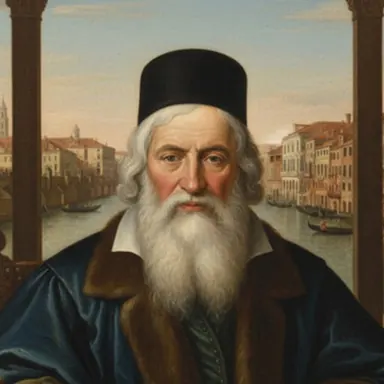
Rabbi Mordechai Yaffe – the "Ba'al ha-Levushim"
12 min read2,478 words
Summary
This text surveys the wide-ranging figure of Rabbi Mordechai Yaffe, one of the great leaders of Ashkenazi Jewry, who became known by the epithet "Ba'al ha-Levushim" ("the Author of the Levushim") after his monumental series of works. The source outlines his life and the main stations of his rabbinate in Europe, emphasising his unique contribution to the formation of the "middle way" in halakhic ruling—an approach that combines the final ruling with an explanation of the reasons and grounds of the commandments. The survey highlights his harmonious worldview, which sought to weave together the revealed and the hidden Torah with broad knowledge of the sciences and philosophy, as the expression of a spiritual garment that protects the soul. Finally, the text details the codified structure of his ten books, which encompass all areas of Jewish life, and commemorates his legacy as a prominent public leader and as a halakhic authority whose influence resonates to this day.
The Torah Enterprise, Halakhic Teaching and Public Leadership of Rabbi Mordechai Yaffe – the "Ba'al ha-Levushim"
Rabbi Mordechai Yaffe, known throughout the Jewish world as the "Ba'al ha-Levush" or the "Ba'al ha-Levushim", stands as one of the pillars of the halakhic ruling, thought and public leadership of the Jewry of Ashkenaz and Poland at the close of the golden age of the sixteenth century and the beginning of the seventeenth century.[1, 2] His many-sided work, extending over the fields of halakha, biblical exegesis, Kabbalah, philosophy and the exact sciences, attests to a phenomenal personality who sought to create a harmonious and comprehensive synthesis between the wisdom of the Torah and the laws of nature and the cosmos.[2] As a rabbi and leader who led the communities of Bohemia and Poland, and as the formulator of halakhic rulings in the method of the "middle way", Rabbi Mordechai shaped the character of Ashkenazi halakhic ruling for generations.[2, 3]
His Spiritual Growth, His Teachers and the Stations of His Life
Rabbi Mordechai Yaffe was born in 5290 (c. 1530) in Prague, to a distinguished family descended directly from Rashi.[2, 4] His father, Rabbi Avraham Yaffe (called R. Avraham of Biem, that is, of Bohemia), was a student of Rabbi Avraham ben Avigdor and later served as the chief rabbi of Bohemia.[2, 4] This scholarly family environment of leadership paved Rabbi Mordechai's way to the great Torah centres of Poland at that time.[2, 4]
In his youth Rabbi Mordechai studied with two of the greatest halakhic authorities of the period, who conducted profound methodological debates with each other: Rabbi Shlomo Luria (the Maharshal) and Rabbi Moshe Isserles (the Rema), in Lublin and in Krakow.[2] The Maharshal, who championed an uncompromising striving for the Talmudic sources and firmly opposed pilpul and the later system of customs, together with the Rema, who sought to codify halakha while giving decisive weight to the customs of Ashkenaz, both left a deep imprint on Rabbi Mordechai's halakhic path.[1, 2, 5]
A biographical anecdote that teaches of the halakhic and moral sensitivity in which he was raised describes how Rabbi Mordechai was alarmed when the sage Rabbi Yitzchak Aboab rebuked him because his son had recited a blessing and he had not answered "Amen" after it.[6] Rabbi Aboab made clear to him that this was a transgression entailing a severe punishment at the hands of Heaven, and that the light punishment of temporary excommunication he had imposed on him was in fact intended to save him from that punishment.[6] This event shaped his meticulous fear of Heaven and his absolute commitment to the details of halakha.[6]
The course of Rabbi Mordechai's life was marked by upheavals and many geographical moves, which reflected the communal and political dynamics of the period.[2, 7]
The Geographical Stations in the Life of the Ba'al ha-Levushim
The chronological differences between the various sources – some point to 5356 (1596) as the year in which the Maharal and Rabbi Mordechai exchanged their places between Posen and Prague [1], and some point to 5359 (1599) as the year of the Maharal's final return to Prague and of the Levush's move to Posen [2] – attest to the close connection and frequent exchanges between the two giants of the generation, who shared between them the leadership of the most central communities in Bohemia and Poland.[1, 2]
The Metaphysics of the Garment: The Introduction to "Levush Malkhut" and the Theological Conception
The key to understanding the Torah and literary conception of Rabbi Mordechai Yaffe lies in the magnificent introduction he composed for his life's work, the book "Levush Malkhut" ("Royal Garment").[3] The repeated use of the root l-v-sh ("to clothe") and the choice to define himself as "the tailor of the garments" are not mere wordplay, but reflect a complete theology linking the creation of the world, the fall of man, the writing down of the Oral Torah and the work of halakhic ruling.[3, 4]
In his introduction, Rabbi Mordechai unfolds a cosmic historiosophical picture [3]:
The primordial sin and the loss of the spiritual garment: God created Adam and Eve naked but without shame.[3] Following the sin and the eating from the Tree of Knowledge (which he calls "da'at ha-maz'imim", "the knowledge of those who provoke wrath"), human beings lost their original spiritual standing, felt their nakedness and clothed themselves in shame and disgrace.[3] In His mercy, God granted them "garments of light" (garments of salvation and a robe of righteousness) to cover their physical and spiritual nakedness.[3]
The Torah as a garment for the soul: the purpose of the giving of the Torah on lowly Mount Sinai – which attests to God's humility – is to be a new spiritual garment for man, clothing him in a spirit of wisdom, knowledge and fear of the Lord.[3] Through fulfilling the commandments and meditating on them day and night, man fashions his garments of glory, which protect his divine soul that was breathed into him from beneath the Throne of Glory.[3]
The exile and the writing down of the Oral Torah: the Torah was handed down orally from Moses to Joshua and to the heads of the generations.[3] With the destruction and the going into exile, the many troubles threatened to bring about the forgetting of the Torah and the return of the world to chaos and void.[3] In this critical situation, Rabbi Yehuda ha-Nasi expounded "It is time to act for the Lord, they have made void Your Torah" and wrote down the Mishnah – an act defined in the introduction as the making of "garments of skin ('or) in the light (or) of His choice", that is, the creation of a written garment that would preserve the embers of the Torah in the cold of exile.[3]
Out of this conception, Rabbi Mordechai sees himself as a link who succeeds in offering a new halakhic garment suited to the needs of his generation.[3] The first book, "Levush ha-Techelet" ("The Garment of Blue", dealing with the first part of Orach Chaim), is so called not only after the verse in the Scroll of Esther, but also because, just as a person is obliged to wear tzitzit of blue every day, so he must clothe himself in the practical laws that appear in the book, which accompany him throughout his daily routine.[3]
His Halakhic Teaching and the Approach of the "Middle Way"
When Rabbi Mordechai Yaffe set out to write his books of halakha, he identified an acute crisis among the students of Torah in Poland and Ashkenaz.[3] The publication of Rabbi Yosef Karo's work "Beit Yosef" confronted learners with a wide-ranging work full of details and disputes, which made it difficult to extract a quick bottom line for halakhic ruling.[3] On the other hand, the decisive brevity of the "Shulchan Arukh" presented the laws as cut-and-dried decrees, without explanation, without source and without internal logic.[3]
Therefore, Rabbi Mordechai conceived the method of the "middle way".[3] His aim was to fashion a halakhic code that is not short and dry like the Shulchan Arukh, but also not long and wearisome like the Beit Yosef.[3] The halakhic Levushim present the final halakhic ruling, but weave into it, in a concise and clear manner, the reasons and logical grounds of the commandment.[3]
This philosophy of learning is directly linked to his sharp opposition to the method of pilpul, which was very widespread in the yeshivot of Poland in those days.[1] Rabbi Mordechai held that pilpul produces an artificial and distorted Torah, which distances the learner from the truth.[1] He advocated learning based on "the straightness and depth of the plain meaning", with a constant striving for learning directed entirely towards practical halakha ("to bring the teaching to its conclusion in accordance with the halakha").[1]
The success of the "Levushim" series was so great that for a long period the work was perceived as a real alternative to the Shulchan Arukh of Rabbi Yosef Karo and the Rema.[1, 2] The great halakhic authorities of the following generations, among them the author of the Shulchan Arukh ha-Rav (Chabad), treated the rulings of the Levush as a necessary starting point for every halakhic discussion.[8]
The Great Synthesis: Halakha, Kabbalah and the Sciences
The dramatic uniqueness of Rabbi Mordechai Yaffe within the landscape of 16th-century Ashkenazi scholarship was his conscious combination of fields of knowledge often regarded as opposed.[2] He refused to narrow his horizons to the narrow field of halakha, and created a system of thought combining Spanish Kabbalah with rationalism and exact science.[2, 9]
The Integration of Kabbalah into Halakha
Rabbi Mordechai was one of the foremost students of Rabbi Mattityahu Delacrut, one of the first disseminators of Kabbalah in Poland, who championed the pre-Lurianic Spanish method of Kabbalah.[1, 2] The Levush esteemed his teacher deeply and described him in his book as "a man of faithfulness, one of the greatest of the later kabbalists, head of the rabbis".[1] Rabbi Mordechai integrated, in an unprecedented way, kabbalistic explanations into his practical halakhic rulings, out of the conception that the hidden and the revealed nourish each other.[1] In his yeshiva in Horodno he even introduced systematic study of Kabbalah for his students alongside the study of the Gemara.[7, 9] Testimony to the depth of his engagement with the esoteric teaching is his work "Levush Even Yekarah" (included in the volume "Levushei Or Yekarot"), which is a thorough kabbalistic explanation of Recanati's commentary on the Torah.[2, 9, 10]
Openness to the Sciences and to External Wisdom
Whereas his teachers, the Rema and the Maharshal, showed opposition or significant reservation regarding the study of sciences and external wisdom, out of fear of neglecting Torah study, the Ba'al ha-Levush disagreed with them firmly and held that these studies are permitted and even essential for understanding the Torah.[2, 9] He himself acquired enormous expertise in mathematics, geography and astronomy.[2]
This cosmological and scientific vision found expression in two unique works [1, 2, 9]:
- Levush Eder ha-Yakar: a scientific-astronomical work explaining Maimonides' Laws of the Sanctification of the New Month, as well as the book "Tzurat ha-Aretz" ("The Form of the Earth") by the Spanish-Jewish sage Rabbi Avraham bar Chiyya ha-Nasi.[1, 9, 10]
- Levush Pinat Yikrat: a comprehensive philosophical explanation devoted entirely to elucidating Maimonides' "Guide of the Perplexed", focusing on the study of nature and the physical cosmos.[1, 9, 10]
The Complete Structure of His Literary Enterprise: The Ten Levushim
The literary enterprise of Rabbi Mordechai Yaffe is organised under the overall title "Levush Malkhut", and is divided into ten halakhic, exegetical and speculative books.[3, 7]
Note: the last three Levushim (Pinat Yikrat, Eder ha-Yakar and Even Yekarah) were printed together in a single volume known by the collective name "Levushei Or Yekarot".[1, 2]
Public Leadership, Family Dynasty and His Influence for Generations
Beyond his literary greatness, Rabbi Mordechai Yaffe was a dominant statesman and communal leader.[4] He served as a central member and as "chief spokesman" in the "Council of Four Lands", the supreme body of Eastern European Jewry.[4] Within this framework he led many communal enactments, engaged in the redemption of captives and helped to regulate the legal and economic status of the communities.[4]
Testimony to his physical building activity is the magnificent synagogue he built during his tenure in Horodno.[2] Rabbi Mordechai established an illustrious family dynasty of Torah scholars and leaders who took their place at the central junctions of Ashkenazi Jewry.[4]
The Dynasty of the Descendants of the Ba'al ha-Levushim
His sons:
- Rabbi Mordechai: served as head of the rabbinic court and rabbi of the city of Nikolsburg, and continued his father's dynasty of halakhic ruling in Moravia.[4]
- Rabbi Peretz: a prominent Torah scholar who was active in Poland.[4]
His daughters and sons-in-law:
- Volka: married Rabbi Shmuel Wahl, one of the important scholars and leaders in Poland.[4]
- Bila: married Rabbi Yechiel Michel ha-Levi Epstein.[4]
- A third daughter: married Rabbi Binyamin Wolf Ginzburg, who served as rabbi of the city of Mainz in Ashkenaz.[4]
The influence of the Ba'al ha-Levushim extended beyond the bounds of the world of halakhic ruling and spread also into the world of Hasidism and Kabbalah in the following generations.[4] A rich spiritual folklore developed around his figure and his books; later Hasidic traditions, among them stories attributed to Rabbi Levi Yitzchak Bender of the Breslov Hasidim, emphasised the holiness of the "Levushim" and the spiritual spark hidden in the names he gave his books, thereby strengthening his standing not only as a rationalist halakhic authority but as a tzaddik endowed with divine inspiration.[4]
In his last days, while ill in Posen, Rabbi Mordechai displayed a noble loyalty to the public.[4] Only two days before his death on 3 Adar II 5372, he sent a letter of farewell and guidance to the rabbis of the "Council of Four Lands", signing with a trembling hand but with a clear mind: "I am now lying on my sickbed, may it not befall you, and hang upon the judgment of the King of the kings of kings; signing with feeble hands, Mordechai called Yaffe".[4] This signature closed a glorious chapter of leadership, creativity and the charting of a path that continued to illuminate the world of halakha and Jewish thought for hundreds of years after his passing.[1, 2]
Sources10
- 1.רבי מרדכי יפה בעל הלבוש כל המידע - ג אדר פטירתו של הרב יפה - המאיר לארץ, hameir-laarets.org.il/hilulots/ג-אדר-רבי-מרדכי-יפה-בעל-הלבוש/
- 2.מרדכי יפה - ויקיפדיה, he.wikipedia.org/wiki/מרדכי_יפה
- 3.לבוש התכלת – ויקיטקסט, he.wikisource.org/wiki/לבוש_התכלת
- 4.רבי מרדכי יפה בעל ה'לבושים' - ג' אדר. - ברסלב סיטי, breslevcity.co.il/רבי-מרדכי-יפה-בעל-הלבושים-ג-אדר/
- 5.לבוש האורה – רבי מרדכי יפה - תורה שבכתב, app.torahb.co.il/topics/1193-2/
- 6."דע לך, צדיק גמור הייתי. רק פעם אחת שלא עניתי אמן על ברכה של ילד, זלזלתי - קיבלתי כאן בעולם הזה את העונש המגיע לי!" - דרשו, dirshu.co.il/393912-2/
- 7.מרדכי יפה - חב"דפדיה, chabadpedia.co.il/index.php?title=מרדכי_יפה&mobileaction=toggle_view_desktop
- 8.שולחן ערוך: סימן ח - BeitChabad.com - בית חב"ד, he.chabad.org/library/article_cdo/aid/3269314
- 9.מרדכי יפה - חב"דפדיה, chabadpedia.co.il/wiki/מרדכי_יפה
- 10.עשרה לבושי מלכות - ויקיטקסט, he.wikisource.org/wiki/עשרה_לבושי_מלכות