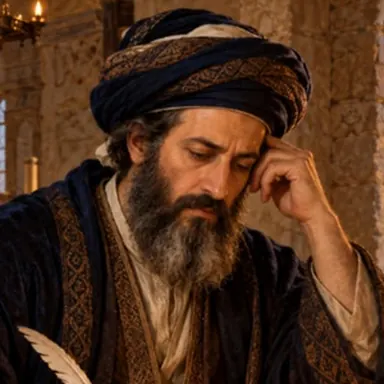
The Torah Portrait and Work of Rabbi Shmuel de Uzeda: A Giant of Homiletics, Anthology and Kabbalah in Safed's Golden Age
15 min read3,039 words
Introduction and Historical Background: Safed in the 16th Century as a Spiritual Center
During the 16th century, following the Expulsion from Spain and the consolidation of Ottoman rule in the Land of Israel, the city of Safed became the most influential spiritual, scholarly and kabbalistic center in the Jewish world [cite: 1]. In this period, known as "the Golden Age of Safed," an unprecedented array of sages gathered in the city, including Maran Rabbi Yosef Karo, Rabbi Moshe Cordovero (the Ramak), Rabbi Yitzchak Luria (the Holy Ari), Rabbi Moshe Alshich and Rabbi Chaim Vital [cite: 1]. In this unique environment, in which profound halakhic study, abundant homiletic creativity and a breakthrough in the Kabbalah of the esoteric merged, Rabbi Shmuel ben Yitzchak de Uzeda grew up and worked [cite: 1, 2, 3].
Rabbi Shmuel de Uzeda represents a monumental figure of an all-encompassing sage, who harmoniously combined his standing as head of a central yeshiva, a kabbalist from the circle of the Ari's "cubs," a preacher by the grace of the Most High, and a brilliant compiler (anthologist) who preserved the inalienable assets of Jewish exegesis [cite: 1, 2, 3]. His central work, "Midrash Shmuel" on Tractate Avot, not only became an integral foundational book of the Jewish library, but served as a cultural and textual bridge between medieval exegesis and the new printed literature [cite: 1, 2, 3, 4, 5].
His Life, His Teachers and His Spiritual Environment
Rabbi Shmuel de Uzeda was born in the city of Safed in the year 5305 (1545) to his father, Rabbi Yitzchak de Uzeda [cite: 1]. The family name "de Uzeda" reveals the geographic roots of his family, which traced itself to exiles from the town of Uzeda (Uceda) in the province of Toledo in Spain [cite: 4]. His upbringing in the Safed of the mid-16th century exposed him from a young age to an atmosphere saturated with messianic yearnings, holiness and Torah study of great intensity [cite: 1]. He acquired the foundations of his scholarly and homiletic path in the study hall of Rabbi Elisha Galico, one of the foremost sages of Safed and a disciple of Maran Rabbi Yosef Karo [cite: 1]. Inspired by Rabbi Elisha Galico, Rabbi Shmuel developed extraordinary homiletic skills and became a fervent preacher who drew to himself an audience thirsty to hear the words of the living God [cite: 1].
Alongside his studies of the revealed Torah, Rabbi Shmuel was counted among the members of the small circle of the kabbalists of Safed [cite: 1, 2, 3]. He was a friend of Rabbi Moshe Cordovero (the Ramak), and later, from about the year 5360, became one who filled a central role in the circle of the foremost disciples of the Holy Ari [cite: 1, 5]. After the Ari's early passing in the year 5332 (1572), Rabbi Shmuel continued his Kabbalah studies with the Ari's disciple and successor, Rabbi Chaim Vital [cite: 1, 2, 3]. Unequivocal testimony to his senior standing in this circle is found in the year 5335 (1575), when he signed at the head of the signatories on the famous "Deed of Association" of the Ari's disciples, in which they undertook to study Kabbalah exclusively from the mouth of Rabbi Chaim Vital and to recognize him as the spiritual heir of the Ari [cite: 1, 5]. In the esoteric tradition a unique testimony is preserved to the exceptionally high regard the Ari felt for him, when it is related that the Ari explained to his disciples that he accorded him special honor from a revelation that the soul of the pious Tanna Rabbi Pinchas ben Yair had been impregnated in the soul of Rabbi Shmuel [cite: 5].
Alongside his engagement in esoteric wisdom, Rabbi Shmuel stood at the head of a large and central yeshiva in Safed, in which both the subjects of the revealed Torah (Talmud, halakha and the decisors) and esoteric studies (Kabbalah) were taught [cite: 1, 2, 3]. This yeshiva served as a Torah beacon and produced many disciples [cite: 3]. To secure the economic existence of the yeshiva and of the sages of Safed, who groaned under a harsh burden of taxes and economic distress, Rabbi Shmuel set out in the year 5357 (1597) on a Torah mission and fundraising campaign in the city of Kushta (Istanbul), the capital of the Ottoman Empire [cite: 1, 2, 4]. In Kushta he also served as a preacher and spiritual leader, and printed some of his works there [cite: 4]. Rabbi Shmuel de Uzeda died in Safed around the years 5364–5365 (1604–1605), at about the age of 59, and was buried in the holy soil of Safed beside his teachers and colleagues [cite: 1, 2].
| Parameter | Historical and biographical details |
|---|---|
| Year and place of birth | 5305 (1545), Safed [cite: 1] |
| Year and place of death | 5364–5365 (1604–1605), Safed [cite: 1, 2] |
| Family lineage | Son of Rabbi Yitzchak de Uzeda; the family originated in Uzeda, Spain [cite: 1, 4] |
| His foremost teachers | Rabbi Elisha Galico (the revealed Torah and homiletics), the Holy Ari (Kabbalah), Rabbi Chaim Vital [cite: 1, 2, 3] |
| Main roles | Head of a yeshiva of the revealed and the esoteric in Safed, chief preacher, emissary (shadar) in Kushta [cite: 1, 2, 3, 4] |
| Key event | Signing at the head of the signatories on the Deed of Association of the Ari's disciples (5335) [cite: 1, 5] |
His Literary Work: Anthology, Commentary and Homiletics
The Torah work of Rabbi Shmuel de Uzeda is characterized by a rare combination of precise scholarly-Torah compilation and homiletic originality and depth of thought [cite: 1, 2, 3]. His most famous and influential book is "Midrash Shmuel" on Tractate Avot, which was first printed in Venice in the year 5339 (1579) [cite: 1, 2, 3, 4, 5]. This book was defined by the sages of the generations as a kind of "Shitah Mekubbetzet" on Tractate Avot [cite: 1, 5, 6].
The book is based on an extensive anthology of manuscripts, alongside his personal sermons [cite: 1, 2, 3]. Within the framework of the anthological enterprise, Rabbi Shmuel compiled, surveyed and cited dozens of commentaries on Tractate Avot that existed in his time in rare manuscripts and had not yet been placed under the printing press [cite: 1, 2, 3, 4, 7]. Among others, he embedded in his book the commentaries of Rabbenu Yonah Gerondi, the Ramah (Rabbi Meir Abulafia), the Rashbam, the Meiri, Rabbi Shmuel ibn Sid, Rabbi Yosef ibn Nachmias, Rabbi Baruch ibn Melech, Rabbi Yosef ibn Shoshan, and Rabbi Moshe Almosnino [cite: 4, 8]. The methodological importance of the book is of the first rank, since were it not for Rabbi Shmuel's citations, many of these commentaries would have been lost and would not have reached us at all [cite: 1, 4, 7]. Alongside the compilation, the book contains original explanations, inquiries and sermons of Rabbi Shmuel himself, which he created and delivered before the public in his sermons in Safed and Kushta [cite: 1, 2, 3].
The book enjoyed exceptional circulation and was printed three more times during the author's lifetime, including the Venice edition of 5360 with the precise proofreading of Rabbi Moshe Alfalas, and became the classic foundational commentary on Tractate Avot, printed in dozens of editions [cite: 1, 2, 4, 9]. The book's importance is also evident in the establishment of the text of the Mishnah: the Gaon Rabbi Shabtai Sofer of Przemyśl established a halakhic-textual rule that wherever there is doubt regarding the exact text of Tractate Avot, one is to decide according to the book "Midrash Shmuel," since Rabbi Shmuel examined precise and ancient manuscripts [cite: 5]. From the typological standpoint, it is proper to distinguish between the "Midrash Shmuel" of Rabbi Shmuel de Uzeda on Tractate Avot and the early amoraic midrash on the Book of Samuel, which is also called "Midrash Shmuel" or "Aggadata deShmuel" [cite: 10, 11].
Alongside "Midrash Shmuel," Rabbi Shmuel composed a comprehensive series of commentaries on the Five Megillot and other books of the Tanakh, characterized by an abundance of sermons, ethics and textual analysis [cite: 1, 2, 3, 4]:
- Lechem Dimah (Bread of Tears): a deep and comprehensive commentary on the Scroll of Lamentations, printed in Venice in the year 5360 (1600), dealing with the destruction, national suffering, and the paths of repentance and consolation [cite: 1, 2, 3, 4].
- Iggeret Shmuel (Shmuel's Letter): a commentary on the Scroll of Ruth, printed in Kuruçeşme near Kushta in the year 5357 (1597), combining literal and conceptual explanation with ethical foundations concerning kindness and redemption [cite: 1, 2, 3, 4].
- Commentary on the Scroll of Esther: a work that remained in manuscript for many years and was published in the year 5753 by Rabbi Chaim Aharon Kaufman, and was afterward incorporated into the "Mikraot Gedolot" edition of the Five Megillot [cite: 1, 3].
- Midrash Shmuel on the Torah: a comprehensive commentary on the weekly portions that he wrote and that remained in manuscript, until it was deciphered and published in New York in the year 5775 (2015) [cite: 1, 4].
- Additional works in manuscript: Rabbi Shmuel left behind the "Kovetz HaDerushim HaGadol" ("the Great Collection of Sermons"; a collection of unedited sermons), novellae on Tractate Ketubot, and commentaries on the books of Isaiah, Job, Daniel, Ecclesiastes and the Song of Songs [cite: 1, 2, 4].
| Title of the Work | Subject of the Work | Year and Place of First Printing | Nature of the Work and Main Characteristics |
|---|---|---|---|
| Midrash Shmuel | Commentary on Tractate Avot | 5339 (1579), Venice [cite: 1, 4, 5] | Interpretive anthology ("Shitah Mekubbetzet") and original commentary; foundational book [cite: 1, 2, 3, 5] |
| Lechem Dimah | Commentary on the Scroll of Lamentations | 5360 (1600), Venice [cite: 1, 4] | Homiletics, study and ethics on mourning for the destruction and on redemption [cite: 1, 2, 3, 4] |
| Iggeret Shmuel | Commentary on the Scroll of Ruth | 5357 (1597), Kuruçeşme [cite: 1, 4] | Commentary on kindness, redemption and the royal family [cite: 1, 2, 3, 4] |
| Commentary on the Scroll of Esther | Commentary on the Scroll of Esther | 5753 (1993), Jerusalem [cite: 1] | Published from manuscript; included in the Mikraot Gedolot [cite: 1, 3] |
| Midrash Shmuel on the Torah | Commentary on the Torah | 5775 (2015), New York [cite: 1, 4] | Compiled and edited from rare manuscripts [cite: 1, 4] |
His Torah, Intellectual and Educational Teaching
The teaching of Rabbi Shmuel de Uzeda is characterized by a multidimensional and profound conception. Although he was versed in the secrets of Lurianic Kabbalah, he chose, like his friend Rabbi Moshe Alshich, not to focus in his books on publicizing simplistic esoteric secrets, but to use kabbalistic insights as a concealed foundation for building an ethical, homiletic and educational system intended for the general public [cite: 1]. In his view, homiletics is not merely textual pilpul, but a primary means to awaken hearts, to bring the public closer to the service of God and to instill ethical norms [cite: 1, 3, 8]. In his commentaries he organically combines depth of Talmudic analysis, the philosophical-Torah insights of the sages of Spain, and kabbalistic hints [cite: 1, 8]. His avoidance of printing distinctly kabbalistic works reflects a cautious educational stance, according to which the esoteric is intended for direct study in closed circles, while the printed book must serve the welfare of the public and focus on the refinement of character traits [cite: 1].
A central issue treated at length in his commentaries is the purity of intention in Torah study and the broadening of the concept of "Torah for its own sake" [cite: 8, 12]. In his commentary on the Tanna's warning, "Do not make them a crown with which to magnify yourself, nor an axe with which to cut," Rabbi Shmuel analyzes the gradations of human motives in Torah study [cite: 8]. The basic prohibition of "an axe with which to cut" completely rules out enlisting the wisdom of the Torah in order to obtain a livelihood, social standing or authority in this world [cite: 8]. But Rabbi Shmuel goes on and deepens the criticism also toward the spiritual level of "a crown with which to magnify yourself" [cite: 8]. In his view, a person who studies Torah in order to earn spiritual reward in the World to Come or to grow in spiritual stature still holds a utilitarian conception of the Torah [cite: 8]. Proper and complete study stems solely from absolute humility, an inner thirst for divine wisdom and pure love of God [cite: 8, 12]. The true sage is defined by him as one who always sees himself as lacking, out of an understanding that divine wisdom is infinite and that the student must persist in an unceasing running and thirsting toward the source of living waters [cite: 12].
Rabbi Shmuel's conception of authority and Torah epistemology finds clear expression in his discussions of "faith in the Sages" [cite: 13]. In his commentaries he determines that the absolute acceptance of the words of the Sages, and belief in them as if they had been given directly from Sinai, are not only a halakhic commandment derived from the precept "you shall not turn aside," but constitute a basic prerequisite for attaining the wisdom of the esoteric [cite: 13]. According to Rabbi Shmuel, a person who casts doubt on the words of the Sages or approaches them with external criticism blocks for himself the possibility of understanding the secrets of the Torah, since the secrets of the Torah are revealed only to one who is fully and unreservedly connected to the tradition of the Sages [cite: 13].
At the same time, Rabbi Shmuel presents a fascinating complexity regarding the tension between pilpul and practice, and between caution and stringency [cite: 14]. In his interpretation of the Sages' saying "Greater is one who enjoys the fruit of his labor than one who fears Heaven," he offers an analysis that prefers sharp study and intellectual effort over passive stringency [cite: 14]. Rabbi Shmuel explains that a person accustomed to being stringent upon himself in every doubt of halakha out of mere fear of sin stands at a lower level than a Torah scholar who applies straightforward pilpul and deep exertion, and by means of them is able to clarify the law and permit something that at first glance seemed forbidden [cite: 14]. The ability to clarify the halakha and enable the permitted through exertion in Torah attests to a deeper mastery of the divine law and to a spiritual achievement higher than that of the God-fearing person who withdraws behind stringencies [cite: 14].
His Influence and Legacy for the Generations
The influence of Rabbi Shmuel de Uzeda on the world of Jewish scholarship is long-term and continues to our own day [cite: 1, 2, 3, 5]:
An inalienable asset ("nekhes tzon barzel") in the exegesis of Avot: The book "Midrash Shmuel" was accepted in all the Jewish dispersions – among the sages of Spain, Ashkenaz and the East – as the most important and comprehensive work on Tractate Avot [cite: 1, 2, 3, 5]. It is impossible to understand the development of the interpretation of this tractate without studying his book [cite: 2, 3, 5].
Preservation of the literature of the Rishonim: His compiling work saved from loss dozens of rare works of the sages of the Middle Ages [cite: 1, 4, 7]. Scholars of Talmudic and midrashic literature in recent generations make use of his book as a primary source for reconstructing the texts of Rishonim that did not survive in manuscript [cite: 4, 7].
Reliance by Maran the Chida and the sages of the generations: the greatest of the Chidas, Rabbi Chaim Yosef David Azulai, in his book "Shem HaGedolim" ("Names of the Great"), showers extravagant praise on Rabbi Shmuel de Uzeda and his book "Midrash Shmuel," and cites him frequently in his halakhic and homiletic works [cite: 13, 14, 15].
The pillar of Safed homiletics: Together with Rabbi Moshe Alshich, Rabbi Shmuel shaped the character of the Jewish sermon in the 16th and 17th centuries, one that combines the plain meaning (peshat), allusion (remez), homiletic interpretation (derash) and secret (sod), and places the refinement of character traits and faith at the center [cite: 1].
Summary
Rabbi Shmuel de Uzeda stands in the annals of the Torah of Israel as an exemplary figure of an all-encompassing sage, who succeeded in uniting in his personality and in his works the different worlds of Safed in its Golden Age [cite: 1, 2, 3]. As a distinguished member of the fellowship of the Ari and Rabbi Chaim Vital, and as a head of a yeshiva and eminent preacher, he left a rich Torah legacy characterized by ethical depth, scholarly integrity and a scholarly-Torah compilation that has no substitute [cite: 1, 2, 3, 5]. His book "Midrash Shmuel" remains to this day one of the central and most beloved books in the Jewish library, living testimony to his spiritual work and to his educational and intellectual teaching, which continues to illuminate the way of Torah learners and seekers of wisdom in all generations [cite: 1, 2, 3, 5].
Sources15
- 1.שמואל אוזידא - ויקיפדיה, he.wikipedia.org/wiki/שמואל_אוזידא
- 2.רבי שמואל אוזידא – ויקישיבה, yeshiva.org.il/wiki/index.php/רבי_שמואל_אוזידא
- 3.שמואל די אוזידא | מקורות מתוך ספריית ספריא, sefaria.org.il/topics/samuel-de-ueda
- 4.Samuel ben Isaac de Uçeda - Wikipedia, en.wikipedia.org/wiki/Samuel_ben_Isaac_de_Uçeda
- 5.Midrash Shmuel, Pirkei Avot. First Edition - Venice 1579 With a very early Kabbalistic 'chiddush' from the Ari z"l! - Zaidy Auctions, zaidy.com/auction/217-2-en/lot-33-3/
- 6.חיי חיי האבות האבות, machon.co.il/wp-content/uploads/2025/09/חיי-האבות.pdf
- 7.מסכת אבות – ספרי ראשונים, ספרי ליקוטים ומהדורת 'עוז והדר' - The Seforim Blog, seforimblog.com/2010/08/blog-post_6564/
- 8.מדרש שמואל (אוזידא)/ד - ויקיטקסט, he.wikisource.org/wiki/מדרש_שמואל_(אוזידא)/ד
- 9.יודאיקה Judaica - Fastly, bidspirit-images.global.ssl.fastly.net/kedem/auctionDayDocs/504/518/catalog/catalog_88_-part_1-_web.pdf
- 10.מדרש שמואל - ויקיפדיה, he.wikipedia.org/wiki/מדרש_שמואל
- 11.Midrash Samuel - Jewish Virtual Library, jewishvirtuallibrary.org/midrash-samuel
- 12.בראשית - דברי משה לכל פרשות בראשית - אור עמרם, oramram.co.il/בראשית-דברי-משה-לכל-פרשות-בראשית/
- 13.אמונת חכמים - נאמני תורה ועבודה, toravoda.org.il/אמונת-חכמים/
- 14.להחמיר נגד מרן. האמנם???| עמוד 2 - פורום כותל המזרח, forum.mizrach.co.il/threads/lhhmyr-ngd-mrn-hmnm.639/page-2
- 15.ברכות ד - מכון הלכה ברורה, halachabrura.org/agada/01brachot-4.htm