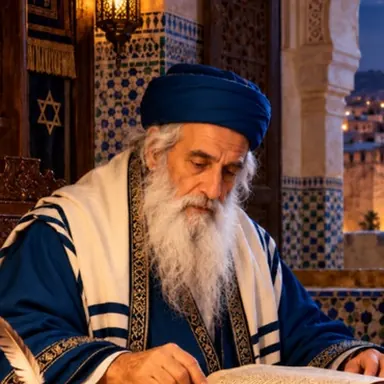
The Work, Torah Teaching and Public Leadership of Rabbi Raphael Berdugo ("the Angel Raphael")
16 min read3,299 words
Historical Context, Family Lineage and Life
Rabbi Raphael Berdugo (5507, 1747 – 21 Tishrei 5582, 17 October 1821), known by the epithet "the Angel Raphael", is counted among the greatest halakhic decisors, commentators and spiritual leaders of Moroccan Jewry in the eighteenth century and the beginning of the nineteenth century [cite: 1, 2, 3]. He was active in the city of Meknes, which was at that time a Torah and halakhic centre of the first rank in the Maghreb and brought together extensive dynasties of sages [cite: 1, 4, 5]. Rabbi Raphael was born into a distinguished family of sages and rabbinic judges whose communal flourishing began in the seventeenth century [cite: 1, 2].
His family lineage placed him at the centre of the Torah creativity of the city of Meknes [cite: 1, 4]. Rabbi Raphael was the son and student of Rabbi Mordechai Berdugo, called "HaMarbitz" (5475–5522), who served as head of the rabbinic court, head of a yeshiva and a renowned disseminator of Torah [cite: 6, 7]. On his mother's side, Mrs. Bellaida, he was the great-grandson and grandson of the famous head of the Meknes yeshiva and head of the rabbinic court, Rabbi Moshe Berdugo, known by the epithet "HaMashbir" (5439–5491), who was the principal teacher of his son-in-law HaMarbitz [cite: 2, 6, 7]. His eldest brother, Rabbi Yekutiel Berdugo, also served as his spiritual guide and as head of the rabbinic court of the city [cite: 1, 2, 7]. Rabbi Raphael led the family to the peak of its halakhic authority, and left four sons: Rabbi Maimon Berdugo (called HaMevin, author of the responsa "Lev Mevin" and "Penei Mevin"), Rabbi Mordechai, Rabbi Avraham and Rabbi Meir [cite: 2, 4].
Rabbi Raphael's childhood was interwoven with heavy economic hardship and complex personal suffering [cite: 2, 4]. At only fifteen he was orphaned of his father and even delivered a bitter eulogy over him [cite: 2]. Because of his family's dire poverty he could not buy candles for light, and he applied himself to his study by the light of the moon [cite: 4]. These life circumstances of material want in the years of his childhood and youth later shaped his deep social sensitivity as head of the rabbinic court and leader of the community [cite: 4]. Alongside this, he coped throughout his life with heavy family bereavement, having lost three wives whom he married one after another, as well as his son Chaim, who died at the age of only about five [cite: 2, 7].
He began his interpretive and Talmudic path at a very young age; already when he was about twenty-four he began to set down in writing profound novellae on the Talmud [cite: 2, 7]. Around the year 5546 (1786), in his thirties, he was appointed third judge in the great rabbinic court of Meknes, alongside the head of the court Rabbi Shlomo Toledano and the second judge, his brother Rabbi Yekutiel [cite: 1, 2]. Upon the death of his brother Rabbi Yekutiel in the year 5562 (1802), Rabbi Raphael rose to serve as head of the rabbinic court and as the spiritual and halakhic leader of the community [cite: 1, 2].
The epithet "the Angel Raphael" clung to him in his lifetime and in the generations after him because of his holiness, his asceticism and his supreme spiritual conduct [cite: 6, 7, 8]. His death occurred on the night of Hoshana Rabba 5582 (1821), while he was engaged in studying the Idra from the Book of the Zohar as part of the Tikkun of the night of Hoshana Rabba, at the age of seventy-five [cite: 2, 3]. Communal tradition in Morocco relates that when a government decree was enforced a year after his burial and his coffin was taken out, his body was found whole without any change [cite: 1, 2].
Public Leadership, Enactments and Halakhic Rulings
The public leadership of Rabbi Raphael Berdugo was characterised by a combination of uncompromising firmness towards the powerful men of the community and deep compassion and concern for the weaker strata [cite: 1, 4, 9]. The period of his tenure was saturated with political and economic upheavals in Morocco, including decrees and pogroms in the days of Sultan Mulay Yazid (the riots of 5650), years of severe drought and epidemics that claimed many victims [cite: 1, 10]. Within this complex reality, Rabbi Raphael did not confine his role to the four cubits of Torah law, but acted as an active civic and social leader [cite: 1, 9].
Rabbi Raphael's communal enactments directly affected the social and religious structure of the community in Meknes [cite: 1, 2, 10]. One of his most prominent enactments was the abolition of the ancient custom that obliged families to distribute sweets and food to all the people of the city upon the birth of a daughter, a custom that placed a heavy financial burden on poor families and shamed those who could not meet the expense [cite: 4]. In the field of family and personal-status law he introduced unprecedented reforms in the laws of inheritance, such as regulating the inheritance rights of the husband and the children in the event of the wife's death, in order to prevent prolonged family disputes and to protect orphans [cite: 1, 9].
Besides these, he legislated comprehensive enactments for enforcing public order and morality, including limiting excessive spending at family celebrations, a ban on card games, and preventing animals from roaming in the Jewish quarter [cite: 2]. On the religious-halakhic plane, he led a firm move to abolish old local slaughtering customs and to subject all the ritual slaughterers and inspectors to the customs of Castile (Spain), in order to create uniformity and a binding halakhic standard [cite: 1, 9]. He likewise served as the protector of Torah scholars and stood up fearlessly against the wealthy and notables of the community when they refrained from participating properly in the economic burden or treated those who studied Torah with contempt [cite: 1, 9].
His firm positions and his independent rulings led more than once to fierce controversies with sages older than him or his peers in the generation, the most famous and sharpest controversy being with his colleague on the rabbinic court, Rabbi Baruch Toledano [cite: 1, 9]. Despite these controversies, Rabbi Raphael's halakhic authority grew and became established throughout the lands of the Maghreb, and his rulings were accepted with a submission and admiration that is rarely found [cite: 1, 2, 7]. His nephew, the halakhic decisor Rabbi Yaakov Berdugo, testified to his standing that all regarded him as a great tree to rely upon, and that even in his lifetime all the sages of his generation would heed him with great reverence and as a supreme authority [cite: 2, 7].
The Literary Enterprise and Torah Creativity
Rabbi Raphael Berdugo left behind an extensive and varied literary legacy encompassing all the disciplines of the Torah: halakha and rulings, biblical commentary, novellae on the Talmud, homiletics, the study of aggadah, and Judeo-Arabic linguistics [cite: 2, 3, 10, 11]. Some of his works circulated in manuscript for decades and were printed only in later generations through the editorial work of the sages of Morocco and of modern scholars [cite: 2, 3, 9].
| Title of the book | Field and genre | Place and year of first / notable printing | Main features and Torah content |
|---|---|---|---|
| Responsa Mishpatim Yesharim | Questions and answers (halakha) | Kraków 5651 (1891) [cite: 2, 9, 12] | 2 parts. A central halakhic work that spread his name as a decisor of the first rank throughout Morocco [cite: 2]. |
| Torot Emet | Glosses and commentary on the Shulchan Arukh | Meknes 5699 (1939) [cite: 2, 9] | A critical and independent discussion of the four parts of the Shulchan Arukh, edited and published by Rabbi Shalom Messas [cite: 2, 9, 13]. |
| Mei Menuchot | Commentary and sermons on the Torah | Jerusalem 5665 (1905) / Djerba [cite: 2, 9, 14] | 2 parts. A profound commentary combining plain meaning, homiletics and philosophical ideas based on the sages of Spain [cite: 2, 14]. |
| Mesamchei Lev | Biblical commentary (Mei Menuchot, part 3) | Ramat Gan / Jerusalem [cite: 2, 11, 15] | An original commentary focusing on resolving contradictions and inconsistencies in Scripture (especially in the books of the Prophets) [cite: 2, 11]. |
| Sharvit HaZahav | Novellae on the tractates of the Talmud | Jerusalem 5735 (1975) [cite: 2, 9] | 2 parts. A scholarly Talmudic analysis written in his youth (from the age of 24) [cite: 2, 7]. |
| Rokeach Mirkachat | Commentary on and explanation of the aggadot of the Talmud | Jerusalem (new edition, 3 volumes) [cite: 15] | A groundbreaking work with a critical and rational approach to the analysis of figures and sayings in the aggadot of the Talmud [cite: 2, 15]. |
| Leshon Limudim | Translation and linguistic commentary on the Bible | Scholarly edition (3 volumes) [cite: 16] | A dictionary and interpretive index to the Bible in Maghrebi Judeo-Arabic (the Meknes dialect) [cite: 3, 16]. |
| Chesed VeEmet | Sermons and eulogies | Jerusalem / Meknes [cite: 2, 3] | Sermons for the cycle of the year, community events and eulogies for the sages of his generation [cite: 2, 3]. |
| Rav Peninim | Sermons and essays | Casablanca 5730 (1970) [cite: 2, 9, 15] | A collection of profound sermons on the Torah, the festivals and Pirkei Avot [cite: 2, 9, 15]. |
A close study of his work reveals that his writings are not merely a collection of laws or sermons, but an architectonic structure of wide-ranging halakhic and interpretive thought [cite: 2, 10, 11]. In his book "Torot Emet" Rabbi Raphael presents a fundamental analysis of the words of Maran Rabbi Yosef Karo and the Rema [cite: 2, 9]. His halakhic inclination does not yield to accepted conventions when the Talmudic proofs indicate otherwise; he examines the words of the Shulchan Arukh in direct relation to the discussions of the Bavli, the Yerushalmi and the responsa of the Rishonim [cite: 7, 17, 18].
In his book "Rokeach Mirkachat", devoted to the aggadot of the Talmud, Rabbi Raphael presented a unique conception [cite: 2, 15]. Unlike tendencies that kept away from a plain analysis of the aggadah or that interpreted it only through abstract kabbalistic symbols, Rabbi Raphael approached the aggadot of the Talmud with the tools of rational criticism, psychological analysis of the characters, and the derivation of practical moral and educational lessons [cite: 2, 15]. This work is considered exceptional in its interpretive daring [cite: 2, 15].
His book "Leshon Limudim" is a mighty linguistic-pedagogical project [cite: 16]. The work, extending over hundreds of pages, was intended to make the text of the Bible accessible to the local community through translation and morphological and syntactic explanation in Judeo-Arabic in the classic Maghrebi accent of the Meknes community [cite: 3, 16]. This work served as a central study tool in the batei midrash of Morocco and in time became a source of the first rank for scholars of Jewish languages and dialects [cite: 16].
Terminology and Theoretical Methodology: Intellectual Independence, Plain Meaning and Aggadah
An examination of Rabbi Raphael Berdugo's creative methodology reveals a three-dimensional structure harmoniously integrated in all his writings [cite: 11, 15, 18]. On the halakhic plane, in his book "Torot Emet", he focuses on direct study of the Talmudic discussions and the early decisors, while taking care to remain independent of later commentators and sensitive to the needs of the community and the individual [cite: 2, 7, 9, 18]. On the interpretive plane, in his book "Mesamchei Lev", he establishes a methodology of preferring the linguistic-historical plain meaning, independently resolving contradictions in Scripture and integrating philosophical and grammatical insights [cite: 2, 11]. On the homiletical and aggadic plane, in his book "Rokeach Mirkachat", he breaks new ground in the rational analysis of the aggadot of the Sages, offering educational and psychological criticism, and rejecting pilpul detached from reality [cite: 2, 15].
Independence in Rulings and Approach to the Sources of Halakha
Rabbi Raphael championed an approach of ruling from the primary sources [cite: 17, 18]. When a halakhic decision was required of him, he immersed himself in the analysis of the Talmudic discussion and the positions of the Rishonim (the Rif, Maimonides (Rambam) and the Rosh), and did not hesitate to reject interpretations of Acharonim that seemed to him a convoluted midrash or a pilpul that did not sit well with reason [cite: 7, 17, 18]. This freedom of study was also reflected in his readiness to be lenient in places where he identified excessive stringencies that have no firm basis in the Talmud, while strictly maintaining the boundaries of binding halakha [cite: 17, 18].
The Methodology of Resolving Contradictions in Scripture ("Mesamchei Lev")
In his book "Mesamchei Lev" he developed a systematic methodology for resolving inconsistencies and contradictions in the biblical text, especially in the books of the Former Prophets [cite: 11]. Rabbi Raphael's studies in this field have been examined in modern academic research, which points to three basic principles in his method [cite: 11]:
- 1.Preferring the linguistic-historical plain meaning: the greatest possible effort to solve textual difficulties by means of grammatical analysis, historical context and the structure of the book, while reducing recourse to midrashic solutions that take the text away from its plain meaning [cite: 11].
- 2.Independent interpretive solutions: readiness to propose an original resolution of contradictions in Scripture, even when this solution differs from the solutions of the Sages or of prominent medieval commentators such as Rashi, Radak and Ibn Ezra [cite: 11].
- 3.A chronological and realistic conception: treating the historical events in the Bible from a realistic conception of the order of time and of the political and social circumstances of the period [cite: 11].
Combining Plain Meaning, Kabbalah and Philosophy
Although he was a godly and holy kabbalist who was involved in the secrets of the esoteric teaching (as the circumstances of his death while engaged in the Zohar attest) [cite: 1, 2, 6], Rabbi Raphael separated sharply and clearly between the world of Kabbalah and the world of the plain meaning and practical halakha [cite: 18, 19]. In his books of commentary and halakha (such as "Mei Menuchot" and "Torot Emet"), he refrained from grafting kabbalistic ideas onto the plain meaning of the verses or onto the halakhic ruling, unless this was necessary and well founded [cite: 18, 19]. In interpreting the Torah he made extensive use of philosophical and intellectual tools drawn from the teaching of the sages of Spain in the Middle Ages, stressing man's free will, God's knowledge and individual providence [cite: 19].
The Influence of His Legacy, Its Reception and Its Study in the Modern Era
The legacy of Rabbi Raphael Berdugo continued to resonate deeply in the world of halakha and thought of North African Jewry and beyond throughout the nineteenth and twentieth centuries [cite: 1, 9, 13]. The sages of Morocco in subsequent generations saw in him a supreme halakhic point of reference. The decisor of the generation, Rabbi Shalom Messas of blessed memory, chief rabbi of Jerusalem and of Morocco, devoted great effort to correcting, editing and publishing the writings of Rabbi Raphael, and in particular his central book "Torot Emet", in the recognition that the Torah of "the Angel" is a pillar of Maghrebi halakhic instruction [cite: 9, 13, 20].
In recent decades the teaching of Rabbi Raphael Berdugo has enjoyed a renewed flowering both in the batei midrash and in the world of academic research. On the Torah and halakhic plane, institutes and rabbis of the family are working to publish all his works in modern, carefully prepared and vocalised editions. Within this framework his books "Mei Menuchot" on the Torah, edited by his grandson Rabbi David Berdugo, have been republished [cite: 14], as has his book "Rokeach Mirkachat" on the aggadot of the Talmud in three volumes, accompanied by the commentary "Or Meir" and by the interpretive-philosophical introduction "Shalom Rav" by Dr. Mori Mordechai Amar [cite: 15].
At the same time, scholars of the heritage of the East and of the Hebrew language, headed by Prof. Moshe Bar-Asher, have devoted comprehensive studies to Rabbi Raphael's linguistic and translation work [cite: 16]. In the scholarly edition of "Leshon Limudim", Bar-Asher analysed the Hebrew and Aramaic elements in the Judeo-Arabic dialect of Meknes, and presented the work as an enduring linguistic and cultural asset [cite: 16]. Likewise, biblical scholars such as Prof. Michael Avioz have analysed his interpretive approach to resolving contradictions in the Prophets [cite: 11]. On the public and historical plane, his grave marker in the old Jewish cemetery of Meknes continues to serve as a focus of pilgrimage [cite: 1, 3], and in 2021 the 200th anniversary of his death was marked throughout the Jewish world and in Morocco with official events, with the participation of community leaders and public figures, emphasising his central role in shaping the spiritual and halakhic identity of North African Jewry [cite: 21, 22].
Summary and Conclusions
Rabbi Raphael Berdugo, "the Angel Raphael", represents the figure of a comprehensive spiritual leader who united in his personality kabbalistic depth and personal asceticism with firm and open public leadership [cite: 1, 2, 4]. His halakhic and public work was driven by deep social sensitivity and by a readiness to fight for the distressed strata, through bold communal enactments and a thorough overhaul of the laws of inheritance, monetary matters and ritual slaughter [cite: 1, 4, 9].
On the theoretical and intellectual plane, Rabbi Raphael bequeathed a methodology based on fearless independence in rulings, striving for the straightforward plain meaning, rational-critical analysis of the aggadot of the Sages, and making the sources of Judaism accessible to the general public in its own language [cite: 2, 11, 15, 16]. His extensive work, which is enjoying a renewed flowering and fresh study in our days, stands as a witness to the glorious splendour of Torah creativity in Morocco and continues to be a source of inspiration for decisors, preachers and scholars to this very day [cite: 9, 11, 15, 16].
Sources22
- 1.Rabbi Raphael Berdugo - Tzadikim - Daily Zohar, dailyzohar.com/tzadikim/1099-Rabbi-Raphael-Berdugo
- 2.רפאל בירדוגו - ויקיפדיה, he.wikipedia.org/wiki/רפאל_בירדוגו
- 3.רבי רפאל ברדוגו, מקנס - המרכז למטייל במרוקו, moroc.co.il/heritage/hilulot/raphael-berdugo
- 4.שושלת של תורה ואמונה: סיפורם של הרבנים ממשפחת בירדוגו - הידברות, hidabroot.org/article/1195980
- 5.Rafaʿel Berdugo - Oxford Reference, oxfordreference.com/display/10.1093/oi/authority.20110803095500776
- 6.מכירה חלק פריטים נדירים ומיוחדים - Fastly, bidspirit-images.global.ssl.fastly.net/kedem/auctionDocs/499/catalog/catalog_86-1_-web_1.pdf
- 7.כתובה לנישואי רבי רפאל בירדוגו "המלאך רפאל", רבה הראשי של מקנס – בחתימות רבי שמואל בן ואעיש ורבי משה בן שלוש - Kedem Auctions, kedem-auctions.com
- 8.כף זהב. שיר בכתב יד מאת 'המלאך רפאל' רבי רפאל בירדוגו. אוטוגרף. מרוקו, המאה ה 19-18, winners-auctions.com
- 9.Raphael Berdugo - Wikipedia, en.wikipedia.org/wiki/Raphael_Berdugo
- 10."את הארבה למינו ואת הסלעם למינהו..." (ויקרא יא, כב) – הספרייה היהודית, אוניברסיטת בר-אילן - Facebook, facebook.com/JewishLibrary.biu/photos/2176357619111411/
- 11.דרכו של ר' רפאל בירדוגו ביישוב סתירות במקרא בספרו "משמחי לב" - Bar-Ilan University, cris.biu.ac.il/en/publications/
- 12.ספר שאלות ותשובות משפטים ישרים - רפאל בירדוגו - Google Books, books.google.com/books/about/?id=ZV_txAEACAAJ
- 13.הרב יצחק יוסף לפרשת כי תשא - הלכות בישול בשבת - הידברות, hidabroot.org/article/238173
- 14.מי מנוחות השלם על התורה סט ב' כרכים / למלאך רבי רפאל בירדוגו זיע"א - אוצר הספרים, sefer.org.il/items/8872621
- 15.רקח מרקחת - שלום ר"ב - ש"ס - הספריה הספרדית העולמית, wslibrary.net/items/8869042
- 16.משה בר-אשר - ויקיפדיה, he.wikipedia.org/wiki/משה_בר-אשר
- 17.הרב-א.אסולין-הלכות חכמי מרוקו - מורשת יהדות מרוקו, moreshet-morocco.com
- 18.שלחן ערוך המדות - א, toratemetfreeware.com/online/f_02555.html
- 19.ביאור:אמונה טהורה/השער השביעי: אמונה - ויקיטקסט, he.wikisource.org/wiki/ביאור:אמונה_טהורה/השער_השביעי:_אמונה
- 20.רבי ש.משאש ז"ל-אורה של ירושלים | מורשת יהדות מרוקו, moreshet-morocco.com
- 21.Rabbi Raphael Berdugo commemorated 200 years after his death, eurojewcong.org/news/communities-news/morocco/rabbi-raphael-berdugo-commemorated-200-years-after-his-death/
- 22."Moroccan Jews have a very different history from other Arab countries", said Serge Berdugo, eurojewcong.org/news/communities-news/morocco/moroccan-jews-have-a-very-different-history-from-other-arab-countries-said-serge-berdugo/