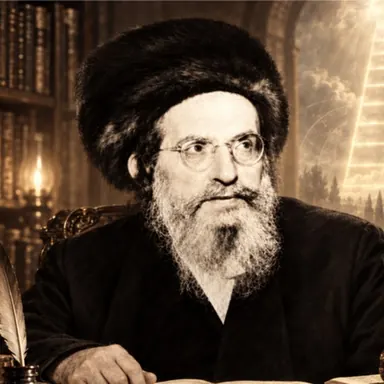
The Life's Work and Torah-Kabbalistic Teaching of Rabbi Yehuda Leib HaLevi Ashlag ("Baal HaSulam"): Studies in His Biography, His Philosophical-Social Thought and His Interpretive Enterprise
27 min read5,434 words
Summary
Rabbi Yehuda Leib HaLevi Ashlag (5 Tishrei 5645, 24 September 1884 – 10 Tishrei 5715, 7 October 1954), known by the epithet "Baal HaSulam" ("Master of the Ladder") after his comprehensive commentary on the Zohar, is regarded as one of the most prominent and revolutionary scholars and interpreters of Kabbalah in the modern era [cite: 1, 2]. This thinker brought about a methodological, conceptual and pedagogical revolution in the Jewish esoteric teaching [cite: 1, 2]. His theological-Kabbalistic teaching combined a profound ontological discussion of the structure of the upper worlds with a radical social-universal conception, which offered a dialectical analysis of human society and outlined a blueprint for a rectified society founded on the commandment "Love your neighbor as yourself" and on the principles of "altruistic communism" [cite: 1, 2, 3, 4].
The Ashlagian doctrine placed at its center the democratization of the hidden wisdom: its emergence from the esoteric sphere and the opening of Kabbalah to all strata of the people as a tool for a transformation of consciousness, morality and redemption [cite: 1, 5, 6]. This comprehensive analysis examines the stations of his life, his canonical works, the foundations of the metaphysics and psychology he developed, his social-political teaching and his lasting influence on Jewish thought and academic research.
His Life, Spiritual Development and Public Activity
His Early Years in Europe and His Growth in Hasidism
Yehuda Leib HaLevi Ashlag was born in the town of Łuków in Poland (then in the Russian Empire) to Rabbi Simcha HaLevi and Masha Rachel [cite: 2, 7]. Already in his youth he stood out as an enormously diligent and assiduous student [cite: 7]. Biographical traditions and Hasidic sources relate that before reaching the age of bar mitzvah he was well versed in extensive parts of the Talmud [cite: 7], and that his passion for studying the esoteric teaching led him to hide pages of the Ari's "Etz Chaim" inside the volumes of the Gemara in order to study them in secret [cite: 2, 8, 9]. By the age of eighteen his knowledge of the Zohar, the writings of the Ari and the writings of Rabbi Moshe Cordovero (the Ramak) had reached the level of fluency by heart [cite: 8].
He acquired the teaching of Hasidism in the Polish study halls [cite: 7]. He became a disciple of the Rebbe Rabbi Meir Shalom Rabinowicz of Kaluszyn (a grandson of the "Holy Jew" of Peshischa), and after his death he sheltered in the shadow of his son, Rabbi Yehoshua Asher II of Porisov [cite: 2, 7, 9]. He also traveled to the Rebbes Rabbi Yissachar Dov Rokeach of Belz and Rabbi Yechiel Meir of Ostrowiec [cite: 2, 7].
In the year 5666 (1906), at about the age of twenty, he married Mrs. Rivka Roiza Abramovitz [cite: 2, 7, 9]. The couple had eleven children, among them the prominent disseminators of his teaching, the righteous Rabbi Baruch Shalom HaLevi Ashlag (the Rabash) and Rabbi Shlomo Binyamin HaLevi Ashlag [cite: 2, 9, 10]. At the age of nineteen he was ordained to the rabbinate by the great rabbis of Warsaw [cite: 1, 8, 9]. To meet the requirements of the civil law for receiving an official rabbinical certificate, he learned the Russian language within a short time [cite: 9]. For about sixteen years he served as a dayan (judge) and halakhic instructor at the rabbinical court in Warsaw, and during this period he published his first work, "Sichot Chaim" [cite: 1, 2, 9].
| Year / Period | Main station in his life and work |
|---|---|
| 1884 (5645) | Birth in Łuków, Poland, to a Hasidic family [cite: 2, 7]. |
| 1903 (5663) | Rabbinic ordination in Warsaw at the age of 19 and the beginning of extensive engagement in the esoteric teaching [cite: 1, 8, 9]. |
| 1906–1921 | Service as a dayan and halakhic instructor in Warsaw, and the encounter with the mysterious teacher who handed down to him the secrets of Kabbalah [cite: 1, 7, 9]. |
| 1921 (5682) | Immigration to the Land of Israel with his family and settlement in the Old City of Jerusalem [cite: 1, 2, 10]. |
| 1926–1928 | Stay in London and the writing of his first Kabbalistic work, "Panim Meirot u-Panim Masbirot" [cite: 11]. |
| 1935–1936 | The beginning of the printing of "Talmud Eser HaSefirot," a fundamental commentary in 16 parts on the writings of the Ari [cite: 11]. |
| 1940 (5700) | Publication of the newspaper "HaUmma," a Kabbalistic-social newspaper that was closed down by the British authorities [cite: 1, 2]. |
| 1943–1953 | Writing and printing of the 21 volumes of the "Sulam Commentary" on the Zohar [cite: 6, 12]. |
| 1954 (5715) | His death on Yom Kippur and his burial in the Har HaMenuchot cemetery in Jerusalem [cite: 2, 7]. |
The Mystical Experience and the Mysterious Teacher
One of the formative events in Rabbi Ashlag's spiritual development, mentioned in his letter of 10 Marcheshvan 5688 (1927) to his brother-in-law Rabbi Avraham Mendel Braunstein, is his encounter with a mysterious teacher in Warsaw [cite: 2, 7]. Rabbi Ashlag describes how on the night of 12 Marcheshvan a man who was a wondrous sage in the wisdom of Kabbalah revealed himself to him [cite: 7]. For about six months he studied with him every night after midnight in the ways of holiness and purity, until the teacher revealed to him a secret in its full sense [cite: 7]. Following this revelation and the transmission of the secret, the teacher fell ill and died, but Rabbi Ashlag saw this event as a turning point in his spiritual attainment [cite: 7].
In Letter 39 (from the year 5687) Baal HaSulam testified to his sense of a unique mission and noted that he had merited the "ibbur (impregnation) of the soul of the holy Ari," a profound spiritual attainment that no person had merited since the death of the Ari, intended to enable his breakthrough in study and the dissemination of Kabbalah to the masses [cite: 7, 13].
Immigration to the Land of Israel and Activity in Jerusalem and Gush Dan
In the year 5682 (1921), following his Zionist-religious outlook and his recognition that the Land of Israel is the sole place for realizing the spiritual and social potential of the people of Israel, Rabbi Ashlag immigrated with his family to the Land of Israel and settled in the Old City of Jerusalem [cite: 1, 2, 10]. In his first years in the Land he assumed the guise of a hidden Torah scholar, until his name became known as one of the geniuses of Kabbalah in Jerusalem [cite: 1]. He drew close a select group of disciples and began to lecture to them on the ways of the esoteric teaching [cite: 1, 10].
In the years 5686–5688 (1926–1928) he stayed in London, where he composed his first comprehensive commentary on the Ari's "Etz Chaim," "Panim Meirot" and "Panim Masbirot," which served as the basis for his later work "Talmud Eser HaSefirot" [cite: 11]. On his return to the Land he lived in the Givat Shaul neighborhood of Jerusalem and served as the rabbi of the neighborhood, and afterwards moved to live in Tel Aviv and Bnei Brak in order to draw closer to the workers and to the general public [cite: 1, 10].
The Dialogue with the Leaders of the Yishuv and the Revolutionary Work
Rabbi Ashlag did not confine his spiritual work within the doors of the study hall alone, but strove to influence the shapers of the national home in the making [cite: 1]. He held profound and frequent meetings with the heads of the Labor movement and the Hebrew Yishuv, among them David Ben-Gurion, Moshe Sharett, Zalman Shazar, Chaim Arlosoroff, Moshe Aram and the poet Chaim Nachman Bialik [cite: 1].
David Ben-Gurion recorded in his notes his surprise at the content of their meetings, noting that whereas Ben-Gurion wished to delve with him into the secrets of Kabbalah, Rabbi Ashlag wished to discuss with him socialist dialectics and the structure of the rectified society [cite: 1, 7]. His burning attachment to the revival of the nation in its land was so deep that on the kiddush knife with which he sliced the challot on the Sabbath he engraved the words "State of Israel" [cite: 1].
In the year 5700 (5 June 1940) he took a step without precedent in the Haredi and Kabbalistic world: he published a Kabbalistic-political newspaper named "HaUmma" ("The Nation") [cite: 1, 2]. In this newspaper he combined accessible Kabbalistic explanations with a trenchant socio-economic analysis, and called for the unification of the people on the basis of the values of mutual responsibility and mutual giving [cite: 1, 2]. The newspaper was closed down by the British Mandate authorities after only one issue, owing to the lack of a formal license and fear of revolutionary messages [cite: 2].
In his last years he invested all his physical strength in writing, proofreading and typesetting the "Sulam" commentary [cite: 1, 7]. The strenuous work with the lead type at the printing house severely damaged his health and led to lead poisoning and the deterioration of his physical condition [cite: 7]. Rabbi Ashlag died on Yom Kippur 5715 (7 October 1954), while the prayer leader in the adjacent room was crying out in prayer the verse "With long life will I satisfy him, and show him My salvation" [cite: 2, 7]. He was laid to rest in the Har HaMenuchot cemetery in Jerusalem [cite: 2].
The Interpretive and Canonical Enterprise
The works of Baal HaSulam constitute a wide-ranging textual corpus that combines a didactic structure of study with theological depth. The two pillars of his work are "Talmud Eser HaSefirot" and the "Sulam Commentary" on the Zohar [cite: 1].
"Talmud Eser HaSefirot" ("The Study of the Ten Sefirot")
"Talmud Eser HaSefirot," which began to be published in the year 5696 (1935–1936), is regarded as the undisputed masterpiece of Rabbi Y. L. Ashlag in explaining the teaching of the Ari [cite: 1, 11]. The work, which extends over 16 parts, was built on a Talmudic-academic pattern that allows graded and systematic study of the dynamics of the spiritual worlds [cite: 11, 14].
Rabbi Ashlag took the foundational passages from the writings of the Ari (mainly from the books "Etz Chaim" and "Mevo She'arim") and organized them in a four-part pedagogical structure:
- 1.The source text ("the Inner Text"): the words of the Ari in their original wording [cite: 11].
- 2.Or Penimi (Inner Light): a literal, running commentary attached to the text of the Ari, explaining the concepts and the sequence of matters [cite: 11].
- 3.Histaklut Penimit (Inner Observation): a broad and deep thematic treatment analyzing the central philosophical and Kabbalistic topics discussed in that part, filling out the implications of the metaphysical structure for consciousness [cite: 11].
- 4.Table of questions and answers: a unique didactic section divided into "questions and answers on the meaning of the words" and "questions and answers on the topics," intended for memorization, self-testing and the consolidation of memory [cite: 11].
In the introduction to this work Baal HaSulam set a clear goal: "to blast the iron wall that stands and separates us from the wisdom of Kabbalah" [cite: 11]. He guided the learner toward a gradual didactic approach, according to which one should first read the source and the "Or Penimi" commentary, delve into the "Histaklut Penimit" and test the knowledge with the tables of questions and answers [cite: 11].
| Part | Main Kabbalistic subject |
|---|---|
| Part 1 | Tzimtzum (contraction) and Kav (line) [cite: 11] |
| Part 2 | Circles and Straightness [cite: 11] |
| Part 3 | Direct Light and Returning Light [cite: 11] |
| Part 4 | The Ten Sefirot of Akudim [cite: 11] |
| Part 5 | The Ten Sefirot of Akudim in the second expansion (Mati ve-Lo Mati) [cite: 11] |
| Part 6 | The Ten Sefirot of the world of Nekudim [cite: 11, 15] |
| Part 7 | The Ten Sefirot of the seven primordial kings who died (the breaking of the vessels) [cite: 11] |
| Part 8 | The Ten Sefirot of the world of Atzilut [cite: 11] |
| Part 9 | The couplings (zivvugim) of the Sefirot [cite: 11] |
| Part 10 | The first ibbur (gestation) of Zeir Anpin (ZA) [cite: 11, 16] |
| Part 11 | The correction of lights, sparks and vessels in the fetus, and the second ibbur [cite: 11] |
| Part 12 | The second ibbur of ZA [cite: 11] |
| Part 13 | The images of the Partzufim and the corrections |
| Part 14 | The gadlut (greatness) of Zeir Anpin [cite: 11] |
| Part 15 | The Partzufim of Abba and Imma and of Zeir Anpin and Nukva |
| Part 16 | The worlds of Beriah, Yetzirah and Assiyah (BYA) |
The "Sulam Commentary" on the Zohar
The writing of the "Sulam" commentary began in the year 5703 (1943) and was completed in the year 5713 (1953) [cite: 6]. The commentary covered all parts of the Zohar (the Zohar on the Torah, Tikkunei HaZohar, Zohar Chadash) and was printed in 18 to 21 volumes [cite: 6, 7, 12]. Rabbi Y. L. Ashlag translated the Aramaic text into lucid Hebrew, vocalized the text, and appended to it an explanation based on the teaching of the Ari [cite: 1, 6].
Rabbi Ashlag explained the choice of the name "HaSulam" ("the Ladder"): he noted that the function of the commentary is like the function of any ladder: if there is a storehouse full of every good thing, a person lacks nothing but a ladder to climb up to it, and then all the good of the world is in his hands; the commentary is not an end in itself, but an introduction for every person that enables him to delve into the Zohar itself [cite: 6].
The completion of the writing of the commentary was celebrated on Lag BaOmer 5713 with an enormous thanksgiving feast in Meron near the tomb of Rabbi Shimon bar Yochai, which continued in weeks of celebrations in his home [cite: 6, 7]. At this event he declared that making the Zohar accessible to the present generation is testimony that humanity stands on the threshold of the era of the days of the Messiah, and that the study of the Zohar is the central spiritual tool for bringing the redemption [cite: 5, 6].
| Parameter of comparison | Talmud Eser HaSefirot (TES) [cite: 1, 11] | The Sulam Commentary on the Zohar [cite: 1, 6] |
|---|---|---|
| Base text | The writings of the Ari ("Etz Chaim," "Mevo She'arim") [cite: 6, 11] | The Zohar, Tikkunei Zohar, Zohar Chadash [cite: 6, 12] |
| Number of volumes | 5–7 volumes (16 parts) [cite: 11, 14, 17] | 18–21 volumes [cite: 6, 7, 12] |
| Years of publication | 5696 (1935/6) onward [cite: 11] | 5703–5713 (1943–1953) [cite: 6] |
| Source language | Kabbalistic Hebrew (the language of the Ari) [cite: 11] | Aramaic translated into Hebrew and vocalized [cite: 6] |
| Pedagogical methodology | Source text, running commentary, thematic analysis, questions and answers [cite: 11] | Literal translation, running commentary that decodes symbols into Kabbalistic structures [cite: 1, 6] |
| Main target audience | Advanced learners seeking ontological systematicity [cite: 11] | All of Israel, from beginners to accomplished Kabbalists [cite: 1, 6, 17] |
Additional Books and Treatises
Alongside his two principal works, Baal HaSulam left a rich corpus of philosophical and social essays. In the treatise "Matan Torah" ("The Giving of the Torah") he analyzed the development of morality and human involvement in the commandment "Love your neighbor as yourself" as the sole spiritual key to attaining adhesion (devekut) to the Creator [cite: 1]. In the treatises "The Peace," "The Arvut" (mutual responsibility) and "The Freedom" he developed a profound psychological-sociological analysis of human nature and the social structure [cite: 5, 18, 19].
In addition, the volume "Pri Chacham" collects spiritual letters and essays sent to his disciples, dealing with practical guidance for inner divine service [cite: 1, 12]. Late philosophical-political manuscripts were collected under the name "Writings of the Last Generation," in which he outlined a detailed plan for a future rectified social order [cite: 1, 3, 4, 20]. Finally, the work "Shamati" ("I Heard") contains profound essays and talks recorded by his son, Rabbi Baruch Shalom Ashlag, directly from his father's mouth [cite: 2].
The Metaphysical and Psychological Foundations of His Teaching
The thought of Baal HaSulam conceptualizes Lurianic Kabbalah by means of psychological and ontological categories, which make the abstract Kabbalistic symbols accessible to the analysis of the human soul and the development of consciousness.
The Fundamental Dichotomy: "The Will to Receive" versus "The Will to Bestow"
At the basis of Ashlagian metaphysics stands the assumption that the Creator is an essence of absolute love and outflow, "the will to bestow" [cite: 2, 14]. In order to realize this will to bestow contentment and emanation, the Creator created ex nihilo the created being, whose ontological essence is "the will to receive" pleasure and vitality [cite: 2, 14]. Baal HaSulam argues that the "will to receive" is the substance that was created, and all physical and spiritual matter in reality is nothing but different intensities and varied manifestations of this will [cite: 2, 4, 14].
However, the disparity of form between the bestowing Creator and the receiving creature creates a spiritual dissonance called in Kabbalah "nahama de-kisufa" (the shame of receiving). In order to cancel this shame and to bring the creature to perfection, the created matter underwent a process of descent and a model of contraction. In the First Contraction (Tzimtzum Aleph) the Malkhut of the Infinite contracted the spiritual light from within itself, in order to build a system in which man would be able to produce a mechanism of free choice and self-work [cite: 11, 21].
By means of the "screen" (masach) and the "returning light," man developed a psychic mechanism that enables him to reject automatic egoistic reception, and to receive the abundance only to the extent that he can direct the reception as giving contentment to the Creator ("receiving in order to bestow") [cite: 21, 22]. This process leads to "equivalence of form" (devekut), a connection that is not physical but an equivalence of psychic qualities, in which the more a person develops a will to bestow upon his fellow, the more he equalizes his form with the Creator and attains an ontological union with Him [cite: 2, 12].
The Four Phases of Direct Light and the Development of the Soul
The process of the formation of the spiritual vessel is built, according to Baal HaSulam, of four fixed stages that take place at every level in the upper worlds and in the human soul [cite: 21, 22]:
- Root phase: the light of the Infinite that shines and brings into being the will to receive [cite: 21, 22].
- Phase 1 (Chokhmah): the spreading of the light within the primary will to receive, in which the vessel takes in the abundance but is not actively aware of itself [cite: 21, 22].
- Phase 2 (Binah): the awakening of the will to receive to resemble the Source of light, which develops a will to bestow and constitutes the root of purification [cite: 21, 22].
- Phase 3 (Zeir Anpin): the drawing down of the light of Chasadim with a small illumination of the light of Chokhmah [cite: 21, 22].
- Phase 4 (Malkhut): the awakening of the independent and complete will to receive, which understands its lack and wishes to receive the light of Chokhmah in full [cite: 21, 22].
This course is accompanied by a dynamic of the purification of the screen [cite: 21]. When the screen is purified of its coarseness (from Phase 4 to Phase 3, 2 and so on), new levels of light emerge, which find expression in the human soul as the five parts of the soul: nefesh, ruach, neshama, chaya, yechida (NaRaNHaY) [cite: 21, 23].
The Methodology of "Make for Yourself a Teacher" and the Society of Learners
Rabbi Ashlag stressed that the psychological change from egoism to altruism cannot take place in isolation [cite: 2, 24]. He formulated a practical conception of a "society of mutual responsibility" (arvut), in which individuals band together in order to cancel their self-importance before a group of equals [cite: 2, 4, 24]. Within this framework he defined the conception of "make for yourself a teacher": a person must choose a spiritual teacher who has attained, and nullify his egocentric opinion before him, in order to acquire the teacher's consciousness and cleave to his spiritual form [cite: 2].
The Social-Political Theory: "Altruistic Communism" and the Writings of "The Last Generation"
A unique and exceptional core of Baal HaSulam's thought is his socio-economic analysis, which has won appreciation and extensive study from scholars of Kabbalah and of the social sciences, such as Prof. Boaz Huss [cite: 2, 20, 25]. Rabbi Ashlag proposed a fusion of the Kabbalistic esoteric teaching with socialist and utopian ideas, under the concept of "altruistic communism" [cite: 2, 3, 20, 25].
The Dialectical Analysis of Marxism and the Soviet Regime
In the writings of "The Last Generation" and in his social essays (such as "The Peace" and "The Arvut"), Baal HaSulam carried out a brilliant analysis of the economic regimes in human history [cite: 3, 4, 5, 18, 20]. He divided human beings into two morphological-moral types: egoists, who make up about 90% of the world's population and all of whose motives are founded on personal benefit, and altruists (idealists), who make up about 10% of the population and are endowed with a nature that gives its soul for the common good [cite: 4].
According to his analysis, the utopian communism that preceded Karl Marx failed because it was founded only on a few exceptional altruists, and could not hold out against an egoistic majority [cite: 4]. Marx, by contrast, drove the revolution forward by mobilizing the egoism of the oppressed class (the proletariat), which was interested in a just distribution of resources for personal reasons [cite: 4].
However, already in 1933 Rabbi Ashlag foresaw with certainty the future collapse of the Soviet regime in the Soviet Union [cite: 2]. His reasoning was metaphysical-sociological: an imposed regime that tries to distribute resources equally ("according to his needs"), but lacks a foundation for the sake of Heaven and the spiritual values of love of one's fellow, must deteriorate into totalitarianism, oppression, a decline in economic creativity and finally internal disintegration [cite: 2, 3, 4].
| Feature for comparison | Marxist-Soviet communism | Altruistic communism (the teaching of Baal HaSulam) |
|---|---|---|
| Basic motive for work | Personal benefit, class war and the egoism of the proletariat [cite: 4]. | Love of one's fellow, equivalence of form with the Creator and giving for the sake of Heaven [cite: 2, 3, 4]. |
| Means of enforcement and implementation | State coercion, mechanisms of terror and central bureaucracy [cite: 2]. | Spiritual education, positive environmental influence and a change of consciousness [cite: 1, 3]. |
| Purpose of the system | Human material equality in a secular-materialist world [cite: 2]. | Adhesion to the Divine, mutual responsibility and world peace [cite: 2, 3, 18]. |
| Expected historical outcome | Corruption, a decline in productivity and final internal collapse [cite: 2]. | Moral rectification of the world, complete redemption and human perfection [cite: 3, 5]. |
The Socio-Economic Principle of the Future Society
In the social blueprint of "The Last Generation," Baal HaSulam formulated the laws of the rectified society [cite: 3, 4, 20]:
Every person will work and contribute to society to the full extent of his ability, and will receive resources to meet his essential needs only [cite: 3, 14]. The motive for work will not stem from monetary reward or from honor, but from the will to give contentment to the Creator and to serve humanity [cite: 2, 3, 4]. In "The Article on Peace" he explained that the laws of nature/the Creator oblige the human race to live in a rectified society [cite: 19]. Just as a systemic breakdown in a physical body causes illness, so a deviation from the law of "Love your neighbor as yourself" causes wars, suffering and social disasters, which are nothing but automatic punishments of the mechanism of nature [cite: 19].
Already in the first half of the 20th century Baal HaSulam identified the chain of global interdependence [cite: 18]. He argued that in the modern world no country can be alone in its security or its welfare, and the socio-economic solution must ultimately encompass all of humanity [cite: 3, 4, 18].
His Attitude to Zionism, to the Redemption and to the State of Israel
Rabbi Ashlag saw the Jewish national awakening and the establishment of the State of Israel as a critical stage in the process of the miraculous and historical redemption [cite: 1, 2].
Historical events such as the Balfour Declaration were perceived by him as a sign from Heaven of the duty to immigrate to the Land of Israel [cite: 2]. His disciples' sources note that in the 1920s he warned that a window of opportunity of twenty years had been granted from Heaven to immigrate to the Land of Israel before disaster befell European Jewry, and he even tried to found a secret group of three hundred well-to-do families in Poland for organized immigration [cite: 2].
According to his conception, the redemption is not a passive process that merely waits for a heavenly miracle, but demands an active act of social and spiritual rectification [cite: 1, 6]. He defined the role of the State of Israel not only as a physical refuge for Jews, but as a spiritual laboratory for a rectified society that will be "a light to the nations" in realizing the law of mutual responsibility and love of one's fellow [cite: 1, 3, 5]. In his essay "The Shofar of the Messiah" he argued that the dissemination of the wisdom of Kabbalah is the shofar that gathers in the exiles and awakens the human spirit to rise higher [cite: 5].
His Musical and Hasidic Work
Another fascinating facet of Baal HaSulam's work is his musical compositions [cite: 2, 26]. Rabbi Ashlag composed Kabbalistic melodies that his disciples regard as tools of consciousness for attaining devekut and for expressing the emotions of the soul immersed in the upper worlds [cite: 2, 26].
Among his famous melodies one may count "Lamnatze'ach al Shoshanim" (Psalm 45), a complex and profound musical work some 20 minutes long [cite: 2], "Asader li-Seudata," sung at Sabbath tables, and "Azamer bi-Shevachin," which serves as a Kabbalistic melody for the Sabbath meals [cite: 2]. These melodies are preserved and sung to this day in the Hasidic courts that follow his path, and have received arrangements and public documentation [cite: 2, 26].
His Legacy, His Disciples and His Influence on Research and on the Modern Public
His Disciples and Successors
After his death the leadership of his disciples and Hasidim split into several main branches, which continued to disseminate his writings and to teach according to his method [cite: 2, 10].
| Branch / framework of activity | Central figures | Character of the activity and contribution to preserving the legacy |
|---|---|---|
| The main (Hasidic) branch | Rabbi Baruch Shalom HaLevi Ashlag (the Rabash) [cite: 2, 10] | His eldest son and successor, author of the "Shamati" essays and of the practical Sulam essays [cite: 2, 10, 12]. |
| The family and printing branch | Rabbi Shlomo Binyamin HaLevi Ashlag [cite: 2, 10] | His son, engaged in printing and disseminating the writings of Baal HaSulam and in establishing the study hall [cite: 2, 10]. |
| The Stretyn and yeshiva branch | Rabbi Yehuda Tzvi Brandwein [cite: 2, 20] | His brother-in-law and disciple, leader of the Stretyn Hasidism and founder of the "Kol Yehuda" yeshiva [cite: 2, 20]. |
| Modern mass dissemination | The "Bnei Baruch" movement (M. Laitman) and the Kabbalah Centre (P. Berg) [cite: 13, 20, 24] | Organizations founded by disciples of the Rabash and of Rabbi Brandwein for broad dissemination in Israel and around the world [cite: 13, 20, 24]. |
| Distinctive communities and centers | "Or HaGanuz" (Rabbi Scheinberger), "Sulam Yehuda" (Rabbi Pinchas) [cite: 2, 17] | Torah-Kabbalistic study centers that combine community life and divine service according to the method of Baal HaSulam [cite: 2, 17]. |
Today there are several courts and communities that continue his path, among them the courts of the Ashlag Rebbes in Bnei Brak, the "Or HaGanuz" community headed by Rabbi Mordechai Scheinberger, the "Sulam Yehuda" organization headed by Rabbi Shaked Eliyahu Pinchas, as well as broad dissemination movements such as "Bnei Baruch" headed by Michael Laitman and the "Kabbalah Centre" founded by Rabbi Shraga Feivel Berg (a disciple of Rabbi Brandwein) [cite: 2, 12, 13, 17, 20].
Academic Research on His Teaching
In recent decades Rabbi Ashlag's thought has become a central focus of academic research in the field of Jewish thought and the historiography of Kabbalah in the 20th century.
Prof. Boaz Huss (Ben-Gurion University) devoted several fundamental studies to Ashlagian Kabbalah, and in particular his well-known article "Altruistic Communism: The Modernist Kabbalah of Rabbi Ashlag" (2006), in which he analyzed the adaptation of Kabbalah to modernism and to contemporary political conceptions [cite: 20, 25]. Prof. Jonathan Meir studied the vicissitudes of the printing of his writings, his relations with thinkers such as Hillel Zeitlin and the dynamics of the dissemination of the esoteric teaching in the Land of Israel in the first half of the 20th century [cite: 13, 20, 27]. Further scholars, such as Prof. Eliezer Schweid and Prof. Ron Margolin, analyzed his teaching of love, his theodicy and the response of his thought to the events of the Holocaust and the national rebirth [cite: 2, 20].
Summary
Rabbi Yehuda Leib HaLevi Ashlag, "Baal HaSulam," created a unique synthesis in the world of Jewish and Kabbalistic thought [cite: 1, 2]. By means of an interpretive enterprise of enormous dimensions, culminating in "Talmud Eser HaSefirot" and the "Sulam Commentary," he dismantled the linguistic and conceptual barriers that had prevented access to the study of the hidden teaching, and turned Kabbalah from an exoteric-esoteric system into an applicable psychological-social method [cite: 1, 6, 11].
His thought offers a profound diagnosis of human nature, which identifies in the egocentric "will to receive" the root of all human suffering and conflict, and sets against it "the will to bestow" and mutual responsibility as an absolute condition for survival and social flourishing [cite: 1, 2, 3, 14]. The conception of "altruistic communism" that he developed, together with his call for a global mutual responsibility based on the commandment "Love your neighbor as yourself," establish him not only as an outstanding Hasidic Kabbalist, but as an innovative and daring thinker whose teaching continues to challenge and enrich learners, scholars and the general public to this very day [cite: 1, 2, 3, 25].
Sources28
- 1.בעל הסולם – הרב יהודה לייב אשלג - kab.co.il
- 2.- קבלה לעם, kab.co.il/בעל-הסולם-הרב-יהודה-לייב-אשלג/
- 2.יהודה לייב הלוי אשלג - ויקיפדיה, he.wikipedia.org/wiki/יהודה_לייב_הלוי_אשלג
- 3.המבנה הכלכלי-חברתי של החברה העתידית | קבלה מדיה - Kabbalah Media, kabbalahmedia.info/he/programs/cu/YgbnW4Xw?activeTab=summary
- 4.בעל הסולם. הדור האחרון | קבלה מדיה - Kabbalah Media, kabbalahmedia.info/he/lessons/series/cu/wBm8CIAt?activeTab=transcription
- 5.מאמרים | בעל הסולם - הרב יהודה לייב אשלג, sulam-y.co.il/category/ספרי-חסידות-אוצר-הכתבים/כתבי-חסידות-אשלג/כתבי-בעל-הסולם/מאמרי-בעל-הסולם-יהודה-אשלג/
- 6.הקדמות הסולם שערים לעבודת ה' בדרך חכמת האמת | הרב יהודה אשל"ג, zolsefer.co.il/הקדמות-הסולם-שערים-לעבודת-ה-בדרך-חכמת-האמת-הרב-יהודה-אשל-ג.html
- 7.בעל הסולם - הרב אשלג - בסוד הדברים, besodh.com/הרב-אשלג-בעל-הסולם/
- 8.הרב אשלג - "בעל הסולם" 1885- 1954 תרמ"ו - תשס"ו, mudaut.co.il/הרב-יהודה-לייב-אשלג-בעל-הסולם/
- 9.בעל הסולם, messages.responder.co.il/7890605
- 10.הרב ברוך שלום הלוי אשלג – ויקישיבה, yeshiva.org.il/wiki/index.php/הרב_ברוך_שלום_הלוי_אשלג
- 11.תלמוד עשר הספירות - ויקיפדיה, he.wikipedia.org/wiki/תלמוד_עשר_הספירות
- 12.נבואתו של בעל הסולם | סולם יהודה | ספריה תרונית ללימוד קבלה וחסידות אשלג, sulam-y.co.il/נבואתו-של-בעל-הסולם-המקובל-יהודה-אשלג/
- 13.ניו אייג' | לולאת האל | עמוד 22, tomerpersico.com/tag/ניו-אייג/page/22/
- 14.קבלה - ויקיפדיה, he.wikipedia.org/wiki/קבלה
- 15.תלמוד עשר הספירות חלק ו - התע"ס לקריאה חינם | סולם יהודה, sulam-y.co.il/תלמוד-עשר-הספירות-תעס-חלק-ו-סולם-יהודה/
- 16.תלמוד עשר הספירות | חלק י - סולם יהודה, sulam-y.co.il/תלמוד-עשר-הספירות-תעס-חלק-י-סולם-יהודה/
- 17.פרשת שבוע — שיעורי קבלה לפי הזוהר הקדוש - סולם יהודה, sulam-y.co.il/topics/פרשת-שבוע-שיעורי-תורה-קבלה/
- 18.1123 - Calaméo, calameo.com/books/00477730665b9427ce598
- 19.בעל הסולם. השלום | קבלה מדיה - Kabbalah Media, kabbalahmedia.info/he/lessons/cu/1Rz3EUc2?activeTab=transcription
- 20.'בני ברוך' - סיפורה של קבוצה דתית חדשה, bmj.org.il/wp-content/uploads/2019/12/25.14.Ben_Tal.pdf
- 21.תלמוד עשר הספירות עמוד קכ הרב יוחאי ימיני | סולם יהודה, sulam-y.co.il/video/תלמוד-עשר-הספירות-עמוד-קכ/
- 22.תלמוד עשר הספירות חלק ב פרק א אות ה - סולם יהודה, sulam-y.co.il/video/תלמוד-עשר-הספירות-חלק-ב-פרק-א-7/
- 23.עשר הספירות בגוף האדם - חכמת הקבלה - יצחק אהרון, kabalah.co.il/עשר_הספירות_בגוף_האדם/
- 24.לייטמן, בני ברוך, סיכום אירוע - לולאת האל, tomerpersico.com/2008/07/21/laitman-summary/
- 25.בועז הוס - ויקיפדיה, he.wikipedia.org/wiki/בועז_הוס
- 26.ניגוני בעל הסולם [הרב יהודה לייב אשלג] - הספרייה הלאומית, nli.org.il/he/items/NNL_MUSIC_AL990035198650205171/NLI
- 27.ספריה וירטואלית - קבלה - מכון הלכה ברורה, halachabrura.org/library/library6.htm