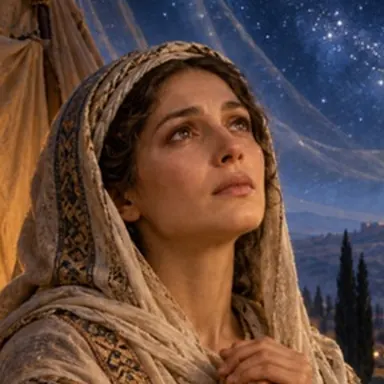
The Kingdom of Thought and Prayer: The Work, Torah Teaching and Metaphysical Standing of Leah the Matriarch
23 min read4,543 words
Summary
This article sketches the metaphysical portrait of Leah the Matriarch and presents her as a figure who represents the world of thought and prayer, in contrast to her sister Rachel, who is identified with the world of action and revelation. The text examines her biographical roots, her power to change decrees through her tender, tearful eyes, and the revolution in faith she brought about by founding the concept of thanksgiving, which recognizes a particular divine providence that transcends the laws of nature. Through kabbalistic and Hasidic analysis, the source explains how Leah symbolizes "Alma de-Itkasya" (the concealed world), a supreme spiritual level of understanding (binah) and repentance that is reflected also in the division of the midnight "Tikkun" and in her hidden burial in the Cave of Machpelah. Ultimately, the article emphasizes that Leah gave the people of Israel the ability to recognize free gifts and grace in the midst of hardship and rejection, and thereby shaped the eternal spiritual foundation of the nation.
The figure of Leah the Matriarch, the fourth of the four Matriarchs of the people of Israel, presents one of the most complex and profound theological structures in biblical, midrashic and kabbalistic literature [cite: 1]. Unlike her younger sister Rachel, whose figure was identified with manifest perfection, physical beauty and a tangible historical presence, Leah represents the power of hidden thought, of prayer that pierces barriers, and of the cosmic transformation of human destiny [cite: 1, 2, 3, 4]. Through the story of her life, the change in the family order on the wedding night, the birth of her sons and her eternal burial place, an entire Torah doctrine takes shape that lays the foundations of the spiritual consciousness and the eternal leadership of the people of Israel [cite: 3, 5, 6].
The Roots of Leah's Figure and the Semiotic Web of Her Name
Leah was born in Haran to Laban the Aramean and to her mother Adina [cite: 3, 5]. Leah's name carries a double semiotic charge in the various sources. In the biblical Hebrew tradition, the name Leah echoes the words for weariness, slackness, fatigue and weakness [cite: 1]. The Midrash attributes this weariness to the physical and emotional state she was in because of her anxiety over her fateful future [cite: 3, 7]. Semitic and Arabic linguistics offer an alternative explanation, according to which the name Leah derives from the word for "wild cow" [cite: 5]. This connection gives her personality a shade of natural, wild and untamed power, standing in complete contrast to the attempts of her father Laban to civilize and subdue her [cite: 5].
The Midrashim of the Sages present Leah as a figure who lived under a constant existential threat [cite: 7, 8]. According to the social order accepted in those generations, Rebecca's two sons were to marry Laban's two daughters: the elder to the elder and the younger to the younger [cite: 3, 7]. Leah, the firstborn, was destined for Esau the wicked, while Rachel, the younger, was destined for Jacob the wholehearted [cite: 3, 7]. The knowledge that her historical portion was to fall to the lot of Esau, who was known as a robber of people and a shedder of blood, caused Leah a profound shock [cite: 7]. She would sit constantly at the crossroads, ask the passers-by about Esau's deeds, and weep bitter tears in supplication to the Holy One, blessed be He, that He change the evil decree [cite: 4, 7]. It was this prolonged weeping that shaped her chief physical trait: "And Leah's eyes were tender" [cite: 3, 7]. The tenderness of her eyes, which according to the plain sense of the verse is sometimes perceived as an aesthetic defect compared with Rachel's beauty, was interpreted by the Sages as Leah's greatest praise: visible testimony to the power of constant prayer that tears up decrees [cite: 7, 8, 9].
The Secret of the "Signs" and the Switch on the Wedding Night: From Tragedy to an Act of Cosmic Kindness
The building of the shared home with Jacob took place amid an elaborate act of deceit initiated by Laban [cite: 1, 3]. Jacob, who suspected Laban's crooked character in advance, gave Rachel secret signs so that he could identify her on the wedding night and prevent her being switched for Leah [cite: 3]. However, when Rachel saw that her father was leading Leah to the wedding canopy, she was moved with compassion for her elder sister [cite: 3, 7]. Out of self-sacrifice and deep modesty, Rachel chose to give Leah the secret signs so that she would not be shamed and her disgrace exposed in public [cite: 3, 7, 10].
This act is not merely a dramatic family event, but an action with cosmic consequences for the structure of the Israelite nation [cite: 6, 11]. Laban accompanied the deception with a further symbolic step: he gave Leah Zilpah as her handmaid [cite: 3]. This was done contrary to custom, since Zilpah was younger than Bilhah (Rachel's handmaid), and Laban sought to mislead Jacob into thinking that the bride was indeed the younger Rachel [cite: 3]. The later Midrash gives the giving of the handmaids an inner psycho-theological dimension: Laban gave the anxious Bilhah to the beautiful Rachel in order to calm her fears and build up her strength, while to Leah of the "tender" and weeping eyes he gave Zilpah, whose name alludes to the "sprinkling" (zilluf) of tears [cite: 12]. Zilpah knew how to contain Leah's weeping, and together they found rest for their aching souls [cite: 12].
The consequences of this switch accompanied Leah throughout her life [cite: 2, 6]. Jacob, who loved Rachel completely, treated Leah as "hated," an attitude that stemmed both from the sense of deception he had experienced and from the difference in spiritual level between them [cite: 3, 5]. This gap was expressed in a physically and hierarchically discriminatory way during the tense encounter with Esau [cite: 5]. Jacob, fearing for the lives of his family, arranged the camp in a hierarchical order that revealed the extent of his preference: at the front, in the most vulnerable position, were placed the handmaids and their children; in the middle, at a moderate degree of vulnerability, were placed Leah and her children; and at the rear, in the most protected and secure position, were placed Rachel and Joseph [cite: 5]. The Midrash of the Sages presents this preference as a measure-for-measure punishment of Jacob for the deceit he himself had practiced toward his father Isaac in order to receive the blessings [cite: 5, 13].
Chronological Biography and Midrashic Timeline
To understand the scope of Leah's work, one must examine the biographical and chronological data that appear in the various sources. The timeline of Leah's life and the way it was woven into Jacob's life are presented in the Tannaitic and midrashic sources with certain differences of version regarding her exact age at the time of her death.
The Ontological Revolution of Thanksgiving: "This Time I Will Give Thanks" and the Foundations of Jewish Consciousness
The summit of Leah's spiritual teaching, which changed the face of monotheistic faith for all generations, comes with the birth of her fourth son, Judah [cite: 3]. Scripture notes that after the first three sons, Leah named her fourth son Judah, saying: "This time I will give thanks to the Lord" (ha-pa'am odeh et Hashem) [cite: 3, 15, 16]. The Gemara in Tractate Berakhot interprets this naming as an unprecedented theological revolution: from the day the Holy One, blessed be He, created His world, there was no person who gave thanks to Him until Leah came and gave thanks to Him [cite: 15, 17, 18, 19].
To grasp the depth of this statement, one must distinguish between two fundamental concepts in the philosophy of religion and in Jewish thought: the concept of "blessing" (berakhah) and the concept of "thanksgiving" (hoda'ah).
Blessing is an address to God out of recognition of the fixed lawfulness of nature [cite: 17]. When a person blesses over bread or over fruit, he gives thanks for the fixed metaphysical law by which God governs His world and bestows a constant flow of abundance [cite: 17]. Blessing does not demand a change in the order of the world, but a recognition that the good comes from an ordered and purposeful cause [cite: 17]. Thanksgiving (hoda'ah or hodayah), by contrast, takes place only where an absolute free will is revealed, one that transcends the fixed and predictable lawfulness [cite: 17]. Thanksgiving is the recognition of a good that has come to a person beyond the letter of the law, a good that does not come to him by strict justice or by the ordinary allotment of nature [cite: 17, 20, 21, 22].
The Matriarchs were prophetesses and knew that twelve tribes were destined to come forth from Jacob, and that since he had four wives, the share of each of them in building the nation was three sons [cite: 3, 21]. When Leah bore her fourth son, she understood that she had received an abundance beyond the mathematical division and dry distributive justice [cite: 20, 21, 22]. By saying "This time I will give thanks to the Lord," she did not merely express a feeling of joy, but established a new ontological conception of the relationship between the Creator and the created [cite: 15, 17]. She recognized God not only as the source of the fixed laws of nature, but as a personal God, possessing free and beneficent will, who watches over the individual personally and grants him free gifts beyond the letter of the law [cite: 15, 17].
This distinction is represented in the subtle linguistic change that the Sages used [cite: 15]:
In the statement about Abraham, who called God "Lord," it is said: "from the day the Holy One, blessed be He, created the world" (et ha-olam) [cite: 18]. Abraham's calling expressed recognition of the general Creator of nature and of the cosmos as a whole [cite: 15].
In the statement about Leah, who gave thanks to God, it is said: "from the day the Holy One, blessed be He, created His world" (et olamo), with the addition of the possessive letter vav [cite: 15, 17, 18, 19]. This addition, as the Ben Yehoyada explains, indicates faith in constant particular providence [cite: 15]. Leah emphasized that the world is not abandoned to the laws of the constellations and of nature, but remains "His world," the world of the Holy One, blessed be He, who governs it by His free will at every single moment [cite: 15].
From this conception the name of the child, Judah (Yehuda), was derived, and from it the historical name of the whole people, "Jews" (Yehudim) [cite: 8, 15]. A Jew is one who holds fast to Leah's way of thanksgiving, a person who recognizes the presence of God in the details of his everyday life and acknowledges that his whole existence rests on free and constant divine grace [cite: 15].
The Theological Structure of Leah's Motherhood: An Analysis of Her Sons' Names and Their Influence on the Generations
The birth of Leah's sons is not merely a biological sequence, but a spiritual journey in which Leah formulates the stages of development of the human soul and its relationship with the Divine. Each name she gave represents a cosmic theological level, reflected in the character and destiny of the tribes that descended from her through the generations.
The Psychology of the Sacred Struggle: The Relationship of the Sisters and the Controversy over Prayer
The relationship between Leah and Rachel is saturated with deep existential and spiritual tension, which Scripture articulates through jealousy and the struggle over fertility [cite: 1]. Scripture states: "And Rachel envied her sister" [cite: 1, 21]. The Sages in the Midrash (cited in Rashi's commentary) interpret this envy in a way that clears it of petty motives: Rachel did not envy Leah for being a mother of sons as such, but "envied her good deeds" [cite: 21]. Rachel assumed that the reason Leah had been granted sons while she herself remained barren lay in Leah's greater righteousness, and thereby spurred herself on to spiritual deepening and to improving her deeds [cite: 10, 21].
This tension erupts in the charged conversation between Rachel and Jacob, when Rachel cries out: "Give me children, or else I die" [cite: 10, 21]. Jacob's response is sharp and surprising: "And Jacob's anger was kindled against Rachel, and he said: Am I in God's stead, who has withheld from you the fruit of the womb?" [cite: 10]. Nechama Leibowitz's studies of the commentary of Nahmanides (Ramban) reveal the depth of the theological dispute that broke out here [cite: 25]. Jacob was not angry with Rachel because of her weakness or her personal grief [cite: 25]. His anger was aroused by what he identified as a mistaken conception of the essence of prayer and of man's relationship with his God [cite: 25].
Rachel demanded that Jacob pray for her as Isaac had prayed for Rebecca [cite: 10, 21, 25]. But Jacob answered her that Isaac had prayed for his wife when both of them were barren, whereas here Leah had already borne sons and Jacob was not prevented from fulfilling the commandment to be fruitful and multiply [cite: 10, 21, 25]. Nahmanides explains that Jacob discerned in Rachel's words an attempt to "compel" the divine will by means of the spiritual power of the tzaddik [cite: 25]. This is the essential difference between the incantation and magic of idolatry, which seek to subjugate the Divine to the will of man, and true Jewish prayer [cite: 25]. The one who truly prays, like Leah, comes to God from a stance of complete self-nullification, shedding tears and pleading for mercy, out of the understanding that abundance is a free gift and is not forced upon the Creator [cite: 4, 7, 25]. Jacob demanded that Rachel cease from the magical demand that the tzaddik act on her behalf, and turn to a personal prayer flowing from the depths of the heart and from complete submission, as Leah had done throughout her life [cite: 4, 7, 25].
Beyond Materiality: Leah in the Teaching of Kabbalah and Hasidism
In the esoteric teaching and in Hasidism, the two sisters are not merely two historical figures, but two cosmological poles that govern divine and human reality alike [cite: 3, 4, 26].
Leah is "Alma de-Itkasya" (the concealed world) and the sefirah of Binah (understanding), also called the first letter heh of the Name Havayah (the Tetragrammaton) [cite: 3, 4, 23, 26]. She is the source of supernal thought, the spiritual root from which the attributes and the words descend [cite: 3, 23]. Thought works without cease, free of the fetters of materiality, and cannot be fully grasped by man's limited faculties [cite: 3, 23]. For this reason Leah is called by this name, from the word for weariness, since thought is always roaming and active [cite: 3]. Rachel, by contrast, is "Alma de-Itgalya" (the revealed world) and the sefirah of Malkhut (kingship), called the second letter heh of the Name Havayah [cite: 4, 23, 26]. Rachel represents the letters of speech and action, the vessels that make it possible to draw the divine light down to the lower worlds and to reveal it within matter [cite: 23, 26].
From this distinction, Hasidic teaching (and especially the author of the Tanya in his book Torah Or) explains the tragic dispute between the generation of the wilderness and the way of Jacob our father [cite: 23]. The generation of the wilderness, called "the generation of knowledge" (dor de'ah), belonged in its essence to the aspect of Leah, the world of abstract thought [cite: 23]. They lived in the wilderness, were nourished by the spiritual manna, drank from Miriam's well and were not required to perform the physical toil of plowing and sowing [cite: 23]. Their principled claim was that there was no need to descend into the physical Land of Israel and to engage in practical commandments and in matter [cite: 23]. They sought to remain in the hidden and supernal realm of Leah's thought, called in Kabbalah "Leviathan," the creature that swims in the hidden sea of thought and maintains a constant attachment (devekut) detached from the world [cite: 23].
But Jacob our father knew that this way of abstract attachment is intended only for a select few in every generation [cite: 23]. The true purpose of creation is not to remain in the worlds of abstract thought, but to descend into the revealed world of matter, to refine the sparks and to fulfill practical commandments in physical speech and action: the way of Rachel, called in Kabbalah the "wild ox" (shor ha-bar) that acts upon the land [cite: 23]. The error of the generation of the wilderness was that they did not understand that it is precisely physical action and simple speech that draw down the highest light of the Infinite (Ein Sof), according to the mystery of "their end is embedded in their beginning" [cite: 23]. Jacob made his principal dwelling in Rachel's tent, because his longing was to bring about the revelation of the Shekhinah below, within the world of speech and action [cite: 23].
Tikkun Chatzot and the Division of the Shekhinah: The Concealed Mother and the Lamenting Mother
The bipolar structure of Rachel and Leah is translated in practice into the midnight devotion and the "Tikkun Chatzot" prayer, as it was instituted according to the Kabbalah of the holy Ari [cite: 28, 29, 30]. At midnight, when the world is in transition between day and night, the Shekhinah divides into two aspects that reflect the two Matriarchs [cite: 28, 30, 31].
Tikkun Rachel is the first, active part of the mourning [cite: 28]. It expresses the lament of the banished Shekhinah, weeping over the destruction of the physical Temple, the burning of the Sanctuary and the exile of her children [cite: 28, 29]. Because of its painful character, which touches directly on the destruction in the world of action and speech, the times when it may be said are very limited [cite: 23]. Tikkun Rachel is not said on days when Tachanun is not said, on Sabbaths, on festivals, in a Sabbatical year in the Land of Israel, or at the joyful occasion of a circumcision or a wedding [cite: 29, 30, 31, 32]. When it is said, one sits on the cold floor near the mezuzah, removes one's shoes and places ashes on the head at the place where the tefillin are laid [cite: 28, 30, 33].
Tikkun Leah, by contrast, is entirely joy, petition and thanksgiving [cite: 24, 28, 33]. It represents the building of the ancient inner Temple, which stands beyond the dimension of time and physical destruction [cite: 24]. Since Leah belongs to the hidden and supernal world of thought, historical and physical destruction cannot harm her or destroy her Temple [cite: 23]. Therefore Tikkun Leah is said on almost every day of the year, including Sabbaths and festivals on which Tachanun is not said (without the recitation of confession or laments) [cite: 24, 29, 30, 32]. When it is said, one does not sit on the ground or observe mourning customs, but engages in the pure longing of the soul for the Divine [cite: 29, 33].
This division is reflected geographically and metaphysically in the burial places of the sisters as well [cite: 4, 6]:
Rachel was buried on the way to Ephrath: an open place, at a crossroads, outside the boundaries of Hebron [cite: 4, 34, 35, 36]. Her burial on the road was meant to allow her to stand there when her children went into exile to Babylonia, to weep over them and to arouse heavenly mercy for them by the merit of her self-sacrifice [cite: 4, 10]. This is an expression of the revealed world that laments and accompanies human suffering within materiality [cite: 4, 23].
Leah was buried in the Cave of Machpelah: the holy tomb of the Patriarchs, a place closed, covered and hidden from the eyes of all the living [cite: 3, 4, 5, 6]. Her burial inside the cave, beside Jacob, reflects her eternal belonging to the hidden and protected world of thought [cite: 2, 3, 4]. She was granted eternal closeness to Jacob as compensation for having been hated in her lifetime, and thus her standing as his eternal wife in the world of truth was established [cite: 2, 5].
The Encounter with Other Cultures: Leah in Christian Hermeneutics and Western Literature
Leah's spiritual power and the structural tension between her and Rachel went beyond the boundaries of the world of Kabbalah and Jewish Midrash, and gave rise to complex interpretations in other religions and in Western literature as well [cite: 5].
In early Christianity, and especially in the theological writing of the Church Fathers, the figure of Leah was interpreted in a consistently allegorical manner intended to serve anti-Jewish polemic [cite: 5]. Leah's "tender eyes" were interpreted as a symbol of the spiritual blindness of the Jews, who failed to recognize the messiahship of Jesus [cite: 5]. The bowed and veiled Leah is represented in medieval church art as the figure of "Synagoga" (the defeated synagogue): a figure whose eyes are covered, whose staff is broken and from whose hands the Tablets of the Covenant are falling [cite: 5]. Rachel, the younger and beautiful, symbolized for them, by contrast, "Ecclesia" (the new and victorious Christian Church) [cite: 5].
This view underwent refinement and profound change in the masterpieces of Western literature [cite: 5]. In Dante Alighieri's Divine Comedy (Purgatorio, terrace 7), Rachel and Leah appear as symbols of two classic Christian ways of life [cite: 5]. Leah is shown gathering flowers to weave a garland, and so she symbolizes the practical, active life ("The Active Life"), a life of doing kindness and of social activity in this world [cite: 5]. Rachel, by contrast, is shown gazing ceaselessly at her reflection in a mirror, and so she symbolizes the detached, contemplative life ("The Contemplative Life"), a life of inner reflection, meditation and abstract theological study [cite: 5].
In modern times, modern Hebrew poetry sought to "fill in" the gaps in the biblical narrative and to give voice to Leah's sense of suffering and rejection [cite: 2, 5]. The poet Yonatan Ratosh, in his poem "Boker" ("Morning"), uses the biblical verse describing the seven years Jacob worked for Rachel, which seemed to him "but a few days, for the love he had for her" [cite: 5, 10]. Ratosh reverses the point of view and presents Jacob waking on the morning after the wedding and discovering the deception, as he hurls at Leah an existential fury over "these seven accursed years that I served for you, Leah" [cite: 5]. This poetry, like the Midrash, presents Leah as a tragic yet vital figure, who bears on her back the heavy price of building the house of Israel [cite: 1, 2].
Summary and Conclusions
The Torah teaching and spiritual work of Leah the Matriarch present a unique model of holiness that acts from the depth of thought, prayer and repentance [cite: 3, 4, 27]. Leah did not receive open love in her lifetime, and was subject to constant suffering, discrimination and rejection [cite: 1, 3, 5]. Yet precisely from this place of a life in the shadow, Leah built a power of faith that has no equal [cite: 1, 9]. She taught the people of Israel the language of thanksgiving: the recognition of particular providence and of the free divine grace granted to man beyond the dry laws of nature [cite: 15, 17].
Whereas Rachel represents the world of action and of open revelation, Leah represents the root of thought, understanding and repentance, which are not damaged by the injuries of time and exile [cite: 3, 4, 23, 26, 27]. The union of these two forces, Judah and Issachar (Leah's sons) together with Joseph and Benjamin (Rachel's sons), is the complete foundation for the building of the people of Israel and for its future redemption through the joining of the Messiah son of Joseph and the Messiah son of David [cite: 11, 24, 37, 38]. Leah's place in the Cave of Machpelah ensures that the hidden and holy world of thought of the nation will remain preserved and eternal forever [cite: 3, 4, 6].
Sources38
- 1.לאה אמנו - 929, 929.org.il/tag/343
- 2.לאה אמנו | לקסיקון לתרבות ישראל - תרבות.il, tarbutil.cet.ac.il/lexicon/לאה-אמנו/
- 3.לאה אמנו - חב"דפדיה, chabadpedia.co.il/index.php?title=לאה_אמנו&mobileaction=toggle_view_desktop
- 4.לאה היא עלמא דאתכסיא ורחל היא עלמא דאתגליא - בית הוראה אביר יעקב, abiryaakov.com/האביר-היומי/זוהר-יומי/לאה-היא-עלמא-דאתכסיא-ורחל-היא-עלמא-דאתגליא
- 5.לאה - ויקיפדיה, he.wikipedia.org/wiki/לאה
- 6.עבודת ה' של שנואה לאה - אורות כרמיאל, ykarmiel.co.il/עבודת-ה-של-שנואה-לאה/
- 7.קטגוריה:בראשית כט יז - ויקיטקסט, he.wikisource.org/wiki/קטגוריה:בראשית_כט_יז
- 8.רוך וקושי - בית אבי חי, bac.org.il/blog/?postID=10882
- 9.לאה אמנו: 10 עובדות על דמותה הקדושה, ודרך מפתיעה לקריעת גזר הדין - הידברות, hidabroot.org/article/189937
- 10."הבה לי בנים, ואם אין – מתה אנוכי": חייה ומותה של רחל אמנו ע"פ מדרשי חז"ל - מוקד תהילים ארצי, tehillim-center.co.il/article/650
- 11.בית לאה ובית רחל / פרשת ויצא - פורום המדרשות התורניות לבנות, hamidrashot.org.il/lesson/בית-לאה-ובית-רחל-פרשת-ויצא/
- 12.דרשוני כרך א, אימהות ואבות, ועיני לאה רכות | האוסף של ספריא, sefaria.org.il/Dirshuni_I,_Matriarchs_and_Patriarchs,_XII
- 13.פרשת ויצא – במקומי "במקומנו" - שעטנז – יוצרים יהדות פנטסטית, shaatnez.org/2022/12/02/מתחילה-מנחמה-פרשת-ויצא-במקומי-במקומנ/
- 14.ב. רחל ולאה – ירושלמי ובבלי - Gal enai, galeinai.org.il/t/lessons/toc_h15_0_8/content/toc_h2_1
- 15.מיום שברא הקב"ה את עולמו לא היה אדם שהודה להקב"ה עד שבאתה לאה והודתו? | בראשית - פורום אוצר התורה, forum-otzar-hatorah.co.il/threads/מיום-שברא-הקב-ה-את-עולמו-לא-היה-אדם-שהודה-להקב-ה-עד-שבאתה-לאה-והודתו.10235/
- 16.ותהר עוד ותלד בן ותאמר הפעם אודה את־ה' על־כן קראה שמו יהודה ותעמד מלדת - מקראות גדולות הכתר, mgketer.org/tanach/1/29/35
- 17.עין איה על ברכות א עח - ויקיטקסט, he.wikisource.org/wiki/עין_איה_על_ברכות_א_עח
- 18.ברכות ז ב - ויקיטקסט, he.wikisource.org/wiki/ברכות_ז_ב
- 19.Marit HaAyin on Berakhot 7b:2 | The Sefaria Library, sefaria.org/Marit_HaAyin_on_Berakhot.7b.2
- 20.רש״י על בראשית - פרק כ״ט - פסוק ל״ה | רבנו, rabenu.app/books/bereshit-rashi/ch29-v35/
- 21.בראשית - רש''י ושפתי חכמים - תצוגה משולבת - פרשת ויצא, toratemetfreeware.com/online/f_01866_part_7.html
- 22.ברכת אשר על התורה, בראשית כ״ט:ל״ה | האוסף של ספריא, sefaria.org.il/Birkat_Asher_on_Torah,_Genesis.29.35
- 23.וללכן שתי בנות - BeitChabad.com - בית חב"ד, he.chabad.org/library/article_cdo/aid/5899157
- 24.לאה - ערוץ מאיר - אתר היהדות הגדול בעולם, meirtv.com/alon-2442/
- 25.רחל ולאה - פרשת ויצא - גיליונות נחמה ליבוביץ, nechama.org.il/guidance/308.html
- 26.רחל ולאה - חב"דפדיה, chabadpedia.co.il/index.php?title=רחל_ולאה&mobileaction=toggle_view_desktop
- 27.שיחת השבוע 934 - כל המדורים ברצף - צעירי אגודת חב"ד, chabad.org.il/Magazines/Article.asp?ArticleID=1522&CategoryID=539
- 28.תיקון חצות - מנוקד לקריאה נוחה וברורה | פרשת יהדות, parashat.co.il/sidur/tikun-hatzot/
- 29.תיקון חצות - ויקיטקסט, he.wikisource.org/wiki/תיקון_חצות
- 30.פרק א' - סדר הלילה ותיקון חצות • אתר הרב מרדכי אליהו, harav.org/books/yemot_hachol_1/
- 31.סידור נוסח עדות המזרח, סדר תיקון חצות, לשם יחוד | האוסף של ספריא, sefaria.org.il/Siddur_Edot_HaMizrach,_The_Midnight_Rite,_LeShem_Yichud
- 32.מהו תיקון חצות, וכיצד עורכים אותו? כל מה שרציתם לדעת על תיקון חצות - הידברות, hidabroot.org/article/1124885
- 33.סדר תיקון חצות - נוסח עדות מזרח, עם דינים והלכות - משיב כהלכה, meshiv.co.il/תיקון-חצות/
- 34.קבורת רחל בדרך אפרת ולא במערת המכפלה - תורתך שאלתי, shaalti.co.il/parashiot-idea/קבורת-רחל-בדרך-אפרת-ולא-במערת-המכפלה/
- 35.מה הייתה דעתו של הרמב"ן על מקום קבורת רחל? / יצחק מייטליס, daat.ac.il/daat/maamar.asp?id=145
- 36.קבורת יעקב ליד לאה | הרב ש. יוסף וייצן | שאל את הרב - אתר ישיבה, yeshiva.org.il/ask/42211
- 37.משיח בן יוסף ואנשי האמנה בירושלים | הרב ש. יוסף וייצן | בית המדרש - אתר ישיבה, yeshiva.org.il/midrash/668
- 38.קול התור ב ב - ויקיטקסט, he.wikisource.org/wiki/קול_התור_ב_ב