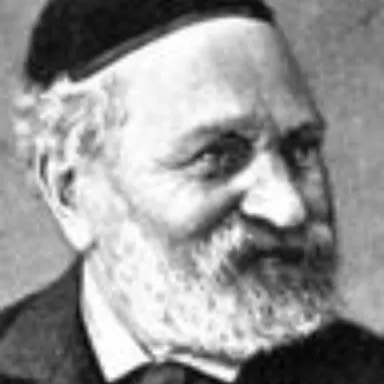
The Work, Torah Teaching and Public Legacy of Rabbi Dr. Azriel Hildesheimer: A Historical and Theological Analysis of the Shaping of Modern Orthodoxy
15 min read2,915 words
Summary
This text surveys the many-sided work of Rabbi Dr. Azriel Hildesheimer, a key figure in the establishment of Modern Orthodoxy in the 19th century. The source presents his unique worldview, which sought to combine absolute fidelity to halakha with academic education and scientific research, culminating in the founding of the Rabbinical Seminary in Berlin. Beyond his Torah leadership and broad learning, the text emphasizes his public activism, expressed in pioneering initiatives for building Jerusalem and in practical support for Jewish settlement in the Land of Israel. Hildesheimer's path emerges as an approach of religious pragmatism and modernization that knew how to harness innovative tools to fortify the Jewish tradition in the face of the challenges of emancipation.
Formative and Creative Years: Biography and Family Background
Rabbi Dr. Azriel Hildesheimer is counted among the most influential key figures in the shaping of Modern Orthodoxy and Neo-Orthodoxy in Central Europe during the nineteenth century [cite: 1, 2]. He was born on 11 May 1820 (27 Iyar 5580) in the city of Halberstadt in the Kingdom of Saxony, to his parents Golda and Yehuda Leib Hildesheimer (son of Moshe Glei, son of Meir Glei) [cite: 2]. His father, a native of the city of Hildesheim (from which the family name derives), died when Azriel was young, leaving him an orphan in his youth [cite: 2]. This reality of life contributed to the development of the personal independence and determination that characterized his educational and Torah path [cite: 2].
In his childhood Rabbi Hildesheimer was educated at the Orthodox school "Hasharat Zvi" in his native city [cite: 2]. This pioneering institution was the first Orthodox school among Ashkenazi Jews to integrate structured secular studies into the curriculum, with the aim of preventing Jewish parents from sending their children to be educated in Christian institutions in order to acquire a general education [cite: 2]. Early exposure to an educational model that balanced the sacred and the secular laid the conceptual foundations of his future teaching.
At the age of 17 he went to study in Altona, at the yeshiva of Rabbi Yaakov Ettlinger, author of the well-known halakhic work "Arukh la-Ner" [cite: 1, 2]. In Altona he was deeply influenced by the figure of Chacham Isaac Bernays of Hamburg, who served him as a model to emulate as a modern preacher of broad influence [cite: 1, 2]. Alongside his intensive sacred studies, Hildesheimer applied himself diligently to the study of classical languages [cite: 1, 2]. In 1840 he returned to Halberstadt to study at the Dom Gymnasium, and afterwards went on to academic studies at the University of Berlin, where he studied in the faculty of Semitic languages and mathematics [cite: 2]. In 1842 he received a doctorate from the University of Halle (Halle) for a study dealing with biblical exegesis [cite: 2].
On completing his academic studies he returned to Halberstadt and married Henriette (Jettchen) Hirsch, daughter of Aharon Hirsch-Gettingen, a wealthy metal merchant [cite: 2]. This marriage gave him financial independence throughout his life, enabling him to devote his energy and resources to public activity and charity without depending on a rabbinic post as his sole source of livelihood [cite: 1, 2]. His wife died in 1883 [cite: 2]. The couple had nine children, many of whom took part in the leadership of the educational and public institutions of German Jewry [cite: 2].
The family structure and family ties of Rabbi Hildesheimer reflect the network of public and academic influence that he wove around himself, as shown in the following table:
His Educational and Orthodox Teaching: From Eisenstadt to Berlin
The Eisenstadt Period and the Controversy in Hungary
In 1851 Rabbi Hildesheimer was appointed rabbi of the city of Eisenstadt in Hungary [cite: 2, 4]. On taking up the post, he began to put his revolutionary educational conception into practice and established a school for boys that combined in-depth sacred studies with secular studies taught in the German language [cite: 2]. He later established in the city a beit midrash for training rabbis, which enjoyed exceptional success and attracted students from all over Europe and even from the United States, the number of students leaping from 12 in 1851 to 128 in 1868 [cite: 2].
This educational activity, which was perceived as a blessed synthesis in Central Europe, aroused fierce opposition among the zealous and conservative currents of Hungarian Jewry, headed by Rabbi Hillel Lichtenstein and his son-in-law Rabbi Akiva Yosef Schlesinger [cite: 2]. The opponents saw in his use of the German language and in the introduction of secular studies an opening to cultural assimilation and a grave threat to the boundaries of tradition [cite: 2]. The controversy grew so sharp that the zealots compared Rabbi Hildesheimer to "a pig stretching out its hooves," an epithet meant to mark a leader who presents a halakhically kosher exterior but introduces flaws from within, especially because of his uncompromising support for the establishment of modern schools in Jerusalem [cite: 2].
The "Adass Jisroel" Congregation in Berlin
In 1869 Rabbi Hildesheimer was invited to Berlin to serve as the first rabbi of the Orthodox congregation "Adass Jisroel" (Adass Jisroel), founded that same year in response to the growing strength of the Reform and liberal current in the city [cite: 2, 5]. The congregation presented a modern model of a Neo-Orthodox community operating independently [cite: 5]. Hildesheimer had to wage a tough intellectual and communal struggle against the leaders of Reform in Berlin, Dr. Abraham Geiger and Rabbi Samuel Holdheim (and his successor Ritter), and did so in close cooperation with Rabbi Samson Raphael Hirsch and with Meir (Markus) Lehmann, editor of the newspaper "Der Israelit" [cite: 1, 2, 4]. The congregation operated continuously until it was dissolved by the Nazi regime in 1939, and resumed operating in 1989 under the auspices of the first government of East Germany after the fall of the Berlin Wall [cite: 5].
The Founding of the Rabbinical Seminary in Berlin and Orthodox Wissenschaft des Judentums
Rabbi Hildesheimer's greatest institutional achievement in Berlin was the founding of the Rabbinical Seminary in Berlin (Rabbinerseminar zu Berlin) on 1 Cheshvan 5634 (22 October 1873) [cite: 4]. The direct motive for founding the institution was the opening of the liberal "Higher School for the Science of Judaism" in Berlin in 1872 under the leadership of Geiger and Lazarus [cite: 4]. Hildesheimer refused to abandon the arena of academic research and rabbinic training to the liberal current, and labored to create an Orthodox alternative worthy of the name [cite: 4].
The overarching aim of the seminary was to create a school of research that would heal the rift that had opened between the "Science of Judaism" and fidelity to tradition and halakha [cite: 4]. Hildesheimer required his students to acquire an excellent scientific academic education at the university (most of them studied at the nearby Friedrich Wilhelm University) in parallel with their Torah training, and thereby shaped the figure of the Orthodox Jew as an active partner in public and academic life [cite: 4]. On 29 November 1873 the institution received official approval from the German authorities, granting it the status of a recognized academic institution, and it was housed in a building purchased at Gipsstrasse 12a [cite: 3].
Like Rabbi Samson Raphael Hirsch, Hildesheimer disliked the title "Orthodox" and regarded his system as true and complete Judaism [cite: 4]. In 1882, after the lines of demarcation from the other currents had stabilized, the word "Orthodox" was dropped from the institution's name and it was called simply "the Rabbinical Seminary in Berlin" [cite: 4]. The curriculum combined the character of a traditional yeshiva, with an emphasis on the study of Talmud and the halakhic decisors and on examinations of comprehensive knowledge, but introduced a fundamental change: no subjects from Choshen Mishpat were studied at all, since Hildesheimer held that emancipation had abolished the practical relevance of Jewish monetary law in the modern state [cite: 4].
The spiritual and academic leadership of the institution underwent a number of changes over the years, as described in the following table:
The seminary's teaching staff included key figures who deeply influenced generations of rabbis [cite: 3]. Among the prominent lecturers was Dr. Joseph Wohlgemuth, who joined in 1895, taught speculative homiletics and philosophy of religion, and edited the important journal "Jeschurun" [cite: 3]. Wohlgemuth's inclusion enabled Rabbi Dr. David Zvi Hoffmann to concentrate all his energy on advanced Talmudic-halakhic teaching for the upper classes [cite: 3]. Other lecturers were Rabbi Dr. Meir Hildesheimer, Rabbi Dr. Ezra HaKohen Munk, and the physician and rabbi Dr. Eduard Chaim Biberfeld [cite: 3]. The seminary attracted outstanding students such as Saul Weingort, Chanoch Hans Meyer, Yerachmiel Bergman and Ephraim Yehuda Offenberg [cite: 3].
His Torah Teaching and Writings
Rabbi Hildesheimer left an indelible mark both through the publication of philological Torah studies and through the writing of halakhic responsa and novellae on the Talmud [cite: 2, 6].
The "Halakhot Gedolot" Edition Project
The crowning achievement of Rabbi Hildesheimer's scholarly Torah work was the publication of the book Halakhot Gedolot (Behag), one of the central halakhic works of the Geonic period, attributed to Rabbi Shimon Kayyara [cite: 6, 7]. Until Hildesheimer's research, the Torah world relied on the Venice printing of the book of 5308 (1548), which was corrupt and fragmentary [cite: 6, 8]. Hildesheimer recognized the need for an accurate edition based on ancient manuscripts in order to establish the original text that lay before the sages of Spain and the Rishonim [cite: 6, 7].
He devoted many long years to meticulous philological work and prepared for print a scholarly edition based on Vatican manuscript 142 of the book [cite: 6]. This edition, printed in Berlin in 5608–5652 (1888–1892), was called by scholars "Halakhot Gedolot Aspamia" (Spain), on the view that this is the accurate text that was used by the Rif and the great sages of Spain and Italy [cite: 6, 7]. Later, his grandson, Naftali Zvi Hildesheimer, continued his project and published an expanded scholarly edition in three volumes in Jerusalem (5732–5747), including extensive introductions and annotations [cite: 6].
The comparison between the various editions of this foundational book is presented in the following table:
Responsa and Halakhic Novellae
During his lifetime Rabbi Hildesheimer published books and articles in German, while his halakhic writings remained in manuscript [cite: 2]. After his death, the manuscripts were brought to the Land of Israel by his grandson, and members of the family labored to publish them during the twentieth century in two main collections [cite: 2]:
- Responsa of Rabbi Azriel: a collection of halakhic questions and answers that presents his practical rulings and his engagement with the challenges of modernity and emancipation [cite: 2]. Part I (Orach Chaim and Yoreh De'ah) was printed in Tel Aviv in 5729 (1969), and Part II (Even ha-Ezer and Choshen Mishpat) was printed in 5736 (1976) [cite: 2].
- Chiddushei Rabbi Azriel (Novellae of Rabbi Azriel): a body of scholarly novellae on the Talmud printed in three parts by Machon Yerushalayim: Part I on tractates Yevamot and Ketubbot (5744); Part II on tractates Nedarim, Nazir, Sotah, Gittin and Kiddushin (5752); and Part III on tractate Berakhot and Seder Moed (5760) [cite: 2].
Public Activism and Activity for the Land of Israel and the Jewish Diaspora
Rabbi Hildesheimer was a philanthropic man of action who did not confine his activity to the walls of the beit midrash, but worked resolutely to improve the living conditions, security and education of Jewish communities throughout the world, among them the Jews of Persia and the Jews of Ethiopia [cite: 1, 2].
The Establishment of the "Batei Machse" Neighborhood in Jerusalem
In 5596 (1836) "Kollel HOD" (Holland and Deutschland) was founded to support the Jews of the Land of Israel, and Rabbi Hildesheimer was later appointed one of the kollel's officers [cite: 2]. In view of the rapid growth of the Jewish population in Jerusalem in the mid-19th century and the worsening housing distress within the walls, Rabbi Hildesheimer put forward a pioneering idea: the establishment of an independent, planned Jewish quarter that would offer housing to the needy and to guests [cite: 2, 9].
To this end, the members of the kollel initiated the purchase of a plot of land registered in the name of a deceased Sephardi Jew, near the Rothschild Hospital [cite: 2, 9]. The official bill of sale was signed in 1859 in the names of Rabbi Hildesheimer and Kollel HOD, and on this land the splendid apartment complex of Batei Machse was built between 1860 and 1890 [cite: 2, 10]. The complex provided a roof over the heads of families of limited means, while the Hildesheimer family retained a historical "chazakah" (right of possession) to one apartment there [cite: 2, 9]. At the heart of the complex lay a large open square, which the residents called the "Deutscher Platz" (the Germans' Square), and in 1908 "Beit Horowitz," intended to house Torah scholars, was built on its northern side, but it was completely destroyed by the Jordanians after the War of Independence [cite: 9].
The "Lema'an Zion" Society and the Consolidation of Agricultural Settlement
In 1888 Rabbi Hildesheimer founded the Lema'an Zion society with the aim of helping the Jews of the Land of Israel to earn their livelihood productively [cite: 2]. The society supplied work tools, loans for setting up businesses and vocational education for boys, so as to keep them from falling into the nets of the Christian mission that was active in the country [cite: 2]. Among the society's undertakings were support for 30 Jewish families in Ramla, aid to the fishermen of Tiberias, and the consolidation of a Jewish community in Nazareth [cite: 2].
In addition, Rabbi Hildesheimer acted together with the magnate Ovadia Lachman to support Rabbi Aryeh Leib Frumkin, who sought to establish Jewish agricultural settlement [cite: 2]. With their financial support, Frumkin purchased in 1884 about 900 dunams of the lands of the village of Umm Labes, on which the Lachman estate in Petah Tikva was established [cite: 2]. The first stone house in the colony was built there, and it also served for the defense of the settlers [cite: 2]. Rabbi Hildesheimer was actively involved in planning the agricultural educational institution that was intended to be established on the estate and in drawing up its curriculum [cite: 2].
Political Rescue Efforts
Rabbi Hildesheimer did not hesitate to use his diplomatic connections and his international standing for urgent rescue efforts [cite: 2]. A clear example of this occurred in 1894, when the reviver of the Hebrew language, Eliezer Ben-Yehuda, was arrested together with his father-in-law by the Ottoman authorities following internal denunciations [cite: 2]. Although they were deeply divided ideologically, Rabbi Hildesheimer immediately mobilized on behalf of Ben-Yehuda, published sharp articles in the press and exerted heavy political pressure on the Turkish government until the sentence was annulled and they were released from prison [cite: 2].
Summary and Conclusions
Rabbi Dr. Azriel Hildesheimer represents a unique type of Jewish leadership that combines deep-rooted halakhic scholarship, broad academic education and international public activism [cite: 1, 2]. Three fundamental conclusions emerge from the analysis of his work and teaching:
- Reshaping the scientific-Torah discourse: through the founding of the Rabbinical Seminary in Berlin, Hildesheimer proved that Orthodoxy need not defend itself against science and research, but can harness the scientific tools of philological and historical research to establish and defend the tradition [cite: 4]. The edition of "Halakhot Gedolot" that he published is a model of this synthesis [cite: 6].
- Halakhic pragmatism and modernization: his decision to omit the study of Choshen Mishpat from the curriculum of the Rabbinical Seminary underlines his realistic understanding of the post-emancipation reality [cite: 4]. Hildesheimer recognized that the strength of modern rabbinic leadership lies in fortifying education, personal status and everyday halakha, and not in an attempt to preserve civil judicial powers that had been lost in the modern state.
- Practical pre-political Zionism: his consistent support for the building of Jerusalem, for the construction of the Batei Machse neighborhood and for the creation of sources of employment and agriculture in the Land of Israel (such as the Lachman estate) places him among the harbingers of practical religious Zionism [cite: 1, 2, 9]. He knew how to cooperate with diverse parties, from conservatives to secular maskilim such as Ben-Yehuda, out of an overall view of the good of the Jewish people and the settlement of the Land [cite: 2].
Rabbi Hildesheimer's legacy continues to serve as an inspiration for institutions of Torah and science throughout the world, and the reopening of the Rabbinical Seminary in Berlin in the 21st century is living testimony to the vitality and eternity of his educational and Torah teaching [cite: 4].
Sources10
- 1.הרב עזריאל הילדסהיימר – ויקישיבה, yeshiva.org.il/wiki/index.php/הרב_עזריאל_הילדסהיימר
- 2.עזריאל הילדסהיימר - ויקיפדיה, he.wikipedia.org/wiki/עזריאל_הילדסהיימר
- 3.בית המדרש לרבנים ברלין - עדת ישראל - Adass Jisroel, adassjisroel.de/he/אתמול/בית-המדרש-לרבנים-ברלין/
- 4.בית המדרש לרבנים בברלין - ויקיפדיה, he.wikipedia.org/wiki/בית_המדרש_לרבנים_בברלין
- 5.עדת ישראל - ויקיפדיה, he.wikipedia.org/wiki/עדת_ישראל
- 6.הלכות גדולות - ויקיפדיה, he.wikipedia.org/wiki/הלכות_גדולות
- 7.הלכות גדולות – ויקישיבה, yeshiva.org.il/wiki/index.php/הלכות_גדולות
- 8.הלכות גדולות, מהדורה ראשונה. ונציה, ש"ח. ההקדמה הראשונה לספר עברי - ווינרס מכירות פומביות, winners-auctions.com/items/הלכות-גדולות-מהדורה-ראשונה-ונציה-שח-ה-3/
- 9.בתי מחסה: מהו בעצם סיפורָם של ה'בתים' ולמי הם העניקו 'מחסה'? - Eyal Davidson, eyaldavidson.co.il/בתי-מחסה-מהו-בעצם-סיפורָם-של-הבתים-ולמ/
- 10.בתי מחסה - ויקיפדיה, he.wikipedia.org/wiki/בתי_מחסה