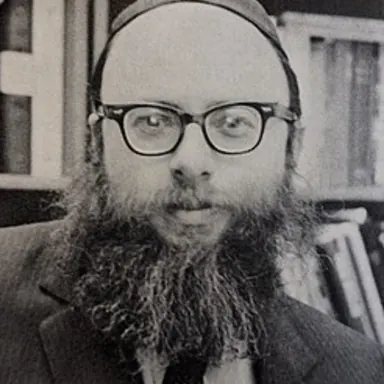
The Reception and Appraisal of Rabbi Aryeh Moshe Eliyahu Kaplan's Work in the Eyes of the Sages of Israel and the Great Torah Scholars
15 min read2,935 words
Summary
This article surveys the many-sided figure of Rabbi Aryeh Moshe Eliyahu Kaplan, focusing on the unique synthesis he created between profound Torah scholarship and broad scientific education. The text describes his extraordinary life path as a youth who drew close to Judaism and became a prodigy who conducted halakhic and theological discourse with the great sages of the generation, such as Rabbi Moshe Feinstein, while bridging the gap between modernity and tradition. The source details Rabbi Kaplan's revolutionary contribution to resolving the contradictions between science and Torah, especially on the question of the age of the universe, and to reconstructing techniques of Jewish spirituality and meditation for contemporary seekers. In conclusion, the article stresses the importance of his literary and translation enterprise, which made him a living bridge bringing the inner dimension of the Torah and halakha to the modern public of the English-speaking world.
Introduction: Portrait of an Extraordinary Torah-Scientific Synthesis
Rabbi Aryeh Moshe Eliyahu Kaplan (1934-1983) is regarded by scholars and historians of Orthodox Judaism in the United States as one of the most original and influential figures of the second half of the twentieth century [cite: 1, 2]. Understanding his reception among the sages of his generation requires a thorough examination of his unconventional life path, which began with a boy named "Len" in the Bronx neighborhood of New York, far from the world of Torah [cite: 1]. Following his mother's death when he was of bar mitzvah age, Kaplan was expelled from the public school system and grew up as a street child [cite: 1]. The turning point came when a young Klausenburg Hasid named Chanoch Rosenberg noticed him as a stranger in the synagogue, befriended him and taught him the fundamentals of the Hebrew language and of the Chumash [cite: 1]. This unique background, as one who had experienced the secular world and spiritual loneliness from the outside, shaped his wondrous sensitivity and his later ability to speak to the hearts of young seekers [cite: 3, 4].
Despite his late start, Kaplan displayed extraordinary genius that brought him to the central halls of Torah of that time [cite: 3]. At the age of fifteen he was accepted to Yeshiva "Torah Vodaath," where he had the privilege of learning from the gaon Rabbi Yaakov Kamenetsky [cite: 1, 5]. At eighteen he was already counted among the select group of students sent under the direction of Rabbi Shmuel Kamenetsky to help Rabbi Simcha Wasserman establish Yeshiva "Or Elchonon" in Los Angeles [cite: 1, 6]. Later on he made his way to Jerusalem, to the Mir Yeshiva, where he received rabbinic ordination in 1956 from two of the greatest halakhic decisors and heads of yeshivas in the Land of Israel: the head of the Mir Yeshiva, the gaon Rabbi Eliezer Yehuda Finkel, and the Chief Rabbi of Israel, the gaon Rabbi Yitzhak Isaac HaLevi Herzog [cite: 1]. Alongside his Torah studies he completed advanced degrees in physics at the University of Louisville and the University of Maryland, and engaged in advanced scientific research funded by the National Science Foundation of the United States [cite: 1]. This synthesis of rigorous scientific education with deep Lithuanian and Hasidic scholarship made him a uniquely authoritative figure in the eyes of the leaders of the Orthodox public in America [cite: 4, 7].
The Halakhic Dialogue with the Decisor of the Generation: Responsa Igrot Moshe
One of the clearest testimonies to Rabbi Kaplan's Torah standing in his youth is reflected in the halakhic exchange he conducted with the halakhic leader of American Jewry, the gaon Rabbi Moshe Feinstein [cite: 8, 9]. While working as a teacher at the community school "Eliahu Academy" in Louisville, Kentucky (a pluralistic institution in which most of the students came from non-observant homes), Rabbi Kaplan had to deal with complex educational and halakhic questions [cite: 6, 8]. He turned to Rabbi Moshe Feinstein with the question of whether it was permitted to organize a dedicated prayer minyan for teenagers on Shabbat, when it was entirely clear that the children's parents would drive them to the synagogue in their cars [cite: 8, 10].
Rabbi Feinstein's responsum, which appears in the responsa "Igrot Moshe" (Orach Chaim, Part I, sections 98-99), reveals the enormous esteem he held for Rabbi Kaplan's philosophy of outreach, alongside an uncompromising safeguarding of the bounds of halakha [cite: 8]:
An attitude of honor and esteem: Rabbi Feinstein addresses the young Rabbi Kaplan with lofty titles that attest to a deep Torah fellowship: "His Esteemed Honor, my friend the Rabbi, our teacher Rabbi Aryeh Moshe Eli' Kaplan, shlit"a" [cite: 8]. This form of address proves that Rabbi Feinstein regarded him as a halakhic authority worthy of the name, and not merely an outreach activist [cite: 8].
The limits of halakha versus the needs of the hour: halakhically, Rabbi Feinstein ruled that organizing a minyan that relies on arrival by car involves the prohibition of "You shall not place a stumbling block before the blind," since the organizers actively assist and encourage the Sabbath desecration of the children and their parents [cite: 8, 10]. Nevertheless, he stressed that one should continue to draw them close in other ways and try to influence the children to come on foot [cite: 8].
This responsum later received detailed attention from the gaon Rabbi Aharon Lichtenstein, who analyzed the inherent tension arising from it between the instinct of drawing the distant near and saving souls and the constraints of strict halakhic law [cite: 8]. This fact illustrates that even in the eyes of the great Torah scholars identified with the conservative yeshiva world, Rabbi Kaplan's work in Louisville, and in other isolated communities such as Mason City in Iowa and Kingsport in Tennessee, was perceived as a measured spiritual pioneering, halakhically supervised [cite: 6, 8].
Cosmology and Science: The Controversy over the Age of the Universe and the Doctrine of the Sabbatical Cycles
Another field in which Rabbi Kaplan provoked profound Torah discussion was his attempt to reconcile the apparent contradiction between the scientific age of the universe (estimated at billions of years) and the biblical chronology of six days of creation [cite: 11, 12, 13]. Rabbi Kaplan presented a non-apologetic approach based on early kabbalistic sources, first and foremost the system of the kabbalist Rabbi Isaac of Acre, one of the disciples of Nahmanides (Ramban) [cite: 11, 14].
According to this system, which relies on "Sefer ha-Temunah" (the Book of the Image), attributed to the Tanna Rabbi Ishmael (but most likely written in the thirteenth century), creation proceeds in cosmic cycles called "shemitot" (sabbatical cycles) [cite: 15]. The calculation that Rabbi Kaplan developed is based on the following data [cite: 14]:
The world passes through seven cycles of 7,000 years each [cite: 14].
According to Rabbi Isaac of Acre, these years are not ordinary human years but "years of the Holy One, blessed be He," where one divine day equals 1,000 human years, and therefore a divine year equals 365,250 human years [cite: 14].
Since the world is now in the seventh cycle (or the sixth according to other sources such as "Livnat ha-Sappir"), the present creation took place after about 42,000 divine years, which translate into an age of the universe of about 15.3 billion years, a figure that corresponds astonishingly to the estimates of modern astrophysics for the Big Bang [cite: 12, 14].
This approach aroused a halakhic and ideological controversy among kabbalists and halakhic sages [cite: 14]:
Criticism from the school of the Ari and the Ramak: many kabbalists pointed out that the two fathers of later Kabbalah, Rabbi Moshe Cordovero (the Ramak) and Rabbi Yitzchak Luria (the holy Ari), rejected the physical interpretation of the doctrine of the shemitot and determined that it refers to spiritual worlds alone, which have no historical-material expression in our universe [cite: 14, 15].
Rabbi Kaplan's theological defense: in response to this criticism Rabbi Kaplan clarified that since this is not a practical halakhic question, there is no single binding ruling on the subject, and the Ari's opinion does not negate the legitimacy of the system of Nahmanides and his disciples [cite: 14]. He stressed that great scholars of earlier generations, such as the author of "Tiferet Yisrael" (Rabbi Israel Lipschitz) in his essay "Or ha-Chaim" and Rav Kook, relied on precisely these doctrines in order to give a response of faith to the discoveries of fossils and dinosaurs [cite: 14, 16, 17].
A Comparison of Theological and Rabbinic Positions on Rabbi Kaplan's Thought and Work
Early Theology versus Intellectual Maturity: The 1966 Memorandum and the Development of His Outlook
In February 1966, while serving as rabbi of the "Adath Israel" congregation in Mason City, Iowa, Rabbi Kaplan composed an eleven-page theological memorandum in response to questions sent to him on behalf of the B'nai B'rith organization in Washington [cite: 6, 20]. This document, which was brought to light by the researcher Menachem Butler, presents positions defined as daring and exceptional in terms of conservative Orthodoxy [cite: 6, 20]:
The status of the resurrection of the dead in the teaching of Maimonides (Rambam): in this memorandum Rabbi Kaplan stated categorically that Maimonides does not believe in the resurrection of the dead in its plain sense (that is, the physical revival of bodies), but interprets this concept as a parable for the eternal spiritual existence of the soul in the World to Come, relying on the Guide of the Perplexed II:27 and ignoring Maimonides' famous "Treatise on the Resurrection of the Dead" [cite: 20].
The attitude to Jesus and to external miracles: Rabbi Kaplan suggested that one may acknowledge the truth of the miracles attributed to Jesus without this harming Jewish faith, since his mission was not intended for the Jewish people at all but for the nations of the world [cite: 20].
Historical studies show that these positions characterized the period of his activity in the remote communities, where he was required to maintain a constant dialogue with priests and non-Jewish intellectuals as part of his membership in the local "Ministerial Association" [cite: 6, 20]. However, his later teaching underwent a clear process of maturation and alignment with the Orthodox mainstream [cite: 2, 3]. In his later books, such as "The Resurrection of the Dead and the Age of the Universe," he completely retracted the allegorical interpretation of Maimonides and presented advanced biological and scientific explanations (such as the use of cloning technologies and DNA) to demonstrate the physical feasibility of the resurrection of the dead [cite: 15, 17]. Likewise, he became one of the most prominent fighters against the missionary movements in the United States through writing the influential booklet "The Real Messiah?", which presents a sharp and uncompromising traditional Jewish position [cite: 4, 22].
The Reconstruction of Jewish Meditation and the Teaching of Breslov Hasidism
Rabbi Kaplan's pioneering work in the field of Jewish spirituality and mysticism was deeply influenced by his acquaintance with Rabbi Zvi Aryeh Rosenfeld, who brought the teaching of Breslov to the United States in the 1950s [cite: 2, 23]. Together with him, Rabbi Kaplan labored on translating and annotating foundational Hasidic books, first and foremost "Tikkun ha-Klali" and *"Sichot ha-Ran"* (under the title "Rabbi Nachman's Wisdom") [cite: 2, 23]. This collaboration won the blessing of the elder Hasidim in Jerusalem and in the United States, who saw Rabbi Kaplan as a faithful vehicle for spreading the wellsprings of Hasidism outward, especially among Jews who had lost their connection to the tradition [cite: 4, 23].
At the same time Rabbi Kaplan developed a comprehensive theory reconstructing the ways of prophecy and the meditative divine service of the ancient kabbalists [cite: 24, 25]. He held that meditation is not an invention of the religions of the Far East, but a rooted Jewish spiritual tool used by the prophets, by the masters of the Heikhalot and by Chasidei Ashkenaz (the Ashkenazi Pietists) [cite: 7, 26]. The response of the Torah establishment to this enterprise was mixed [cite: 8, 21]:
Fear of revealing the hidden: in certain circles in Borough Park reservations were expressed about Rabbi Kaplan's having exposed practical kabbalistic methods (such as contemplation of holy names and of the letters of Sefer Yetzirah) to the broad public in English, and even having collaborated with non-Jewish publishing houses [cite: 21].
Seeing his enterprise as urgent saving of souls: on the other hand, the leaders of the teshuva (return to Judaism) movement and of the NCSY organization extolled the fact that these works prevented hundreds of thousands of young people from grazing in foreign fields [cite: 1, 18]. Rabbi Pinchas Stolper compared Rabbi Kaplan to the Ramchal (Rabbi Moshe Chaim Luzzatto): both were original men of the spirit who wrote systematic and rational books on the esoteric teaching in order to guide the perplexed members of their generation, and both experienced a certain loneliness because of the masses' inability to grasp the magnitude of their mission [cite: 3].
The Monumental Translation Enterprise and the Controversy over the Approbations for "The Living Torah"
The crowning achievement of Rabbi Kaplan's literary enterprise, published shortly before his sudden death at the age of 48, is the comprehensive translation and commentary on the Chumash, "The Living Torah" ("Torah Chayah") [cite: 1, 27]. The book was written at an inconceivable writing pace of only nine months, using methodological tools from the world of physics to organize and arrange enormous quantities of geographical, botanical and historical information [cite: 2, 4].
In the rabbinic world an interesting controversy arose over the question of the work's status [cite: 28]:
The question of approbations (traditional haskamot): Rabbi Kaplan chose to translate the verses in a modern and flowing style, deciding between different commentators on a clearly literary and halakhic basis (usually in accordance with the rulings of Maimonides in the Yad ha-Chazakah) [cite: 29]. In some conservative Haredi circles criticism was voiced that the book was published without official "haskamot" (approbations) from the great sages of the generation or famous Admorim (Hasidic rebbes) (such as the Gerrer Rebbe or the halakhic decisors of the generation in the Land of Israel) [cite: 28]. It was argued that without such explicit approval, the work could not be regarded as an authorized "translation" (Targum) for communal reading, but only as the author's personal commentary [cite: 28].
Its actual acceptance as a foundational book: despite the formal controversy, in practice the work became one of the most popular and highly regarded Chumashim in Orthodox synagogues throughout the English-speaking world [cite: 5, 30]. Many scholars and heads of yeshivas praised the in-depth footnotes, which give precise sources for every word and translation, thereby making the Chumash a first-rate study aid both for beginners and for accomplished Torah scholars [cite: 2, 23].
The whole of Rabbi Kaplan's work, from his youthful halakhic correspondence with Rabbi Moshe Feinstein to his cosmological essays and his monumental translations, attests that he was perceived in the eyes of the sages of Israel as a unique figure: a living bridge connecting the world of rigorous science with the inner dimension of the Torah and pure halakha [cite: 5, 7, 8].
Sources30
- 1.Aryeh Kaplan - Wikipedia, en.wikipedia.org/wiki/Aryeh_Kaplan
- 2.Aryeh Kaplan - Wikipedia, the free encyclopedia - Torah Musings, torahmusings.com/wp-content/uploads/2006/08/Aryeh_Kaplan
- 3.An Appreciation of Rabbi Aryeh Kaplan + Video - NCSY @ 60, 60.ncsy.org/appreciation-rabbi-aryeh-kaplan/
- 4.Aryeh Kaplan The Aryeh Kaplan Reader The Gift He Left Behind | PDF - Scribd, scribd.com/document/264531176/Aryeh-Kaplan-the-Aryeh-Kaplan-Reader-the-Gift-He-Left-Behind
- 5.R' Aryeh Kaplan Ztl - Reuben Miller, reubenmiller.com/aryeh-kaplan
- 6.An Unpublished 1966 Memorandum from Rabbi Aryeh Kaplan Answers Questions on Jewish Theology - The Seforim Blog, seforimblog.com/2021/03/an-unpublished-1966-memorandum-from-rabbi-aryeh-kaplan-answers-questions-on-jewish-theology/?print=print
- 7.מדיטציה יהודית - אריה קפלן | עברית - חנות ספרים, e-vrit.co.il/product/6558/מדיטציה-יהודית
- 8.Lost Rabbi Aryeh Kaplan part III | The Book of Doctrines and Opinions:, kavvanah.blog/2012/04/25/lost-rabbi-aryeh-kaplan-part-iii/
- 9.הסכמת הרב משה פיינשטיין זצ''ל לגבי הפתק של ברסלב | שאל את הרב - כיפה, kipa.co.il/שאל-את-הרב/הסכמת-הרב-משה-פיינשטיין-זצל-לגבי-הפתק/
- 10.Rabbi Aryeh Kaplan zt"l | Rabbi Yoel Lieberman | Ask the Rabbi - yeshiva.co, yeshiva.co/ask/59173
- 11.The Age of the Universe – A Torah True Perspective (Online Book) - OLAMI Resources, nleresources.com/kiruv-and-chinuch/online-books/chassidus-and-kabbalah/the-age-of-the-universe-a-torah-true-perspective-online-book/
- 12.Torah on the Big Bang and the Age of the Universe | Mayim Achronim, mayimachronim.com/torah-on-the-big-bang-and-the-age-of-the-universe/
- 13.the age of the universe - Rabbi Anthony Manning, rabbimanning.com/wp-content/uploads/2012/05/Torah and the Age of the Universe.pdf
- 14.R. Aryeh Kaplan on the Age of the Universe - Torah Musings, torahmusings.com/2006/08/r-aryeh-kaplan-on-age-of-universe_08/
- 15.A mystical view on immortality, resurrection, and the age of the universe - The Blogs, blogs.timesofisrael.com/a-mystical-view-on-immortality-resurrection-and-the-age-of-the-universe/
- 16.Judaism and Evolution - Jewish Virtual Library, jewishvirtuallibrary.org/judaism-and-evolution
- 17.Immortality, Resurrection, and the Age of the Universe - Ktav Publishing House, ktav.com/products/immortality-resurrection-and-the-age-of-the-universe
- 18.The Legacy of Rabbi Aryeh Kaplan zt”l - NCSY, ncsy.org/kaplan/
- 19.Pinchas Stolper, OU rabbi who retired after abuse scandal, dies at 90 | The Jerusalem Post, jpost.com/diaspora/article-708230
- 20.An Unpublished 1966 Memorandum from Rabbi Aryeh Kaplan Answers Questions on Jewish Theology - The Seforim Blog, seforimblog.com/2021/03/an-unpublished-1966-memorandum-from-rabbi-aryeh-kaplan-answers-questions-on-jewish-theology/
- 21.The Hasidic Underground - Shalom Hartman Institute, hartman.org.il/the-hasidic-underground/
- 22.If you were GOD Aryeh Kaplan Jewish 3 works in 1 book Judaica | eBay, ebay.com/itm/376449497801
- 23.Aryeh Kaplan - Biography - JewAge, jewage.org/wiki/en/Article:Aryeh_Kaplan_-_Biography
- 24.אריה קפלן - ויקיפדיה, he.wikipedia.org/wiki/אריה_קפלן
- 25.Jewish Meditation – A Practical Guide – Rabbi Aryeh Kaplan – Book Review, lovingkindness.co/jewish-meditation-a-practical-guide-rabbi-aryeh-kaplan-book-review/
- 26.Meditation and Kabbalah - Aryeh Kaplan - Google Books, books.google.com/books/about/Meditation_and_Kabbalah.html?id=fPVIABpefO8C
- 27.Aryeh Kaplan: Rabbi and Author | PDF | Jews And Judaism | Jewish Behaviour And Experience - Scribd, scribd.com/document/445220409/Aryeh-Kaplan
- 28.Steinsaltz Daily Study - App Store - Apple, apps.apple.com/us/app/steinsaltz-daily-study/id1543235117
- 29.Choosing the 'Right' Bible Translation for You - Torah In Motion, torahinmotion.org/sites/default/files/programs/TiM short session 4 Choosing a Translation handout.pdf
- 30.The Living Torah - Rabbi Aryeh Kaplan (Hebrew-English) - Seforim Center, seforimcenter.com/The-Living-Torah---Rabbi-Aryeh-Kaplan-Hebrew-English__p-188.aspx