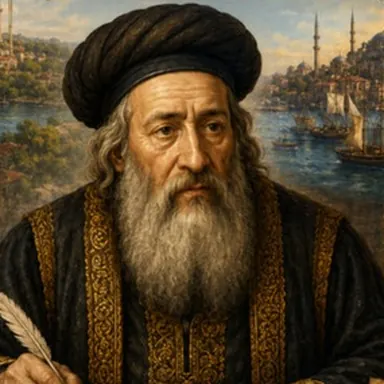
The Work and Torah Teaching of Rabbi Eliyahu ben Chaim (the Ra'anach) in the 16th Century: Halakhic Leadership, Legal Decision and Textual Authority in the Age of Ottoman Transformation
14 min read2,747 words
Summary
This article surveys the life and Torah teaching of Rabbi Eliyahu ben Chaim (the Ra'anach), one of the greatest sages of Turkey in the 16th century, stressing his decisive role as a spiritual leader and central halakhic authority in an era of demographic transformations in the Ottoman Empire. The text presents his work as "Hakham Bashi" in Constantinople, where he succeeded in uniting diverse communities of Spanish exiles and local Jews thanks to his broad halakhic authority and his ability to mediate. Alongside an analysis of his main works, such as the Responsa of the Ra'anach, the source stresses his contribution to establishing the standing of the Shulchan Arukh and his scientific-textual approach, which relied on the "Aleppo Codex" (Keter Aram Tzova) for the accuracy of the biblical text. The aim of the article is to shed light on his figure as one of the pillars of the period of the early Acharonim, whose halakhic influence crossed borders and left a deep mark on the world of halakhic decision-making for generations.
His Life and the Distinction between Him and Sages of Later Generations
The second half of the 16th century in the Ottoman Empire was marked by profound demographic, social and religious transformations, which stemmed to a large extent from the waves of immigration of the exiles from Spain and Portugal to the Ottoman centers of government.[1, 2] This process fundamentally changed the Jewish communal structure in the main cities, foremost among them Adrianople and Constantinople.[1, 3] In this historical and cultural setting Rabbi Eliyahu ben Chaim, known as the Ra'anach (or Maharanach), was active.[1, 3, 4] His Torah teaching and public work place him among the pillars of the period of the early Acharonim, one who shaped with his own hands the face of halakha, preaching and communal leadership in the empire.[1, 3]
The Ra'anach was born around the year 5290 (1530) in Adrianople to his father, Rabbi Baruch ben Chaim.[1, 3] In his youth he acquired his Torah from one of the greatest sages of Turkey in those days, Rabbi Mordechai Matalon, and became known as one of his most prominent and distinguished students.[1, 3] After completing his course of study, he began to disseminate Torah and to raise students in various study halls in Adrianople, and his name began to spread throughout the region as a spiritual leader and a halakhic authority of stature.[1] In the year 5335 (1575) the Ra'anach left Adrianople and moved to the imperial capital, Constantinople, where he was appointed to the lofty post of rabbi of the community and "Hakham Bashi."[1, 3, 4] With his rise to the rabbinate of the capital, his standing became established as one of the greatest respondents of his generation, and thousands of complex halakhic questions from all over the Jewish world were addressed to him.[1, 3] The Ra'anach passed away in Constantinople between the years 5370 and 5373 (1610–1613).[3, 4]
Historical and bibliographical research requires a sharp and clear distinction between the figure of the Ra'anach and another Ottoman sage of an almost identical name who lived in the 19th century, Rabbi Eliyahu son of Rabbi Moshe Chaim of Baghdad.[5] The similarity of names and geography (both were active within the Ottoman Empire) may cause confusion, but their Torah work and their historical contexts are entirely different, as detailed below:
Political and Communal Context: The Rabbinate of the Capital in Constantinople
The Ra'anach's appointment to the office of "Hakham Bashi" in Constantinople in 1575 placed him at the focus of Jewish leadership in the Ottoman Empire at a particularly stormy historical period.[1, 3, 4] The Jewish community of Constantinople in those days bore a unique and complex character; it was composed of local "Romaniote" communities (long-established Byzantine Jews) alongside enormous waves of immigration of exiles from Spain and Portugal, who founded independent congregations of their own and refused to merge with one another.[1, 2, 6]
Analysis of the historical context shows that the office of chief rabbi in Constantinople was accompanied by complex political and social challenges.[6] Earlier leaders, such as Rabbi Eliyahu Mizrachi (the Re'em), encountered significant difficulties in imposing their halakhic and public authority on the new congregations of the Spanish émigrés, who tended to preserve their independence and their original customs.[6] These communities at times even took forceful measures, including imposing bans and forbidding certain leaders to maintain official contacts with the Ottoman government (the office of the "kahya").[6] After the death of the Re'em in 1526, the post was held by sages such as Rabbi Eliyahu (son of Rabbi Binyamin) ha-Levi (died around 1534/1535) and Rabbi Avraham Yerushalmi (from 1555), who tried to stabilize the fragile relations between the communities.[6]
Against the background of this decentralized and tense environment, the figure of the Ra'anach stood out as a unifying and conciliatory factor.[1, 6] The fact that thousands of halakhic questions were addressed to him from all the various congregations in Constantinople and beyond testifies that he succeeded in gaining the trust of the diverse factions and in establishing an agreed halakhic authority.[1, 3] His public rulings touched on sensitive matters of regulating communal ordinances, supervising the laws of commerce and local industry, and representing the community's interests before the Ottoman authorities.[1, 7]
From a legal and social point of view, the Ra'anach worked within a shared halakhic discourse in which drastic communal instruments of enforcement were widely used.[7] In the responsa literature of his contemporaries, such as the Maharashdam (Rabbi Shmuel de Medina of Salonica), we find frequent use of expressions such as "his case is handed over to Heaven and to people" or "banned and excommunicated before Heaven and people" in order to impose social and religious sanctions on anyone who violated the communal ordinances.[7] This use of bans was intended, among other things, to protect vital economic monopolies such as the kosher wine industry, and to prevent unbridled competition from outside the city limits.[7] The Ra'anach, as a leader in Constantinople, was required to exercise similar powers in order to maintain public order and to resolve internal disputes between merchants, communities and charitable institutions at that time.[1, 7]
Halakhic and Technological Discourse: The Printing Revolution and the Rescue of the Writings
The Torah teaching of the Ra'anach is characterized by deep and systematic scholarship, combining comprehensive Talmudic analysis with well-founded halakhic decision and attention to the details of a changing reality.[3] However, the transmission of this Torah to later generations was marked by both personal and technological drama.[4, 8] The period of the Ra'anach's activity coincided with the revolution of Hebrew printing, which changed the way in which books of halakha were written, disseminated and preserved.[8] The gradual change in the use of verbs and patterns related to the craft of printing (such as the use of the verb "dafas" in its various binyanim: kal, nif'al, hif'il and huf'al) in the responsa literature of the 15th and 16th centuries reflects the transition of Jewish society from a culture of manuscripts to a print culture.[8]
The Ra'anach himself experienced the vulnerability of manuscript culture in a particularly painful way: a considerable part of his original writings, which included novellae and comprehensive discussions on most of the tractates of the Babylonian Talmud, was stolen from him during his lifetime.[4] This loss scattered his rulings and novellae, but significant parts were reconstructed and gathered with great effort by members of his family and his students, who brought them to print after his death.[4] Among the central figures in this work of rescue was his principal student, Rabbi Yitzchak de Leon, who collected and published the Ra'anach's novellae on tractate Ketubot as an appendix to the collection of his responsa.[4]
Below is a detailed bibliographical survey of the works of the Ra'anach that have survived and come down to us:
To understand the richness of the Torah milieu in which the Ra'anach worked in Constantinople, it is worth comparing his Torah output with that of his younger contemporary, Rabbi Yosef of Trani (the Maharit).[9] Both worked in the same spiritual center and deeply influenced the development of Ottoman scholarship, dealing with similar subjects and raising many students.[1, 9] The Maharit, son of the Mabit, likewise composed extensive collections of responsa and wrote novellae on the tractates of the Talmud (among them tractates Ketubot, Kiddushin and Shabbat), alongside books of sermons such as "Tzafnat Pa'neach."[9] The parallel activity of these two giants testifies to an extraordinary spiritual flowering and to the halakhic productivity of the community in the Ottoman capital.[1, 9]
Halakhic Decision and the Acceptance of the Shulchan Arukh
The Ra'anach was active in the generation after the writing of the "Shulchan Arukh" by Maran Rabbi Yosef Karo. This period was marked by the gradual spread of the rulings of the Shulchan Arukh and their acceptance as a binding and exclusive authority in the Sephardic and Eastern communities, a process that did not pass without hesitations and internal debates.[10] Historical testimony of the highest importance for this process emerges from the words of the Ra'anach himself (in the Responsa of the Ra'anach, siman 109), where he refers to the standing of Maran (or of his principal student the Maharikash, Rabbi Yaakov Castro) and states explicitly: "And the Rav has already been accepted upon us in our place, to follow his rulings."[10]
This testimony illustrates that already in the first generation after the death of the author of the Shulchan Arukh, the acceptance of his rulings had become an accomplished fact in the communities of Turkey, something that helped stabilize the world of halakha and prevent local disputes.[10] On the other hand, the halakhic discussion of the nature of the work continued; the sages of the generation had to reconcile internal contradictions in the Shulchan Arukh, and some explained that the book had originally been written "for young students" (that is, as an accessible halakhic digest) and not as a single source that makes in-depth study of the sources superfluous, an explanation meant to defend the honor of the work against scholarly criticism.[10]
The halakhic importance of the Ra'anach extended beyond the borders of the Ottoman Empire and deeply influenced the world of halakhic decision in Ashkenaz and in Europe in later generations as well.[4, 11] Later decisors and great authorities, foremost among them Rabbi Akiva Eger, expressed enormous esteem for the Ra'anach's scholarship and the depth of his judgment.[4] Rabbi Akiva Eger frequently praised the Responsa of the Ra'anach and used it as a halakhic basis and anchor for his own rulings in cases that were hard to decide.[4]
Further testimony to the Ra'anach's broad acceptance in Europe is the fact that copies of his books were found in the libraries of the great sages and bibliophiles of Europe, such as Rabbi David Heilprin (1814–1860) of Germany, who owned his writings and studied them.[11] The Ra'anach's influence is also evident in the later literature of halakhic decision and halakhic rules, such as the work "Knesset ha-Gedolah" by Rabbi Chaim Benveniste, which discusses the Ra'anach's rulings on complex matters of marital law.[12] A prominent example is the halakhic discussion of the situation of a dying woman in the context of the laws of levirate marriage and chalitzah, in which the author of Knesset ha-Gedolah cited the Ra'anach's ruling to permit, with an in-depth discussion of the halakhic rule that the halakha follows Beit Hillel against Beit Shammai.[12]
Textual Criticism and Reliance on the Aleppo Codex
One of the most fascinating aspects of the Ra'anach's scholarly and halakhic work, demonstrating his scientific-textual outlook, is his halakhic discussion of the tradition of writing Torah scrolls and of reliance on the "Aleppo Codex" (Keter Aram Tzova, the Ben Asher book).[13] The Codex, regarded as the most accurate prototype of the biblical text and on which Maimonides (Rambam) relied in the laws of the Torah scroll, was kept zealously at that time in the Great Synagogue of Aleppo (Aram Tzova) in Syria.[13]
In his book "Mayim Amukim," the Ra'anach had to decide questions concerning the form of writing of various sections of the Torah: determining the exact places of the open and closed sections (parashot petuchot and setumot), as well as points of spelling with defective and plene letters.[13] In order to arrive at an authoritative and true decision, the Ra'anach used philological and textual information that came directly from the Codex in Aleppo.[13] The Ra'anach describes this in his own words:
"I have a corrected book, which I corrected according to a book that was in the hands of a wise man, who corrected it from the Ben Asher book that is in Aleppo."[13]
Elsewhere he adds supporting testimony based on an oral tradition from sages and travelers who had visited the site itself:
"And others also told me that they saw the Ben Asher book that is in Aleppo, and that there is no section break there."[13]
Several profound insights of great historical and textual importance emerge from an analysis of these testimonies:
The existence of channels of mediation and transfer of information: despite the geographical distance and the limited infrastructure of the 16th century, there was close contact and a developed transfer of textual information between the community of Aleppo and the Torah center in Constantinople.[13] The sages of Constantinople were not content with local customs or conjectures but actively sought to obtain copies and corrections made directly against the "Ben Asher book."[13]
- The continuing authority of the Codex: the Ra'anach's testimony proves that even hundreds of years after the writing of the Codex and after Maimonides' ruling, the Codex continued to serve as the "measuring rod" and as the supreme and unchallenged source of authority for practical decisions in the writing of Torah scrolls throughout the Ottoman Empire.[13]
- A methodology of textual criticism: the Ra'anach's ruling reflects an early scientific approach to the preservation of the text. He combines written testimony (the corrected book in his possession) with living oral testimonies of eyewitnesses who had visited Aleppo, thereby creating a careful cross-checking of sources before determining the practical halakha.[13]
Summary and Conclusions
Rabbi Eliyahu ben Chaim (the Ra'anach) represents in all its splendor the figure of the leader and halakhic decisor of the Jewish golden age in the Ottoman Empire after the expulsion from Spain.[1, 2, 3] As a spiritual leader and "Hakham Bashi" in Constantinople, he was endowed with an extraordinary ability to steer a diverse and complex community, to unite different halakhic traditions, and to establish an agreed and respected spiritual authority.[1, 3, 6]
His Torah teaching, perpetuated in his various works, reflects a unique combination of profound and innovative Talmudic scholarship together with a practical and pragmatic response to the needs of the hour.[1, 3, 4] His long-term influence, from establishing the standing of the Shulchan Arukh in the generation after Maran Rabbi Yosef Karo to Rabbi Akiva Eger's consistent reliance on his rulings, places him among the most influential of the early Acharonim.[3, 4, 10]
Beyond his everyday halakhic and public activity, the Ra'anach's commitment to the textual accuracy of the Torah and to the preservation of the biblical tradition through a direct link to the Aleppo Codex constitutes a glorious chapter in the history of the transmission of the Torah, illustrating the constant striving of the sages of that generation toward the most accurate sources of the text.[13]
Sources13
- 1.4 vol set Shu"t & Chiddushim of Ra'anach הראנ"ח רבי אליהו בן חיים שו"ת וחדושים | eBay, ebay.com/itm/395619976110
- 2.Sephardic and Mizrahi Jewry: From the Golden Age of Spain to Modern Times 9780814797419 - DOKUMEN.PUB, dokumen.pub/sephardic-and-mizrahi-jewry-from-the-golden-age-of-spain-to-modern-times-9780814797419.html
- 3.אליהו בן חיים (ראנ"ח) - ויקיפדיה, he.wikipedia.org/wiki/אליהו_בן_חיים_(ראנ"ח)
- 4.Elijah ben ?ayyim - Encyclopedia.com, encyclopedia.com/religion/encyclopedias-almanacs-transcripts-and-maps/elijah-ben-hayyim
- 5.אליהו בן משה חיים - ויקיפדיה, he.wikipedia.org/wiki/אליהו_בן_משה_חיים
- 6.Virtual Jewish World: Istanbul, Turkey, jewishvirtuallibrary.org/istanbl-turkey
- 7.TEXTS Chapter 4 consists of 84 responsa. Each is presented in the following format: summary of the case in English, copy of the - Brill, brill.com/display/book/9789004210189/B9789004210189-s005.pdf
- 8.VERB hidpis "Print", kb.osu.edu/bitstreams/beb6e967-295b-52db-9f19-c74ad336b2a4/download
- 9.רבי יוסף מטראני – ויקישיבה, yeshiva.org.il/wiki/index.php/רבי_יוסף_מטראני
- 10.שו''ת נחלת לוי - ח''ב - תורת אמת, toratemetfreeware.com/online/f_02554.html
- 11.Sefer Mayim ʻamuḳim : sheʼelot u-teshuvot / Eliyahu Mizraḥi ṿe-aḥaraṿ Eliyahu n. Ḥayim. - State Library Victoria, find.slv.vic.gov.au/discovery/fulldisplay/alma993825693607636/61SLV_INST:SLV
- 12.העילות לגירושין - Mercaz Harav | מרכז הרב, mercazharav.org.il/2021/01/10/העילות-לגירושין/
- 13.חלקי הכתר - יד יצחק בן־צבי, ybz.org.il/מחקר/מאגרי-מידע-ואוספים/ארם-צובה/חלקי-הכתר/