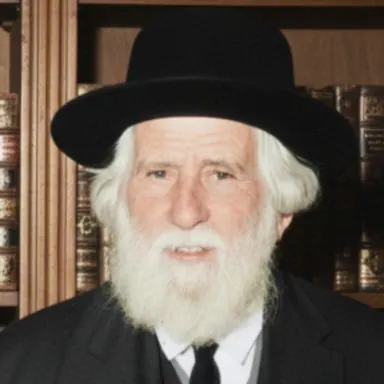
The Torah Teaching, Research Work and Bibliographical Contribution of Rabbi Reuven Margaliot
16 min read3,234 words
Summary
This survey presents the many-sided figure of Rabbi Reuven Margaliot, a self-taught Torah scholar who bridged the world of traditional learning and meticulous bibliographical research. The text details his spiritual growth in Galicia and his public work in Israel as director of the Rambam Library, highlighting his phenomenal erudition and his research method, which relies on internal sources alone. The center of gravity of the work deals with his extensive literary contribution, including annotated editions of the Book of the Zohar and of Sefer Chasidim, alongside significant historical controversies with academia that underline the superiority of comprehensive Torah knowledge. The article seeks to illuminate how a combination of photographic memory and scholarly precision enabled Margaliot to become a unique authority who deeply influenced both the world of the yeshivot and the study of Jewish studies.
Scholarly Biography and Spiritual Growth in Galicia
Rabbi Reuven Margaliot represents a unique and unconventional figure in the scholarly and research landscape of twentieth-century Judaism. He was born in Lvov in Galicia on 7 Kislev 5650 (30 November 1889) and died in Tel Aviv on 7 Elul 5731 (28 August 1971), and was buried there in the Nachalat Yitzchak cemetery.[1, 2] At that time, in the Galicia of the late nineteenth and early twentieth centuries, there were no institutionalized yeshivot on the usual Lithuanian model, and Torah study was conducted in synagogues and in local groups of learners.[2] Against this background Rabbi Margaliot grew up as a distinctly self-taught scholar who acquired his vast Torah knowledge by his own efforts.[2] He maintained an extensive correspondence with the greatest Torah scholars of the generation, among them Moshe Ze'ev Mezuza and Meir Arik, who served as his principal teachers.[1, 2]
Rabbi Margaliot's scholarship was marked by supreme self-sacrifice and absolute devotion to study under harsh conditions of want. In the introduction to his halakhic book "Nefesh Chayah" on the Shulchan Arukh, Orach Chaim, part of which was written in the midst of the First World War, the rabbi described the life of sorrow and want in which he lived, fulfilling in his own person the saying of the Sages, "Eat bread with salt and drink water by measure."[2] The combination of comprehensive self-taught learning with the hardships of existence forged in him an uncompromising approach to the study of Torah sources, an approach combining phenomenal erudition (a "Sinai") with an exceptional photographic memory and a sharp and original capacity for analysis.[3]
After his immigration to the Land of Israel in Tevet 5695 (1934), Rabbi Margaliot joined the religious-Zionist public and was identified with religious Zionism.[1] His research and Torah work earned him great public and national esteem, whose clearest expression was his receipt of the Israel Prize, the Rav Kook Prize for Torah Literature (twice), and the "Key to the City" award of Tel Aviv.[1] Among his prominent students who continued his research and public path are Yitzchak Raphael (who headed Mossad HaRav Kook), Reuven Elitzur and Shilo Raphael.[1, 2]
The Research Methodology: Combining Phenomenal Erudition with Internal Criticism
The research method of Rabbi Reuven Margaliot is based on a fundamental ideological and methodological principle: rigorous scholarly and philological inquiry nourished by and relying solely on the internal sacred sources of the Jewish tradition, without leaning on external historical sources.[2] In his first book, "Toldot Adam" on the Maharsha, printed in 5672 (1912) when he was only 23, Rabbi Margaliot demonstrated how an accurate historical biography can be reconstructed and complex methods of study mapped through the meticulous and systematic collection of fragments of information scattered throughout the Torah works of the subject of the research.[2]
An in-depth analysis of his method reveals that it rests on three main pillars:
Concordance-like Erudition and a Phenomenal Memory
Rabbi Margaliot possessed an extraordinary ability to connect different branches of literature (the Babylonian and Jerusalem Talmuds, the halakhic and aggadic midrashim, books of Kabbalah and halakhic rulings).[2, 3] A clear example of this is his life's work "Nitzotzei Zohar," in which he recorded notes and references to parallels between the Book of the Zohar and the literature of the Sages.[2] This project is estimated at more than sixty thousand references and the parallel correspondences between them, a fact that illustrates his broad systemic vision.[2] Similarly, his work "Nitzotzei Or" is a sequel to his book "Margaliyot ha-Yam," and includes notes on the Talmud (in the orders Mo'ed, Nashim, Nezikin and Kodashim) based on an unprecedented mastery of the words of the Rishonim and the Acharonim.[4]
Extreme Methodological Concision
One of the prominent features of his writing is its extreme brevity. Rabbi Margaliot tended to present his findings in the form of dense bibliographical references, leaving the work of deciphering and expanding to the student.[5] This trait was noted by leaders and scholars of his generation; thus, for example, the Lubavitcher Rebbe, who held Rabbi Margaliot's work in enormous esteem and kept all his books in his private library, remarked in one of his letters that although great is the benefit that comes from his "Nitzotzim" and his works, it is to be regretted that he was brief everywhere, even where it would have been fitting to expand in explaining matters.[5] This brevity apparently stemmed from the author's starting assumption that the reader commands the sources at a basic level, and from a desire to compress the maximum amount of bibliographical knowledge into the minimum printed space.
Phenomenological Inquiry into the Tradition of Language and Text
Rabbi Margaliot did not see the traditional text as frozen but as a living space whose internal laws must be investigated. His books such as "Le-Cheker Shemot ve-Khinuyim ba-Talmud" (Studies in Names and Appellations in the Talmud) and "Shem Olam" (which deals with the importance and the mechanisms of saying a thing in the name of the one who said it) show that he investigated the syntactic rules, the disguised names and the Talmudic appellations with the aim of resolving textual and halakhic difficulties caused by a misunderstanding of ancient writing conventions.[1, 4]
His Professional Work as Librarian, Publisher and Bibliographer
There was a close connection between Rabbi Margaliot's scholarly character and his professional work as a librarian and director of Hebrew book institutions. Already in the period when he lived in Lvov, Rabbi Margaliot earned his living from a private bookshop that he owned.[2] This shop was not merely a place of commerce but served as a bibliographical crossroads where Torah scholars, researchers and collectors met. There the rabbi formed his first connection with the world of printing, the study of manuscripts and scholarly cataloguing, and he was closely connected with book research and with the great community library in Lvov.[2]
His bibliographical work found institutional expression with his founding and editing of the journal "Ha-Modia," a monthly for bibliography, book reviews and book matters.[1] This monthly appeared in two periods: issues 1–14 were printed in Lvov in the years 5692–5694 (1932–1934), and issues 1–7 were printed in Tel Aviv after his immigration, in the years 5695–5698 (1935–1938).[1] This journal served as a unique platform for publishing short studies, surveys of rare books and discussions of textual readings.
After his immigration to the Land of Israel, Rabbi Margaliot was appointed director of the Rambam Library in Tel Aviv, a position he held for decades.[1, 2] Under his leadership the library was shaped not as a passive book archive but as a vibrant center of Torah research and elite scholarship.[2] His dominant personality as director and librarian distinctly influenced the character of the library, which aroused a professional controversy within the community of librarians in the Land of Israel.[2]
In 1947 Avraham Yaari, one of the senior librarians and scholars of the National Library in Jerusalem, wrote a comprehensive report on the system of public libraries in Tel Aviv.[2] In this report Yaari criticized the Rambam Library under the management of Rabbi Margaliot, claiming that the library focused excessively on the needs of "scholarly librarians" and of distinctly Torah researchers, while neglecting to make popular literature accessible, in particular Hasidic literature, which could have attracted a broader and more varied readership.[2] This criticism reveals Rabbi Margaliot's worldview: for him, the Jewish librarian is not a technical clerk responsible for arranging shelves but a Torah scholar entrusted with the in-depth bibliographical guidance of researchers and students. Rabbi Margaliot saw the library as a direct aid to new Torah production, a kind of "bibliographical beit midrash," and saw himself as the one who was to supply the purest textual infrastructure for that purpose.[2] This appreciation of his scholarly character also echoed in what was written about him after his death by the biographer G. Kressel in the yearbook "Shanah be-Shanah" (5736) and by his close friend Yitzchak Raphael in the memorial volume he published in his memory.[2]
The Scholarly-Kabbalistic Controversy with Gershom Scholem
The abysmal difference between Rabbi Margaliot's approach to research and the academic research approach of "Jewish studies" found sharp expression in the great controversy he conducted with the father of the academic study of Kabbalah, Professor Gershom Scholem.[2] The controversy revolved around the question of the Sabbateanism of the Gaon Rabbi Jonathan Eybeschütz and the authenticity of the amulets he wrote.[2, 6]
Prof. Scholem sought to prove that Rabbi Jonathan Eybeschütz was a secret Sabbatean.[6] His main proof rested on the presence of a kabbalistic book named "Derush ha-Taninim" within Eybeschütz's amulets.[6] Scholem argued emphatically that in all of kabbalistic literature there is no book named "Derush ha-Taninim" other than the book of Nathan of Gaza, who was one of the most prominent prophets of Sabbateanism.[6] According to Scholem, the book lay before him in a photograph of a manuscript, and it was impossible to claim that its distinctly Sabbatean character had escaped the notice of Rabbi Jonathan Eybeschütz.[6] From this Scholem concluded that the use of amulets incorporating this work constitutes conclusive proof of Eybeschütz's Sabbateanism.[6]
Rabbi Margaliot came out against this thesis in a sharp Torah treatise.[2] He proved, from his vast familiarity with manuscripts and with Orthodox kabbalistic literature, that the term "Derush ha-Taninim" or similar sources exist in the legitimate kabbalistic tradition and are not necessarily connected with Nathan of Gaza or with Sabbateanism. Gershom Scholem responded very sharply to Rabbi Margaliot's article, and chose to call him by the belittling name "Mr. Reuven Margaliot" instead of "Rabbi," in an attempt to strip him of his Torah authority.[2] Nevertheless, on this specific point of the historical debate it turned out that Rabbi Margaliot was right, and Prof. Scholem was later compelled to admit his error formally.[2]
This debate goes beyond the boundaries of a local dispute over amulets and embodies a clash between two epistemological worldviews [2]:
- The academic approach (Gershom Scholem): an approach that often seeks to uncover "underground currents," deviant sects and marginal factors in Jewish history, and to place them at the center of understanding the development of Jewish thought, while granting historical legitimacy to currents rejected by the rabbinic establishment.[2]
- The rabbinic-traditional approach (Rabbi Reuven Margaliot): an approach that seeks to preserve the continuity of Orthodox tradition and to defend the good name of the great sages of Israel.[2] This approach shows that the tools of absolute erudition in the sacred sources and direct familiarity with the world of the sages of the generations are scholarly means of defense superior to external historiographical hypotheses, which may fall into the trap of anachronism and of a lack of inner understanding of the text.[2]
His Kabbalistic Teaching and the Lubavitcher Rebbe's Appreciation of It
Rabbi Margaliot's work in the field of Kabbalah and the Book of the Zohar won enormous resonance also among the spiritual leaders of Diaspora Jewry, foremost among them the leader of Chabad Hasidism, the Lubavitcher Rebbe. The Rebbe kept in his private library Rabbi Margaliot's editions of the Book of the Zohar, Tikkunei Zohar, Zohar Chadash and Sefer ha-Bahir with his notes "Nitzotzei Or" (first edition), as well as the works "Sha'arei Zohar" and the booklet "Ha-Rambam ve-Sefer ha-Zohar" (Maimonides and the Book of the Zohar).[5] In a letter from 5715 (1955) to the editor of Sefer Chasidim, the Rebbe set down detailed remarks on Margaliot's edition, such as the discussion in siman 549 concerning the shift between the second and the third person in the wording of the blessings.[5] The Rebbe spoke of Margaliot's kabbalistic project in warm words: "He has done and is doing a great thing with his Nitzotzim and his notes on the Zohar, Tikkunei Zohar, the Bahir and Zohar Chadash: there is wisdom here and there is craftsmanship here."[5]
Besides the notes on Kabbalah, the Lubavitcher Rebbe referred again and again to Margaliot's research work "Shem Olam."[5] In a talk on Shabbat Parashat Shemot 5736 (1976), the Rebbe mentioned the book in connection with the rules of halakhic decision and the readings of the Talmud.[5] The discussion revolved around the words of the Radbaz, according to which when a dispute between two sages is cited in the Talmud in the form "one said... and one said..." (chad amar... ve-chad amar...), the exact identification of the one who reported the tradition is important.[5] The Rebbe referred to Margaliot's book "Shem Olam" (Introduction, chapter 8), where the matter is discussed at length.[5] The Rebbe also discussed Margaliot's statement in "Shem Olam" (letter 3, 38) according to which Rav everywhere adopted the plain meaning of Scripture and it was Shmuel who interpreted the verses homiletically, and further on proposed an alternative solution that resolves Margaliot's difficulty by internal ways of studying the traditions.[5]
A Systematic Analysis of His Principal Works
The literary work of Rabbi Reuven Margaliot embraces dozens of volumes that are enduring assets both in classical yeshiva study and in Torah bibliographical research.[2, 3] A large part of these works was published and reprinted again and again by Mossad HaRav Kook in Jerusalem.[1, 4, 7]
Margaliyot ha-Yam on Tractate Sanhedrin
This work, first printed in Jerusalem in 5718 (1958) in two volumes, is regarded as an exegetical masterpiece and a fundamental book in the study of Tractate Sanhedrin.[7, 8] The book was printed ahead of the cycle of study of this tractate in the framework of the Daf Yomi, and won enormous popularity that led to repeated printings over the years (in 5737, 5755, 5756, 5765 and 5780).[7] The book presents a systematic and comprehensive collection of dozens of halakhic and conceptual discussions in the order of the tractate's pages, incorporating precise references to the literature of the Rishonim and the Acharonim and original insights of the author's own.[7, 8] As a direct continuation of this project, the rabbi composed the book "Nitzotzei Or" on further tractates in the orders Mo'ed, Nashim, Nezikin and Kodashim, which presents short and brilliant notes on the Gemara and the words of its commentators.[4]
Sefer Chasidim with the Commentary Mekor Chesed
One of Rabbi Margaliot's most important contributions to the study of Ashkenazi Pietism is his annotated edition of "Sefer Chasidim" by Rabbeinu Yehuda HeChasid.[9, 10] The edition includes the commentary "Brit Olam" of the Chida, notes by Rabbi David Sperber, and Margaliot's own project of explanations, called "Mekor Chesed."[9, 10] This commentary presents sources, references and historical and conceptual explanations, and is also accompanied by an annotated edition of the testament of Rabbi Yehuda HeChasid and of his biography.[1] The base edition rested in part on the text of Sefer Chasidim printed in 5684 (1924), and was regularly incorporated into the editions of Mossad HaRav Kook from 5717 (1957) onward.[1] The publication of the book aroused great interest among scholars and researchers and received favorable reviews in the daily press of that period, among them the articles of M. Ungerfeld in the organ "Ha-Tzofeh" (1957), Alter Meir in the organ "She'arim" (1957), and Shimon Federbusch in the organ "Ha-Yom" (1925, on the early editions).[1]
Studies in the History of Halakha and the Masorah
Rabbi Margaliot produced a series of groundbreaking research books dealing with the development of the Torah text and of the Oral Torah.[1] The most prominent of them include:
Yesod ha-Mishnah va-Arikhatah (The Foundation of the Mishnah and Its Redaction): a general and planned survey of the transmission of the Oral Torah from the days of the Men of the Great Assembly to the sealing of the Mishnah.[1] The book was first printed as an article in the collection "Kvei Or" (Lvov 5683 and 5693) and was published as a separate book by Mossad HaRav Kook in 5716 and 5750.[1]
Ha-Mikra ve-ha-Mesorah (Scripture and the Masorah): a unique collection of studies dealing with the rules of the Masorah, variant readings and the rules of biblical spelling (printed in 5724, 5725 and 5749).[1]
Le-Cheker Shemot ve-Khinuyim ba-Talmud (Studies in Names and Appellations in the Talmud): a work that began as a short appendix to the introduction to the Talmud of the Maharatz Chajes (Lvov 5688) and was expanded into a complete monograph that constitutes a philological aid of the first rank for identifying the sages of the Talmud and understanding the appellations appearing in the Talmud (Mossad HaRav Kook 5720 and 5749).[1]
- Malakhei Elyon (Angels on High): a comprehensive research encyclopedia, the first of its kind, that gathers all matters concerning the angels, their names and their functions in the literature of the Talmud, the Midrash and the Kabbalah (Mossad HaRav Kook 5705, 5724 and 5748).[1]
- Mekor ha-Berakhah (The Source of the Blessing): a comprehensive clarification of the commandments over whose performance a blessing is said and of the formulation of their blessings, printed in Lvov in 5694 (1934).[1]
Summary and Conclusions
The comprehensive analysis of the work and teaching of Rabbi Reuven Margaliot shows that he formed an exceptional bridge between the world of traditional scholarship and the world of modern bibliographical research.[2] His designation as a "Sinai" refers not only to his phenomenal memory but to his ability to use this erudition as a scholarly and systematic tool for mapping, cataloguing and uncovering the internal structure of the Jewish bookshelf.[2, 3]
Rabbi Margaliot proved in his studies that absolute reliance on the sacred sources does not limit scholarly capacity; on the contrary, intimate and deep familiarity with the language of the sources opens the way to solving complex historical and textual questions on which external schools of research had failed, as was clearly proved in his great controversy with Gershom Scholem.[2] His vast literary work, together with the editing of the monthly "Ha-Modia" and the scholarly management of the Rambam Library, left an indelible mark on the way Torah has been studied in recent generations, and set a new standard for combining faith and halakhic commitment with meticulous bibliographical precision.[1, 2]
Sources10
- 1.ראובן מרגליות - ויקיפדיה, he.wikipedia.org/wiki/ראובן_מרגליות
- 2.א. הרב ראובן מרגליות – תלמיד חכם וספרן - Safranim's Blog, safranim.com/גיליון-טו/א-הרב-ראובן-מרגליות-חוקר-וספרן/
- 3.ראובן מרגליות - חב"דפדיה, chabadpedia.co.il/index.php?title=ראובן_מרגליות&mobileaction=toggle_view_desktop
- 4.ניצוצי אור על הש"ס - מוסד הרב קוק, mosadharavkook.com/shop/ניצוצי-אור-על-השס/
- 5.התקשרות 804 | המהדיר הרב הגאון ר' ראובן מרגליות - צעירי אגודת חב"ד, chabad.org.il/Magazines/Article.asp?ArticleID=6444&CategoryID=1352
- 6."הרב החריף, קנקן חדש מלא ישן, חכם ושלם": דמותו של הרב ראובן מרגליות, makorrishon.co.il/judaism/article/290447
- 7.מרגליות הים - ויקיפדיה, he.wikipedia.org/wiki/מרגליות_הים
- 8.Margalios HaYam Al Maseches Sanhedrin - Mossad Harav Kook - מרגליות הי - Judaica Plaza, judaicaplaza.com/products/7060140
- 9.ספר חסידים - מוסד הרב קוק, mosadharavkook.com/shop/ספר-חסידים/
- 10.Hebrew SEFER CHASSIDIM Margolies Edition ספר חסידים / שחיבר רבינו יהודה החסיד - eBay, ebay.com/itm/396875056892