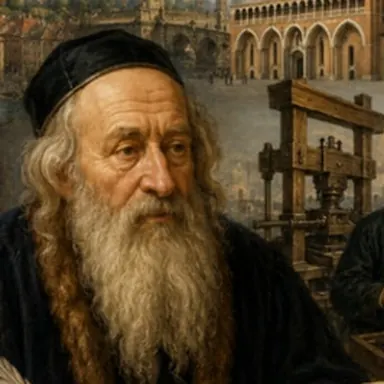
The Work, Torah Teaching and Dynasty of the Maharam of Padua: Jewish Leadership at the Crossroads of Cultures in the 16th Century
16 min read3,171 words
Summary
This survey examines the figure of Rabbi Meir Katzenellenbogen, known as the Maharam of Padua, who served as a central connecting link between the conservative tradition of Ashkenaz and the cultural openness of Italy in the Renaissance period. The text traces the course of his life, from his roots in Germany and Prague to his long years of Torah leadership, highlighting his pragmatic halakhic rulings that seek to preserve "the ways of peace" and human dignity. A key event highlighted in the text is the printers' controversy, which led to the establishment of the foundations of intellectual property in halakha but ended in the tragedy of the burning of the Talmud following an informing to the Church authorities. In conclusion, the article presents the illustrious Katzenellenbogen dynasty that branched out from him, whose descendants continued to influence the worlds of the rabbinate, science and the spirit over many generations.
The Ashkenazi Roots and the Emigration to Italy: Biography and Historical Background
Rabbi Meir Katzenellenbogen, known in the Torah world by the appellation Maharam Padua (or Maharamp), represents one of the most influential key figures in the halakhic and cultural transition of European Jewry from the end of the Middle Ages to the beginning of the modern era.[1] His work extends over a stormy period of technological, political and demographic changes, in which he served as a living bridge between the conservative scholarly tradition of Ashkenazi Jewry and the dynamic and flourishing communities of northern Italy.[1, 2]
The Origin of the Family Name and the Birth of the Dynasty
Rabbi Meir Katzenellenbogen was born in 1473 in the German town of Katzenelnbogen, located in the present-day state of Rhineland-Palatinate.[1, 3] The town once served as the capital of a small historical county under the Holy Roman Empire, and the economic and protection payments made by the local Jews were a major source of income for this principality.[3] Etymologically, the meaning of the name in German is "cat's elbow," but linguists assume that it is a late phonetic corruption of an ancient geographical name that took root in the area.[3] According to the historical sources, the Maharam was the first to bear this family name officially, and from him there branched out one of the most illustrious families of the rabbinic aristocracy in the history of Ashkenazi Jewry.[3]
The Maharam was born to Rabbi Yitzchak Katzenellenbogen and to Julia Malka, who was the daughter of Rabbi Yechiel Luria of Brisk.[1, 3] This lineage bound him by close family ties to the senior Torah leadership of that period; through his mother, the Maharam was the cousin of Malka Isserles, the mother of Rabbi Moshe Isserles (the Rema), the greatest halakhic authority of Polish Jewry, a family connection that was destined to play a decisive role in shaping the face of halakha and in the public struggles of the generation.[1, 3]
In the historical literature there is a slight disagreement regarding the exact year of the Maharam's death. Whereas the accepted and well-documented view holds that he died on 12 January 1565 (10 Shevat 5325) in Padua at the age of about 92, the historian Yochanan Pershel notes that in the historiographical work "Tzemach David" it is written that the Maharam died as early as the year 5318 (1558).[1, 3] The Maharam was buried in the old cemetery at Via Wiel 26 in Padua, with his famous son, Rabbi Shmuel Yehuda Katzenellenbogen, buried to his left.[4]
The Period of Study in Prague and the Move to Padua
In his childhood and youth the Maharam turned eastward to Prague, which was at that time a lively Torah center and a laboratory of pioneering scholarship.[1, 2] In Prague he studied with Rabbi Yaakov Pollak, the founder of the method of "chilukim" (Ashkenazi dialectical pilpul), and studied there together with the man who later became the father of Torah in Poland, Rabbi Shalom Shachna of Lublin.[1, 3] This method of study, which stressed sharpness, textual dissection and the resolution of internal contradictions, gave the Maharam the profound scholarly tools that shaped his halakhic path.[1, 3]
As part of a broad trend of emigration of Jews from Ashkenaz and Bohemia southward to the city-states of northern Italy, the Maharam moved from Prague to Padua, which was under the rule of the Republic of Venice.[1, 2] Padua offered at that time a unique social and cultural climate, and the local yeshiva flourished under the leadership of the city's rabbi, Rabbi Yehuda Mintz (Mahari Mintz).[1, 3] The Maharam joined the yeshiva as the principal disciple of Mahari Mintz, and over the years he formed close family ties with him when he married Chana, the daughter of Rabbi Avraham Mintz (the son of Mahari Mintz).[1, 3]
In the year 5285 (1525) the Maharam was appointed rabbi of the Ashkenazi community in Padua.[1, 3] He stood at the head of the local yeshiva for about forty years, developed it into a world center of attraction for students from distant places, and at the same time served as head of the regional council of rabbis in Venice.[1, 2, 3] His dual role made him the supreme halakhic authority of the entire region, and his title among the sages of the generation, including the Rema, was "head of the rabbinical court of the State of Venice."[1, 3]
His Halakhic Teaching and Torah Work
The halakhic methodology of the Maharam of Padua represents a synthesis between the conservative Ashkenazi approach, which gives great weight to local customs and to close-to-the-text analysis, and the dynamic Italian approach, characterized by intellectual openness and by adaptation to the changing economic and social reality of the city-states of the Italian Renaissance.[1, 2]
His Literary Work and Torah Enterprise
The Maharam of Padua composed a number of central works that constitute cornerstones of the Jewish bookshelf [1]:
- Responsa of the Maharam of Padua: a collection of questions and answers published in Venice in the year 5313 (1553).[1, 5] The book reflects an extensive halakhic correspondence with communities and sages from all over Europe and from the lands of the East, who sought his decision on complex social, economic and personal questions.[1, 5] Some of the Maharam's responsa were also published in the book "Ha Lakhem Zera," which was likewise printed in Venice in the same year.[3]
- Glosses and novellae on the Rambam: comprehensive glosses on the monumental work of Maimonides (Rambam), the "Mishneh Torah."[1, 2, 6] These glosses were printed in the margins of the text and became an inseparable part of scholarly study of the Rambam in the following generations, offering a unique combination of the Sephardic rulings of the Rambam with the traditions of Ashkenaz.[1, 2]
Additions to the book on gittin and chalitza: completions, editing and expansion of the rulings of his wife's grandfather, Mahari Mintz, with the intention of preserving the tradition of halakhic decision of the rabbinical court in Padua.[1]
Other works: glosses on the Turim, commentaries on the Yalkut Shimoni, a book dealing with matters of Divine Names and practical Kabbalah, and a collection of selichot (penitential prayers).[1]
Guiding Principles of Decision: The Ways of Peace and Human Dignity
The rulings of the Maharam of Padua reveal a deep pastoral understanding and a special sensitivity to the integrity of the family and communal fabric. A clear example of this is his ruling on the question of human dignity and the principle of "the ways of peace."[1] The Maharam was required to decide in the case of two brothers whose father, who was an honored and influential public figure (a "minister and great man"), had converted to Christianity (become an apostate).[1] The brothers wished to know whether they were permitted to be called up to the Torah in the synagogue and to be called by the name of their apostate father (that is, "so-and-so son of so-and-so the apostate").[1]
Whereas other rabbis tended to be stringent in order to create a moral deterrent against apostates, the Maharam of Padua ruled that they should be called by their father's name.[1] In his reasoning he explained that the sons should not be punished for the sins of their father, and that they should be spared public shame that might lead to their being distanced from the community, and this out of the overriding consideration of human dignity and "the ways of peace."[1] This ruling shows a pragmatic and humane outlook that prefers bringing near those who are far and preserving communal cohesion over formalistic stringency.
On the other hand, the Maharam displayed firm institutional conservatism when he identified a threat to the stability of communal thought and faith. In the year 5318 (1558), in the midst of a broad controversy over the printing of the "Book of the Zohar" and the book "Ma'arekhet ha-Elohut," the Maharam signed the bans of the sages of Ashkenaz against the printing of these kabbalistic books.[1] His opposition stemmed from the fear that the spreading of the esoteric teaching to the broad public without spiritual supervision and suitable intellectual preparation would lead to grave theological errors and to a crisis of faith, a conception that sees rabbinic leadership as a vital filter against doctrinal shocks.[1]
The Printers' Controversy and the Burning of the Talmud in Venice
The most dramatic event in the life of the Maharam of Padua, which left a tragic mark on the world of Torah in all of Europe, is directly connected with his Torah enterprise and with the printing of the books of the Rambam.[1]
The Economic Background and the Commercial Competition
Between the years 5310–5314 (1550–1554), the Maharam of Padua proofread and prepared for print a splendid edition of the "Mishneh Torah" of Maimonides (Rambam), investing an enormous fortune in it.[1] Since under the laws of the Republic of Venice Jews were forbidden to own printing houses, the Maharam joined forces with the Christian patrician printer Alvise Bragadin.[1] The Maharam included his original glosses and explanations at the end of the book, and planned to earn his living from the sale of the edition in order to cover his many debts.[1]
A short time afterwards, a rival Christian printer named Marco Antonio Giustiniani identified the commercial success, copied the Maharam's glosses and put on the market a similar and cheaper edition, with the aim of breaking the power of the Bragadin printing house and dispossessing the Maharam of his rights.[1] This step was perceived in the Jewish world as blatant robbery and a grave business and Torah encroachment.[1]
The Intervention of the Rema and the Formulation of Laws of Intellectual Property
When the Maharam's relative, the Rema (Rabbi Moshe Isserles), heard of the injustice done to his elderly relative, he intervened in the affair resolutely.[1] The Rema published a forceful halakhic manifesto (appearing in the Responsa of the Rema, siman 10), in which he imposed a ban and excommunication on anyone who would purchase Giustiniani's edition of the Rambam, and instructed that only the books of the Maharam of Padua printed by Bragadin be bought.[1] This historic halakhic ruling laid the foundations for the laws of intellectual property, the protection of copyright and the prevention of unfair competition in Jewish law.
The Informing and the Burning of the Talmud
The economic and halakhic dispute rapidly worsened and spun out of control. The Christian printers, who saw enormous losses before them and were caught in the midst of a religious power struggle in Italy, transferred the confrontation to the authorities of the Catholic Church.[1] Three Jewish apostates who acted at the instigation of the printing houses (Yosef Moro Tzarfati, Chananel de Foligno, and Shlomo Romano / Vittorio Eliano) informed the Inquisition that the Talmud and rabbinic literature contained hatred, heresy and curses against Jesus and Christianity.[1]
The informing led Pope Julius III to issue a sweeping decree for the confiscation and burning of the Talmud.[1] On Rosh Hashanah 5314 (September 1553), thousands of volumes of the Talmud and Hebrew works were burned in the public squares of Rome, and afterwards in Venice and in other cities of northern Italy.[1] The burning of the Talmud created an unprecedented shortage of books and completely changed the character of yeshiva study in Europe, as sages were forced to rely on halakhic abridgements instead of on the Talmud itself.
[ Maharam of Padua & Bragadin ] ◄─── (cooperation in printing the Rambam with glosses)
│
▼
[ Giustiniani (rival) ] ◄─── (copying the glosses and printing a cheaper edition)
│
▼
[ Intervention of the Rema (Poland) ] ◄─── (imposing a ban and excommunication on Giustiniani's buyers)
│
▼
[ The printers' struggle escalates ] ◄─── (three apostates inform the Church against the Talmud)
│
▼
[ Decree of Pope Julius III ] ◄─── (public burning of the Talmud on Rosh Hashanah 5314)
The Katzenellenbogen Lineage: A Trans-European Network of Influence
The historical standing of the Maharam of Padua rests not only on his personal achievements, but also on the illustrious dynasty he raised up, whose branches led the world of Torah, science and the Jewish public for hundreds of years.[3]
His Son: Rabbi Shmuel Yehuda Katzenellenbogen (the Maharshik)
The Maharam's son, Rabbi Shmuel Yehuda Katzenellenbogen (the Maharshik; 1521–1597), was born in Padua and already in his youth became a member of the rabbinical court in Venice and a prominent prodigy.[3] From the year 5325 (c. 1565) he succeeded his father as chief rabbi and head of the yeshiva in Venice, and was recognized as one of the central leaders of Italian Jewry.[3]
The Maharshik was known as an exceptional preacher, and in his lifetime twelve of his sermons were printed in the book "Shnem Asar Derashot" (Twelve Sermons; Venice 5354/1594), among them a moving eulogy for his relative the Rema.[3] He conducted a close correspondence with the Maharshal, the Rema, and the author of the Shulchan Arukh, Rabbi Yosef Karo, who sent him some of his works.[3] The Maharshik raised up many prominent disciples, among them Rabbi Yehuda Arye de Modena (who eulogized him in moving words and described his appearance as that of an angel of God), Rabbi Ben Zion Tzarfati, Rabbi Leib Saraval, the sages of Rovigo Avtalyon and Yekutiel sons of Shlomo of Consiglio, Rabbi Avigdor Cividal and Rabbi Simcha Katz.[3] He was buried beside his father in Padua.[3, 4]
His Grandson: Rabbi Shaul Wahl Katzenellenbogen
The son of the Maharshik and grandson of the Maharam was Rabbi Shaul Wahl (1541/1545–1617).[3, 7] Shaul was born in Padua, was sent to study in the yeshivas of Poland, and stood out as a brilliant scholar and as an influential businessman who attained a special standing at the Polish royal court.[3, 8] His name is connected with the well-known historical legend according to which he was appointed "King of Poland for one night" during a period of transition between reigns, and used his one-night power to pass laws benefiting the Jewish community.[3, 7, 8]
The Other Branches of the Family and Their Influence for Generations
The Katzenellenbogen family continued to branch out into many branches, representing the spiritual and modern leadership of European Jewry [3]:
The branch of Rabbi Moshe and the line of "Yesh Menachilin": Rabbi Moshe Katzenellenbogen (1671–1743) served as rabbi in Schwabach in Germany.[3] His son, Rabbi Pinchas Katzenellenbogen (1691–1767), was a prominent Ashkenazi rabbi and composed the important book of ethics and family history "Yesh Menachilin," which constitutes a valuable historical source for the spiritual life of that period.[3]
The Alsace branch and the Sanhedrin of Paris: Rabbi Naftali Hirsch Katzenellenbogen (1749–1823) served as a rabbi in Germany and in Alsace.[3] Owing to his public standing and political influence, he was chosen to serve as a member of the Sanhedrin of Paris established by Napoleon Bonaparte, and served on the Consistory (the Jewish religious council) of the Upper Rhine.[3]
The Saint Petersburg branch: Rabbi David Tevel Katzenellenbogen (1847–1930) served as the influential rabbi of Saint Petersburg in Russia under the rule of the Tsar and at the beginning of Soviet rule.[3] His son, Eliyahu Katzenellenbogen (1905–1990), acquired a broad education as a doctor of philosophy and an educator, and immigrated to Israel, where he served as deputy director-general of the Ministry of Education.[3]
The Kosova branch and the blood tie to the Chazon Ish: Rabbi Shaul Katzenellenbogen (born Epstein; 1828–1891) served as rabbi of the town of Kosova, and was the grandfather of Rabbi Avraham Yeshayahu Karelitz (the "Chazon Ish"), leader of the Haredi public in the Land of Israel in the 20th century.[3]
Modern rabbis and scholars: Rabbi Mordechai Leib Katzenellenbogen (1954–2021) continued the family's Torah enterprise as a prominent editor and author at Mossad HaRav Kook.[3]
Modern descendants in the world of medicine, science and the spirit: Professor Yitzchak Katzenellenbogen (1896–1971), a world-renowned dermatologist and founder of the dermatology department at Beilinson Hospital [3]; Boris D. Bogen (1869–1929), a Jewish-American educator and relief worker [3]; Gershon Ellenbogen (1917–2003), a British jurist and writer [3]; Konrad Kellen (1913–2007) and Stephen M. Kellen (1914–2004), men of letters, security and banking in the United States [3]; Ostap Ortwin (the literary name of Oskar Katzenellenbogen; 1876–1942), a prominent Polish literary critic [3]; and the actress and media personality Shira Katzenellenbogen.[3]
Summary and Historical Assessment
The work and teaching of Rabbi Meir Katzenellenbogen, the Maharam of Padua, draw the portrait of a halakhic leader with a broad panoramic vision, who succeeded in preserving the foundations of the tradition of Ashkenaz while adapting them to the economic, technological and social challenges of Renaissance Italy.[1, 2] His path in halakhic decision-making, combining deep human sensitivity in matters of "the ways of peace" with theological conservatism in matters of the dissemination of Kabbalah, represents a responsible and balanced model of leadership that strives to preserve the integrity of the community.[1]
The crises he experienced, foremost among them the printers' controversy and the burning of the Talmud, became a formative historical lesson about the dangers of undermining the internal authority of the community and turning to foreign governmental authorities.[1] At the same time, the halakhic response given to this crisis by the Rema laid the legal foundations for the regulation of intellectual property in the Jewish world.[1]
The illustrious Katzenellenbogen dynasty that the Maharam left behind him, which branched out into the most important centers of culture, Torah and science in Europe and in the Land of Israel, ensured that his work and his values would continue to influence halakhic thought and Jewish culture throughout the generations.[3]
Sources8
- 1.מאיר קצנלנבוגן – ויקיפדיה, he.wikipedia.org/wiki/מאיר_קצנלנבוגן
- 2.מהר"ם פדובה | מקורות מתוך ספריית ספריא, sefaria.org.il/topics/maharam-of-padua
- 3.קצנלנבוגן – ויקיפדיה, he.wikipedia.org/wiki/קצנלנבוגן
- 4.רבי מאיר קצנלבוגן [מהר"ם מפדובה] - MyTzadik, mytzadik.com/tzadik.aspx?id=898
- 5.שו"ת מהר"ם פדוואה | Sefaria Library - ספריא, sefaria.org.il/Responsa_Maharam_of_Padua
- 6.משנה תורה להרמב"ם - BeitChabad.com - בית חב"ד, he.chabad.org/library/article_cdo/aid/5634
- 7.שאול ואהל - ויקיפדיה, he.wikipedia.org/wiki/שאול_ואהל
- 8.הרב שאול ואהל - מלך פולין ליום אחד | הספרנים, blog.nli.org.il/king_for_a_day/