Deborah the Prophetess: Leadership, Judgment, and Torah Doctrine – A Multidisciplinary Analysis of Her Figure and Work
15 min read3,080 words
Summary
The text presents a multidisciplinary analysis of the figure of Deborah the Prophetess, portraying her as a central axis of spiritual, judicial, and military leadership in a period of tribal fragmentation and Canaanite bondage. The source examines her mysterious identity as the "wife of Lappidoth" and the halakhic and theological innovation arising from her work, which emphasizes that the indwelling of the Divine Presence depends on a person's deeds and character regardless of gender. Through an analysis of the campaign at the Kishon River and a study of the "Song of Deborah," the author highlights the importance of mutual responsibility and the power of the nation's spirit, which prevails over technological advantage. In conclusion, the article establishes Deborah's legacy as a model of empowering female leadership that combines maternal compassion with judicial transparency and strategic daring.
The appearance of Deborah the Prophetess in the Book of Judges constitutes one of the most fascinating and complex junctures in biblical, halakhic, and intellectual history. In a period characterized by sharp tribal decentralization, prolonged political bondage, and deep religious fluctuations, Deborah emerges not merely as a military or political leader but as a spiritual and judicial axis that unites the people around a consciousness of "the people of the Lord." Her figure, which combines prophecy, judging, military strategy, and sublime poetic creation, stands at the center of extensive Torah discussions that seek to understand the essence of her authority and her unique religious doctrine.[1, 2] An in-depth analysis of the sources reveals that Deborah is not only a historical figure who acted at a given time but a paragon of leadership based on divine inspiration, personal character refinement, and a direct connection to the needs of the collective.
The Historical and Socio-Political Background of the Period of the Judges
To understand the magnitude of Deborah's work, one must examine the harsh reality in which she acted. The Book of Judges describes a cycle of sin, bondage, cry for salvation, and the appearance of a deliverer. In Deborah's days the pressure reached its peak under the rule of Jabin king of Canaan, who reigned in Hazor.[1] Jabin operated a system that oppressed the Children of Israel for twenty years, his military power resting on technology far superior to that of the tribes of Israel – nine hundred iron chariots under the command of the army commander Sisera.[3]
The security situation under the rule of Hazor led to national paralysis. As described in the Song of Deborah, "the highways were deserted" and the main roads were abandoned out of fear of raids and harassment.[4] The people shut themselves in their settlements, the economic system collapsed, and national morale was at an unprecedented low. In this situation, in which the male leaders appeared helpless before the might of the Canaanite chariots, Deborah appeared and set forth an alternative of spiritual strength that translates into political and military action.
Geographical Analysis of the Center of Her Activity
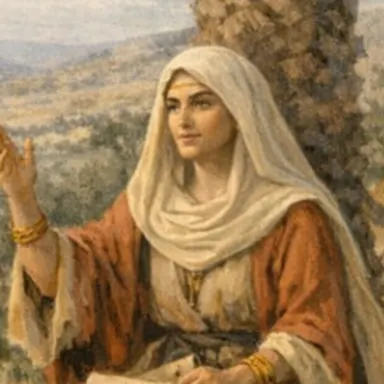
Deborah established her seat in the heart of the land, at a strategic point that allows accessibility to many tribes. She sat under the "Palm of Deborah," between Ramah and Beth-el in the hill country of Ephraim.[1, 5] This choice of the territory of the tribe of Ephraim, which was one of the central and strongest tribes, attests to her recognition of the importance of the governing center. Nevertheless, her affinity was supra-tribal; she did not limit herself to concern for the members of her own tribe alone but served as an address for all the Children of Israel who came up to her for judgment.[6, 7]
The geographic focus teaches that Deborah acted within the settled fabric of Israel, but her influence extended far beyond her physical seat. She succeeded in mobilizing forces from the Galilee (Naphtali and Zebulun) into action in the heart of the valleys, while she herself provided the unifying glue from the center in the hill country of Ephraim.[3, 6]
Her Figure and Identity: The "Wife of Lappidoth" and the Symbolism of the Name
One of the most mysterious titles that accompany Deborah is "wife of Lappidoth."[1] Torah and midrashic interpretation sees in this epithet a key to understanding her personality and her teaching.
The Midrash of the Wicks and Public Service
According to the midrash "Tanna Devei Eliyahu," Deborah was married to a man named Lappidoth, who was a simple man (an "ignoramus," am ha'aretz). Deborah, out of deep concern for his spiritual future and his connection to holiness, instructed him to engage in the craft of making thick wicks for the Tabernacle at Shiloh.[9] The wicks were meant to produce much light ("lapidim" – torches), hence his name. The midrash emphasizes that Deborah acted from the conception that connection to God does not pass only through theoretical study but also through physical and practical service on behalf of the community.[10] In this way she exemplified the doctrine that "greater is its service than its study," as she herself built her home and her husband through a connection to the Tabernacle.
The "Wife of Lappidoth" as an Expression of Inner Strength
Another interpretive approach sees in "wife of Lappidoth" a description of Deborah herself – a woman whose personality burns like a torch of fire. She is described as possessing "alacrity and diligence," a woman who did not shrink from the great darkness of the bondage and spread a light of hope.[6] The fire symbolizes also prophecy, which is perceived as the word of the Lord burning in her bones. Some identify "Lappidoth" with Barak son of Abinoam himself, since "barak" (lightning) and "lapid" (torch) are synonyms for a sudden and powerful light.[6] According to this interpretation, Deborah and Barak were a leadership pair who acted in perfect coordination between the spirit (Deborah) and practical force (Barak).
The Meaning of the Name Deborah: Speech and Action
The name "Devorah" is expounded in the sources in the context of the power of speech (dibbur – speech). Deborah was not merely a prophetess who sees visions but a leader who uses words to build a nation. Her expressive ability is manifest in her song and in her ability to persuade the tribes to mobilize for war.[9] A comparison with the traits of the bee in nature raises motifs of exemplary social order, dominant female leadership in the hive, and the ability to produce honey (spirituality and sweetness) alongside the ability to sting (fighting the enemy).[10] The name reflects the fusion of feminine gentleness with national strength.
The Prophetic Doctrine: "Every Person According to His Deeds"
Deborah is counted as one of the seven prophetesses who prophesied to Israel, alongside Sarah, Miriam, Hannah, Abigail, Huldah, and Esther.[2, 6] Deborah's prophecy represents a profound theological principle regarding the nature of the indwelling of the Divine Presence.
Democratization of the Spirit
The midrash cites a foundational principle arising from Deborah's work: "I call heaven and earth to witness, whether Gentile or Israelite, whether man or woman... everything according to the deed that he does, so the Holy Spirit rests upon him."[9] Deborah is living proof that spiritual rank is not the exclusive possession of men or of a particular priestly class. In that period Phinehas son of Eleazar the priest was alive, and nevertheless the Lord chose to prophesy through Deborah, and this was due to her refinement of character and her good deeds.[9] Her Torah doctrine emphasizes that a person is measured by his deeds and his devotion to the people, and these are the prerequisites for being worthy of prophecy.
Prophecy as a Motive for Military Action
Unlike other prophets who dealt mainly with rebuke, Deborah's prophecy was an operative "military prophecy." She summoned Barak son of Abinoam and conveyed to him a direct divine command: "Has not the Lord God of Israel commanded: Go and draw toward Mount Tabor?"[3] Deborah not only foresaw the victory; she dictated the strategy: drawing the enemy to the valley where the Canaanite chariots would be vulnerable, and exploiting the forces of nature. Her authority was so great that Barak, the experienced commander, refused to go out to war without her physical presence, understanding that she is the channel connecting to divine providence.[1]
The Halakhic Issue: A Woman in Positions of Judging and Authority
Deborah's status as a judge ("and she judged Israel at that time") is at the center of an extensive halakhic discussion throughout the generations. The difficulty arises from the apparent contradiction between her work and the halakhic rule that a woman is not appointed to positions of judging or kingship.[11]
Solutions of Halakhic Interpretation
The Sages of Israel proposed several ways to reconcile the fact that the Children of Israel went up to Deborah for judgment:
- A temporary ruling by divine word: Deborah acted according to a direct prophetic command, and where there is prophecy it overrides the ordinary rules of appointments. Therefore, this is an exceptional case that does not teach about the rule for the generations.[2, 11]
- Voluntary acceptance by the public: Tosafot on tractate Bava Kamma explain that "perhaps they would accept her upon themselves because of the Divine Presence."[2] According to halakha, the public may accept upon itself a person who is not qualified to judge by strict law, and once there is broad agreement ("acceptance"), his rulings are binding. Deborah earned the full trust of the people, and therefore her status as a judge was valid by virtue of the consent of the collective.[11]
- Distinction between judgeship and leadership: Some argue that Deborah did not sit in a religious court that requires eligibility for testimony and judgeship, but served as a "judge" in the broad biblical sense – a political leader, adviser, and teacher of halakha.[11] The people went up to her to hear the word of the Lord and to receive decisions in matters of national leadership, and not necessarily in formal monetary law.
Implications for the Status of Women in the Modern Era
The discussion surrounding Deborah served as a basis for modern rulings regarding the right of women to participate in political life. Rabbi Ben-Zion Meir Hai Uziel and Rabbi Yitzchak Isaac HaLevi Herzog relied on the model of Deborah to determine that in a democratic regime, in which public officials are elected by the people, this is a "voluntary acceptance" by the public, and therefore there is no halakhic prohibition against women serving in public positions.[11] Deborah thus constitutes the historical precedent for female partnership in the leadership of the nation.
Judicial Ethics: Sitting Under the Palm
The Bible emphasizes Deborah's place of residence: "and she sat under the Palm of Deborah." This detail carries profound significance in her Torah teaching and in her professional ethics.
Modesty and Public Space
The Sages explain that Deborah chose to sit under a palm tree precisely because it has no broad crown casting much shade, and therefore it allows sitting in a completely visible place. Her purpose was to prevent the prohibition of "yichud" (seclusion) when men came to her for judgment or for Torah study.[5, 9] This sitting in public attests to her absolute commitment to integrity and public transparency. She did not hide in closed chambers but was accessible to the people under the open sky.
The Symbolism of the Palm in Judgment
The palm symbolizes uprightness ("The righteous shall flourish like the palm tree"). By choosing to sit under the palm, Deborah conveyed a message of righteous judgment without partiality. Just as the palm is straight and tall, so her rulings were upright and could not be swayed.[7] In addition, the midrash notes that just as the palm has "one heart" toward heaven (the lulav), so Deborah's heart was directed entirely to the service of the Lord and to the good of the people of Israel.[8]
The Military Campaign and Female-Male Cooperation
Deborah's work reached its peak in the war against Sisera. Her figure is magnified against the background of the leadership of Barak son of Abinoam. The relationship between them represents a model of cooperation in which the spirit guides the force.
Deborah's Strategy
Deborah identified the weak point of the Canaanite chariots. Chariots are effective on plains and in valleys, but vulnerable in hilly terrain or in mud. She instructed Barak to descend from Mount Tabor to the Kishon River precisely at the moment when she knew (through prophecy) that rain would fall that would cause the Kishon to overflow its banks and turn the valley into a swamp.[3, 4] This is a combination of deep tactical understanding with absolute confidence in divine assistance.
The Heroism of Women as the Decisive Factor
The victory was not completed on the battlefield but in the tent of Jael, wife of Heber the Kenite. Deborah prophesied to Barak that "the Lord will sell Sisera into the hand of a woman," a statement initially perceived as a remark on Barak's hesitancy, but which turned out to be part of a broader divine plan.[1, 6] The cooperation between Deborah the leader and Jael, who acted in the field, underscores Deborah's conception of a "mother in Israel" – leadership that cares for every detail and uses every possible tool to save the people.
The Song of Deborah: The Theological Manifesto of Redemption
The Song of Deborah (Judges chapter 5) is not merely a victory hymn; it is the essence of Deborah's worldview regarding the relationship between the people of Israel and their God and regarding the social responsibility of the tribes.
The Concept of "The People of the Lord"
The song presents the answer to the question of what unites the scattered tribes into one people. Deborah's answer is loyalty to the Lord.[12] In contrast to periods of sin with "new gods" that led to bondage, the victory at the Kishon is perceived as a divine revelation reminiscent of the event at Mount Sinai. Deborah sees the war as a religious event in which "the stars fought from their courses," that is, the entire universe was harnessed for the benefit of those loyal to divine justice.[4, 12]
Criticism of the Tribes and National Responsibility
A significant part of the song is devoted to sharp criticism of the tribes that did not mobilize for the war. Deborah praises Zebulun and Naphtali, who "risked their lives to the point of death," but mocks Reuben, who remained among the sheepfolds to hear the whistling of the flocks.[4] Here she sets forth a Torah demand of mutual responsibility. Her leadership is not content with managing the existing situation but demands total commitment from all parts of the nation for the sake of a shared fate. The curse upon "Meroz" ("because they came not to the help of the Lord") expresses the conception that one who refrains from helping his people in a time of distress is considered as one who betrays his divine mission.[4]
The Contrast Between the "Mother in Israel" and the Mother of Sisera
In the song Deborah appears with the epithet "a mother in Israel." David Ben-Gurion and others interpreted this as a description of a leader who cares for her people as a mother cares for her children, out of compassion and existential responsibility.[6] In contrast, the mother of Sisera is presented waiting at the window, a figure representing the cruelty and arrogance of the enemy who anticipates plunder and the subjugation of women ("a womb, two wombs, for every man's head").[4] This contrast emphasizes the superiority of Israelite morality, represented by Deborah and Jael, over the culture of power of Canaan.
Deborah's Influence and Legacy
Deborah the Prophetess left a deep mark on Jewish and general consciousness, and serves as an inspiration also in our own days.
- A symbol of female empowerment: Deborah is an early and impressive manifestation of female leadership that combines religious, judicial, and military authority. Her figure challenges traditional gender roles and emphasizes the importance of recognizing the contribution of women in positions of influence.[13]
- Cultural inspiration: The Song of Deborah is considered one of the greatest literary works. Her influence is evident in the Hebrew language and in modern literature, from poems by Haim Gouri to contemporary tunes performed at national ceremonies.[4]
A model for leadership in a time of crisis: Deborah teaches that leadership does not grow only out of physical strength, but out of the ability to diagnose reality correctly, to arouse hope in despairing people, and to connect human action to deep spiritual meaning.
Summary and Conclusions
Deborah the Prophetess represents a unique model of the "prophetess-judge," a figure who acted within the halakhic and social framework but also broke through its boundaries by virtue of her personality and inspiration.[1, 2] Her work was based on a combination of personal character refinement (as expressed in the Midrash of the Wicks), transparent judicial ethics (sitting under the palm), and strategic daring driven by a burning faith.[4, 9]
Her Torah doctrine emphasizes the importance of human action as a vessel for the indwelling of the Divine Presence, mutual responsibility as a condition for national existence, and the recognition that the spirit is ultimately the victor over chariot and iron. Deborah not only saved Israel from Jabin and Sisera but gave the nation the language in which it can speak of itself as "the people of the Lord" – a people united around a moral and spiritual mission.[12] Her legacy continues to resonate as a voice calling for leadership based on justice, compassion, and an uncompromising commitment to truth.
Sources13
- 1.שופטים ד-ה: דבורה הנביאה | תנ"ך - ממלכתי ליסודי | מרחב פדגוגי, pop.education.gov.il/tchumey_daat/tanach_mamlachti/yesodi/noseem_nilmadim/dvora-haneviaa/
- 2.דבורה כשופטת ונביאה | אוצר התורה - לגלות את האוצר שבתורה, otzar.org.il/בית-מדרש/אוצר-המקרא-על-התנך/אוצר-המקרא-לספרי-הנביאים/שופטים/כללי/דבורה-כשופטת-ונביאה/
- 3.שופטים פרק ד': דבורה הנביאה - חלק א - לב לדעת, levladaat.org/materials/שופטים-פרק-ד-דבורה-הנביאה-חלק-א/
- 4.שירת דבורה – ויקיפדיה, he.wikipedia.org/wiki/שירת_דבורה
- 5.תומר דבורה (אתר מקראי) - ויקיפדיה, he.wikipedia.org/wiki/תומר_דבורה_(אתר_מקראי)
- 6.דבורה הנביאה – ויקיפדיה, he.wikipedia.org/wiki/דבורה_הנביאה
- 7.פירוש ומשמעות השם דבורה מתוך אינדקס השמות - מטרנה, materna.co.il/שמות-לתינוקות/פירוש-השם-דבורה
- 8.והיא יושבת תחת־תמר דבורה בין הרמה ובין בית־אל בהר אפרים ויעלו אליה בני ישראל למשפט: (שופטים פרק ד פסוק ה) - מקראות גדולות הכתר, mgketer.org/tanach/7/4/5
- 9.דבורה הנביאה | חיבורים בספריא, sefaria.org.il/sheets/410350
- 10.משמעות השם דבורה | שאל את הרב - כיפה, kipa.co.il/שאל-את-הרב/משמעות-השם-דבורה/
- 11.מדינת ישראל לאור התורה - פרק שישי - מעמד האשה: הזכות לבחור ולהיבחר, dintora.org/Show_article/1182
- 12.הצופן המספרי של שירת דבורה - מכון הרטמן, heb.hartman.org.il/the-numerical-cipher-of-deborahs-song/
- 13.דבורה, מרים, רות ואסתר - נשים חזקות ומנהיגות בתנ"ך שנותנות השראה - Novakid, novakidschool.com/he/blog/strong-women-in-the-bible-examples-and-significance/