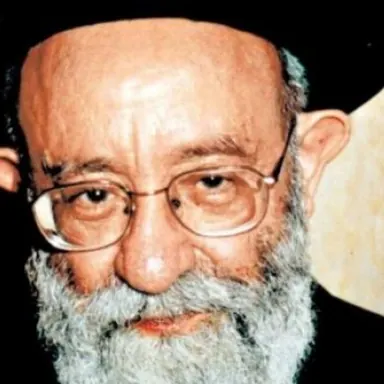
The Torah and Scholarly Legacy of Rabbi Yosef Qafih: A Lifework of Restoration, Translation and Leadership
15 min read3,077 words
Summary
The text surveys the lifework of Rabbi Yosef Qafih, a unique spiritual figure who bridged the rationalist Yemenite tradition and the world of halakhic adjudication and modern academic research in Israel. The survey traces his roots in the "Dor Deah" movement and the preservation of the Maimonidean approach, and emphasizes his monumental work in the precise restoration and translation of the writings of Maimonides (Rambam) and Rasag from ancient manuscripts. In addition to his Torah and judicial activity in the Supreme Rabbinical Court, the source describes his documentary contribution to preserving the folklore and the customs of Yemenite Jewry, which earned him broad recognition and prestigious prizes. Finally, the text presents his figure as a "complete sage" who combined absolute fidelity to the sources with clear rational thinking, a legacy that continues to resonate through institutions of learning that disseminate his teaching to this day.
Introduction to His Teaching: At the Crossroads Between the Yemenite Tradition and Modern Scholarship
Rabbi Yosef Qafih represents one of the most complex and influential figures in the Torah and academic world of the twentieth century. His work is not confined to the limits of halakhic ruling or textual research, but constitutes a living bridge between the world of the Geonim of Babylonia and the Rishonim of Spain and the modern Israeli reality.[1, 2] Having grown up within the tradition of Yemenite Jewry, which preserved with exceptional fidelity the writings of Maimonides (Rambam) and the Geonic method of study, Rabbi Qafih saw himself not merely as a translator or editor, but as a guardian of the walls of pure Jewish rationalism.[1, 3]
Rabbi Qafih's methodology was characterized by a rare combination of phenomenal mastery of ancient manuscripts, a profound understanding of the Judeo-Arabic language, and a capacity for halakhic analysis that is not subject to later conventions but always strives toward the source.[4, 5] He was not content with interpreting the existing text, but worked for its precise restoration, out of a belief that the corruptions of copyists and censorship over the generations had impaired the ability to understand the author's original intention.[5, 6] His figure reflects the transition from the spiritual isolation of Sana'a to the center stage of the world of adjudication and scholarship in Jerusalem, while preserving a unique identity that is not nullified before the dominant currents.[1, 4]
Chapter 1: The Shaping of His Personality in Yemen—Between Tragedy and Rising Above
Family Roots and the Influence of the "Dor Deah"
Yosef Qafih was born on November 27, 1917, in Sana'a, the capital of Yemen, into a reality of political and religious upheavals.[1, 7] His father, Rabbi David Qafih, was murdered as a result of a violent attack by a local Arab when Yosef was less than a year old. At the age of five he also lost his mother, and the responsibility for his upbringing was placed in the hands of his grandfather, Rabbi Yihya Qafih.[1, 7] His grandfather was not only a family leader but a revolutionary figure in Yemenite Jewry, the founder of the "Dor Deah" movement (the Dardaim), which sought to return the community to the rationalist sources of Maimonides (Rambam) and Rav Saadia Gaon, while sharply opposing the influences of later Kabbalah.[8, 9]
The education that young Yosef received in his grandfather's house was founded on linguistic precision, Maimonidean philosophy and an uncompromising commitment to scientific and Torah truth.[1, 9] At a very young age he already revealed an exceptional talent for copying ancient manuscripts, a craft that was widespread among the children of the community but that in his case reached the level of an art.[1] At the age of thirteen only, he copied in his own hand the entire "Guide of the Perplexed" in its original Arabic, an act that attested to his rapid grasp and to his deep affinity with Maimonides' thought.[1]
Survival in the Shadow of the Orphans' Decree
The death of his grandfather, Rabbi Yihya Qafih, in 1931 left Yosef, then 14, exposed to an existential danger because of the "Orphans' Decree"—a Yemenite law that required the conversion to Islam of Jewish orphans.[1, 7] His grandfather's opponents from among the Kabbalistic factions in the community, who waged a bitter ideological struggle against the Dardaim, informed the authorities of his status as an orphan in order to force him to convert to Islam.[1, 7] This attempt to use the coercive power of the Muslim state as a tool in an intra-Jewish struggle left a deep impression on the young Rabbi Qafih and shaped his complex attitude toward communal disputes.[1, 8]
His success in escaping the decree was made possible thanks to the intervention of King Yahya Hamid ad-Din, and with the help of a creative halakhic and legal solution: marriage at a very young age to his cousin Bracha (née Tzadok).[1, 7] This marriage gave him the status of a "family man" and removed him from the category of orphans subject to state supervision. In his first years as an adult in Yemen he worked in the jeweler's craft, a craft that demanded patience and motor precision, qualities that later served him in his research work with fragmentary and worn manuscripts.[1, 7]
Chapter 2: The Move to Israel and Integration into the Rabbinic System
From Merkaz HaRav to the Supreme Rabbinical Court
In 1943 Rabbi Qafih immigrated to the Land of Israel and settled in Jerusalem. Despite being a distinguished Torah scholar already in Yemen, he did not hesitate to integrate into the local study frameworks in order to understand the ways of ruling and study in the Land of Israel.[1, 7] He studied at the Merkaz HaRav yeshiva and furthered his training at the Harry Fischel Institute for judges.[1, 7] His ability to combine the Yemenite tradition with the Lithuanian and Sephardi world of study earned him great esteem from the great figures of the generation.
In 1950 he was appointed a judge in the regional rabbinical court in Jerusalem, thereby beginning a glorious judicial career that lasted decades.[1, 7] In 1970 he reached the peak of his judicial roles with his appointment as a judge in the Supreme Rabbinical Court, where he sat alongside figures such as Rabbi Ovadia Yosef, Rabbi Yosef Shalom Elyashiv and Rabbi Avraham Shapira.[1, 4] Rabbi Qafih was known for his direct approach, based on a deep understanding of human and social reality, while avoiding unnecessary pilpul that does not strive toward a practical decision.[2, 5]
Leadership of the Yemenite Community in Israel
Alongside his state roles, Rabbi Qafih served as president of the Yemenite community in Jerusalem and as a member of the Council of the Chief Rabbinate.[1, 10] He worked tirelessly to preserve the distinctive customs of Yemenite Jewry, while trying to heal the rifts between the various factions (the Dardaim and the Iqshim) that had arisen already in Yemen.[1, 4] His figure was regarded as a supreme authority in matters of custom and prayer, and he was called by his students and admirers "Mari Yosef."[1, 4] His rulings in matters of custom were considered decisive even in the eyes of authorities from other communities, such as Rabbi Mordechai Eliyahu, who held him in immense respect.[1, 4]
Chapter 3: The Maimonidean Enterprise—Restoring the Crown
The center of gravity of Rabbi Qafih's scholarly and Torah work was without doubt his restoration and publication of Maimonides' "Mishneh Torah." This was a mighty enterprise that comprised 25 volumes and was based on ancient Yemenite manuscripts, which were regarded as the most accurate in preserving Maimonides' original text.[5, 11]
The Methodology of the Qafih Edition
Rabbi Qafih's approach to editing the Mishneh Torah was groundbreaking in several respects:
- The precise text: Rabbi Qafih showed that the accepted printed editions (such as the Vilna edition) are saturated with copyists' corruptions and Christian censorship.[6] He used Yemenite manuscripts that remained immune to these influences, and thereby succeeded in resolving many difficulties that had occupied the commentators over the generations.[5]
- Commentary based on the author's own sources: Rabbi Qafih advocated the principle that Maimonides should not be interpreted in isolation from his other writings.[5] In his commentary he frequently compares the Mishneh Torah with the Commentary on the Mishnah, the Guide of the Perplexed and the Sefer HaMitzvot, on the assumption that Maimonides built a consistent intellectual and halakhic system.[3, 5]
- Comprehensive notes from 300 commentators: Alongside his original commentary and the commentaries of the sages of Yemen, Rabbi Qafih gathered notes from more than 300 different commentators, which made the edition a veritable encyclopedia of Maimonides' teaching.[4, 5]
Decision according to the plain meaning and reality: The commentary avoids abstract "lomdish" pilpul and focuses on clarifying the halakha in light of real and historical reality.[5]
The Influence on Modern Halakhic Ruling
Rabbi Qafih's edition made possible a return to ruling directly from Maimonides, something that was difficult to do with the corrupted editions.[3] In Rabbi Qafih's view, Maimonides wrote his book with the aim that every person could rule halakha for practice from it, and the new edition removed the textual obstacles that stood in the way of this goal.[3] The modern movement of the "Rambamists," which aspires to restore Maimonides to the status of exclusive halakhic authority, draws its strength to a large extent from Rabbi Qafih's work.[1, 3]
Chapter 4: The Holy Tongue and the Language of Wisdom—Translations of the Rishonim
Rabbi Qafih was the most prolific and precise translator of his generation in the field of Judeo-Arabic literature. His complete mastery of medieval Arabic enabled him to replace the outdated translations of the Ibn Tibbon family with modern, fluent and scientifically precise Hebrew translations.[4, 10]
Rav Saadia Gaon: Restoring the Geonic Heritage
Rabbi Qafih saw in Rav Saadia Gaon the key to understanding the development of Jewish thought. He translated and edited a long series of his writings:
Ha-Nivchar ba-Emunot uva-De'ot (The Chosen Book of Beliefs and Opinions): Rasag's foundational philosophical work, which in Qafih's translation became more accessible and comprehensible to the learner of our time.[4, 12]
- Commentaries on the Torah and the Writings: A translation of the "Tafsir" and the expanded commentaries on the Torah, Psalms, Job, Proverbs, Daniel and the five Megillot.[4, 10, 12]
- Sefer Yetzirah: With Rasag's commentary, taking care to preserve the precise Kabbalistic and philosophical terms.[4, 10]
The Thought of Spain and Provence
His translations were not limited only to Maimonides (Rambam) and Rasag. He translated the "Kuzari" of Rabbi Yehuda HaLevi, the "Duties of the Heart" of Rabbenu Bachya ibn Pakuda, and the "Gan HaSekhalim" (Garden of the Intellects) of Rabbenu Netanel Birav Fayyumi.[4, 7, 12] In all of these, Rabbi Qafih succeeded in preserving the philosophical nuances of the Arabic original while using a rich yet clear Hebrew, influenced by the language of the Mishnah and of Maimonides.[2, 4]
Chapter 5: Thought and Ruling—Maimonidean Rationalism Put to the Test of Reality
Rabbi Qafih's worldview was rooted deeply in medieval rationalism, but it was directed at the problems of the twentieth century. He saw in Judaism a consistent legal and philosophical system that has no room for superstitions or for mysticism that is not based on authoritative sources.[2, 3, 9]
The Struggle Against Kabbalah and the Zohar
Although in the Land of Israel Rabbi Qafih adopted a more statesmanlike approach than his grandfather, he continued to hold to the principled positions of the "Dor Deah" movement. In his view, the Zohar is a late forgery that does not reflect the teaching of the Tannaim, and the influences of Lurianic Kabbalah introduced into Judaism concepts that are close to idolatry.[8, 9, 13] He objected in particular to the anthropomorphization of the Divinity (partzufim and sefirot) and saw in this an injury to the pure belief in God's unity.[9] Nevertheless, in his public leadership in Israel he preferred to emphasize the positive side of studying Maimonides and the Geonim rather than the negative side of the struggle against Kabbalah, in order to preserve the peace of the community.[1, 4]
The Status of Maimonides Versus the Shulchan Arukh
One of the most charged subjects in his activity was the relationship between the rulings of Maimonides and the rulings of the Shulchan Arukh. Rabbi Qafih argued that for the Jews of Yemen, Maimonides is the exclusive authority from which one may not deviate, since his rulings reflect the ancient Geonic tradition that was practiced in Yemen generations before Maran Yosef Karo.[14] He opposed attempts to "unify" ruling under the Shulchan Arukh, and saw in this the erasure of a legitimate and ancient halakhic tradition.[14]
Chapter 6: Ethnography and Preservation of Heritage—"Halikhot Teiman"
Alongside his textual work, Rabbi Qafih devoted an immense effort to documenting Jewish life in Yemen, out of an understanding that this world was disappearing with the immigration to Israel. His book "Halikhot Teiman" (Customs of Yemen) is an ethnographic masterpiece describing the life of the Jews of Sana'a in all its shades.[7, 15, 16]
The Worlds Documented in the Book
The book is not merely a collection of customs, but a vivid description of an entire social system:
- The life cycle: Customs of birth, the education of children (the "mori"), the magnificent henna and wedding ceremonies, and mourning customs.[4, 15]
- The Jewish year: How Shabbatot and festivals were celebrated in Yemen, including distinctive piyyutim and traditional foods.[15]
- Economic and social life: A description of the crafts (jewelry-making, weaving), the structure of the houses in Sana'a, and the complex relations with the Muslim population under the rule of the Imam.[15]
- The world of popular thought: Popular beliefs, traditional medicine, and folktales.[15]
Thanks to this documentation, Rabbi Qafih succeeded in granting the coming generations of Yemenite Jews in Israel an anchor of identity and pride in their heritage, while making "Halikhot Teiman" a foundational book in all academic research on the Jews of Islam.[2, 4]
Chapter 7: Cultural and Academic Influence—The Leader Above the Partitions
Rabbi Qafih's standing was unique of its kind: he was a rabbi and judge accepted at the heart of the rabbinic establishment, and at the same time a respected researcher in academia and a member of the Academy of the Hebrew Language.[10]
His Contribution to the Hebrew Language
As a member of the Academy of the Hebrew Language, Rabbi Qafih contributed greatly to the renewal of words and the clarification of terms from the early layers of the language, especially from the language of Maimonides and the Arabic translations.[10] He saw Hebrew as a living and developing instrument that must be preserved in connection with its classical sources. His translations are regarded to this day as a model of precise Hebrew, which avoids excessive archaism but preserves stylistic nobility.[4, 17]
Prizes and Recognition
The State of Israel and academic institutions lifted up his contribution with many prestigious prizes:
- The Israel Prize (1969): Awarded to him for his tremendous enterprise in Jewish studies.[10]
- Honorary doctorate: Awarded to him by Bar-Ilan University, as a token of appreciation for the bridge he built between the world of Torah and research.[1, 4, 18]
The Bialik Prize and the Rav Kook Prize: For his contribution to Hebrew and Torah literature.[10]
Chapter 8: The Living Legacy—Machon MaSHa and the Generation of Students
After his death on July 21, 2000, Rabbi Qafih's teaching remained a living and active force in the Torah world.[1] His students, headed by Rabbi Dr. Ratzon Arusi, established and operate the "Mishnat HaRambam Institute" (Machon MaSHa) in Kiryat Ono, which is dedicated to disseminating his teaching and research.[5, 12, 19]
The Activity of Machon MaSHa
The institute serves as a spiritual and research center that continues Rabbi Qafih's path on several levels:
- Continued publishing: The institute reprints the 25 volumes of the Mishneh Torah and additional editions of Rabbi Qafih's translations.[5, 12]
- The journal "Masoret LeYosef": A collection of Torah and research articles dealing with the teaching of Maimonides, the Yemenite heritage and the teaching of Rabbi Qafih.[4, 12]
- Digital Torah lessons: Dissemination of hundreds of hours of recordings of Rabbi Qafih's lessons on the Guide of the Perplexed, Beliefs and Opinions, and Duties of the Heart.[12, 19]
- Halakhic clarification: The institute answers halakhic questions in the spirit of Rabbi Qafih's ruling, which combines fidelity to Maimonides with an understanding of modern reality (electricity on Shabbat, kashrut, and more).[5]
Summary: The Figure of a Complete Sage
Rabbi Yosef Qafih was a rare figure of a "complete sage"—one who combines within himself astonishing mastery of all the chambers of the Torah, scientific command of manuscripts and languages, and the capacity for public leadership under conditions of drastic cultural change.[1, 2] He succeeded in rescuing from oblivion an entire spiritual world of Yemenite Jewry and of the Rishonim, and in making it an integral part of modern Jewish discourse.[2, 7]
His insistence on the precise text, on rationalism and on halakhic independence made him a lighthouse for anyone seeking a rooted, clear and intellectually satisfying Judaism.[1, 3] His legacy lies not only in the many books he left behind, but in the way of study he bequeathed: a path that strives toward truth without fear, honors the past but does not settle on its dregs, and sees in the Torah a Torah of life that speaks to every person in every generation.[2, 3, 5]
Sources19
- 1.Rabbi Yosef Qafih - Tzadikim, dailyzohar.com/tzadikim/1265-Rabbi-Yosef-Qafih
- 2.Rabbi Yosef Qafih Definition - Intro to Judaism Key Term | Fiveable, fiveable.me/key-terms/introduction-to-judaism/rabbi-yosef-qafih
- 3.פסיקת הלכה לפי 'משנה תורה' להרמב"ם - אור הרמב"ם, orharambam.com/post/פסיקת-הלכה-לפי-משנה-תורה-להרמב-ם
- 4.Yosef Qafih - Wikipedia, en.wikipedia.org/wiki/Yosef_Qafih
- 5.משנה תורה לרמב"ם עם פירוש הרב יוסף קאפח - סט מלא 25 כרכים - נצח ישראל, net-sah.org/set/1075
- 6.משנה תורה לרמב"ם - חב"דפדיה, chabadpedia.co.il/index.php/משנה_תורה_לרמב"ם
- 7.When Do We Stop Telling the Story? | Voices on Sefaria, sefaria.org/sheets/400746
- 8.Yiḥyah Qafiḥ - Wikipedia, en.wikipedia.org/wiki/Yiḥyah_Qafiḥ
- 9.Rabbi Yihya Qafih - Tzadikim, dailyzohar.com/tzadikim/1035-Rabbi-Yihya-Qafih
- 10.יוסף קאפח - ויקיפדיה, he.wikipedia.org/wiki/יוסף_קאפח
- 11.משנה תורה להרמב"ם מהדורת הרב קאפח - נוסח תימן • המרכז להפצת יהדות תימן, nosachteiman.co.il/משנה-תורה-להרמבם-מהדורת-הרב-קאפח/
- 12.מכון משנת הרמב"ם - ויקיפדיה, he.wikipedia.org/wiki/מכון_משנת_הרמב"ם
- 13.מלחמות ה' (יחיא קאפח) - ויקיפדיה, he.wikipedia.org/wiki/מלחמות_ה'_(יחיא_קאפח)
- 14.קבלת הוראות מרן - ויקיפדיה, he.wikipedia.org/wiki/קבלת_הוראות_מרן
- 15.הליכות תימן - נוסח תימן • המרכז להפצת יהדות תימן, nosachteiman.co.il/shop/הליכות-תימן/
- 16.הליכות תימן : חיי היהודים בצנעא ובנותיה / מאת יוסף קאפח ; בעריכת ישראל ישעיהו | ספר - הספרייה הלאומית, nli.org.il/he/books/NNL_ALEPH990020533940205171/NLI
- 17.תרגומו של הרב יוסף קאפח לפירוש המשנה לרמב"ם - ספריית אסיף, asif.co.il/wpfb-file/תרגומו-של-הרב-יוסף-קאפח-לפירוש-המשנה-לר/
- 18.Hebrew RAAVAD Teshuvot Upesakim YOSEF QAFIH EDITION תשובות ופסקים - ראב"ד | eBay, ebay.com/itm/396670557505
- 19.קטלוג מכון מש''ה - נצח ישראל, net-sah.org/my-library