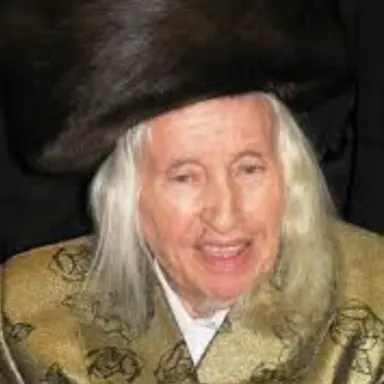
The Work and Torah Teaching of the Kaliver Rebbe, Rabbi Menachem Mendel Taub: Leadership, Commemoration and Torah Creativity in the Shadow of the Destruction
15 min read3,088 words
Summary
The text surveys the life and multifaceted work of the Kaliver Rebbe, Rabbi Menachem Mendel Taub, focusing on the process by which he turned from a Holocaust survivor into a spiritual leader who rebuilt the world of Hasidism. The survey stresses the physical and mental trauma he endured in Auschwitz, which gave birth to a religious vow to devote his life to commemorating the spiritual heroism of those who perished and to proclaiming the call "Shema Yisrael." By presenting his extensive Torah output in the "Kol Menachem" series and groundbreaking social initiatives such as the "Bar Bei Rav de-Chad Yoma" enterprise, the work illustrates how the Rebbe combined deep halakhic scholarship with a public mission of drawing hearts closer and of national unity. Ultimately, the source portrays him as a symbol of the victory of the spirit over destruction, who left behind a legacy of active faith and living memory for future generations.
The Roots of the Kaliv Dynasty and the Emergence of Leadership in Transylvania
Kaliv Hasidism, one of the fascinating strands of the Jewry of Hungary and Transylvania, grew out of the wondrous figure of Rabbi Yitzchak Isaac of Kaliv, the founder of the dynasty. Rabbi Menachem Mendel Taub, who was born on 20 Shevat 5683 (1923) in the town of Margita in Transylvania, was the sixth generation from the founder of the dynasty, and carried with him the complex legacy of a Hasidism that combined emotional popular appeal with deep scholarship.[1, 2] His father, the holy Rabbi Yehuda Yechiel of Rozla, author of "Amal Yehuda," was a direct descendant of the holy Rabbi Yitzchak Isaac of Kaliv, and his figure deeply influenced the spiritual formation of his young son.[2]
The spiritual environment in which Rabbi Menachem Mendel grew up was steeped in kabbalistic and Hasidic traditions. At his circumcision the sandak was his grandfather, the holy gaon and kabbalist Rabbi Pinchas Chaim of Rozla, a figure who was a central axis of the Hasidic world of the time.[2] Despite his lofty lineage, Rabbi Menachem Mendel's early life was not free of suffering; in 5697 (1937), when he was a young boy of only 14, he was orphaned of his father and his mother, which forced him to develop exceptional mental resilience and to take shelter in the shadow of his teachers and relatives in the house of Rozla.[2, 3]
In the yeshivot in which he studied in Transylvania, Rabbi Menachem Mendel was known as one of the finest students, as one who had acquired "the full measure of Torah and wisdom."[2] His Torah education was not limited to classical yeshiva pilpul alone, but also included a deep understanding of the ways of Hasidism and of the esoteric teaching, as he had received them from his forefathers. This period of spiritual growth was cut off at once with the Nazi invasion of Hungary in 1944.
The Inferno of Auschwitz: The Shaping of the "Remnant of the Furnaces"
The Holocaust was the watershed in the life of the Kaliver Rebbe. After the occupation of Hungary by the Germans, Menachem Mendel was sent together with his six brothers and sisters to the Auschwitz extermination camp.[1, 2] His personal trauma was twofold: the total loss of his entire immediate family, all of whom perished in the camp, and personal exposure to horrifying tortures.[1, 4]
During his time in Auschwitz, Rabbi Menachem Mendel fell into the hands of Dr. Josef Mengele, may his name be blotted out, and severe and bitter chemical experiments were carried out on his body.[2, 5] These experiments left permanent physical traces on him: they prevented his beard from growing and left him with the appearance of a smooth face, which in later years became his visual hallmark and living testimony to his suffering.[1, 3] In addition, the experiments severely damaged his health and deprived him of the possibility of having children.[3]
In the utter darkness of Auschwitz, the famous vow that would guide his entire adult life was born. While standing in line for the gas chambers, or during one of the most severe tortures, Rabbi Menachem Mendel turned to the Creator of the world in a silent prayer: he promised that if he merited to come out of this inferno alive, he would devote the rest of his life to proclaiming "Shema Yisrael" in the world and to preserving the memory of the holy martyrs.[2] This faith, which grew out of utter despair, became the engine of an unprecedented life's work in rebuilding the world of Torah and commemorating the Holocaust.
Personal and Public Rehabilitation: From Sweden to the United States
After his liberation from the Bergen-Belsen camp, the Rebbe's journey of rehabilitation began. He moved to Sweden, where another personal miracle occurred: he was reunited with his first wife, Rebbetzin Chana Sara Shifra Shapira, who had also survived the inferno.[2, 5] The couple stayed in Sweden for about six months, a period in which the Rebbe began to gather other survivors around him and to serve them as an initial spiritual support.[5]
In 1947 the couple emigrated to the United States and settled in Cleveland, Ohio.[5] In Cleveland the Rebbe began working to rebuild Kaliv Hasidism and to establish Torah institutions for the survivors who arrived in America. Despite the relative comfort in the United States, the Rebbe's heart was given to the Land of Israel, and he saw the building of the Land as the final answer to the destruction of Europe.
The period in the United States was a period of preparation. The Rebbe began to formulate his Torah teaching, which combined pure halakha with moral guidance focused on rebuilding faith. He understood that the survivors needed not only food and a home, but a religious meaning that would explain their survival and give them strength to go on.
Immigration to Israel and the Founding of "Kiryat Kaliv"
In 1962 the Kaliver Rebbe immigrated to Israel, a step that marked the beginning of a period of significant flowering in his public work.[5] His vision was to establish a Hasidic center that would be a focus of drawing hearts closer and of commemoration. In 1963 he founded "Kiryat Kaliv" in Rishon LeZion.[2] The choice of Rishon LeZion, a city that did not have a distinctly Haredi character at that time, expressed the Rebbe's revolutionary conception: not to shut himself up in the existing Haredi neighborhoods, but to go out to the people and spread the light of Torah in places where it was lacking.
After three years of establishing himself, he moved to live in the neighborhood he had founded.[2] In 1980, out of a wish to be closer to the Haredi Torah centers, he moved to Bnei Brak.[2] There he established the center of Kaliv Hasidism on Chaggai Street, and later moved to a larger building on Aharonovitch Street.[2] The last and most significant move was in 5762 (2002), when he inaugurated a splendid beit midrash in Jerusalem, in Shikun Chabad, where he made his home until his death.[2]
Jerusalem became for him a symbol of spiritual victory. From his home in Jerusalem he directed an extensive network of institutions and organizations, receiving every day petitioners from every stratum of the people – religious, secular, politicians and ordinary folk – all of whom found an attentive ear with the "beardless Rebbe," who radiated warmth and infinite love.
His Torah Teaching: The "Kol Menachem" Enterprise
The Kaliver Rebbe was an extremely prolific author in the field of Torah literature. His work, gathered under the name "Kol Menachem," encompasses all parts of the Torah and is characterized by clarity, erudition and a practical inclination toward moral guidance.
Responsa and Explanations on the Shulchan Arukh
The Rebbe composed an extensive series of questions and answers (responsa), "Kol Menachem," encompassing the four parts of the Shulchan Arukh.[6] His work on Choshen Mishpat (monetary law) is considered especially unique in the Hasidic world, since it deals with intricate legal topics with enormous erudition. The book "Kol Menachem" on Choshen Mishpat contains about five hundred topics and explanations, combining halakhic ruling with conceptual illumination.[7]
Commentary on the Bible and on Psalms
His work on the Five Books of the Torah, "Kol Menachem," is not merely a textual commentary but a tapestry of ideas seeking to strengthen faith and the service of God.[6, 8] Similarly, "Tehillim Kol Menachem" became one of his most popular works, owing to his ability to connect the words of King David with the existential experiences of the modern believer.[6]
His books "Simcha la-Nefesh" (two volumes) deal with the foundations of ethics and Hasidism, and stress the importance of joy as a means of serving the Creator, even in situations of hardship and destruction.[6] His Torah teaching sees Torah study not merely as an accumulation of knowledge, but as a process of refining the soul and building the personality.
"The Physician's Prayer" and Unique Works
The Rebbe's Torah innovativeness also found expression in works intended for specific audiences. "Tefillat ha-Rofe" (The Physician's Prayer), which he composed, was intended for professionals in the field of medicine, and asks the Creator to guide their hands and to grant them the humility required in caring for human life.[2] This prayer is used by many physicians, and it expresses the Rebbe's esteem for the world of medicine as an arm of divine providence.
The Enterprise of Commemoration: "Shema Yisrael" as a Command of Life
The Kaliver Rebbe is considered one of the greatest commemorators of the Holocaust in our generation.[2] His conception of commemoration was unique: he was not content with a memory of death, but sought to commemorate the "spiritual heroism" of the holy martyrs.
The "Shema Yisrael" Encyclopedia
The Rebbe's central project in this field is the "Shema Yisrael" encyclopedia, which includes hundreds of stories of Jewish self-sacrifice during the Holocaust.[2] The aim of the encyclopedia is to show how Jews preserved their identity, put on tefillin, kept the commandments and baked matzot even within the hell of the camps. The Rebbe believed that these stories are the true legacy of the Jewish people, and that they are what should serve as inspiration for future generations.
The great Torah leaders of all circles greatly valued this enterprise. It is told of the tzaddik Rabbi Eliezer Berland (Moharash) of Breslov that he asked his disciples to acquire for him all the Rebbe's books, and especially the encyclopedia commemorating the self-sacrifice in the Holocaust, and that he greatly rejoiced in them.[2]
The Initiative for a Haredi Holocaust Museum
In his last years, the Rebbe invested enormous efforts in promoting the establishment of a Holocaust museum intended for the Haredi public.[2] He felt that the existing museums, such as "Yad Vashem," did not give sufficient expression to the spiritual world that was destroyed and to the faith-based ways in which those who perished coped.[9] His vision was to establish a place that would be a "complementary museum," stressing the continuity of the Torah and the power of faith against Nazi evil.
The ritual most identified with the Rebbe was the mass recitation of "Shema Yisrael" at the conclusion of every public event or prayer. He used to ask the audience to close their eyes and cry out the verse together, in memory of those who were killed in sanctification of God's name. Thus he turned his personal vow from Auschwitz into a public act of national and religious remembrance.
Social Innovation: "Bar Bei Rav de-Chad Yoma" and Further Initiatives
The Kaliver Rebbe worked tirelessly to draw those far away closer and to strengthen Torah study among the general public in Israel.
The "Bar Bei Rav de-Chad Yoma" Enterprise
One of his most influential initiatives is the "Bar Bei Rav de-Chad Yoma" enterprise.[2, 10, 11] The name is taken from the Babylonian Talmud, Tractate Chagigah (folio 5), where the concept "bar bei rav de-chad yoma" ("a one-day student of the study house") is described as an expression for a person who studies for one day and is recognized as though he had studied for a whole year.[10] The Rebbe adopted the concept and turned it into a concentrated program of study for vacation days and festivals, intended for working people and for those who do not study Torah day to day.
The project included thousands of Torah lessons delivered at various venues throughout the country, with refreshments and hospitality served, in order to make the study pleasant for the participants. This enterprise was one of the forerunners of the modern "kiruv" (outreach) movement, and it expressed the Rebbe's belief that every Jew, in every situation, can and should connect with his Torah roots.[11]
The World Day of Speech Fasting
Another innovation of the Rebbe was the establishment of the "World Day of Fasting from Speech."[2] He called on the public to devote one day a year to refraining from idle talk and to engaging in Torah and prayer. This initiative was intended to raise awareness of the power of speech and of the importance of guarding one's tongue, from the view that speech is what represents man's superiority over the beast and that it should be used for holiness alone.
Ties with the Great Torah Leaders and Political-Social Influence
The Kaliver Rebbe was a bridging figure in the rabbinic world. Although he belonged to the Hasidic tradition of Hungary, he developed deep friendships with rabbis of all circles and communities.[8]
He had an exceptional bond with Maran Rabbi Ovadia Yosef, of blessed memory.[2, 3] The two cooperated on matters of drawing those far away closer and strengthening the Sephardi world of Torah, and Rabbi Ovadia greatly valued the Rebbe's devotion to commemorating the Holocaust and to educating the youth. The Rebbe was a regular presence at major Torah events, and his presence radiated supreme moral authority.
The leaders of the state, too, saw him as a national symbol. Prime ministers and presidents came up to his home to receive his blessing and to hear his words on the Holocaust and on unity among the people.[6] He was perceived as one who stood above narrow political disputes, as a figure representing the eternity of the Jewish people.
The Legacy of the Kaliv Melody
Music and melody occupied a central place in the Rebbe's service of God, continuing the tradition of his forefather Rabbi Yitzchak Isaac of Kaliv.
The Melody "Szól a kakas már"
The famous melody "Szól a kakas már" ("The rooster is already crowing") in Hungarian became identified with the Rebbe more than anything else.[12] The melody, which combines Hungarian words about longing for redemption ("When will the Temple already be built?"), was performed by the Rebbe with great emotion on every occasion. He saw this melody as a means of awakening the hearts of the survivors and instilling in them hope for the future redemption.
The Rebbe used to accompany his prayers with melody and song, and believed that a niggun (melody) can reach places that words cannot reach. This musical legacy continues to be an inseparable part of the Kaliv court today.
His Personal Life and His Death
After the death of his first wife, Rebbetzin Chana Sara Shifra, the Rebbe remarried in 5772 (2012), at the age of 89, to Sheindel Melnik of Vinnytsia.[2] This step, taken at a very advanced age, attested to his vitality and to his wish to continue to keep a Jewish home full of joy and activity until his last day. His stepdaughter, Batya Mania, married the Zlotchover Rebbe.[2]
In April 2019, after he fell in his home and his condition deteriorated, the Rebbe died on 23 Nisan 5779, at the age of 96.[2, 6, 8] His death marked the end of an era – the passing of the last of the Rebbes who survived Auschwitz and re-established Hasidic courts in Israel.
Thousands attended his funeral, among them great Torah scholars and public figures from across the whole Israeli spectrum. During the funeral his successor was announced: his step-grandson, Rabbi Yisrael Mordechai Yoel Horowitz, son-in-law of Rabbi Refael Rosenberg.[2, 6, 13] Rabbi Yisrael Mordechai, despite his young age (28 at the time of the appointment), is considered a prominent Torah scholar who served as head of a kollel in the Hasidic community and enjoyed the full trust of the late Rebbe.[13]
The Long-Term Influence of the Kaliv Teaching
The legacy of the Kaliver Rebbe extends beyond the borders of the small Hasidic community he led. It constitutes a model for theological and social coping with the crisis of the Holocaust.
- In the realm of faith: he taught how one can grow out of ashes, not by denying the pain but by channeling it into positive action and meaningful commemoration.
- In the realm of Torah: his "Kol Menachem" books continue to be studied in yeshivot and study halls, offering a rare combination of halakhic erudition and practical Hasidic guidance.[6, 7]
- In the social realm: the "Bar Bei Rav" enterprise laid the foundations for many initiatives of Torah study for the masses, and showed that gaps in Israeli society can be bridged through love of one's fellow Jew and shared Torah study.[11]
The Kaliver Rebbe will be remembered in Jewish history as one who cried out "Shema Yisrael" within the flames, and devoted every breath afterwards to ensuring that this call would never be silenced. His beardless figure will remain a symbol of the strength of the human spirit, capable of defeating absolute evil and turning it into a wellspring of light and kindness.
Sources13
- 1.האדמו"ר מקאליב - remember.bio, remember.bio/he/remember_pages/האדמור-מקאליב/
- 2.האדמו"ר מקאליב - ברסלב סיטי, breslevcity.co.il/הילולת-הצדיקים-רבי-מנחם-מנדל-טאוב/
- 3.ערב יום הזיכרון: "אדמו"ר השואה" נפטר בגיל 96 - ynet, ynet.co.il/articles/0,7340,L-5500620,00.html
- 4.אדמו"ר השואה הלך לעולמו - ynet, ynet.co.il/articles/0,7340,L-5500881,00.html
- 5.האדמו''ר מקאליב זצוק''ל בטיש האחרון לחייו - YouTube, youtube.com/watch?v=2BphioE-YHY
- 6.מנחם מנדל טאוב - ויקיפדיה, he.wikipedia.org/wiki/מנחם_מנדל_טאוב
- 7.ספר | טאוב, מנחם מנדל, מקליב, 1923-2019 מחבר (אשר, יוחאי (עורך)) - הספרייה הלאומית, nli.org.il/he/books/NNL_ALEPH990039263760205171/NLI
- 8.הרבי מקאליב זצ"ל | 'האדמו"ר מאושוויץ', ומי אותו סולו קוקוש שמעורר את הגאולה | כיכר השבת, kikar.co.il/actualy/sv22ma
- 9.The Yad Vashem Holocaust History Museum, yadvashem.org/museum/holocaust-history-museum.html
- 10.בר בי רב דחד יומא - ויקיפדיה, he.wikipedia.org/wiki/בר_בי_רב_דחד_יומא
- 11.מוסדות קאליב אור ירושלים - חנה 23, ירושלים - מוסדות דת - איזי, easy.co.il/page/25778747
- 12.Sol A Kokosh: The Kaliver Rebbe | סול א קאקאש מאר הרבי מקאלב - YouTube, youtube.com/watch?v=eKD9x1P0JLM
- 13.הרבי הצעיר שהוכתר ל'ממשיך' של קאליב - בחדרי חרדים, bhol.co.il/news/995055