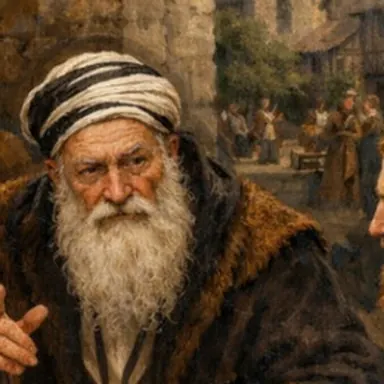
Rabbi Meir ben Shmuel of Ramerupt
12 min read2,302 words
Summary
The article surveys the figure and revolutionary contribution of Rabbi Meir ben Shmuel of Ramerupt, who was called the "Father of the Rabbis" and served as the link between the tradition of the early sages of Ashkenaz and the flourishing of the Tosafist movement in France. The text emphasizes the paradigmatic change he led, in the transition from local, plain-sense commentary to a dialectical and cross-cutting analysis of the Talmud, turning his study hall into an intellectual laboratory that raised up the great men of the generation, among them his sons the Rashbam and Rabbenu Tam. Alongside the development of the methodology of study, the source highlights Rabbi Meir's halakhic courage, as expressed in the emendation of the text of "Kol Nidrei" and in the shaping of liturgical customs that exert influence to this day. In sum, the work presents Ramerupt as a new worldwide Torah center, in which the unification of the Shas took shape as an organic method based on textual criticism and the pursuit of legal coherence.
The Work and Torah Teaching of Rabbi Meir ben Shmuel of Ramerupt: Father of the Tosafot and Founder of North French Dialectics
The intellectual history of medieval European Jewry reaches one of its most decisive turning points in the second half of the 11th century and the first half of the 12th century. At the center of this paradigmatic change stands the figure of Rabbi Meir ben Shmuel of Ramerupt, known by the epithet "Father of the Rabbis."[1] Rabbi Meir, who lived between 1060 and 1135 (4820–4895), was active in the interval between the period of the "Geonim of Lotir" (Lotharingia) and the meteoric flourishing of the Tosafists, and was the central figure who bridged between local, traditional commentary and the dialectical, cross-cutting analysis that has been the hallmark of Jewish scholarship ever since.[2, 3]
The Biographical Foundation and the Rise of the Ramerupt Center
Rabbi Meir ben Shmuel did not arise in a vacuum; he was a product of the oldest and most glorious Torah centers in Ashkenaz and France. In his youth he studied in the study hall of the "Geonim of Lotir" in Magenza (Mainz) and Vermaiza (Worms), where he absorbed the tradition of study of the disciples of Rabbenu Gershom, Light of the Exile.[1] His principal teacher in that period was Rabbi Yitzchak HaLevi, a key figure who also placed Rashi himself within the Ashkenazic chain of transmission.[1] This influence of the Geonim of Lotir is clearly evident in Rabbi Meir's inclination toward linguistic precision and the preservation of ancient customs, but at the same time it prepared the ground for his ability to examine the sources with a critical and analytical eye.
After his years of study in Ashkenaz, Rabbi Meir moved to France and became the distinguished disciple of Rashi in Troyes. The bond between the two went beyond the formal framework of study when Rashi married his second daughter, Yocheved, to him.[1] This marriage was not only a family union but an intellectual merger between the conservative Ashkenazic tradition and the new French interpretive creativity. Rabbi Meir established his seat in the town of Ramerupt (also called Romerug), and there he founded a study hall that became a magnet for students and the power center of his family.[1]
His standing as the "Father of the Rabbis" derives first and foremost from his being the father of the four great men of the generation: Rabbenu Shmuel (Rashbam), Rabbenu Yaakov (Rabbenu Tam), Rabbi Yitzchak (Ribam) and Rabbi Shlomo.[1] Each of his sons continued a different facet of his teaching, but what they all had in common was a deep bond to the study hall in Ramerupt as an intellectual laboratory in which the rules of Tosafist discussion were first formulated. Beyond his sons, his daughter married Rabbi Shmuel of Vitry, and their son was Ri the Elder, the great continuator of the method of Rabbenu Tam, which magnifies Rabbi Meir's role as the genetic and spiritual junction of the entire Tosafist movement.[1]
The Methodological Revolution: The Birth of the Tosafist Method
The most essential contribution of Rabbi Meir ben Shmuel to the Torah world is his development of the study methodology known as "Tosafot."[1] Whereas Rashi, his father-in-law, wrote a comprehensive, local commentary whose purpose was to explain the Talmudic text step by step, Rabbi Meir began to instill an approach of cross-cutting examination.[4] In his study hall in Ramerupt there developed the conception that the Shas is a single organic unit, and that a passage in one tractate cannot stand in an unresolved contradiction to a passage in another tractate.[3]
The constitutive foundation of this method of study is the "debate" (vikuach), the active dialectic in which the learner is not merely passive but raises questions and answers.[5] Rabbi Meir wrote commentaries on the Talmud in which a distinct inclination toward questions and answers is evident, far beyond what was customary in Rashi's commentaries.[1] This change is not merely technical; it represents a transition from commentary (Commentary) to analysis (Analysis). The teaching of Rabbi Meir, as it is cited by his sons and in the Tosafot that we have, is characterized by a pursuit of legal and conceptual coherence.[1, 4]
The learning environment in Ramerupt was described as one in which Torah study begins almost from the moment of birth.[5] Rabbi Meir turned the new method from a path intended only for the select few into a widespread method that became the exclusive form of study throughout France.[5] The ability to take the sacred, canonical text and confront it with itself in order to reach a deeper understanding was the engine that drove his sons, and above all Rabbenu Tam, to become the greatest respondents and disputants in the history of halakha.[3]
His Liturgical and Halakhic Work: The Emendation of "Kol Nidrei" and Household Practices
One of the most fascinating aspects of Rabbi Meir's personality is his halakhic courage. He did not hesitate to propose significant changes in ancient customs and prayer texts when he found that they did not accord with pure halakhic principles.[1] The most famous example of this is his proposal to emend the text of the "Kol Nidrei" prayer.[1]
For generations, the text of "Kol Nidrei" referred to vows that had been absent in the past year. Rabbi Meir identified in this a halakhic difficulty, since a person cannot annul vows retroactively without a proper legal procedure of "opening" (petach) and "regret" (charata) before a beit din. He therefore proposed to change the text so that it would refer to the future: "From this Yom Kippur until the next Yom Kippur."[1] This proposal, which was supported and elaborated later by his son Rabbenu Tam in Sefer HaYashar, was accepted in most of the communities of Ashkenaz and France, and it constitutes the basis for the text we recite today at the opening of Yom Kippur.[1] This is a clear expression of a conception in which halakhic truth overrides the force of accepted popular custom.
Beyond the liturgical emendation, Rabbi Meir's influence is evident in a series of rulings and practices preserved in sources such as "Machzor Vitry" and "Sefer HaYashar."[1, 6] These practices provide a glimpse into everyday life in the study hall and in the private home in Ramerupt, and show how dialectical halakha was translated into practice:
These rulings attest to a combination of customary stringency (as in the case of gentile milk) together with a categorial analysis of concepts (as in the laws of tzitzit). Rabbi Meir saw no contradiction between the two; the stringency was intended to preserve the community's boundaries, while the conceptual analysis was intended to ensure that the commandment would be fulfilled according to its most precise Torah definitions.
His Literary Creation: Between the Revealed and the Hidden
Identifying the precise works of Rabbi Meir ben Shmuel is a challenge for researchers, since most of his teaching became absorbed within the works of his sons and disciples.[5] Nevertheless, several textual anchors exist that make it possible to establish the scope of his writing:
- Early Tosafot: Rabbi Meir wrote commentaries on the Talmud that were already called "Tosafot" in his own time.[1] In the Tosafot that we have his name is mentioned in many places, at times in direct quotation of his commentary on a passage.[1]
- Commentary on tractate Menachot: a significant fragment of Rabbi Meir's commentary (written in collaboration with his son the Rashbam) was printed by mistake within Rashi's commentary on tractate Menachot, on folio 13, side a.[1] This fragment constitutes a rare example of his original style of writing, which combines the clarity of Rashi with the inquiry of the Tosafists.
- The commentary on tractate Nazir: there is an important scholarly hypothesis, attributed to Prof. Y. N. Epstein, that the commentary on tractate Nazir that appears in the Vilna Shas (and is sometimes attributed to Rashi or to the Riban) is in fact the product of the pen of Rabbi Meir ben Shmuel.[1] Although there are those who dispute this identification, such as E. E. Urbach, the very attribution attests to its high level and its distinctive style that links the generations.[1]
Beyond these works, Rabbi Meir engaged in writing piyyutim and selichot, as part of the tradition of the sages of Ashkenaz and France of combining halakha with religious poetry.[1, 7] The piyyutim he composed reflected his spiritual world and the supplication of a generation that experienced the horrors of the Crusades, although the definitive identification of these piyyutim within the collections of liturgy requires further research because of the frequency of the name "Meir" among the paytanim.[1]
The Influence of the Home in Ramerupt on the Crystallization of "Peshat" and "Derash"
Rabbi Meir ben Shmuel served as a counterbalance within a family of intellectual giants. His eldest son, the Rashbam, developed the peshat method to its furthest edge, being at times willing to interpret Scripture contrary to accepted halakha (out of an understanding that peshat and derash are two parallel tracks).[2] By contrast, his second son, Rabbenu Tam, was expert in the complex halakhic dialectic. It was Rabbi Meir who instilled in both of them the foundations of textual criticism.[2]
The Rashbam's inclination toward extreme "peshat" would not have been possible without the protected Torah environment that his father created in Ramerupt. Rabbi Meir gave his sons the self-confidence to challenge interpretive conventions out of deep loyalty to the text.[2] The partnership between him and the Rashbam in writing the commentary on tractate Menachot is testimony that the father regarded his son as an equal partner in the creation, and not merely a student who sets aside his own opinion before his teacher.[1]
This relationship created a model of a "community of scholars" in which the Torah develops through conceptual confrontations among members of the family. When Rabbenu Tam cites his father in Sefer HaYashar, he does so with the reverence reserved for the one who laid the foundations for his entire spiritual edifice.[1, 8] Rabbi Meir was called "the Elder" (HaYashish) by his contemporaries, a title that expresses the authority of the elder of the tribe whose words are heard as a direct echo of the tradition of Rashi, but with a face turned forward to the new generation.[1]
The Historical Legacy of the "Father of the Rabbis"
The figure of Rabbi Meir ben Shmuel of Ramerupt is a rare example of a man whose influence is measured not by the quantity of books he wrote, but by the quality of the disciples and the method that he established. He was the silent engine behind the greatest revolution in the history of Talmudic study since the closing of the Gemara.[9]
Under his leadership, French Jewry was transformed from the periphery of the Torah world (which until then had been concentrated in Babylonia and Germany) into its undisputed center.[3] The study hall in Ramerupt set a new standard of sharpness, breadth of scope and halakhic courage. The ability to unify all parts of the Shas into a single system, as Rabbi Meir began to do in his early "Tosafot," is what enabled the survival of halakha as a living and developing entity in a world of difficult political and religious upheavals.[4, 9]
Rabbi Meir passed away at a good old age in 4895 (1135), the same year in which Maimonides (Rambam) was born in Spain (according to some opinions), and thereby symbolized the passing of the torch of worldwide Torah leadership.[1] His legacy continues to live in every "Tosafot" printed on the page of the Gemara, and in every study hall that sanctifies the "debate" and the dialectical discussion as the royal road to the attainment of truth.
In sum, Rabbi Meir ben Shmuel of Ramerupt was not merely "Rashi's son-in-law" or "the father of Rabbenu Tam," but a key figure in his own right: a thinker, decisor and educator who shaped the character of rabbinic Judaism for generations.[1] The depth of his teaching, which combines the tradition of the Geonim of Lotir with the creativity of French Jewry, remains a foundation for every student of Torah to this day. His courage in emending prayer texts, his sharpness in writing the first Tosafot, and his ability to raise a generation of spiritual giants make him one of the most influential and fascinating figures in the history of our people.
Sources9
- 1.מאיר בן שמואל - ויקיפדיה, he.wikipedia.org/wiki/מאיר_בן_שמואל
- 2.Spiritual and Intellectual History (Part III) - The Cambridge History of Judaism, cambridge.org/core/books/cambridge-history-of-judaism/spiritual-and-intellectual-history/1CBD796EF3BCA4D9335FD7A947DDF4C2
- 3.Talmudic Studies (Chapter 22) - The Cambridge History of Judaism, cambridge.org/core/books/cambridge-history-of-judaism/talmudic-studies/3553FEB85B46AE01A01321F1F5C3E364
- 4.תוספות - ויקיפדיה, he.wikipedia.org/wiki/תוספות
- 5.היצירה התוספותית - BeitChabad.com - בית חבד, he.chabad.org/library/article_cdo/aid/3206280/jewish/-.htm
- 6.מחזור ויטרי חלק א, beureihatefila.com/files/Machzor_Vitri_1.pdf
- 7.שירים לכבוד רבי מאיר בעל הנס - YouTube, youtube.com/watch?v=JvCE4gBtBDQ
- 8.Rabbenu Tam - Wikipedia, it.wikipedia.org/wiki/Rabbenu_Tam
- 9.Reconstructing Ashkenaz: The Human Face of Franco-German Jewry, 1000-1250 0804759502, 9780804759502 - DOKUMEN.PUB, dokumen.pub/reconstructing-ashkenaz-the-human-face-of-franco-german-jewry-1000-1250-0804759502-9780804759502.html