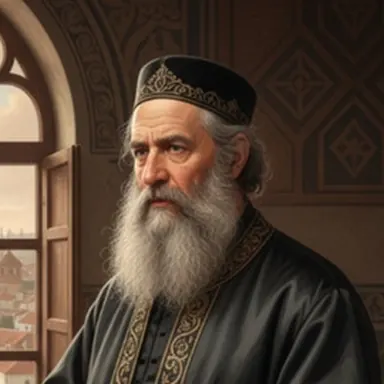
The Work, Torah Teaching and Exegetical Method of Rabbi Yosef Chayun
14 min read2,883 words
Summary
This source surveys the life and Torah contribution of Rabbi Yosef Chayun, who was the foremost spiritual leader of Lisbon Jewry in the late 15th century and a disciple of Rabbi Yitzchak Canpanton. The text highlights his distinctive exegetical method, which rejects the rule of "repetition of the same matter in different words" and advocates absolute semantic and structural precision in reading the verses of Scripture. In addition, the article describes his decisive influence on the great sages of the generation of the expulsion, such as Don Isaac Abravanel and he-Chasid Yaavetz, who studied in his beit midrash and adopted his analytical approach. Finally, it details Chayun's broad body of writings, which has recently enjoyed a renewed scholarly revival, including in-depth commentaries on the books of the Prophets, Psalms and tractate Avot.
Rabbi Yosef ben Rabbi Avraham ha-Nasi Chayun (known by the acronym "Riach") was one of the great sages of Portugal, the spiritual leader of the Lisbon community and the foremost shaper of biblical exegesis in the Iberian Peninsula in the generation preceding the expulsion [cite: 1, 2, 3]. Within the Jewry of Portugal at the close of the Middle Ages, which was a vibrant center of Torah and thought and a bridge to the generation of the expulsion (1497), Rabbi Yosef Chayun was a key spiritual and public figure [cite: 2, 4]. His figure combines forceful communal leadership, wide-ranging exegetical and intellectual creativity, and the raising of disciples who were among the great sages of Spain and Portugal [cite: 1, 2]. His Torah teaching is characterized by precise textual and verbal analysis, applying the analytical method of study of the beit midrash of his teacher, Rabbi Yitzchak Canpanton [cite: 1, 4]. In recent decades his writings have attracted renewed scholarly and Torah interest, following the deciphering and publication of rare manuscripts attributed to him and to his beit midrash [cite: 3, 5, 6, 7].
His Life, Communal Setting and Chain of Legacy
Rabbi Yosef Chayun was born in Lisbon to a wealthy family of honored standing in the community, apparently between the years 5170–5175 (c. 1410–1415) [cite: 1, 4]. Although in his youth he was destined for an extensive commercial career, and he continued to engage in trade on a limited scale throughout his life, he chose to devote most of his time and energy to diligent study of the Torah and to running the institutions of the community [cite: 1, 4]. In the historical sources Chayun is described as a sage "lame in the legs," a fact that points to a physical disability that accompanied him but did not prevent him from becoming the central figure in the spiritual life of Portugal [cite: 1]. He received his Torah from his principal teacher, the kabbalist Rabbi Yitzchak Canpanton, author of the book Darkhei ha-Talmud ("The Ways of the Talmud") and head of the yeshivas of Castile, who imprinted on him a precise analytical method of study [cite: 1, 4]. As the historian Rabbi Eliyahu Capsali describes, Chayun was counted among the four senior disciples of R. Yitzchak Canpanton, alongside Rabbi Yitzchak Aboab, Rabbi Yitzchak de Leon and Rabbi Shimon Mimi, who spread the Torah of Spain and Portugal throughout the whole world [cite: 1].
A central datable event in his life took place in 1466 (5226), when a severe plague struck Lisbon and he was therefore forced to move his residence temporarily to the city of Évora [cite: 1, 4]. The question of the place and date of his death remains the subject of a complex controversy in historical scholarship, reflecting the upheavals of the period of the expulsion [cite: 1].
| The scholar / the source | His position on the time and place of Rabbi Yosef Chayun's death |
|---|---|
| Rabbi Eliyahu Capsali | Left Portugal and died before the expulsion [cite: 1]. |
| Prof. Joseph Hacker | Died in Portugal around 1490 (before the expulsion from Spain) [cite: 1]. |
| Prof. Meir Benayahu | Emigrated to Constantinople (Turkey) and died there in 1496 [cite: 1, 4]. |
| Prof. H. H. Ben-Sasson | Was among the first of the exiles and left Portugal at the time of the expulsion [cite: 1]. |
| Prof. Isaiah Tishby | Died in 1500 at the earliest [cite: 1, 8]. |
Rabbi Yosef Chayun's spiritual and family continuity was carried on through his descendants, who held central positions of leadership [cite: 1, 4]. His son, Rabbi Moshe Chayun, was appointed to succeed him as rabbi and head of the rabbinic court in Lisbon and served as the last rabbi of the community until the decree of forced conversion and expulsion in 1497 [cite: 1, 4]. His daughter married Rabbi Moshe Albotini, and from this union was born a renowned kabbalist and head of a yeshiva in the Land of Israel, Rabbi Yehuda ben Moshe Albotini, author of the halakhic-kabbalistic work Yesod Mishneh Torah [cite: 1, 4]. Likewise, his great-great-grandson, Rabbi Avraham Chayun, was the one who first brought to print, in Venice, his forebear's work on tractate Avot [cite: 1].
His Circle of Disciples and His Influence on the Sages of the Generation of the Expulsion
As head of the yeshiva and leader of the Lisbon community, Rabbi Yosef Chayun raised a unique generation of sages and thinkers who shaped the world of Torah and Jewish thought in the period of transition from the expulsion from Spain and Portugal to the centers of the diaspora [cite: 1, 2, 3]. Among his prominent disciples was Don Isaac Abravanel, who studied with him in his youth in Lisbon [cite: 2, 3, 4, 9]. The relationship between them went beyond the bounds of ordinary teaching and was marked by deep correspondence on fundamental questions of biblical exegesis and faith, and Chayun's methodological influence is clearly evident in the division of chapters into prophecies and in the structural questions characteristic of Abravanel's commentaries on Scripture [cite: 1, 4].
Another principal disciple was Rabbi Yosef Yaavetz, known as "he-Chasid Yaavetz" (the Pious Yaavetz), one of the great thinkers of the generation of the expulsion [cite: 1, 5]. In his book Or ha-Chayim ("The Light of Life"), Yaavetz commits to writing an extraordinary admiration for his teacher, writing that Chayun served as their head and "sat in the seat of wisdom" (Tachkemoni), and was as full of Torah as one of the Amoraim [cite: 1, 5]. Alongside them there grew up in his beit midrash Rabbi David ben Shlomo ibn Yahya, author of the works Kav ve-Naki and Kehillot Moshe and one of the scholars of the Hebrew language in Portugal [cite: 1, 4, 5], as well as Rabbi Avraham Chayun ben Nissim, author of the moral and speculative works Imrot Tehorot ("Pure Sayings") and Ma'amar be-Moftim ("Treatise on Proofs"), who emigrated to Constantinople following the decrees of 1496 [cite: 1, 4, 8].
The Exegetical Methodology and Fundamental Principles of Biblical Interpretation
The exegetical teaching of Rabbi Yosef Chayun represents a planned, systematic and comprehensive method that examines the text of Scripture simultaneously through grammatical, literary and conceptual lenses [cite: 1, 3]. Unlike exegetes who concentrated on the local explanation of difficult words, Chayun approached each biblical book from an overall conception [cite: 1, 3, 10]. A fundamental principle of his method is to open each book with an extensive introduction, in which he sets out eight to ten general matters defining the subjects of the book, its conceptual structure and its prophetic aims [cite: 1]. In the actual exposition he took care to copy the verse in full and to explain all its linguistic components, while clearly delimiting in advance each prophetic unit on its own [cite: 1].
Chayun's most original exegetical contribution is expressed in his reserved attitude toward the poetic-exegetical rule of "repetition of the same matter in different words," which was prevalent in the commentaries of Ibn Ezra and Radak [cite: 1, 11, 12]. According to Chayun, Scripture does not use linguistic doublets merely for rhetorical embellishment, and every change of expression or parallel clause has a distinct semantic and conceptual function [cite: 1, 12]. The studies of Dr. Yochanan Kafih have shown that Chayun did not reject the rule entirely but limited its application: in cases where the verse repeats itself from beginning to end in a complete parallel structure, a repetition of the matter is possible, but where only part of the verse is doubled, the exegete is obliged to define the distinctiveness of each word and condition [cite: 1, 12].
| The verse explained | Radak's commentary (relying on repetition of the matter) | Rabbi Yosef Chayun's commentary (semantic and structural distinction) |
|---|---|---|
| Psalms 17:1: "Hear, O LORD, what is just; attend to my cry (rinnati); give ear to my prayer (tefillati), from lips without deceit" | The whole verse is merely a repetition of the same matter in different words for the sake of rhetoric [cite: 1]. | Four different conditions for a complete prayer: 1. Tzedek (what is just): the truthfulness of the words, without falsehood. 2. Rinnati (my cry): prayer in joy of heart and not out of worry. 3. Tefillati (my prayer): submission and lowliness of the body (bowing and prostration). 4. From lips without deceit: the agreement of heart and tongue [cite: 1]. |
| Jeremiah 31:20: "Set up road markers (tziyunim) for yourself, make yourself guideposts (tamrurim)" | The command is doubled for poetic and prophetic force [cite: 12]. | A realistic distinction between two marking objects: 1. Tziyunim: ordinary signs along the roads [cite: 12]. 2. Tamrurim: especially high heaps of stones intended for navigation from afar out of exile [cite: 12]. |
A distinctive question in his theological-textual system concerns the status of the book of Deuteronomy and his famous correspondence with his disciple Don Isaac Abravanel [cite: 1, 4]. Abravanel was in doubt whether Deuteronomy was written from the mouth of the Almighty letter by letter like the other books of the Torah, or whether Moses our teacher said it in his own language and from his own understanding, in view of the repetitions of the commandments, the first-person formulation and the appearance of new commandments [cite: 1]. In response to these concerns Chayun composed the treatise Maggid Mishneh, in which a three-part division of the book is applied [cite: 1, 4]. According to Chayun, the explanations of the commandments and the rebukes were formulated by Moses from his own understanding and in his own pure language, whereas all the new commandments included in the book were spoken to him by God word for word [cite: 1]. This conception was partly accepted by Abravanel and was later cited in the commentaries of Spanish sages such as Rabbi Yitzchak Karo [cite: 1].
The Body of Writings and Discoveries in the Manuscripts
Rabbi Yosef Chayun's literary output was especially prolific and extensive, and from his Torah legacy more than 1,200 pages have survived in various manuscripts [cite: 1]. Nevertheless, most of his works remained in unique manuscripts for hundreds of years and did not reach the printing press until the modern era [cite: 5, 6]. In the 21st century, thanks to academic research and Torah publishing enterprises, scholarly and critical editions have appeared that bring to light the depth of his work [cite: 3, 5, 6, 7].
| Title of the work | Scope and exegetical content | Printing status and modern research |
|---|---|---|
| Mili de-Avot | An ethical-philosophical commentary on tractate Avot [cite: 1, 4, 13]. | Printed in Venice in 5360 (1600); published in a new edition in 5778 [cite: 1, 14]. |
| Maggid Mishneh | A treatise of responses to Abravanel on the structure and origin of Deuteronomy [cite: 1, 4]. | Published by Dr. Yochanan Kafih in 5777 [cite: 15, 16]. |
| Commentary on Ezekiel | A comprehensive commentary in two volumes, including architectural and cosmological analysis [cite: 3]. | Published from the Petersburg manuscript by Machon Ofek (5766) [cite: 3]. |
| Commentary on Jeremiah | A historical and grammatical analysis of the prophecies according to the qere [cite: 10, 17, 18]. | Critical edition from a manuscript in London by Dr. Yochanan Kafih (2022) [cite: 5, 6, 19]. |
| Commentary on Psalms | A structural, psychological and grammatical exposition of all 175 psalms [cite: 20]. | Published by Dr. Yochanan Kafih by Mossad Harav Kook (5776) [cite: 7, 20]. |
| Commentaries on the Prophets and Writings | Expositions of Isaiah, the Twelve Minor Prophets, Proverbs, the Five Scrolls and the haftarot [cite: 1, 4]. | Partly preserved in manuscripts in research libraries [cite: 1, 3]. |
His commentary on Ezekiel, published in two volumes by Machon Ofek from a manuscript preserved among the Oriental manuscripts in Petersburg, offers a deep and distinctive analysis of the vision of the Chariot and of the structure of the future Temple [cite: 3]. The work is accompanied by scientific-Torah appendices, such as an analysis of the theory of the spheres and the cosmology of the Chariot by Rabbi Shai Walter, and a comparative architectural exposition of the structure of the Temple and its courtyards by Rabbi Zalman Menachem Koren [cite: 3].
His commentary on Jeremiah, edited and published by Dr. Yochanan Kafih from a unique manuscript in the British Library in London, is apparently an autograph, the author's original manuscript, in which he carried out rounds of proofreading and numerous corrections [cite: 5, 6, 19]. The commentary is characterized by precise historical and grammatical distinctions and by a systematic analysis of the prophecies [cite: 10, 17, 18, 21]. Alongside these, his comprehensive commentary on Psalms, published by Mossad Harav Kook, analyzes the psalms from a structural, psychological and spiritual understanding of the one who prays [cite: 20]. Likewise, his work Mili de-Avot on tractate Avot was first printed in Venice in the year 5360 (1600) and was published in a new edition in 5778, presenting a consolidated ethical-educational conception [cite: 1, 14].
His Conceptual Outlook, His Attitude to Philosophy and His Ethical Thought
The theological positions of Rabbi Yosef Chayun reflect an intellectual complexity characteristic of the sages of Portugal on the eve of the expulsion [cite: 1, 2, 3]. Chayun showed a faint and qualified opposition to the extreme Aristotelian philosophical tendencies that were prevalent in Spain and Provence, seeing in them a threat to the simplicity of faith and to halakhic commitment [cite: 1]. Nevertheless, his exegetical method does not refrain from using logical and scientific tools, and his works abound in explanations that presuppose an orderly analytical conception [cite: 3, 5].
In his attitude to Kabbalah and the esoteric, despite being the principal disciple of the kabbalist Rabbi Yitzchak Canpanton, Chayun was careful not to load kabbalistic interpretations onto the plain meaning of Scripture, and kept his discussions on the revealed and logical level [cite: 1, 3, 4]. Kabbalistic questions and the secrets of prayer appeared in his writings only in a discreet and measured way [cite: 3]. In his conception of prophecy he stressed the direct divine providence acting upon the prophet, together with the recognition that every prophet has a distinctive linguistic style and personality reflected in his prophecy [cite: 5].
Summary and His Legacy for the Generations
Rabbi Yosef Chayun stands in the foremost rank of exegesis and spiritual leadership in Portugal at the close of the Middle Ages [cite: 1, 2, 3]. His rich body of work, composed of rigorous textual study, the rejection of empty rhetoric, and the raising of disciples who became leaders, formed an important cultural and Torah bridge from Portugal to the diasporas of the expulsion [cite: 1, 2]. The renewed discovery of his manuscripts and their publication in scholarly and annotated editions in recent years make it possible to recognize the depth of his contribution to biblical exegesis, to Jewish thought and to the establishment of analytical study in the generation of the destruction of the centers of Spain and Portugal [cite: 2, 3, 5, 6].
Sources21
- 1.יוסף חיון - ויקיפדיה, he.wikipedia.org/wiki/יוסף_חיון
- 2.ר' יוסף בן אברהם חיון - הוצאת אוניברסיטת בר־אילן, biupress.co.il/index.php?dir=site&page=catalog&op=item&cs=1177
- 3.פירוש לספר יחזקאל ב' כרכים / רבנו יוסף חיון - אוצר הספרים, sefer.org.il/items/3732382-פירוש-לספר-יחזקאל-ב-כרכים-רבנו-יוסף-חיון-הוצאה-לאור-מכון-אופק
- 4.רבי יוסף חיון - MyTzadik, mytzadik.com/m/tzadik.aspx?id=1385
- 5.יוחנן קאפח - פירוש רבי יוסף חיון על ירמיהו - האיגוד העולמי למדעי היהדות, jewish-studies.org/he/product/יוחנן-קאפח-פירוש-רבי-יוסף-חיון-על-ירמיה/
- 6.פירוש רבי יוסף חיון על ירמיהו - מכללת הרצוג, herzog.ac.il/research-page/פירוש-רבי-יוסף-חיון-על-ירמיהו/
- 7.תהלים עם פירוש רבינו יוסף חיון - geulabook, geulabook.com/en-ca/products/תהלים-עם-פירוש-רבינו-יוסף-חיון
- 8.רבי אברהם חיון זצ”ל – ערוץ התורה – הרב יוסף שובלי, daily-torah.tv/רבי-אברהם-חיון-זצל/
- 9.מה אתם לא יודעים על הפרשן, הפילוסוף והכלכלן דון יצחק אברבנאל - אמס MS, emess.co.il/radio/360159
- 10.פירוש רבי יוסף חיון על ירמיהו - המכללה האקדמית הרצוג, old.herzog.ac.il/research-book/ירמיהו/
- 11.תצוגת רשומה - רמבי"ש, rambish.org.il/results.php?SearchFunction=browse&SearchCode=BRW_INV&SearchRequest=517&SearchSort=publish_year DESC&UserAction=record,&jump=7
- 12.שלילת 'כפל עניין במילות שונות' - מטח, kotar.cet.ac.il/kotarapp/index/Chapter.aspx?nBookID=110802782&nTocEntryID=110804270
- 13.ספר מילי דאבות על מסכת אבות - רבינו יוסף חיון מלישבונה - Judaica Spot, judaicaspot.com/products/ספר-מילי-דאבות-על-מסכת-אבות-רבינו-יוסף-חיון-מלישבונה
- 14.מילי דאבות - ר' יוסף חיון - רבי של חסיד יעבץ ואברבנאל - Z. Berman Books, zbermanbooks.com/מילי-דאבות-ר-יוסף-חיון-רבי-של-חסיד-יעבץ-ואברב
- 15.Magnes - מאגנס, magnespress.co.il/categories?cid=77,68,73,78,142&start=144&cursor=AoJYyP1MJDQxMDA=&responseType=page
- 16.הפקעת קידושין – תשובה לר' יוסף )חיון( - יד יצחק בן צבי, files.ybz.org.il/periodicals/Sefunot/30/SF30.2.pdf
- 17.תיאור כתב היד - מטח, kotar.cet.ac.il/kotarapp/index/Chapter.aspx?nBookID=110802782&nTocEntryID=110804323
- 18.פירוש רבי יוסף חיון על ירמיהו - המכללה האקדמית הרצוג, old.herzog.ac.il/en/research-book/ירמיהו/
- 19.פירוש רבי יוסף חיון על ספר ירמיהו - מטח, kotar.cet.ac.il/kotarapp/index/Chapter.aspx?nBookID=110802782&nTocEntryID=110804185
- 20.פירוש לתהלים / לרבנו יוסף חיון, ראש רבני ליסבון ; יו"ל על פי כתבי יד עם מבוא, הערות וביאורים / מאת הרב יוחנן קאפח | ספר - הספרייה הלאומית, nli.org.il/he/books/NNL_ALEPH990038937740205171/NLI
- 21.פירוש רבי יוסף חיון על ספר ירמיהו - מטח, kotar.cet.ac.il/kotarapp/index/Book.aspx?nBookID=110802782