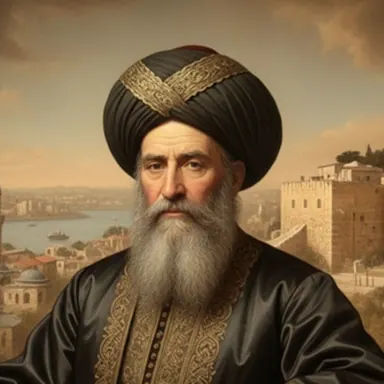
Rabbi Ephraim Navon and the Book "Machaneh Ephraim"
10 min read1,978 words
Summary
This article surveys the life and the monumental contribution of Rabbi Ephraim Navon, author of the book "Machaneh Ephraim," who was one of the key Torah figures in the Ottoman Empire and in the Land of Israel in the 18th century. The text highlights the distinctive conceptual and analytical method of study he developed, which was ahead of its time and became a central foundation not only in the Sephardi world but also in the yeshivot of Lithuania and Ashkenaz. Alongside an analysis of the structure of his book, which combines practical rulings with theoretical novellae arranged according to the order of Maimonides, the author clarifies important bibliographical distinctions in order to prevent confusion between this work and other compositions with a similar name. In conclusion, the source presents how Rabbi Navon's public and Torah work created a pan-Jewish intellectual bridge that continues to shape the world of Torah scholarship to this day.
The Halakhic Work and Torah Teaching of Rabbi Ephraim Navon and the Book "Machaneh Ephraim"
The Torah sphere of the Ottoman Empire during the seventeenth and eighteenth centuries produced some of the most influential halakhic works in the history of the literature of the Oral Torah. At the heart of this spiritual and intellectual flowering stands the figure of Rabbi Ephraim Navon, halakhic decisor, judge and communal leader, who became known to the generations chiefly through his monumental book "Machaneh Ephraim."[1] Rabbi Ephraim Navon's Torah work is not confined to theoretical writing alone, but reflects a complex combination of practical halakhic ruling, service as a judge in the central rabbinic courts of Constantinople, deep social involvement as a leader and as an emissary (shadar) of the Jerusalem community, and the development of a unique methodology of study that became a classic treasure both in the Sephardi world and in the Ashkenazi yeshiva world.[1, 2, 3]
Historical Background, Biography and the Network of Public and Family Ties
Rabbi Ephraim Navon was born in Constantinople (Istanbul) in the year 5437 (1677) to his father, Rabbi Aharon Navon.[1] His Torah upbringing took place in the splendid study halls of the capital of the Ottoman Empire, where he absorbed the foundations of profound Sephardi analytical study. Around the year 5460 (1700), he decided to immigrate to the Land of Israel and settled in Jerusalem.[2] This journey was made in the company of his father-in-law, Hakham Yehuda Argas, a prominent Torah figure in his own right, which points to his close family ties with the scholarly elite of that period.[2] Rabbi Ephraim Navon's stay in Jerusalem established his public and Torah standing, until in the year 5481 (1721) he was chosen to serve as a rabbinic emissary (shadar) on behalf of the Jerusalem community.[2] This role required him to return to Turkey in order to raise financial resources and to represent the urgent affairs of the community in the Land of Israel, decisive testimony to the great trust placed in his leadership and political abilities.[2]
Upon his return to Constantinople, he met Rabbi Yehuda Rosanes, who was the head of the local rabbinic court and author of the famous book "Mishneh la-Melekh" on Maimonides.[1] Rabbi Yehuda Rosanes immediately recognized the exceptional greatness of Rabbi Ephraim Navon and appointed him to serve as an authorized teacher of halakha and a judge in his court.[1] This Torah collaboration between the two spiritual giants gave rise to an exceptionally creative learning environment. Rabbi Ephraim's colleagues and contemporaries described his total devotion to the Torah and the breadth of his scholarly horizons as never ceasing for a moment, his heart being, in their words, "like the heart of a lion," seeking to clarify the topics down to their practical halakhic depth, with complete mastery of the paths of the entire Talmud.[1] Rabbi Ephraim Navon passed away in the prime of his life, at only about 58, on 26 Nisan 5495 (1735), and was buried in the cemetery in Istanbul.[1] His public and spiritual legacy continued through his son, Rabbi Yehuda Navon, who rose to greatness and in time served in the lofty office of the Rishon le-Zion – the official spiritual leader of the Jewry of the Land of Israel.[1]
The Book "Machaneh Ephraim": Structure, Genre and Editions
Rabbi Ephraim Navon's monumental book, "Machaneh Ephraim," was first printed in Constantinople in the year 5498 (1738), about three years after the author's death.[3, 4] This book is regarded as a masterpiece that ingeniously combines two separate Torah genres: on the one hand, questions and answers (responsa) that arose from his practice as a decisor and judge, and on the other hand, abstract theoretical novellae.[2, 4] The book is arranged "going round" according to the order of the laws of Maimonides' "Mishneh Torah."[1, 4] This arrangement does not indicate that the book is an ordinary textual commentary on Maimonides; rather, the author chose to use Maimonides' codificatory structure as a conceptual framework through which he analyzes complex Talmudic topics and examines the words of the Rishonim and the decisors who preceded him.[2, 3, 4]
Within the framework of the work, Rabbi Ephraim Navon devotes extensive sections to clarifying the depth of various laws, among them the laws of oaths, the laws of vows, the laws of charity and the laws of damage to property.[4] Rabbi Ephraim Navon's analyses of these subjects are characterized by the ability to distill sharp legal definitions that directly affect the application of the laws in practice. Because of the book's decisive importance, it was reprinted again and again over the generations.[3, 4] The first edition, printed in Constantinople, comprised 357 folios and formed the basis for all subsequent editions.[3, 4] In the year 5638 (1878) a new edition was printed in Warsaw, divided into two volumes, each volume containing exactly 181 folios, and thus the book was made accessible to the scholars of Eastern Europe.[4] In the modern era the book enjoyed a renewed flowering with the printing of a modern edition in two volumes by the "Yafeh Nof" publishing house, based on the research and publishing work of Prof. Shraga Feivel Dimitrovsky.[5]
The structural and historical differences between the various editions of the book "Machaneh Ephraim" can be seen in the following table:
His Torah Teaching, Methodology of Study and Its Pan-Jewish Influence
The dramatic distinctiveness of the book "Machaneh Ephraim" lies in its method of study, which represents the golden age of Sephardi-Ottoman Torah scholarship in the eighteenth century. Unlike the methods of study prevalent in Europe at that time, which often focused on local pilpul or on attempts to resolve isolated textual contradictions, Rabbi Ephraim Navon's method was based on abstract conceptual analysis and categorical legal definitions.[3, 6] His halakhic inquiries sought to distill the "essence" of the law – for example, whether a particular right is defined as a personal lien (shi'bud ha-guf, a personal debt) or as a lien on property (shi'bud nekhasim, a right in rem) – and from this principled definition to draw implications for dozens of different halakhic topics that on the surface appeared unconnected to one another.[3, 6]
This abstract analytical approach preceded by decades the development of the conceptualized method of study of the Lithuanian yeshivot. For this reason, the book won rapid and wide-ranging acceptance in all the communities of the Jewish diaspora, and entirely crossed the boundaries between Sephardi Jewry and Ashkenazi Jewry.[3] His work became an inseparable part of the theoretical curriculum in the prominent yeshivot of Lithuania.[3] The great Acharonim of Eastern Europe, headed by Rabbi Aryeh Leib Heller in his book "Ketzot ha-Choshen" and Rabbi Yaakov Lorberbaum in his book "Netivot ha-Mishpat," maintained a constant and intensive scholarly dialogue with the novellae of the "Machaneh Ephraim," and built entire stories upon the conceptual foundations he had laid.[3, 6] This phenomenon illustrates how a halakhic work that grew in Constantinople became an intellectual engine that shaped the character of the Ashkenazi yeshiva world in the generations that followed.
Bibliographical Distinction and the Prevention of Historical Confusions of Identity
In the historical and bibliographical study of the Jewish bookshelf, the use of similar book titles is widespread, which can lead to grave chronological and methodological errors. In the case of the phrase "Machaneh Ephraim," an absolute distinction must be made between three principal works that are entirely different in character, period and geographical location:
First, the book "Machaneh Ephraim" on Maimonides, the subject of this report, written in Constantinople by Rabbi Ephraim Navon.[1, 4] Second, there is a book with exactly the same name, "Machaneh Ephraim" on the Talmud, which was written by Rabbi Ephraim Zalman Margolies, one of the great halakhic decisors of Galicia at the end of the eighteenth century and the beginning of the nineteenth century.[5] This Galician work is arranged according to the tractates of the Talmud and combines Ashkenazi scholarly methodology with practical halakhic ruling, and there is no direct connection between it and the work of Rabbi Ephraim Navon.[5] Third, there is the well-known Hasidic work "Degel Machaneh Ephraim," written by Rabbi Moshe Chaim Ephraim of Sudilkov, grandson of Rabbi Israel Baal Shem Tov (the Besht).[7] This book is saturated with kabbalistic and Hasidic interpretation and constitutes one of the earliest and most reliable sources for the teaching of the Besht himself, with no connection to the legal literature of Constantinople.[7]
In addition to the bibliographical confusion between the books, there is also a potential historical confusion between figures bearing the name Ephraim Navon. In the twentieth century there was active in Jerusalem an artist, a scribe of Torah scrolls, tefillin and mezuzot, and a folk and folkloristic painter named Ephraim Navon, who was known by the nickname "the painter of menorahs" (shiviti) and kept a shop for frames and mirrors in the spice market in the Old City until his death in the 1930s.[8] This modern figure, despite his activity in Jerusalem, is in no way connected to Rabbi Ephraim Navon, the eighteenth-century halakhic decisor and author of the "Machaneh Ephraim."[1, 8]
Below is a comprehensive comparative table of bibliographical distinctions to prevent confusion of identities:
Summary and Halakhic and Historical Conclusions
An examination of the work and teaching of Rabbi Ephraim Navon yields deep insights regarding the dynamics of the Torah world in the eighteenth century. First, the course of Rabbi Ephraim Navon's life – from his birth in Constantinople, through his immigration to Jerusalem and his mission back to Turkey, to his appointment as a judge in the court of Rabbi Yehuda Rosanes – illustrates that the Ottoman Torah sphere functioned as a close-knit social and intellectual network.[1, 2] The public mission (the office of shadar) was not merely a financial instrument for the survival of the community in Jerusalem, but served as a vital channel for transmitting ideas and innovative methods of study between the various centers.[2]
Second, the fact that the book "Machaneh Ephraim" was so completely accepted in the yeshivot of Lithuania and Ashkenaz underscores the existence of a methodological common denominator that crossed ethnic groups and communities.[3] The striving for theoretical conceptualization, for categorical division and for the formulation of abstract legal rules was shared by the sages of Constantinople and the scholars of Eastern Europe.[3, 6] Thereby Rabbi Ephraim Navon became one of the fathers of modern Torah scholarship, and his book continues to serve as a central tool for developing legal and halakhic thinking in all the study halls to this very day.[3]
Sources8
- 1.אפרים נבון - ויקיפדיה, he.wikipedia.org/wiki/אפרים_נבון
- 2.HEBREW MACHANE EPHRAIM Rabbi Efraim Navon מחנה אפרים - eBay, ebay.com/itm/376107541515
- 3.אוסף גדול וחשוב של ספרים עתיקים, תס"ד-תרכ"ז. רובם מהדורות ראשונות. חתימות. | Appelauction, appelauction.com/auction/250-פריטים-נדירים-ומיוחדים-he/lot-7-אוסף-גדול/
- 4.מחנה אפרים – ויקיטקסט, he.wikisource.org/wiki/מחנה_אפרים
- 5.מחנה אפרים סט ב' כרכים / דז'ימיטרובסקי - אוצר הספרים, sefer.org.il/items/8898729-מחנה-אפרים-סט-ב-כרכים-דז-ימיטרובסקי-הוצאה-לאור-יפה-נוף-פלדהיים
- 6.מחברים | מקורות מתוך ספריית ספריא, sefaria.org.il/topics/category/authors
- 7.כוחות מושכים מעלה ומטה - לב לדעת, levladaat.org/materials/כוחות-מושכים-מעלה-ומטה/
- 8.יודאיקה: ספרי קודש, כתבי יד, מכתבי רבנים - Fastly, bidspirit-images.global.ssl.fastly.net/kedemauctionDocs/442/catalog/Full_Catalog_Auction_6.pdf