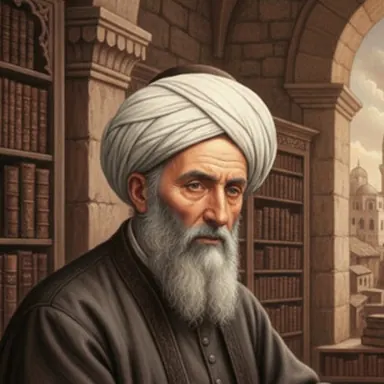
Rabbi Isaac Nunes Belmonte and His Work "Sha'ar ha-Melekh" on Maimonides' Mishneh Torah
15 min read2,943 words
Chapter 1: Historical Introduction, Identification of the Author and the Work
1.1. Presenting Rabbi Isaac Nunes Belmonte (RNB) and His Place among the Acharonim
The book "Sha'ar ha-Melekh" (The King's Gate) is one of the pillars of the literature of the Acharonim who comment on Maimonides' "Mishneh Torah." Its author, Rabbi Isaac ben Moshe Nunes Belmonte (Isaac Nunis-Bilmonte) [1, 2, 3], is a central figure in the Sephardic Torah world of the 18th century, whose name became almost identical with the name of his work. Rabbi Isaac Nunes Belmonte was active at the heart of the Sephardic community in the Ottoman Empire, centered mainly in Izmir (Smyrna), Turkey.[4] The main period of the book's composition is estimated at between 1730 and 1770 CE.[2, 5]
"Sha'ar ha-Melekh" does not generally deal with direct halakhic ruling (in the manner of the Shulchan Arukh), but serves as an analytical work whose main purpose is to broaden the theoretical discussion surrounding Maimonides' rulings, through a thorough clarification of the Talmudic passages and the Rishonim from which those rulings were derived.[4, 6] The swift recognition of the work's depth led to its first printing in Salonika in 5531 (1771).[4] The book's special importance lies not only in the sharpness of the author's thought but also in his rare mastery of early Torah sources that are no longer found in the study halls.
1.2. The Torah Background: The Sephardic Torah Center in Izmir
The activity of Rabbi Isaac Nunes Belmonte takes place against the background of the important Torah center of Izmir in the 18th century. Izmir served as a stronghold of the Sephardic-Ottoman Torah tradition, which was characterized by in-depth and systematic study, much influenced by the legacy of the great sages of the earlier Sephardic centers such as Salonika.
The painstaking and comprehensive style of "Sha'ar ha-Melekh," characterized by a tendency toward thorough clarification and extensive use of the writings of the Rishonim and Acharonim [7], is a direct product of the Turkish-Ottoman tradition. This scholarly tradition maintained a close connection with the philological legacy of the Rishonim, which was reflected in the study halls of these centers and gave RNB access to early manuscripts that were not accessible to the rabbis of Europe at that time. As a result, his pilpul tends to be based on wide-ranging textual knowledge, and it in fact serves as a kind of showcase for the distinctive method of study that developed in Turkey.
1.3. An Explicit Distinction between Similar Figures (Discretization)
For the sake of precise academic analysis, care must be taken to separate Rabbi Isaac ben Moshe Nunes Belmonte, the author of "Sha'ar ha-Melekh," who was active in Izmir in the 18th century [1, 2, 4], from another sage bearing a similar family name, Rabbi Yitzchak Yosef Nunes-Vais. Rabbi Yitzchak Yosef Nunes-Vais, who lived in Hungary, is known as the author of the book "Si'ach Yitzchak" on the Talmud and of glosses on the Tosafot Yeshanim on tractate Yoma.[8, 9, 10] Despite the similarity of names, these are two sages from different periods and different geographical places, and their Torah teaching, as reflected in their works, is essentially different.
Chapter 2: The Author's Life and Teachers – Devotion to Torah in the Shadow of Hardship
2.1. Personal Biography and Dates of His Life
Rabbi Isaac ben Moshe Nunes Belmonte died on a specific date: 18 Nisan 5534 (1774).[4, 11] According to the records, his estimated date of birth is around 5470 (1710) or 5475 (1715).[4] The biographical record reveals that the author contended with significant hardships in his life, for it was written of him that he was "poor and sick."[4]
Coping with a difficult economic situation and frail health, while at the same time producing a work as comprehensive and complex as "Sha'ar ha-Melekh," reflects a high degree of devotion and toil in Torah. It required exceptional personal and spiritual strength to devote himself to Talmudic and philological study demanding constant diligence. The discovery of the inscription on RNB's tombstone, which extols his standing as "the perfect sage" and as "one who spread Torah in Israel" [4], attests that despite his physical and economic condition he was recognized in his community as a leading Torah figure.
2.2. His Teachers: The Torah Chain of Izmir
Rabbi Isaac Nunes Belmonte was the distinguished disciple of the greatest rabbis of Izmir in his generation, who left their mark on his pilpulistic and analytical way of study. Among his principal teachers are:
- Rabbi Chaim Abulafia: his principal teacher, the author of the book Etz ha-Chaim. RNB received from him an approbation for his book and frequently quotes his words.[4]
- Rabbi Barzilai Yaavetz: whom RNB called by the title "my teacher, the Rav Leshon Limmudim," after his book.[4]
- Rabbi Yitzchak ha-Kohen Rapoport: whom RNB called "my teacher, the Rav Batei Kehunah" [4], likewise after his book.
RNB's teachers were rabbinic judges, heads of yeshivot and leading halakhic decisors. His education in a study hall that combined halakhic ruling and theoretical study shaped the distinctive style of "Sha'ar ha-Melekh," which tends toward deep study of the Talmudic passages yet does not shy away from reaching halakhic decisions where these are called for.[7] RNB also included in his work novellae that he heard from his teachers and contemporaries, such as Rabbi Yehuda Ashkenazi, thereby making "Sha'ar ha-Melekh" not only an expression of his own teaching but also a record of the Torah of the rabbis of Izmir in that period.[4]
2.3. His Last Days: The Mission to Italy and Death Abroad
The end of RNB's life highlighted his public involvement and the depth of his commitment to Torah and the community. In 5532 (1772) a severe fire struck Izmir and destroyed its synagogues.[4] RNB set out on a vital public mission to Italy, and especially to the city of Livorno, in order to collect donations for the rebuilding of the ruins.[4]
His journey to Italy also served as an opportunity to continue his Torah work. While in Livorno, which was an important center of Jewish printing, he worked to print additional manuscripts, among them "Shitah Mekubbetzet" on tractate Bava Batra.[4] This combination of public activity and literary activity until his last day attests that RNB saw himself as one who continued to spread Torah in every situation. He died in Livorno on 18 Nisan 5534 (1774), before he managed to complete the project of printing "Shitah Mekubbetzet."[4]
Chapter 3: The Book "Sha'ar ha-Melekh" – Structure, Content and Scope of Coverage
3.1. The History of the Printing and the Reception of the Book
The first publication of "Sha'ar ha-Melekh" took place in Salonika in 5531 (1771) [4], with the support of his relative, Baruch Gagin.[4] Recognition of the book's importance was immediate, and it received approbations from leading rabbis even before its publication, among them his teacher Rabbi Chaim Abulafia.[4] Over the generations, recognition of the book expanded greatly, and it was praised by great sages both in the Sephardic centers (such as the Chida) and in the Ashkenazi centers (such as Rabbi Mordechai Banet and Rabbi Elazar Kallir).[4, 7]
The book's enduring importance found expression in its continued printing in many editions (5561, 5619, 5655, 5670 and others) [4], as well as in new and corrected editions published in the 21st century by leading Torah institutes, such as Machon Yerushalayim and Machon ha-Maor.[6, 7, 12] These editions include an apparatus of corrections, source references and notes by the great sages of later generations, which attest to the book's didactic and theoretical vitality to this day.[7]
3.2. The Appended Works
Many modern editions of "Sha'ar ha-Melekh" include appended works, which broaden the body of the author's work and the sources surrounding the book:
- "Derekh ha-Sha'ar" (or "Derekh ha-Melekh"): this is a collection of sermons composed by RNB, which was printed at the end of the book.[6, 12, 13] It is noted that these sermons were "stored away and hidden in a place not visible to all" [6], which heightens the historical importance of their publication. These sermons were also incorporated into the book Derekh ha-Yam by his disciple Rabbi Raphael Yitzchak Mayo.[4]
- "Ginzei ha-Melekh": a compilation of the words of the Acharonim and their glosses on RNB's words, appended to the new editions.[6] This is evidence of the continued pilpulistic discussion of the author's method.
3.3. The Scope of Coverage of the "Mishneh Torah"
"Sha'ar ha-Melekh" accompanies the "Mishneh Torah" according to the order of the laws, but focuses on topics that demand sharp pilpul and on passages in which there is a need to establish Maimonides' position. The work does not cover all the books, but covers extensive chapters in several of Maimonides' central books:
The emphasis on intricate laws, and particularly in Sefer Hafla'ah (Oaths, Vows) [14], reflects RNB's attraction to topics that require extracting legal principles from the words of the Sages, using multi-layered textual analysis.
Chapter 4: His Torah Teaching and Analytical Method – Depth of Study and Uncommon Erudition
4.1. The Pilpulistic Essence: The Shift from Dealing with Halakha to Dealing with the Talmudic Passage
"Sha'ar ha-Melekh" is defined as a work of "chiddushim" (novellae), and its central method is not dry halakhic ruling but the expansion of the Talmudic passages that lie behind Maimonides' words.[4, 7] RNB uses Maimonides' laws as a point of departure for pilpulistic discussions, in the course of which he compares Maimonides' view with the views of the Rishonim and Acharonim.[7] His distinctive style is "his study in the style of the sages of Turkey" [7], combining diligence, analytical sharpness and extensive erudition spanning hundreds of years of Torah literature.
Although it is mainly theoretical, the power of his inquiry led to the fact that "at times he rules on halakha."[7, 13] This fact reflects the author's confidence in his decisions: having clarified the passage from its foundations, he did not hesitate to draw out the implied halakhic decision, even if in doing so he departed from the accepted format of "chiddushim."
4.2. His Philological Contribution: The Lost Sources as a Historical Window
The most prominent feature giving "Sha'ar ha-Melekh" its unusual scholarly importance is its ability to preserve lost information from the literature of the Rishonim. Rabbi Isaac Nunes Belmonte quotes from books that "no longer exist today" [7], probably because these literary treasures were still accessible in the Torah center of Izmir.
Among the lost writings he cites:
- Shitah Mekubbetzet: parts of the work on tractates Kiddushin and Yevamot, which do not exist in the standard editions.[4, 7]
- Other Rishonim: quotations from an early book of the Rishonim from the time of the Rashba (Rabbi Shlomo ben Aderet), as well as views and novellae by Rabbi Aharon Lapapa.[4, 7]
This phenomenon ties "Sha'ar ha-Melekh" inseparably to the tradition of manuscript preservation of the sages of the Ottoman Empire, who formed a bridge between the early Sephardic tradition and later generations. When scholars or learned students encounter a textual difficulty in the Rishonim, RNB's words sometimes serve as the only textual witness to a lost reading or position. This contribution is philological and historical of a unique kind, and it is the main source of RNB's esteemed standing as a man of rare erudition.[7]
Chapter 5: Methodological Analysis: "Sha'ar ha-Melekh" in the Context of the Interpretation of Maimonides
5.1. The Dialogue with "Kesef Mishneh" (R. Joseph Karo)
"Sha'ar ha-Melekh" operated in an interpretive arena in which central commentators on Maimonides, such as the "Maggid Mishneh," the "Migdal Oz" and the "Kesef Mishneh" [16, 17], were already well known. Whereas the "Kesef Mishneh" focused on identifying Maimonides' sources, RNB adopted a more analytical approach. The book does not merely identify a source, but develops a pilpulistic discussion whose aim is to establish and analytically support Maimonides' rulings, especially in places where the matter is not explicit in the Talmud or is subject to dispute.
RNB's painstaking method is aimed at strengthening Maimonides' standing. His way of study demonstrates how every ruling in the "Mishneh Torah" stems from meticulous study and from a consistent method of decision in the Talmudic passages. His discussion is directed at an audience that has already studied the more basic commentaries and now seeks an in-depth analysis of Maimonides' process of ruling.
5.2. Case Analysis: The Study of the "Laws of Kings" (the Question of a Convert and Kingship)
RNB's discussion in the Laws of Kings, concerning the prohibition of appointing a king or any office of authority from the community of converts, illustrates his analytical sharpness well.[18] Maimonides rules that the prohibition "You may not set a foreigner over you, who is not your brother" applies not only to a king but to every office of authority in Israel, and that the permission to appoint a person from the community of converts exists only if his mother is an Israelite.[18]
RNB analyzes the ruling and points out that Maimonides learned this from the case of Rav Mari bar Rachel, whose conception was not in holiness (his father was a gentile and his mother an Israelite), and whom Rava declared fit for office. From this, RNB concludes that Maimonides holds that kingship and other offices of authority fall under "chad dina" (one law), and that when a gentile has relations with a daughter of Israel, his son is fit for office.[18]
The complexity arises when RNB compares this with the Tosefta, which requires of a king a condition of priestly lineage, according to which the child is blemished. RNB is not content with the difficulty, but proposes a radical solution based on authority: the Babylonian Talmud, from which Maimonides learned, disagrees with the Tosefta on this matter. In this way RNB explains why Maimonides omitted the relevant Tosefta in other places – not out of forgetfulness, but out of a deliberate ruling against it.[18] This is a high style of textual analysis, establishing Maimonides as an analytical decisor who decides between different Tannaitic sources.
Chapter 6: Legacy and Influence – "The Desirable and Beneficial Erudition"
6.1. The Recognition of the Great Sages of Israel
"Sha'ar ha-Melekh" won exceptional esteem immediately upon its publication. Its recognition crossed the boundaries of communities and customs, for the great sages of Ashkenaz and Sepharad alike praised the work.[7] The recognition of Rabbi Akiva Eiger and the Chida [7] proves the universal quality of the book and its ability to serve as a basis for shared study.
The book's standing as a groundbreaking study tool was sharply defined by Rabbi Yaakov Schor, who recommended: "And let the book Sha'ar ha-Melekh on Maimonides not depart from your mouth, for through it you will be trained in the desirable and beneficial erudition."[7] This recommendation is not merely praise but a didactic program. It establishes that the best way to acquire true erudition – one that connects the Talmud, the Rishonim and Maimonides – passes through the diligence and analysis of RNB.
6.2. Influence on Later Generations and on Torah Institutions
The influence of "Sha'ar ha-Melekh" was deeply absorbed into Torah institutions. The very existence of the "Sha'ar ha-Melekh" yeshiva in Jerusalem [19], which took the book's name as its own, attests to its having become a brand representing a tradition of thorough study of Maimonides.
On the literary plane, the inclusion of the commentary in the most important scholarly and yeshiva editions of Maimonides (Machon Yerushalayim, Machon ha-Maor) [7, 12], together with the appended work "Ginzei ha-Melekh" [6], shows that in the 21st century too "Sha'ar ha-Melekh" continues to be vital as a tool of pilpulistic work and as a source of historical knowledge.
The following table summarizes the features of the theoretical method of "Sha'ar ha-Melekh":
Table of the Features of the Theoretical Method of "Sha'ar ha-Melekh"
Summary and Conclusions
Rabbi Isaac ben Moshe Nunes Belmonte, the author of "Sha'ar ha-Melekh," left behind a twofold legacy: as an analytical establisher and defender of Maimonides' rulings and as a faithful guardian of lost literary treasures. His activity in the center of Izmir in the 18th century, against a background of personal hardship, produced a work that became an indispensable tool for anyone seeking to acquire deep and interconnected erudition linking the Talmudic passages with canonical halakhic ruling. "Sha'ar ha-Melekh" remains vital because it offers not only a commentary but a method of thinking that trains the student to penetrate to the depth of the processes of halakhic ruling, while still serving as a unique archive of knowledge of early Torah writings.
Sources19
- 1.שער המלך -- נוניס, יצחק בן משה - HebrewBooks.org Sefer Detail, hebrewbooks.org/14144
- 2.שער המלך על משנה תורה, הלכות שבת - ספריא, sefaria.org.il/Sha'ar_HaMelekh_on_Mishneh_Torah,_Sabbath
- 3.שער המלך | מפרשי הרמב''ם | ספרי הלכה - למדן - בית הספרים, lamdanbooks.co.il/product/שער-המלך
- 4.רבי יצחק נוניש בילמונטי – המכלול, hamichlol.org.il/שער_המלך
- 5.שער המלך על משנה תורה, הלכות שקלים - ספריא, sefaria.org.il/Sha'ar_HaMelekh_on_Mishneh_Torah,_Sheqel_Dues
- 6.שער המלך על הרמב"ם / מכון המאור - אוצר הספרים, sefer.org.il/items/3733462-שער-המלך-על-הרמב-ם-מכון-המאור-הוצאה-לאור-מכון-המאור
- 7.שער המלך על הרמב"ם - 2 כרכים - המדף היהודי, hamadaf-y.co.il/חנות/הלכה-ושותים/משנה-תורה-לרמבם/שער-המלך-על-הרמבם/
- 8.שיח יצחק - יצחק וויס - Google Books, books.google.com/books/about/שיח_יצחק.html?id=9LLkmAEACAAJ
- 9.שיח יצחק / - יצחק וויס - Google Books, books.google.com/books/about/שיח_יצחק.html?id=m9-6zwEACAAJ
- 10.HebrewBooks.org 6471 שיח יצחק - יומא -- נוניס-ויס, יצחק יוסף, beta.hebrewbooks.org/6471
- 11.רבי יצחק נוניש בילמונטי - המכלול, hamichlol.org.il/רבי_יצחק_נוניש_בילמונטי
- 12.שער המלך על הרמב"ם / מכון המאור. - משנה שופס, shop.mishna.org.il/products/שער-המלך-על-הרמבם
- 13.שער המלך על הרמב"ם - ד' כרכים - מורשת מרן שופס, shops.moreshet-maran.com/מוצרים/שער-המלך-על-הרמבם-ד-כרכים/
- 14.הלכה, משנה תורה, מפרשים, שער המלך - ספריא, sefaria.org.il/texts/Halakhah/Mishneh Torah/Commentary/Sha'ar HaMelekh
- 15.Sha'ar HaMelekh on Mishneh Torah, Levirate Marriage and Release - Sefaria, sefaria.org/Sha'ar_HaMelekh_on_Mishneh_Torah,_Levirate_Marriage_and_Release
- 16.שער המלך/מלכים/א - אוצר הספרים היהודי השיתופי, wiki.jewishbooks.org.il/mediawiki/wiki/שער_המלך/מלכים/א
- 17.Mishneh Torah - Halakhah - Sefaria, sefaria.org/texts/Halakhah/Mishneh Torah
- 18.HebrewBooks.org - רמב"ם הלכות מלכים ומלחמותיהם פרק א הלכה ד - פ' שער המלך, hebrewbooks.org/rambam.aspx?mfid=54669&rid=14902
- 19.ישיבת שער המלך - Charity Extra, charityextra.com/shamelech