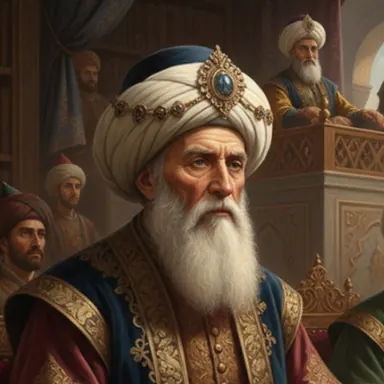
Rabbi Eliyahu Mizrachi (the Re'em) in the Mirror of His Age
18 min read3,603 words
Summary
The text surveys the wide-ranging figure of Rabbi Eliyahu Mizrachi (the Re'em), a key figure who connected the worlds of political leadership, science and religious exegesis at the height of the period of transition to the modern era. The article describes how the Re'em combined Ashkenazi logic with the spirit of the Renaissance and served as "Hakham Bashi" in the Ottoman Empire, a role in which he displayed exceptional compassion and integrity in absorbing the exiles from Spain and protecting the conversos (anusim). His chief intellectual contribution is summed up in his becoming the foremost commentator on Rashi, harnessing mathematical and astronomical tools to establish a consistent methodology for understanding Scripture and halakha. Ultimately, the source presents a model of a holistic polymath sage, who succeeded in bridging cultural and communal gaps and in shaping the identity of the Jewry of the Ottoman Empire for generations.
Leadership, Science and Exegesis: The Torah Teaching and Public Work of Rabbi Eliyahu Mizrachi (the Re'em) in the Mirror of His Age
The fifteenth and sixteenth centuries were a dramatic period of transition in the history of the Jewish people and of the whole world. The fall of Constantinople to the Ottomans in 1453 and the expulsion from Spain in 1492 created a new geopolitical and spiritual reality. At the heart of these upheavals stood the monumental figure of Rabbi Eliyahu ben Avraham Mizrachi, known by the acronym the Re'em.[1, 2] The Re'em was not merely the spiritual leader of a local community but a figure who shaped the face of Judaism in the Ottoman Empire and the world of the study of Scripture and halakha for generations to come.[3, 4] As a leader who combined phenomenal Talmudic erudition, a capacity for political leadership vis-à-vis sultans, and a profound command of the exact sciences, the Re'em represents the ideal type of the Jewish polymath sage in the era of transition between the Middle Ages and the modern era.[1, 5, 6]
Chapter 1: The Foundations of His Biography and the Formation of the Figure
Rabbi Eliyahu Mizrachi was born in Constantinople (Kushta) around the year 5210 (1450-1455).[5, 7] He grew out of the community of the Romaniote Jews – the Greek-speaking Jews who had lived in the Mediterranean basin and in the Byzantine Empire since antiquity, well before the massive arrival of the exiles from Spain.[1] This identity gave him a unique cultural foundation: on the one hand, a deep commitment to the ancient local tradition, and on the other, intellectual openness to languages and sciences.[1, 6]
The Re'em's Torah training was varied and fascinating. At the beginning of his path he studied under Rabbi Eliyahu ha-Levi (known as Rabbi Eliyahu the Elder) in Constantinople, but the decisive turning point in his education came when he traveled to Padua in Italy to study with Rabbi Yehuda Mintz.[1, 2, 4, 6] The yeshiva of Padua was at that time a focal point of encounter between the Ashkenazi world of learning (Rabbi Yehuda Mintz was one of the great Ashkenazi sages who had settled in Italy) and the spirit of the Italian Renaissance. There the Re'em acquired the analytical tools of the Ashkenazi method of study – textual precision and logical pilpul – which he would later combine in his commentaries and rulings.[1, 2]
In addition to sacred studies, the Re'em trained thoroughly in the sciences of his time. He commanded Greek and Arabic, which opened for him a window onto the scientific and philosophical sources of the classical and Muslim world.[1, 4, 6] His special expertise was in mathematics, algebra and astronomy, fields in which he was considered an authority not only in the Jewish community but also among the men of science of his time.[2, 3, 5]
Chapter 2: The Crown and the Divan – Political and Public Leadership
Upon the death of Rabbi Moshe Capsali around 1495, the Re'em was chosen to succeed him as chief rabbi of the Ottoman Empire, a post known by the title "Hakham Bashi."[1, 3, 6] The Re'em's standing at the sultan's court (the Sublime Porte, Bab-ı Âli) was unprecedented. He served as a member of the "Divan" – the supreme council of the empire – where he sat alongside the mufti (the Muslim leader) and the Greek patriarch (the Christian leader).[2, 7] In the order of protocol, the Re'em was at times even granted a more honored place than that of the Christian patriarch, which attests to the great esteem of the Ottoman government for the strength and stability of the Jewish community under his leadership.[2, 7]
The post of "Hakham Bashi" carried a threefold responsibility: spiritual, judicial and administrative. The Re'em was the supreme authority for settling disputes within the Jewish community, and the sultan granted him the authority to judge and decide every internal Jewish matter.[3, 4, 6] Alongside this, he was responsible for collecting taxes from the Jews for the state treasury, a complex task that demanded absolute integrity and the ability to maneuver between the demands of the government and the hardships of the community.[2]
The Absorption of the Exiles from Spain and the Guidance of the Conversos
The peak of the Re'em's public activity was in dealing with the consequences of the expulsion from Spain in 1492. The waves of refugees who reached the shores of the Ottoman Empire created an enormous humanitarian and religious crisis. The Re'em worked tirelessly to ease their absorption, to settle them in existing communities and to provide for their physical and spiritual needs.[2, 6]
An especially painful issue was the question of the "anusim" (conversos) – those Jews who had been forced to convert to Christianity and lived as Christians in Spain and Portugal, but fled to the Ottoman Empire in order to return to their Judaism. The Re'em took a courageous and welcoming approach: he ruled that they should be received back with open arms and allowed to integrate into communal life without reservation, out of understanding for their plight and appreciation of their self-sacrifice in the very act of reaching a free place.[2] This approach helped rehabilitate thousands of families who returned to the fold of Judaism under his leadership.[2]
The Attitude Toward the Karaite Community
In Constantinople there was a large and long-established Karaite community. While many sages tended to be stringent and to keep apart from them, the Re'em adopted a line of relative tolerance, following the path of his teacher Rabbi Eliyahu ha-Levi.[1, 2, 6] He permitted teaching the Karaites the Oral Torah (Talmud), in the hope that exposure to the beauty and depth of the rabbinic tradition would bring them back to normative Judaism.[1, 5] At the same time, he kept clear boundaries and forbade intermarriage with the Karaites so long as they had not fully accepted upon themselves the yoke of the commandments and rabbinic halakha.[6]
Chapter 3: "The Faithful Steward of Rashi's House" – His Exegetical Teaching on Scripture
The Re'em's most famous and influential work is his commentary on Rashi on the Torah, known as "Sefer ha-Mizrachi" (Venice, 1527).[1, 5] This book is not merely another commentary; it constitutes the central layer without which Rashi's words cannot be understood in depth.[8] Among students, the Re'em is regarded as the "house commentator" of Rashi, and his words appear in almost every edition of the Chumash with Rashi's commentary and its commentators, sometimes in abridged form under the name "Siftei Chakhamim."[2, 9]
The Re'em approached Rashi's commentary with holy awe and with precise scientific-logical study. He asserted that in Rashi's commentary "there is not a single one of his statements that does not require much investigation and wondrous study."[10] For the Re'em, Rashi is not merely a compiler of midrashim but a master of linguistic and substantive precision, who chose every word with care in order to resolve a difficulty in the biblical text.[11]
The Methodology of "Sefer ha-Mizrachi"
The Re'em developed a unique method of studying Rashi's commentary, made up of three main layers:
- Uncovering the sources: Rashi often cites midrashim in extremely condensed form without indicating their source in the Talmud or in the midrashim of the Sages. The Re'em locates the exact source, compares the versions and explains why Rashi chose specifically a particular wording.[1, 12]
- Resolving difficulties and contradictions: When Rashi appears to contradict himself in different places, or when his words do not accord with the plain meaning of Scripture, the Re'em builds a complex logical system in order to resolve the difficulty. He uses fixed exegetical rules and shows that Rashi always operates within a consistent framework.[1, 5]
- Polemic with Nahmanides (Ramban): This is one of the most fascinating parts of the work. Nahmanides, in his commentary on the Torah, frequently raises difficulties against Rashi and disagrees with him, at times sharply. The Re'em took upon himself the role of Rashi's "defender." He analyzes Nahmanides' objections and often shows that they rest on a misunderstanding of the depth of Rashi's intent or on different basic assumptions, and in this way he restores the crown of Rashi's commentary to its former glory.[1, 5, 12]
Examples from His Exegetical Teaching
In his commentary on the book of Genesis, the Re'em demonstrates his ability to combine theological inquiry with textual precision. For example, in the commentary on Genesis 1, he deals with the question of the order of Creation and confronts the difficulty of why the Torah opens with the story of Creation rather than with the commandments.[13] He explains that Rashi's aim was to implant faith in the Creator's ownership of the world in order to justify the giving of the Land of Israel to the people of Israel against the claims of the nations of the world ("you are robbers").[13] The Re'em delves into the explanation of the midrash and shows how the first verses build the moral and legal infrastructure of the entire Torah.[13]
Another example is the Re'em's treatment of mathematical and geographical subjects within the Torah. When Scripture describes the borders of the Land or the measurements of the Tabernacle, the Re'em uses his extensive geometrical knowledge to prove that Rashi's interpretation is the only one that fits spatial reality.[2, 7] He even added schematic maps to certain editions to illustrate his words.[7]
Chapter 4: Restoring the Scientific Tools – The Re'em as Mathematician and Astronomer
The Re'em's distinctiveness among the sages of his generation was his complete command of the natural sciences. He did not see science as "external wisdom" cut off from the sacred, but as an indispensable instrument for understanding the Torah and halakha.[2, 3] In his book "Responsa," he declares that knowledge of mathematics and astronomy is essential for clarifying the laws of sanctifying the new month, calculations of kilayim (forbidden mixtures), questions of land division and the laws of inheritance.[2, 5]
His Principal Scientific Works
- Sefer ha-Mispar (Melekhet ha-Machshevet): This is a comprehensive pedagogical work whose aim is to impart to the student the foundations of arithmetic.[1, 14] The book deals with the four arithmetical operations – addition (kibbutz), subtraction, multiplication (hakka'ah) and division.[14] The Re'em details the ways of working with whole numbers, common fractions and astronomical fractions (shivrei tekhunah).[5, 14] One of the fascinating chapters of the book is devoted to solving complex word problems, and another chapter (in certain editions) even deals with the logic of the game of chess.[1, 5, 14]
- Commentary on Ptolemy's Almagest: The Almagest was the most important astronomical text of the Middle Ages. The Re'em wrote a profound commentary on this work, which attests to a broad cosmological understanding and the ability to analyze mathematical models of the motion of the heavenly bodies.[1, 5]
- Commentary on Euclid's Elements: In this work the Re'em deals with classical geometry, which formed the basis of all the scientific thought of his time.[1]
- A method for finding the cube root: The Re'em is considered one of the first mathematicians (or the first developer of a consistent method) for finding the third root (cube root) of a number.[1, 4, 6] This achievement was a significant breakthrough in the algebra of the 15th century.
The Re'em believed in the harmony between reason and faith. In the introduction to his scientific books, he stresses that while theology deals with the sublime and the abstract, the exact sciences supply the "concreteness" needed to fulfill the commandments in the material world.[5] He educated his students at the yeshiva in Constantinople not only in Talmud and halakha but also in mathematics and astronomy, as part of a holistic curriculum.[2]
Chapter 5: His Halakhic Work and Legal Rulings
Beyond being a commentator and a scientist, the Re'em was the supreme halakhic decisor of his generation. His halakhic work includes two principal compositions that reflect his authority and his distinctive path:
The Responsa of the Re'em and "Mayim Amukim"
The Re'em's halakhic responsa are regarded as pillars of halakhic ruling in the Ottoman Empire.[3] He dealt with intricate questions of life that arose as a result of the expulsion from Spain, the redemption of captives, the status of the various communities within the empire, and complex laws of marriage.[1, 6]
His rulings are characterized by exceptional independence of thought. The Re'em did not hesitate to disagree with great sages of his generation if he held that the halakhic truth lay elsewhere.[5, 6] He was known for his opposition to popular customs that had no solid basis in the sources, and he called them "foolish customs" that there is no obligation to obey.[6] On the other hand, he showed enormous social sensitivity and used his power to protect the weak and agunot (chained women) in the turbulent reality of the 16th century.[2, 3]
Tosafot Semag (Chiddushei ha-Re'em)
Another important work is "Tosafot Semag," which comprises novellae and notes on the Sefer Mitzvot Gadol of Rabbi Moshe of Coucy.[1, 5, 6] This book combines the study style of the Ashkenazi sages (the Tosafot) with the systematic approach of the Sephardi sages. The Re'em analyzes each and every commandment, examines its roots in the Talmud and its development among the Rishonim, and decides practical questions.[1, 5] The work won great esteem and was printed together with the Semag in later editions under the title "Chiddushim" (Novellae).[5]
Chapter 6: The Controversy over Rabbi Capsali – A Test of Leadership and Integrity
One of the formative events in the life of the Re'em, which attests to his moral character, is the affair of the controversy surrounding his predecessor in the post, Rabbi Moshe Capsali.[2] Rabbi Capsali was an authoritative and exacting figure, who imposed heavy taxes on the wealthy members of the community in order to support institutions of charity and loving-kindness. As a result, enemies arose against him among the affluent classes, who sent false testimony to Rabbi Yosef Colon (the Maharik) in Italy, one of the greatest of the generation at that time.[2]
The Maharik, misled by the witnesses, wrote a sharp letter against Rabbi Capsali and instructed the community to remove him from his post.[2] The Re'em, who was then a young and promising Torah scholar in Constantinople, knew well that the accusations were false. Although he personally was the immediate candidate to succeed Capsali in his post should he be removed, the Re'em chose to come to the defense of his maligned teacher.[2] He wished to publish words condemning the false testimony, but his teacher, Rabbi Yehuda Mintz (who was a relative of the Maharik), forbade him to intervene directly in the controversy so as not to harm the honor of the Maharik.[2] The Re'em obeyed his teacher, but his pain over the injustice was great. In the end, the Maharik understood that he had erred, sent his son to ask forgiveness of Rabbi Capsali, and justice came to light.[2] This event shaped the Re'em as a leader who prefers truth and justice over personal advancement, a quality that accompanied him throughout all the years of his leadership.[2]
Chapter 7: His Legacy and Influence for Generations
Rabbi Eliyahu Mizrachi died in Constantinople around the years 5285-5286 (1525-1526).[1, 5, 7] His death marked the end of an era in the leadership of the Jewry of the Ottoman Empire. Because of his irreplaceable personal greatness and the complexity of the post, the Jewish community asked the sultan to abolish the state office of "Hakham Bashi" after his death, and authority once again came to be divided among the rabbis of the various communities.[2]
Nevertheless, his spiritual influence only grew and intensified. "Sefer ha-Mizrachi" was first printed in Venice in 1527 by his son, Rabbi Yisrael Mizrachi, and has since become a cornerstone of every Jewish library.[1, 5, 7] The great figures of the generations after him regarded him with immense reverence:
- Rabbi Shlomo Luria (the Maharshal): wrote his work "Yeriot Shlomo" as a book of critical glosses and explanations on the Re'em, out of deep appreciation for his method.[1]
- Rabbi Shmuel Edels (the Maharsha): referred to the words of the Re'em in his novellae, and often subjected his words to pilpul just as the words of the Rishonim were subjected to it.[1]
- The authors of "Siftei Chakhamim": made the essentials of the Re'em's words accessible to every simple learner, and thereby ensured that his teaching would be studied at every age and at every level.[2, 9]
Summary of the Re'em's Contribution
The Re'em was a unique figure who connected worlds: between East and West, between Romaniotes and Sephardim and Ashkenazim, between the sacred and the profane, and between political leadership and religious devotion. He proved that one can be a brilliant man of science without giving up the tip of a yod in halakha, and that one can lead a spiritual empire out of humility and absolute integrity.[2, 3]
His Torah legacy, embodied in "Sefer ha-Mizrachi," continues to enlighten the eyes of Torah students to this day. He gave the student the key to understanding Rashi, and thereby preserved the infrastructure of the study of Scripture for generations.[8] His public work, which provided a safe haven for tens of thousands of exiles, ensured the survival and flourishing of Judaism in the Ottoman Empire over hundreds of years.[2, 6] Rabbi Eliyahu Mizrachi will remain forever in the national memory as the "faithful steward of the house" of the people of Israel in its most difficult hour, and as the great luminary who guided the path of the generation toward the modern era.[3, 10]
In-Depth Analysis: The Re'em as a Bridge Between Cultures and His Future Influences
To grasp the full scope of the Re'em's figure, one must examine not only the dry facts but the deep processes he set in motion. The Re'em worked at the meeting point between the Middle Ages and the Renaissance, and in many senses he was ahead of his time in his systemic conception.
The Logical and Scientific Synthesis
The Re'em's use of mathematics as a hermeneutic tool is one of his most original contributions.[2, 5] Whereas his predecessors saw science as an external tool, the Re'em embedded scientific logic within exegesis. When he explains Rashi, he is not content with a textual explanation but builds a logical model based on "necessity" – a term taken from the world of mathematics and philosophy.[1, 10] This insight teaches that for the Re'em, the truth of the Torah and the truth of science flow from the same divine source, and therefore they must be reconciled with each other.[5]
Shaping the Ottoman-Jewish Identity
The Re'em's success in absorbing the exiles from Spain created what we call today the glorious "Turkish Jewry."[2, 6] Without his moderate and authoritative leadership, the tensions between the veteran Romaniotes and the new Sephardim might have led to an irreparable split. The Re'em created a legal and communal infrastructure that allowed the various communities to preserve their customs on the one hand, yet to act as one body vis-à-vis the government on the other.[2]
The Re'em as a Model of Modern Spiritual Leadership
In retrospect, the figure of the Re'em serves as a model for a rabbinate that combines "Torah with derekh eretz" (worldly engagement) in its broadest sense. His ability to sit in the sultan's Divan as an official representative, and at the same time to write profound novellae on the Semag or to solve complicated algebraic equations, is testimony to exceptional spiritual strength.[1, 3, 7] He bequeathed to the generations that followed the understanding that the Torah does not live in a vacuum, but rather calls upon the leader to be versed in the finest details of the political, social and scientific reality of his time.[2, 3]
As his students and successors testified of him, Rabbi Eliyahu Mizrachi was "the great luminary" on whom the hopes of the generation hung.[3, 10] His work and teaching have remained relevant even five hundred years after his death, as conclusive testimony to the power of a Torah connected to life and to science.[1, 5, 8]
Sources14
- 1.Elijah Mizrachi - Wikipedia, en.wikipedia.org/wiki/Elijah_Mizrachi
- 2.Rabbi Eliyahu Mizrahi (Rom) - circa 5210-5286; 1450-1526 ..., chabad.org/library/article_cdo/aid/112362/jewish/Rabbi-Eliyahu-Mizrahi-Rom.htm
- 3.ר' אליהו מזרחי – הרא"ם - תורה שבכתב, app.torahb.co.il/topics/ר-אליהו-מזרחי-הראם/
- 4.אליהו בן אברהם מזרחי | מקורות מתוך ספריית ספריא, sefaria.org.il/topics/eliyahu-ben-abraham-mizrahi
- 5.Jewish Commentator: Eliyahu Mizraḥi | Etz Hayim—"Tree of Life"", etz-hayim.com/commentators/commentator.php?id=eliyahu-mizraḥi
- 6.Eliyahu Mizrachi (Re'em) | Texts from the Sefaria Library, sefaria.org/topics/eliyahu-ben-abraham-mizrahi
- 7.Elijah ben Abraham Mizrahi, Sefer Elijah Mizrahi al HaTorah; Furth 1763 - Shapero Rare Books, shapero.com/en-us/products/elijah-mizrahi-al-hatorah-1763-109205
- 8.ויקיטקסט:מפרשי רש"י למקרא, he.wikisource.org/wiki/ויקיטקסט:מפרשי_רש"י_למקרא
- 9.דברים - רש''י ושפתי חכמים - תצוגה משולבת - כל הספר - תורת אמת, toratemetfreeware.com/online/f_01870_all.html
- 10.רש"י צריך עיון - תורה ומדינה, toramedina.org.il/media/2193/רשי-צריך-עיון-ספר-גמור-לפרסום-1.pdf
- 11.רש"י - ויקיפדיה, he.wikipedia.org/wiki/רש"י
- 12.מזרחי | ספריית ספריא, sefaria.org.il/Mizrachi
- 13.מזרחי רבי אליהו בראשית ספר, daat.ac.il/daat/tanach/parshanut/mizrachi/bereshit.pdf
- 14.אליהו מזרחי - ויקיפדיה, he.wikipedia.org/wiki/אליהו_מזרחי