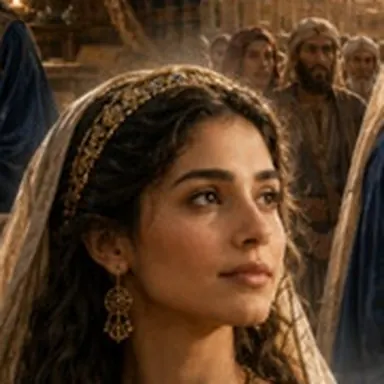
Serach bat Asher: Keeper of the Memory of the Generations, Inner Peace and the Tradition of Redemption
17 min read3,354 words
Summary
This text surveys the wondrous figure of Serach bat Asher as a central axis in the history of Israel, weaving together the period of the Patriarchs, the descent to Egypt and the final redemption. The article emphasizes her role as keeper of the memory of the generations and as bearer of the secrets of redemption, from the tidings of life she brought to Jacob to the decisive help she gave Moses in locating Joseph's coffin. Beyond the historical aspect, the work sketches her spiritual stature as a symbol of inner peace and as an eternal figure bridging the world of matter and the world of mystery, while examining her unique standing in halakha, Midrash and Kabbalah. The purpose of the work is to present Serach as a living link that ensures the continuity of the tradition and the spiritual strength of the nation throughout all the generations.
- Preserving the Collective Memory
- The Secret of the Code of Redemption
- The Inheritance of Eternal Life
- Bringing National Peace
- The Continuity of the Tradition of the Generations
Serach bat Asher: Keeper of the Memory of the Generations, Inner Peace and the Tradition of Redemption
The figure of Serach bat Asher is one of the most unique and fascinating phenomena in the Bible and in the literature of the Sages. Whereas the biblical text mentions her very briefly and only in passing, the interpretive and kabbalistic tradition granted her the status of an extraordinary meta-historical spiritual axis [cite: 1, 2, 3]. Serach is not merely a chronological figure who lived miraculously long, but serves as a living symbol of the preservation of collective memory, as a supreme source for bringing inner and national peace, and as the bearer of the divine code of redemption that links the period of the Patriarchs with the era of the Exodus from Egypt and the kingdom of David [cite: 2, 4, 5]. Her work and teaching reflect the preservation of the historical consciousness of the people of Israel and the spiritual power inherent in faithfulness to the tradition of the forefathers [cite: 5, 6].
Her Family Identity and Her Biblical Standing
An examination of Serach's family origins reveals a complex layer in the definition of her identity. According to the plain sense of Scripture she is counted among the seventy souls who went down to Egypt: "And the sons of Asher: Imnah, and Ishvah, and Ishvi, and Beriah, and Serach their sister" (Genesis 46:17) [cite: 1, 7, 8]. However, the traditions of the Sages and the commentators present a more complex family phenomenology. Targum Onkelos, as cited by Nahmanides (Ramban), suggests that Serach was not Asher's biological daughter but "the daughter of Asher's wife" [cite: 9, 10]. Sefer HaYashar expands this conception and specifies that Serach was born to Malkiel son of Elam son of Shem and to Hadurah daughter of Avimael, and when she was orphaned of her father at the age of three, her mother married Asher, and she grew up and was educated in the house of Jacob our father [cite: 9, 11].
This identification as a foster daughter resolves many textual difficulties and explains why she appears in the census of those receiving inheritances in the Book of Numbers: "And the name of the daughter of Asher was Serach" (Numbers 26:46) [cite: 7, 11, 12, 13]. Since her biological father died without male heirs, she was considered an independent heiress of an inheritance, similar to the later status of the daughters of Zelophehad [cite: 10, 11, 14]. Being part of the house of Jacob while possessing an independent line of descent gives her a unique standing as a link connecting different families and as one who embodies an integrative identity that crosses tribes [cite: 15].
Bringing the Tidings of Life to Jacob Our Father and the Inheritance of Immortality
Serach's first formative role in biblical history takes place with the return of the brothers from Egypt after the discovery of Joseph. The brothers faced a real existential fear: dramatic news that Joseph, who had been considered dead for twenty-two years, was still alive and ruler in Egypt might cause the heart of the aged Jacob to collapse [cite: 3, 14]. To prevent this shock, the brothers looked for a refined and gradual way of conveying the message, and turned to Serach, who was known for her wisdom and her talent for playing the biblical lyre [cite: 3, 9, 14].
According to Sefer HaYashar and Midrash HaGadol, Serach waited for the hour when Jacob stood in his prayer, a moment when his soul was open to receiving supernal spiritual frequencies [cite: 3, 5, 8]. She began to play the lyre and to sing in refined rhyming language: "Joseph is in Egypt, born to him upon his knees, Manasseh and Ephraim" (Yosef be-Mitzrayim, yuldu lo al birkayim, Menasheh ve-Efrayim) [cite: 3, 5, 8]. This melody penetrated the depths of Jacob's consciousness without arousing physiological resistance or emotional shock, and when he finished his prayer and saw the wagons, his spirit revived and the holy spirit rested upon him [cite: 3, 5, 8, 9].
The Midrash emphasizes that in return for this life-saving act, which made possible the continuity of Jacob's faith, Jacob blessed her with immortality: "This mouth that brought me tidings of Joseph that he lives shall not taste the taste of death" [cite: 7], and thus it was determined that death would never rule over her [cite: 9]. Targum Yonatan adds a splendid kabbalistic layer, according to which by the merit of these tidings that revived Jacob's spirit, Serach was privileged to enter the Garden of Eden alive, accompanied and guided by sixty myriads of angels [cite: 10, 11]. This fact illustrates the immense importance that the tradition attributes to bringing tidings of life and peace, parallel to the Exodus from Egypt itself, since the sixty myriads of angels reflect the number of those who went out of Egypt, who were destined to be redeemed by the merit of that continuity of generations that Serach helped to preserve [cite: 10].
Keeper of the Secret of Redemption and of the Memory of the Generations in Egypt
Beyond her physical longevity, Serach became the curator of the spiritual memory and of the secret codes of redemption. The midrashic tradition in Pirkei de-Rabbi Eliezer relates that the secret of redemption was handed down in a secret line from Abraham to Isaac, from Jacob to Joseph, and Joseph handed it to his brothers when he said, "God will surely remember you" (pakod yifkod Elohim etchem) (Genesis 50:25) [cite: 3, 5, 7, 17, 18]. Asher, Serach's father, received this secret and entrusted it to his daughter, understanding that she would live long and would serve as the exclusive seal of authentication for the future redeemer [cite: 3, 5, 18, 19].
When Moses and Aaron appeared before the elders of Israel and performed the physical signs, the people still hesitated [cite: 3, 5, 19]. The elders turned to Serach and asked her opinion about the man who had come and performed these signs [cite: 3, 5, 19]. Serach determined decisively: "There is nothing in these signs" [cite: 3, 5, 7, 19], since physical signs can be forged or produced by sorcery. But when they told her that Moses had used the expression "I have surely remembered you" (pakod pakadti etchem) (Exodus 3:16), she declared at once: "This is the true redeemer" [cite: 3, 5, 7].
The doubled letters pe-pe were the esoteric activation code of redemption [cite: 5, 7]. Serach served here as an epistemological bridge; without the spiritual certificate of identity that she supplied, the people of Israel would not have obeyed Moses, and the national process would have been halted on account of skepticism [cite: 5].
Rescuing Joseph's Coffin from the Depths of the Nile
This theme of preserving memory reaches its climax on the eve of the Exodus from Egypt. The Torah notes that while all Israel were occupied with despoiling Egypt and gathering property, Moses our teacher was occupied with searching for the bones of Joseph, in keeping with the verse "The wise of heart takes commandments" (Proverbs 10:8) [cite: 7, 20]. Moses searched for Joseph's coffin for three days to no avail [cite: 20]. Midrash Tanchuma and the Talmud in Tractate Sotah relate that Serach bat Asher, who was the last survivor of that generation, met Moses, worn out and exhausted [cite: 5, 8, 11, 12, 14, 19, 20, 21, 22].
She revealed to him that the Egyptians had made for Joseph a heavy metal coffin and sunk it in the Nile so that its waters would be blessed, and so that the people of Israel would never be able to leave Egypt, because of the oath not to be redeemed without his bones [cite: 3, 5, 8, 11, 12, 14, 18, 19, 20, 21, 22]. The Midrash details that the Egyptians used metal spikes and joined them with lead ("be-etz") to ensure the complete sinking of the coffin [cite: 5]. Moses stood on the bank of the river, called on Joseph to show himself so as to release the oath, and the coffin floated up miraculously [cite: 5, 12, 20, 22].
On this matter the Tosafists in Tractate Sotah raise a fundamental difficulty: Why did Moses have to go specifically to a woman to ask where Joseph was buried? [cite: 11, 20] After all, other sources note that other people of that generation remained alive, such as Yair son of Manasseh or Machir son of Manasseh, who was born already in the days of Jacob and was privileged to see Joseph [cite: 11, 20]. The Tosafot offer two answers that illuminate Serach's unique standing:
First, Moses did not go to look for her on his own initiative; rather, it was she who met him by chance after three days of fruitless searching and offered her help [cite: 20].
Second, even if there were great men in the generation, the secret of redemption and the details of Joseph's burial had been handed down and entrusted exclusively and traditionally into the hands of Serach, as the trustee of the tribes' memory [cite: 11, 20].
Serach bat Asher in the Study Hall of Rabbi Yochanan
Serach's presence in the study hall of Rabbi Yochanan once again underscores the vitality of collective memory [cite: 2, 19]. Whereas Rabbi Yochanan interprets the verse "and the waters were a wall unto them" (Exodus 14:22) as an opaque and fortified wall, Serach's intervention turns the discussion from theoretical thought into unmediated experience [cite: 2, 19]. Her determination that the waters were "like shining windows," transparent as glass, is not merely a physical correction of the picture of the situation, but a principled position: the Torah is a living reality, and the historical tradition is not a dry text but a transparent mirror through which the miracles of the past are reflected in bright light [cite: 2, 7, 19, 23].
Serach serves as the central link in a chain of transmission that shortens the chronological gap of the world to a few individual figures [cite: 5, 11]. According to a homily of the Sages, Jacob our father saw Serach, Serach saw Achiyah the Shilonite, Achiyah the Shilonite saw Elijah the prophet, and Elijah lives and endures until the coming of the Messiah [cite: 5, 11]. This chain grants a physical and spiritual continuity that dispels the sense of estrangement of the later generations and brings the future redemption nearer [cite: 5, 11].
The Wise Woman of Abel Beth Maacah and the Bringing of Peace
The integration that the Sages make between Serach bat Asher and "the wise woman of Abel Beth Maacah" (2 Samuel 20) reveals her role as one who brings inner peace and heals national rifts [cite: 1, 4, 5, 6, 8, 14]. The siege that Joab son of Zeruiah laid on Abel Beth Maacah threatened to bring catastrophic destruction on a great city in Israel on account of a single rebel [cite: 4, 5, 6]. Serach, as one who had lived for hundreds of years, addresses Joab from the top of the wall [cite: 4, 7, 8]. Her great age at that time is estimated as follows: $$T_{\text{years}} \approx 650 \text{ years}$$ This fact gave her an indisputable historical authority [cite: 5].
The Midrash on Proverbs applies to her the verse from Eshet Chayil (A Woman of Valor): "She opens her mouth with wisdom, and the teaching of kindness is on her tongue" (Proverbs 31:26) [cite: 1]. Her wisdom found expression in conducting a sophisticated rhetorical dialogue with the hard army commander [cite: 4]. She asks him: "Are you Joab?" (2 Samuel 20:17) [cite: 1, 4, 17], hinting to him that his deeds do not accord with his name (Yo'av – "the Lord is a father," representing mercy) or with his expected wisdom [cite: 4]. She presents herself as one of "those who are peaceable and faithful in Israel" (shlumei emunei Yisrael) [cite: 5, 7, 8, 24]. Beyond the plain meaning of loyalty to the kingdom of David, the Sages expound that "shlumim" and "emunim" symbolize the completion of the historical counts [cite: 5]: the completion of the count of the seventy souls in Egypt (in which she was the extra soul that completed it) and the completion of the sequence of spiritual transmission from Joseph to Moses [cite: 1, 2, 5, 7].
Through these acts Serach prevented terrible bloodshed [cite: 4, 6]. She held up a moral mirror before the military authority and proved that inner peace and the avoidance of national destruction are preferable to ruthless collective punishment [cite: 4, 6]. Her ability to persuade the people of the city to sacrifice the single rebel, Sheba son of Bichri, in order to save the whole forms a foundational halakhic basis in the laws of "handing over" (moser) and of saving lives in the public sphere [cite: 4, 6, 8].
Her Torah and Mystical Teaching in the Women's Palaces in the Garden of Eden
In the esoteric literature, and especially in the Zohar, Serach is given a central place in the world of souls [cite: 11, 15, 16]. The Zohar describes four supernal palaces reserved for righteous women, at whose head stand exemplary female figures: Bithiah daughter of Pharaoh, Jochebed the mother of Moses, Deborah the Prophetess, and Serach bat Asher [cite: 11, 14, 16, 25].
Serach's palace houses myriads of souls of women who are engaged in praises of the Creator of the world and in deep study of the precepts of the Torah and their reasons [cite: 11, 14, 16, 25]. According to the Zohar, three times a day it is proclaimed in the palace that "the likeness of the image of Joseph the righteous is coming" [cite: 11, 14, 16]. Serach goes out to the special curtain reserved for her, gazes at Joseph's radiant light and bows down in immense joy, declaring: "Happy is that day on which I brought my aged father the tidings that Joseph lives" [cite: 11, 14, 16].
On the mystical level, Joseph represents the sefirah of Yesod (the general source of influx of spiritual energy), while Serach represents the sefirah of Malkhut, which receives this abundance and preserves it in the aspect of "inner peace" [cite: 15, 16]. Study in Serach's palace focuses on the reasons for the commandments and their inner secrets, which shows that her Torah teaching is not merely dry halakhic teaching but an experiential-kabbalistic teaching that connects the material deed to its supernal metaphysical root [cite: 11, 14, 16, 25, 26].
The Tomb of Serach in Isfahan in Persia
The material dimension of Serach's eternity finds tangible expression in the tradition of the Jewish community of Isfahan in Persia [cite: 3, 16]. Her attributed burial site, known as "Serach's Chamber" or "the Synagogue of Serach bat Asher," located in the ancient cemetery of Pir Bakran, served for hundreds of years as one of the most important pilgrimage sites of Eastern Jewry [cite: 16, 23].
According to historical testimonies, a tombstone was found at the site marking Serach's death in the year 1133 CE [cite: 16, 23]. The place is regarded as a source of deliverance, prayer and healing, similar to the standing of Rachel's Tomb in Bethlehem [cite: 16, 23]. A wondrous local tradition relates that the entrance of the mausoleum would change its physical dimensions; when a person with negative intentions or corrupt character tried to enter, the entrance would "shrink" and block his way, whereas for people of good character and the pure of heart the entrance would widen and allow easy entry [cite: 16, 23]. This tradition shows that even in the distant exile of Persia, Serach was perceived as an active protector of the people and as one whose holiness and moral and physical righteousness remained whole and enduring for generations [cite: 2, 16, 23].
Summary and Conclusions
The analysis of the figure of Serach bat Asher reveals a broad theological conception of memory, peace and redemption [cite: 4, 5, 21]. She is no longer just a biblical heroine but a cosmic symbol embodying the chain of generations and the survival power of the Congregation of Israel [cite: 2, 15]. Her dynamic passages between the period of the Patriarchs, the days of servitude, the redemption, the period of King David and the study hall show that in Jewish consciousness history is not a collection of random events but one harmonious continuum directed toward complete redemption [cite: 2, 5, 18].
Serach teaches that preserving national memory and transmitting the precise tradition from generation to generation are a necessary condition for understanding the processes of redemption [cite: 5, 21]. At the same time, her wisdom and her bringing of peace in Abel Beth Maacah emphasize that the power of Torah is expressed not only in abstract theoretical knowledge, but in the practical ability to prevent destruction, to bring hearts closer and to create inner peace within Jewish society and beyond it [cite: 4, 6, 23]. Thus Serach bat Asher remains an eternal spiritual teacher, whose song and lyre continue to resound in the heart of the nation to this very day [cite: 9, 18].
Sources29
- 1.'ותָּבוֹא הָאִשָּׁה אֶל כָּל הָעָם בְּחָכְמָתָהּ': על האשה החכמה מאבל בית המעכה - ספריא, sefaria.org.il/sheets/217146
- 2.שרח בת אשר - אחת היא ופרסמה הכתוב - חב"ד - אור אין סוף, abc770.org/article_node_6119/
- 3.סרח - או שרח - בת אשר: סיפור חייה של דמות מרתקת, במדרש ובאגדה - BeitChabad.com - בית חב"ד, he.chabad.org/library/article_cdo/aid/2074346
- 4.האישה החכמה מאבל בית מעכה - ויקיפדיה, he.wikipedia.org/wiki/האישה_החכמה_מאבל_בית_מעכה
- 5.מי את סרח בת אשר? | הבלוג של אורי הייטנר - WordPress.com, heitner.wordpress.com/2010/03/20/מי-את-סרח-בת-אשר/
- 6.להמשיך את המסורת של סרח בת אשר - דרשות לשלוחים - Shluchim Sermons, shluchimsermons.org/he/2455
- 7.Serach, Jacob's Immortal Granddaughter - TheTorah.com, thetorah.com/article/serach-jacobs-immortal-granddaughter
- 8.שֶׂ֥רַח בַּת־אָשֵׁ֗ר סרח Serach bas Asher | חיבורים בספריא, sefaria.org.il/sheets/249119
- 9.שרח - ויקיפדיה, he.wikipedia.org/wiki/שרח
- 10.מ"ג במדבר כו מו - ויקיטקסט, he.wikisource.org/wiki/מ"ג_במדבר_כו_מו
- 11.האם שרח היתה בת אשר? ותולדות חייה היחודיים - דין | שאל את הרב, din.org.il/2023/12/22/האם-שרח-היתה-בת-אשר-ותולדות-חייה-היחודי/
- 12.אבי הראל: כמה זמן חיה סרח בת אשר? - ייצור ידע, xn--7dbl2a.com/2020/01/01/אבי-הראל-כמה-זמן-חיה-סרח-בת-אשר/
- 13.ושם בת־אשר שרח: (במדבר פרק כו פסוק מו) - מקראות גדולות הכתר, mgketer.org/tanach/4/26/46
- 14.8 Fascinating Facts About Serach, Daughter of Asher - Chabad.org, chabad.org/library/article_cdo/aid/5329601/jewish/8-Fascinating-Facts-About-Serach-Daughter-of-Asher.htm
- 15.The Asher Personality - GalEinai, inner.org/the-asher-personality/
- 16.Serah bat Asher III: Serah in Exile or The Death of Serah - Jewish Monster Hunting, jewishmonsterhunting.com/2020/01/19/serah-bat-asher-iii-serah-in-exile-or-the-death-of-serah/
- 17.סרח בת אשר | מקורות מתוך ספריית ספריא, sefaria.org.il/topics/serah-the-daughter-of-asher
- 18.Parashat Pinchas 5784 - Liberal Judaism, liberaljudaism.org/2024/07/parashat-pinchas-5784/
- 19.פרשת ויגש: מי את, שרח בת אשר? - בעניינים, baicc.org/5348/פרשת-ויגש-מי-את-שרח-בת-אשר/
- 20.סוטה יג א - ויקיטקסט, he.wikisource.org/wiki/סוטה_יג_א
- 21.פרק 15 – קריאה – דברי הימים – אנשים I אירועים I יצירות, ilanabc.co.il/פרק-15-קריאה/
- 22.מסכת סוטה דף יג - הדף היומי ב15 דקות - שיעורי דף יומי קצרים בגמרא, sinai.org.il/daf-yomi-sota-13/
- 23.serach bat asher – Jewish Monster Hunting, jewishmonsterhunting.com/tag/serach-bat-asher/
- 24.Those Who Went to Gan Eden Alive | חיבורים בספריא, sefaria.org.il/sheets/14693
- 25.The Heavenly Academies - Mayim Achronim, mayimachronim.com/the-heavenly-academies/
- 26.זהר פרשת ויקהל/חלק שני - ויקיטקסט, he.wikisource.org/wiki/זהר_פרשת_ויקהל/חלק_שני
- 27.צדיקים שנכנסו בחייהם לגן עדן - ויקיפדיה, he.wikipedia.org/wiki/צדיקים_שנכנסו_בחייהם_לגן_עדן
- 28.Those Who Went to Gan Eden Alive | האוסף של ספריא, sefaria.org.il/Sheet.14693
- 29.מרים הנביאה - ויקיספר, he.wikibooks.org/wiki/מרים_הנביאה