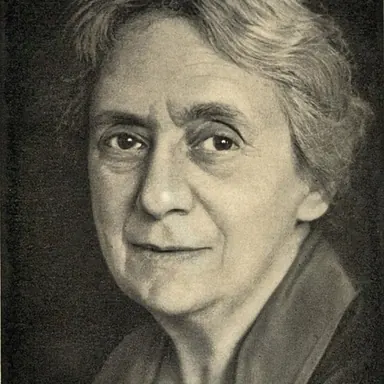
Document 1/2
Henrietta Szold: A Legacy of Pioneering, Feminism and Social Action
14 min read2,798 words
The Work, Torah Teaching and Educational-Gender Thought of Henrietta Szold: A Historical and Theological Analysis
The article surveys the figure of Henrietta Szold not only as a practical Zionist leader, but as a Torah thinker and trailblazer who forged a unique synthesis between Jewish tradition and modern feminism. By examining the stations of her life, from her scholarly education in Baltimore to her pioneering studies at the rabbinical seminary, the text reveals how her halakhic positions—and especially her formative Kaddish letter—gave religious validity to the active participation of women in the sacred sphere. The author emphasizes that Szold's public work in the "Hadassah" organization and in the "Youth Aliyah" enterprise was not detached from religion, but constituted a moral application of the values of kindness and repair that draw their inspiration directly from the Jewish bookshelf. In this way, the article presents a model of spiritual leadership that combines a deep commitment to the chain of generations with an egalitarian and humanistic worldview.
Henrietta Szold (1860–1945) has been recorded in the pages of Zionist history mainly as a practical leader, the founder of the women's organization "Hadassah" and the head of the "Youth Aliyah" enterprise.[1, 2, 3] However, an in-depth examination of her life story, her writings and her public decisions reveals that her public work was a direct expression of an ordered Torah teaching, a broad scholarly education and a pioneering feminist theological worldview.[4, 5] Szold presented a unique model of spiritual Zionism that drew its legitimacy from the Jewish bookshelf and from a deep commitment to preserving the chain of tradition and adapting it to the modern era.[4, 5, 6]
Scholarly Roots and Early Education in Baltimore
Szold was born in Baltimore, Maryland, the eldest of the eight daughters of Rabbi Benjamin Szold, a conservative congregational rabbi and a prominent scholar.[1, 7] In the absence of sons, Szold became her father's intellectual protégée, serving him as editor and translator of his studies.[6, 7] Rabbi Szold gave his daughter a Jewish education that was profound and exceptional for women at that time, which included the study of Hebrew, Scripture and the sources of the Sages.[1, 7] Alongside this, with his encouragement, she became the first Jewish girl in her community to study at the local general high school, where she graduated with honors at the age of sixteen, in parallel with Jewish studies at a religious school (ulpana).[8]
Since the gates of higher education were closed to women in those days, Szold began to work as a teacher of mathematics and languages at a girls' school, and for fifteen years she taught at the religious school of the "Oheb Shalom" congregation, where she gave courses in Bible and Jewish history for adults.[1, 8] Her early public and intellectual activity incorporated a deep national consciousness; she was a member of a Hebrew literary society, and in 1893 she was a founding member of the Zionist society "Chevrat Zion" (Hebras Zion) in Baltimore—about two years before the writing of Theodor Herzl's book "The Jewish State."[7] This fact testifies that Szold's Zionist consciousness preceded political Zionism and grew out of a deep cultural and Torah attachment to the heritage of Israel.[4, 9]
In 1893 Szold began to serve as the first editor and secretary of the Jewish Publication Society of America (JPS), a position she held for more than 23 years.[1, 7] In this framework she edited, translated and supervised the publication of most of the important books of the period, among them the translation into English of Tzvi Graetz's monumental work "History of the Jews" (Divrei Yemei Yisrael), and the publication of the "American Jewish Year Book."[7] This work demanded of her unprecedented theoretical and historical erudition, and placed her at the central crossroads of the dissemination of knowledge and Torah to the Jewry of the United States.[7]
- Period of her life
- Main role and activity
- Influence and contribution to her Torah and public teaching
- Her youth and early adulthood
Student at a religious school (ulpana), teacher at the "Oheb Shalom" religious school and research assistant to her father.[1, 7, 8]
Acquiring a broad scholarly education in Scripture and languages, and establishing her commitment to teaching the heritage of Israel.[1, 7]
1893–1916
Chief editor and secretary of the Jewish Publication Society (JPS).[1, 7]
Mediating Jewish culture and history to the Anglo-Saxon public through editing and translating the writings of Graetz.[7]
1904–1909
Studies at the Jewish Theological Seminary of America (JTS) and work with Prof. Louis Ginzberg.[8, 10]
A gender breakthrough in academic Talmud studies and the development of independent Torah-research tools.[7, 8]
1912 onward
Founding of the Zionist women's organization "Hadassah" and establishment of health institutions.[4, 5, 11]
Translating the Jewish values of tzedakah (charity), chesed (kindness) and tikkun olam (repairing the world) into a modern health and welfare enterprise.[5, 9]
1933–1945
Directing the "Youth Aliyah" enterprise in the Land of Israel.[3]
Rescuing tens of thousands of youths while taking pedagogical care to match the education to the religious background of the home.[10]
The Breakthrough in the Torah Academy and the Relationship with Prof. Louis Ginzberg
In 1902, out of a desire to deepen her Torah knowledge at the highest level that then existed in the United States, Szold and her mother decided to move to New York and to live near the Jewish Theological Seminary of America (JTS).[7] At that time Prof. Solomon (Shneur Zalman) Schechter was appointed president of the institution.[7] Schechter immediately recognized Szold's scholarly stature, and when she asked to be admitted to study at the institution—which was then a school for rabbis intended for men only—he agreed to admit her.[7, 10] Her admission in 1904 was conditioned on a formal declaration that she would not seek to receive rabbinic ordination upon completing her studies, and thus she became the first woman to study at this Torah institution.[8, 10]
In the framework of her studies at JTS, Szold was especially moved to study Talmud, a subject that was completely closed to women in the traditional religious world.[8] In the classroom she met Prof. Louis (Levi) Ginzberg, a young and brilliant Talmud scholar who was 13 years younger than she.[8] A close relationship developed between the two on two planes: on the professional plane Szold served as editor and principal research assistant for his books, and on the personal plane she developed deep feelings of love toward him, as she expressed in a revealing personal letter she wrote to him in July 1905, in which she noted that he was the first to give her soul its womanhood.[8]
The complex relationship continued for about four more years, until in 1909, upon Ginzberg's return from a journey in Europe, he informed her of his engagement to another woman.[8] The event struck Szold with astonishment and caused her deep heartbreak.[8, 12] Her sisters and her mother felt that he had deceived her, but Szold displayed exceptional nobility of spirit and spoke in his defense.[8] In a letter she wrote to her mother in February 1909 she expressed her wish to continue to trust in his friendship, and explained that she was sure a sudden enthusiasm had swept him away and that he was incapable of admitting that he had wronged her.[8] She even deliberated whether to remove her name from his book that was about to be published, and asked her mother in pain: "Do you see in me my father's daughter?"[8] This personal crisis was a turning point in her life, after which she turned to intensive practical Zionist activity and made her first visit to the Land of Israel.[7]
Halakhic and Gender Theology: The Test Case of the Kaddish Letter
In 1916, following her mother's death, Szold's Torah and halakhic teaching was put to a practical and formative test.[5, 6] A friend of the family, Haim Peretz, approached her with a noble offer to serve as "Kaddish" for her mother, on the assumption that in the absence of sons in the family there would be no one to fulfill the commandment as is customary in Orthodox tradition.[5, 6, 13] In response, Szold sent him a detailed letter of refusal on 16 September 1916, which constitutes a first-rate halakhic and theological manifesto for the combination of feminism and commitment to tradition.[5, 6, 11]
In this letter Szold presented a developed hermeneutic conception of halakha and Jewish custom, founded on three main arguments:
First, Szold redefined the theological meaning of the Kaddish prayer.[6, 14] In her view, the Kaddish is not a mystical rite intended solely for the elevation of the soul of the deceased, but a public and binding declaration by the survivor of his intention and desire to adopt the communal and spiritual attachment that his parents had.[5, 6, 14] This declaration is intended to ensure that the chain of tradition remains unbroken from generation to generation.[6, 13] Therefore, this duty rests on the direct biological descendants of the deceased and cannot be transferred to another; Peretz's duty is to preserve the chain of generations of his own family, while on her and her sisters rests the duty of preserving that of their family.[6, 13]
Second, Szold presented a categorical halakhic distinction between "exemption" and "prohibition" regarding women's obligation in the commandments.[6, 11] She held that the Torah and custom never intended to exclude women from these religious duties.[6, 11] In her view, women were released from time-bound positive commandments out of consideration for the conditions of their lives and their family roles, which did not allow them to keep fixed times, but this release was merely an exemption.[5, 6, 11] Therefore, when a woman is able and capable of fulfilling the commandment, her fulfillment is valid, valuable and meaningful exactly as its fulfillment by a man.[5, 6]
Third, Szold relied on the personal legacy of her parents as a legitimate basis for a ruling.[5, 6] She noted that her parents raised eight daughters and never expressed regret that no son had been born to them.[5, 6] Moreover, when her father died, her mother refused to allow strange men to say Kaddish in place of her daughters.[5, 6] Therefore, by saying Kaddish herself, Szold felt that she was acting in complete harmony with the spirit and will of her parents.[5, 6]
This letter won enormous appreciation over the years, and became a source of inspiration for key legal and public figures.[5, 13] Justice of the Supreme Court of the United States Ruth Bader Ginsburg noted that the letter was a deep personal source of inspiration for her.[5, 13] Ginsburg defined Szold's reply as a "wonderfully and perfectly worded rejection" (pitch-perfect putdown), combining a firm stand for women's rights with courtesy, gratitude and a rational explanation intended to bring the other closer to her position and not to arouse antagonism.[13] She saw Szold, alongside Emma Lazarus, as the two Jewish figures who most influenced the shaping of her legal and social worldview.[13]
- Intellectual stream / figure
- Status of halakha and tradition
- Status of women in religious life
- Model of leadership and social justice
- The conservative Orthodox stream (early 20th century)
Strict preservation of the status quo; opposition to any change in customs out of fear of Reform.[5, 6]
Exclusion of women from the study of the Oral Torah and from filling public liturgical roles such as Kaddish.[6, 7]
Traditional patriarchal leadership based on male rabbinic authority alone.
The secular Zionist stream in the Land of Israel
Negation of the exile and its customs; viewing halakha as a historical burden to be freed from in favor of "the new Hebrew."
Equal rights for women out of a socialist view and pioneering practice, without connection to the world of the commandments.
Revolutionary leadership focused on physical and national building, while severing itself from the religious heritage.
Henrietta Szold (the teaching of synthesis)
Deep commitment to tradition and halakha, with a dynamic interpretation that allows adaptation to the spirit of the time.[4, 5, 6]
Inclusion of women in Torah study and active observance of commandments, out of understanding the exemption as a leniency and not as a prohibition.[6, 7, 11]
Leadership combining Torah education, universal Jewish ethics and modern social and health action.[5, 9]
Halakhic Educational Thought in the Youth Aliyah Enterprises
In 1933, at the age of 73, Szold was appointed by the Zionist Executive, headed by Chaim Weizmann and Arthur Ruppin, to direct the "Youth Aliyah" enterprise.[2, 3] The enterprise, which was intended to rescue Jewish youth from Nazi rule in Europe and later from Arab countries, confronted Szold with complex pedagogical and theological challenges.[3] Szold, who defined herself as having "a strong constitution, devotion to duty and a great conscience" alongside "organizational ability and a capacity for holy wrath," applied her moral and religious principles to the management of the entire enterprise.[5]
At the outset, critical voices were heard from various quarters of the Zionist movement, who claimed that in view of the immediate danger to life in Europe, the youths should be brought up to the Land as quickly as possible without attention to educational conditions or prior screening.[10] Szold firmly rejected this approach.[10] She believed that the physical rescue of a child without preserving his spiritual and cultural world is an injury to his soul.[10] She personally investigated the family background of every boy and girl in order to find out whether they came from a religious or a secular home, and insisted on matching them with a parallel framework of study and absorption in the Land—whether in religious kibbutzim or in general frameworks.[10]
This pedagogical approach stemmed from her view that education in the Land of Israel must be a direct and stable continuation of the parental home, in order to prevent emotional crises and loss of identity among the youths who had been forced to part from their families.[10] She saw herself as personally responsible for every child, met them at the ports and personally answered thousands of letters they sent her, in which she would instill confidence in them and advise them: "Always be yourself."[10, 15] Under her leadership, the enterprise absorbed about 30 thousand children and youths, integrating advanced social work, psychological clinics and a response tailored to their spiritual needs.[2, 3]
The Value-Based Application of Her Teaching in the Health System and in Society
Szold's Torah teaching, which emphasizes the values of kindness, mutual aid and moral obligation, found its full expression also in the founding of the "Hadassah" organization and in building the public health system in the Land of Israel.[3, 4, 5] Szold believed that the Zionist idea cannot be reduced to a narrow national-political definition, but must carry a moral message of social repair and healing.[4, 5, 9] Under her leadership, "Hadassah" established an advanced medical infrastructure intended to serve all the inhabitants of the Land—Jews and Arabs alike—out of a deep humanistic conception that sees health as a basic human right reflecting the values of Jewish ethics.[5]
This conception laid the foundations for a shared and egalitarian society, and its influence is evident to this day; the Hadassah hospital operates as a microcosm of a shared society in which staff and patients of all religions and ethnic backgrounds work and recover together, with the institution serving as the central pillar of medical research in Israel and concentrating about 55% of all medical research projects in the country.[7]
Ultimately, the figure of Henrietta Szold represents a rare and complete synthesis of traditional Jewish scholarship, groundbreaking gender thought and pioneering action in the field.[3, 6, 7] She proved that the struggle for gender equality and social justice does not require disconnection from the world of halakha and tradition, but on the contrary—it can and should draw its strength and its legitimacy from the depths of Jewish thought and from the historical chain of generations.[4, 5, 6]
Sources15
- 1.הנרייטה סאלד: מייסדת הדסה ואם עליית הנוער - מוזיאון ידידי ישראל - Friend of zion museum, fozmuseum.com/he/הנרייטה-סאלד/
- 2.ייסוד עליית הנוער - הארכיון הציוני, zionistarchives.org.il/datelist/Pages/AliyatHanoar.aspx
- 3.הנרייטה סאלד - הספרייה הלאומית, nli.org.il/he/discover/israel/figures/henrietta-szold
- 4.Israel - Jewish Theological Seminary, jtsa.edu/post-torah/theme/israel/page/2/
- 5.Henrietta Szold on Saying Kaddish | Jewish Women's Archive, jwa.org/teach/golearn/feb06
- 6.Henrietta Szold's letter to Haym Peretz on saying Kaddish for her mother, jwa.org/media/henrietta-szold-s-letter-to-haym-peretz-on-saying-kaddish-for-her-mother
- 7.Henrietta Szold's Zionism and Ours: A Hadassah and JTS Conversation - YouTube, youtube.com/watch?v=IQlWuqzDAg0
- 8.מבט אישי: הנרייטה סאלד - הארכיון הציוני, zionistarchives.org.il/AttheCZA/Pages/הנרייטה-סאלד.aspx
- 9.Henrietta Szold's Zionism and Ours: A JTS and Hadassah Event, hadassah.org/story/henrietta-szolds-zionism-and-ours-a-jts-and-hadassah-event
- 10.הנרייטה סאלד - ויקיפדיה, he.wikipedia.org/wiki/הנרייטה_סאלד
- 11.Podcast Ep #24: In Miriam's Footsteps: Jewish Women's Leadership & the Pursuit of Justice, hebrewcollege.edu/blog/in-miriams-footsteps/
- 12.הנריטה סאלד - הספרייה הלאומית, merkazruach.nli.org.il/windows-2-0/hnryyth-sld
- 13.Say Kaddish for Ruth Bader Ginsburg - Kveller, kveller.com/how-to-say-kaddish-for-ruth-bader-ginsburg/
- 14.Why Do We Say Kaddish? - Park Avenue Synagogue, pasyn.org/sermons/2021/why-do-we-say-kaddish/
- 15.להאיר מרחבים חשוכים - הנרייטה סאלד - מכון הרטמן, heb.hartman.org.il/henrietta-szold/