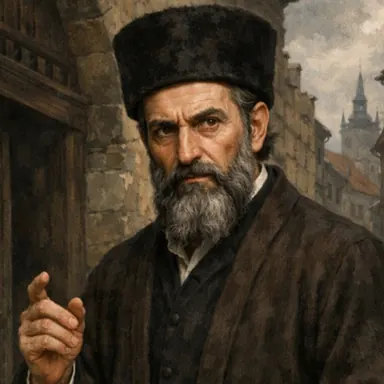
"A Watcher and a Holy One Came Down from Heaven": The Work, Thought and Torah Teaching of Rabbi Shlomo Ephraim of Luntschitz
20 min read4,013 words
Summary
The text surveys the life and teaching of Rabbi Shlomo Ephraim of Luntschitz, author of the renowned commentary "Kli Yakar," who was active in Poland and Prague in the 16th and 17th centuries. The article describes the rabbi's development from an itinerant preacher into a communal leader and head of a yeshiva, with emphasis on the influence of his teacher the Maharshal and on his formative move to the rabbinic seat of Prague as the successor of the Maharal. At the heart of his thought stands a sharp social and moral critique, which denounces the pursuit of money, the corruption of leadership and intellectual scholarship detached from the fear of Heaven. The aim of the source is to present his figure as a bridge between the plain meaning of Scripture and the refinement of character, while highlighting the educational reforms he proposed and his deep attachment to the Land of Israel and to redemption.
The figure of Rabbi Shlomo Ephraim of Luntschitz, known by his immortal epithet "the Kli Yakar," stands as one of the central pillars of Jewish thought in the early modern period. His many-sided work as a biblical commentator, a supremely gifted preacher, a fearless communal leader and a profound head of a yeshiva shaped to a great extent the character of the Jewry of Poland and Bohemia at the end of the 16th century and the beginning of the 17th century.[1, 2, 3] His Torah teaching, interwoven with penetrating social criticism and an uncompromising demand for moral integrity, makes him a unique figure who bridges the classical world of Talmudic scholarship and the world of mussar and homiletics addressed to the wider public.[4, 5]
Chapter 1: Biographical Foundations and Stations of Life
Rabbi Shlomo Ephraim was born in the town of Luntschitz (Łęczyca) in Poland, around the year 5310 (1550).[5, 6, 7] His birth took place in a period of spiritual and cultural flourishing in Polish Jewry, but also in the midst of political difficulties; certain traditions note that he was born while his parents, Rabbi Aharon and his wife, were in prison, which hints at the upheavals that befell the Jewish community at that time.[5, 8, 9] In his youth he was called only Ephraim, and his second name, Shlomo, was added only at a later stage following a formative medical event.[5, 8, 10]
The Years of Study and the Influence of the Maharshal
The first significant station in the shaping of his Torah personality was the yeshiva of Rabbi Shlomo Luria, the Maharshal, in the city of Lublin.[5, 9, 11] The Maharshal was known for his critical and independent approach, his aversion to empty pilpul and his striving to return to the primary sources – Scripture, the Mishnah and the Talmud – in their original sense.[5] Rabbi Shlomo Ephraim adopted this approach in full, and it became a central axis in all his later writings, in which he attacks again and again the intellectual amusement that does not lead to the fear of Heaven or to the refinement of character.[5, 11] The Maharshal's influence is also evident in the readiness of the "Kli Yakar" to disagree with Rishonim and Acharonim when the plain meaning or the moral truth demanded it.[4]
After his period of study, Rabbi Shlomo Ephraim moved to Jarosław in Galicia, where he began to become famous as an exceptional preacher.[8, 9] His rhetorical ability to sweep the masses along, together with an interpretive depth that made Scripture accessible to everyday life, made him one of the most sought-after figures on the pulpits of the synagogues of Poland.[2, 9, 12] He wandered among the great communities – Lublin, Lvov and Jarosław – and acquired a reputation as a public reprover who shows no favor to the rich or to the leaders.[5, 9, 13]
The Formative Illness and the Move to Prague
In 5361 (1601), while living in Lublin, Rabbi Ephraim was bedridden with a dangerous illness that threatened his life.[5, 10, 13] During this illness the name "Shlomo" was added to his name as a segulah (a spiritual remedy) for healing.[5, 7] Upon his recovery, he vowed to devote his strength to writing a commentary on the Torah that would express his gratitude to the Creator for saving him.[10, 13] This event was not only a personal turning point, but also a literary one; it marked the transition from an itinerant preacher to the author of one of the most influential works in the history of Jewish exegesis – the "Kli Yakar."[12, 13, 14]
In 5364 (1604), an official invitation arrived from the illustrious community of Prague.[6, 8, 13] He was called to serve as head of the yeshiva and head of the rabbinic court alongside the Maharal of Prague, who was then in his old age.[5, 6, 14] The combination of the Maharal, the profound thinker and philosopher, and Rabbi Shlomo Ephraim, the sharp preacher and moralist, created a spiritual golden age in Prague.[5, 12] After the Maharal's death in 5369 (1609), Rabbi Shlomo Ephraim was appointed chief rabbi of the city, a post he held until his death in 5379 (1619).[5, 6, 11]
Chapter 2: The Literary Legacy – From Midrash to Social Reproof
The writing of Rabbi Shlomo Ephraim is characterized by a rare fusion of interpretive depth, sweeping rhetoric and radical social criticism. His books are not merely collections of homilies, but moral manifestos that seek to repair the failings of the community and of the soul.[4, 12, 14]
"Kli Yakar": A Torah Commentary as an Act of Thanksgiving and Moral Instruction
The most famous work, which made his name a household word for every student of Torah, is the "Kli Yakar" on the Five Books of the Torah (Lublin, 1602).[4, 11, 12] The book was written out of a sense of mission after his recovery from his grave illness.[10, 13] The name of the book derives from a combination of his names: "Ephraim" is alluded to in the verse "Is Ephraim a dear son to me," and "Shlomo" is alluded to in the verse in Proverbs "but the lips of knowledge are a precious vessel (kli yakar)."[12, 14]
The "Kli Yakar" is not a simple plain-meaning commentary in the classical sense, but a work that uses the verses of the Torah as a platform for discussing the problems of the generation.[4, 14] The author testifies in his introduction that his words are "very close to the plain meaning," but in practice he weaves into the plain meaning dozens of midrashim of the Sages, philosophical ideas and sharp reproofs.[3, 4] He engages in dialogue with the giants of exegesis who preceded him – Rashi, Ramban, Abravanel and Sforno – and often proposes original solutions to textual difficulties that they left open.[4, 16]
"Olelot Ephraim" and "Ir Gibborim": The Beginning of His Path as a Preacher
His book "Ir Gibborim" (Basel, 1580) is an early work dealing with matters of ethics and homilies on the Torah.[8, 11] Already there his tendency is evident to emphasize the heroism of the person who conquers his inclination, as opposed to empty physical heroism.[8, 11]
"Olelot Ephraim" (Lublin, 1590) is a monumental collection of sermons on the festivals of the year and on the events of the Jewish life cycle (circumcision, marriage and more).[5, 11] The book is known for its sharp criticism of customs of revelry and drunkenness on festival days, and of the lack of intention in prayer among the common people.[5] These sermons reveal the "Kli Yakar" as a preacher who is not afraid to confront his audience, and they are written in a rich style that combines proverbs and midrashim.[5, 14]
"Amudei Shesh": Social Philosophy in a Time of Plague
The work "Amudei Shesh" (Prague, 1617) was written in tragic circumstances, when Rabbi Shlomo Ephraim was forced to flee Prague to the small town of Bischitz because of the plague that broke out in the city in 1607.[8, 15] The book is based on the six pillars of the world mentioned in the Mishnah in tractate Avot: Torah, divine service, acts of loving-kindness, justice, truth and peace.[5, 15] In each of these "pillars" he sets out an orderly teaching on the way in which Jewish society should conduct itself in order to merit divine protection.[15] This is one of the rarest and most profound books of homiletics, combining halakha with practical social philosophy.[15]
Chapter 3: Exegetical Method and Modes of Thought
Rabbi Shlomo Ephraim's method in his commentary on the Torah is a complex synthesis of the worlds of PaRDeS, where the central emphasis is always on the moral and educational aspect.[3, 4]
The Plain Meaning as an Instrument in the Service of Ethics
Although Rabbi Shlomo Ephraim testifies of himself as one who strives for the plain meaning, his plain meaning is not dry and linguistic but a "living" plain meaning.[4] He sees the words as the vehicle for conveying deeper messages. He often raises difficulties about the order of the words in a verse or about linguistic redundancies, and finds in them allusions to social behaviors.[4, 16] For example, in his commentary on the portion "Lekh Lekha," he analyzes the detailed phrase "from your land, from your birthplace and from your father's house" not merely as a geographical designation, but as a gradation of psychological difficulties that a person is required to overcome in order to attain cleaving to God.[16]
He treats Rashi with great respect, but does not hesitate to propose an alternative interpretation if he finds that Rashi's interpretation does not accord with moral logic or with the plain meaning of Scripture.[3, 4] He frequently uses the method of Don Isaac Abravanel, who poses a series of questions at the opening of each portion, as a tool for stimulating the learner's thought.[4]
His Position Toward Midrash and Kabbalah
Rabbi Shlomo Ephraim incorporates many midrashim into his commentaries, but he does so with caution.[4] He tries to reconcile contradictions between the midrash and the plain meaning, and stresses that the midrash is intended to illuminate a particular moral point and not necessarily to describe a historical fact.[4]
With regard to Kabbalah, his position is fascinating; although he lived in a period in which the esoteric teaching began to spread (in the days of the Shelah and the disciples of the Arizal), he uses it sparingly.[3, 4] He cites "the masters of Kabbalah" mainly on subjects connected with the structure of the Tabernacle or with prayer, but refrains from making his commentary kabbalistic.[4] For him, the main thing is making the Torah accessible to the masses, and Kabbalah, being a hidden teaching, is not always the appropriate instrument for this.[4]
Chapter 4: Social Ethics and the Critique of the Classes
Rabbi Shlomo Ephraim of Luntschitz will be remembered for generations as one of the sharpest and most courageous critics of Jewish society.[4, 5] He did not spare the rod of his criticism from any social stratum, and saw moral corruption as the greatest threat to the existence of the people.[4, 14]
The War on the Lust for Money and Materialism
One of the most recurrent motifs in the "Kli Yakar" is the denunciation of the pursuit of money.[4] He saw wealth as an enormous spiritual obstacle, and determined emphatically that "Torah and wealth flee from one another."[4] In his view, wealth causes a person to forget his Creator, encourages pride and leads to the exploitation of the poor.[4] He sharply criticized the rich who boasted of their money but were stingy with charity, and those who thought that their money would buy them spiritual standing.[4]
He denounced phenomena of the pursuit of luxuries and the adoption of the ways of life of the gentiles around them.[4, 5] His criticism was social and economic in essence: he identified how class gaps create estrangement of hearts among the people of Israel, and argued that without social solidarity there is no point to the religious commandments.[4]
Critique of the Leadership and the Rabbinate
Rabbi Shlomo Ephraim did not hesitate to attack his own colleagues in the rabbinic class as well.[4, 5] He warned sharply against the phenomenon of appointing rabbis and judges not according to their greatness in Torah, but according to their connections or their money.[4] He saw the purchase of rabbinic posts as a grave sin that undermines the foundations of justice in Israel.[4]
Likewise, he criticized the rabbis and preachers who use their sermons to flatter the rich instead of reproving them for their deeds.[4] He demanded absolute integrity from the leadership of the community – the "heads of the kahal" – and a preference for the common good over their personal good.[5] In his sermons in Lvov and in Prague, he more than once stood before the parnassim (communal leaders) and hurled harsh words at them about the neglect of the poor and the perversion of justice.[5, 9]
Chapter 5: The Struggle Against the Method of Pilpul and the Educational Reform
Like his teacher the Maharshal and his partner the Maharal, Rabbi Shlomo Ephraim was one of the chief fighters against the method of study that was prevalent in the yeshivot of Poland at that time – the method of pilpul.[5, 11]
The Opposition to Empty Pilpul
He saw empty pilpul as both a spiritual and an intellectual danger. In his view, pilpul causes the learner to occupy himself with things that are not true, only in order to display sharpness of mind.[5] He argued that this method distances the learner from understanding the Torah in its plain sense and prevents him from arriving at a settled halakhic ruling.[5] In his books he stresses again and again the need to return to "the straight path" – study based on understanding the sources in their depth, without needless sophistry.[5]
Changing the Order of Study for Children
Rabbi Shlomo Ephraim proposed a comprehensive educational reform.[5] He firmly opposed the custom of teaching young children Talmud and pilpul before they had a good command of Scripture and the Mishnah.[5] He saw this as an educational distortion that causes children to lose the basic connection with the foundations of faith and Torah.[5] In his view, one must follow the order of study established by the Sages: "At five years old, Scripture; at ten, Mishnah; at fifteen, Talmud."[5] This position placed him on a single front with the Maharal, who waged a similar struggle in Prague.[5]
Chapter 6: The Conception of Prayer, Faith and Trust
For Rabbi Shlomo Ephraim, prayer is not merely a religious ceremony but a living stance before the Creator, which demands full intention and humility of spirit.[5, 17]
Prayer as "Service of the Heart"
He sharply criticized those who pray without intention, and called this "prayer that stands at the summit of the world, yet people treat it with contempt."[5, 18] He stressed that speech in prayer is an expression of the soul, and that one whose lust is for money will not be able to pray truly, for his heart will be given over to his business.[18] In his view, prayer is the secret "weapon" of the people of Israel, but the power of this weapon is conditional on purity of heart.[17]
He encouraged the public to put prayer before every action, and not to wait for a crisis in order to cry out to God.[17] His conception of prayer was very personal; he believed that every person can break through the gates of Heaven if he comes out of a broken heart and humility.[13, 17]
Faith and Providence in Times of Crisis
Rabbi Shlomo Ephraim's thought was tested in real time during difficult events that befell Prague.[11] In 1611 (5371), regiments of the Passau army invaded the city, and a massacre was carried out against some of the inhabitants.[11] The Jewish community was in enormous danger, but was saved miraculously.[11] Rabbi Shlomo Ephraim composed two special selichot (penitential prayers) in memory of the miracle and the riots, and established a fast day on 2 Adar.[11]
In these selichot he expresses his deep faith in divine providence, but also his demand for communal soul-searching.[19] He argued that the security situation of the people of Israel is directly connected with the state of modesty and holiness within the camp: "Therefore shall your camp be holy... that He see no unseemly thing in you, and turn away from you."[19] For him, divine protection is not automatic, but conditional on constant moral improvement.[19]
Chapter 7: The Land of Israel and Redemption in the Teaching of the Kli Yakar
Another subject that receives a central place in his writings is the attitude toward the Land of Israel and redemption.[4] Although he lived in the heart of Europe and attained senior standing, he did not cease to call for the return to Zion.[4]
The Critique of Remaining in Exile
Rabbi Shlomo Ephraim leveled penetrating criticism at the Jews of his generation who do not truly aspire to return to the Land of Israel.[4] He argued that material comfort in exile makes the people forget its true destiny.[4] In his commentaries he explains that the sin of the spies repeats itself in every generation, when Jews prefer the "fleshpot" of exile to the holiness of the Land of Israel.[4]
He saw the Land of Israel as the only place in which the people of Israel can fully realize its spiritual potential.[4] Redemption, in his view, depends to a great extent on the will of the people of Israel to return to its land and to repair its social qualities.[4]
Chapter 8: The Ties with the Maharal and His Influence on His Generation
Rabbi Shlomo Ephraim's stay in Prague alongside the Maharal was a central chapter in his life.[5, 6, 12] Although each of them was an independent personality with a different style, there was a deep spiritual synergy between them.[5, 12]
Joint Work in Prague
When Rabbi Shlomo Ephraim arrived in Prague in 1604, the Maharal was already about ninety years old.[5] The Kli Yakar served as his assistant and as head of the yeshiva, and took upon himself the burden of preaching and the moral guidance of the community.[5, 6] Both shared the same aversion to pilpul and the same aspiration for social repair.[5] After the Maharal's death in 1609, Rabbi Shlomo Ephraim became his natural heir and continued to lead the community in the same spirit.[5, 6, 11]
Under his leadership, Prague became a Torah center that attracted students from all over Europe.[9, 20] Among his prominent students one can count Rabbi Yom-Tov Lipmann Heller, author of the "Tosafot Yom Tov" on the Mishnah, who absorbed from his teacher the direct approach to the sources and the courageous stand for truth.[5, 9, 20] Another student was Rabbi Shabtai Sheftel Horowitz, son of the Shelah and author of the book "Vavei HaAmudim," who continued the path of the Kli Yakar in mussar and homiletics.[5, 9]
Chapter 9: His Figure in the Mirror of Scholarship and the Generations
The influence of Rabbi Shlomo Ephraim did not fade with his death.[3, 4, 20] His books continued to be printed again and again, and the "Kli Yakar" became an inseparable part of every "Mikraot Gedolot" Chumash.[3, 4]
The Reception of the Book "Kli Yakar"
The reason for the immense success of the "Kli Yakar" lies in its ability to speak to all strata of the people.[3, 20] Scholars found in it deep novellae and resolutions of difficulties in the words of the Rishonim, while the common people found in it moral reproofs and ideas that speak to the heart.[3, 14] The book is considered one of the pillars of biblical exegesis, and the appraisals of it by the great sages of Israel throughout the generations have been enthusiastic.[3, 13, 16]
The Chida, in his book "Shem HaGedolim," praises Rabbi Shlomo Ephraim as a wonderful preacher and as an author whose "eye has seen every precious thing."[13, 16] The Mussar movement, which arose hundreds of years later, saw him as one of its forerunners, and the thinkers of the movement frequently quote from his commentaries as a basis for the work of character refinement.[4, 14]
Modern Studies of His Thought
Modern scholars, such as Leonard Levin, see Rabbi Shlomo Ephraim as a key figure in the "Polish-Jewish Renaissance."[21, 22] He is described as a thinker who succeeded in combining the influences of Renaissance humanism with traditional rabbinic thought.[21] Levin's studies emphasize how Rabbi Shlomo Ephraim used philosophical concepts to strengthen faith and Jewish morality, and how his critical stance toward society reflects the transition of European Jewry to the modern era.[21, 22]
Chapter 10: Summary and Spiritual Testament
Rabbi Shlomo Ephraim of Luntschitz died on 7 Iyar (or 7 Adar II) 5379 (1619).[5, 8] He was buried in the Old Cemetery in Prague, a place that became a focus of pilgrimage.[5] Words of praise were engraved on his tombstone, reflecting the esteem of his contemporaries for his mighty work as a leader and reprover.[5, 11]
His Legacy for the Generations
The legacy of Rabbi Shlomo Ephraim consists of three central foundations:
- Torah as an instrument for refining character: he taught that Torah study that does not bring about the fear of Heaven and social repair is devoid of content.[4, 5]
- Uncompromising leadership: he proved that a rabbi must be the voice of the social conscience, even at the cost of confrontation with the powerful and the rich.[4, 5]
A return to the plain meaning and to truth: his struggle against pilpul and his call for a proper order of study remain relevant in the educational systems of our day as well.[5]
Rabbi Shlomo Ephraim of Luntschitz was not merely a "precious vessel" (kli yakar) containing the wisdom of the generations, but a flowing spring of reproof and love for the people of Israel.[3, 12, 14] His extensive literary work continues to illuminate the path of everyone who seeks to find in the Torah not only laws and rules, but also a refined moral, social and spiritual way of life.[3, 4, 20] His figure remains engraved in the national memory as one who succeeded in combining depth of study with exceptional social sensitivity, and thereby secured his place as an enduring treasure of Jewish thought for all time.[2, 3, 12]
Sources25
- 1.שלמה אפרים מלונטשיץ | מקורות מתוך ספריית ספריא, sefaria.org.il/topics/shlomo-ephraim-ben-aaron-luntschitz
- 2.Shlomo Ephraim ben Aaron Luntschitz | Texts from the Sefaria Library, sefaria.org/topics/shlomo-ephraim-ben-aaron-luntschitz
- 3.כלי יקר – רבי שלמה אפרים מלונטשיץ - תורה שבכתב, app.torahb.co.il/topics/כלי-יקר-רבי-שלמה-אפרים-מלונטשיץ/
- 4.כלי יקר – ויקיפדיה, he.wikipedia.org/wiki/כלי_יקר
- 5.שלמה אפרים מלונטשיץ - ויקיפדיה, he.wikipedia.org/wiki/שלמה_אפרים_מלונטשיץ
- 6.הגה"ק רבי שלמה אפרים מלונטשיץ זי"ע - בית הוראה אביר יעקב, abiryaakov.com/האביר-היומי/זכרון-לצדיק/הגה-ק-רבי-שלמה-אפרים-מלונטשיץ-זי-ע
- 7.Kli Yakar - Jewish Knowledge Base - Chabad.org, chabad.org/search/keyword_cdo/kid/10961/jewish/Kli-Yakar.htm
- 8.רבי שלמה אפרים מלונטשיץ – ויקישיבה, yeshiva.org.il/wiki/index.php/רבי_שלמה_אפרים_מלונטשיץ
- 9.רבי שלמה אפרים לונטשיץ - MyTzadik, mytzadik.com/m/tzadik.aspx?id=822
- 10.ה"כלי יקר": 6 עובדות על הצדיק - ערוץ 2000, tv2000.co.il/article/41426
- 11.Shlomo Ephraim Luntschitz - Wikipedia, en.wikipedia.org/wiki/Shlomo_Ephraim_Luntschitz
- 12.7 עובדות מרתקות על ה"כלי יקר": הגאון שידע להפוך מחלה קשה לגילוי אלוקי - הידברות, hidabroot.org/article/1215087
- 13.בעל הכלי יקר זצ"ל – כשהוא בוכה, זה הזמן שהתפילה תמיד מתקבלת - כיכר השבת, kikar.co.il/actualy/svs10d
- 14.כלי יקר - ב כרכים - הוצאת חורב, hamadaf-y.co.il/חנות/תורה-נביאים-כתובים/פרשת-שבוע/כלי-יקר-ב-כרכים-הוצאת-חורב/
- 15.עמודי שש -לרבינו בעל הכלי יקר -זצוק''ל - Shirah Seforim Distributors, shirahdistributors.com/products/עמודי-שש-לרבינו-בעל-הכלי-יקר-זצוקל
- 16.כלי יקר על בראשית יב א - ויקיטקסט, he.wikisource.org/wiki/כלי_יקר_על_בראשית_יב_א
- 17.אמרי יחזקאל - תורת אמת, toratemetfreeware.com/online/f_02033.html
- 18.ברומו של עולם - על התפילה - תורת אמת, toratemetfreeware.com/online/f_01659.html
- 19.תבורך מנשים - תורת אמת, toratemetfreeware.com/online/f_05108.html
- 20.Kli Yakar Shemos Volume 1 Zichron Avrohom Edition [Hardcover] - The Judaica Place, judaicaplace.com/kli-yakar-shemos-volume-1-zichron-avrohom-edition-hardcover/9781422642757/
- 21.Seeing with Both Eyes: Ephraim Luntshitz and the Polish-Jewish Renaissance (Supplements to the Journal of Jewish Thought and Philosophy #2) | Annie Bloom's Books, annieblooms.com/book/9789004164840
- 22.Seeing with Both Eyes – Ephraim Luntshitz and the Polish-Jewish Renaissance | Brill, brill.com/display/title/14338
- 23.POLISH-JEWISH AND CZECH-JEWISH STUDIES: (DIS)SIMILARITIES - ejournals.eu, ejournals.eu/en/journal_article_files/full_text/018eced7-eea7-70b1-b70f-4f19900b3cf7/download
- 24.Science, Medicine, and Jewish Philosophy (Chapter 19) - The Cambridge History of Judaism, cambridge.org/core/books/cambridge-history-of-judaism/science-medicine-and-jewish-philosophy/7D04AEAD777A73D4225202D3341E4A93
- 25.Jewcology: Genesis, human stewardship of Earth | The Jerusalem Post, jpost.com/enviro-tech/jewcology-genesis-human-stewardship-of-earth/article-287250