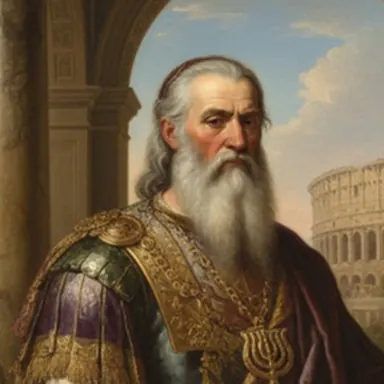
Leadership, Halakha and Self-Sacrifice: The Figure and Torah Teaching of Theodos of Rome
15 min read3,092 words
Summary
The article surveys the many-sided figure of Theodos of Rome, a prominent community leader in the period of the Tannaim who represents the complex interrelations between the Diaspora and the center in the Land of Israel. The text analyzes his independent halakhic authority, which found expression in the custom of eating a "gedi mekulas" (a kid roasted whole) on the nights of Passover, an act that aroused a sharp controversy with the Sages because of the fear of establishing a cultic alternative to the Temple. Alongside his public activity, the sources stress his being a benefactor and supporter of Torah scholars, while examining the question of whether his standing derived from political power or from his greatness in Torah. At the focus of his teaching stands the homily on the self-sacrifice of Hananiah, Mishael and Azariah, which illustrates his conception of the sanctification of God's name (kiddush Hashem) as a moral and existential duty for Diaspora Jewry. In the bottom line, the article presents Theodos as a model of Jewish leadership bridging destruction and renewal, while preserving national identity in a reality of exile.
The figure of Theodos of Rome constitutes a fascinating junction in Jewish historiography of the period of the Tannaim, since it combines within it questions of political leadership, halakhic authority and the complex interrelations between the center in the Land of Israel and the Diaspora. Theodos, who was apparently active at the end of the first century and the beginning of the second century CE, appears in the sources of the Sages as a multifaceted figure: a leader of the Roman community who introduced independent customs, a philanthropist who supported students of Torah in times of crisis, and a homilist who delved deeply into questions of the sanctification of God's name and self-sacrifice.[1, 2, 3] An analysis of his work requires looking not only at the direct Talmudic texts, but also at the broad historical context of Roman Jewry under imperial rule and at the process of shaping the world of halakha after the destruction of the Second Temple.
The Historical and Social Background of Roman Jewry in the Time of Theodos
Roman Jewry in the time of Theodos was an established community with a history of hundreds of years. The beginning of the community is attributed as early as the second century BCE, when immigrants from Alexandria and Judea began to settle in the imperial capital.[4] In the transitional period between the destruction of the Temple and the Bar Kokhba revolt, the community occupied a central place in the Jewish world as the most important economic and political center in the western Diaspora. The community enjoyed a certain religious autonomy, maintained synagogues, cemeteries and charitable institutions, and was involved to a certain extent in local politics.[4, 5]
Within this community Theodos functioned as "archisynagogos" (head of the synagogue) or as the parnas (lay leader) of the community, a role that demanded of him not only Torah knowledge but also the ability to represent the community before the Roman authorities.[3] His solid economic standing enabled him to serve as a support for the whole community and for the sages of the Land of Israel in particular. The sources note that the community in Rome continued to send funds to the Land of Israel even after the destruction, and in certain cases Theodos acted to divert the tax money that had formerly been destined for the Temple (and was now imposed by the Romans as the "Fiscus Iudaicus") toward the upkeep of the study houses and yeshivas in the Land of Israel and in the Diaspora.[3, 4]
The Controversy over the Kid Roasted Whole: Halakhic Leadership versus the Authority of the Center
The most formative event identified with Theodos of Rome is his introduction of the eating of "gedayim mekulasin" (kids roasted whole) on the nights of Passover in Rome.[8, 9] This act stands at the center of a wide-ranging halakhic controversy, which reflects the tension between the wish to preserve the memory of the Temple and the fear of creating cultic alternatives outside Jerusalem.
The Definition of "Gedi Mekulas" and the Cultic Context
The term "mekulas" derives from the word "kulsa" (Helmet / copper hat), and it describes a manner of roasting in which the kid is roasted whole with its head, its legs and its entrails placed upon it, in a way that recalls a soldier wearing his helmet or carrying his weapons at his side.[9, 10] This form of roasting was the distinctive way in which the Passover sacrifice was offered and eaten in the Temple in Jerusalem, as stated in the Torah: "its head with its legs and with its entrails."[9, 11, 12]
Theodos led the Jews of Rome to adopt this custom in their homes on the Seder night after the destruction.[1, 2] The motive for this act was apparently a strong desire to preserve the experience of the Temple and the living memory of the Passover sacrifice among the Jews of the Diaspora. In a world in which the religious center lay in ruins, Theodos sought to create a "remembrance of the Temple" as tangible as possible, which would strengthen the national and religious identity of the community.[10, 11]
The Opposition of the Sages of the Land of Israel
The response of the spiritual leadership in the Land of Israel was sharp and unequivocal. The Sages sent Theodos a sharp message: "Were you not Theodos, we would have decreed excommunication upon you, for you feed Israel consecrated food outside [Jerusalem]."[8, 11, 12] The significance of the threat of excommunication lies not only in its personal aspect toward Theodos, but in the general message to the Diaspora communities: there is no permission to restore the sacrificial service outside the Temple Mount.
The Sages' main fear stemmed from "mar'it ayin" (appearances). Eating a kid roasted whole, which is identified so distinctly with the Passover sacrifice, could lead the multitude to the mistaken thought that they were indeed offering a legitimate Passover sacrifice outside Jerusalem.[11, 13] This was especially grave in light of the fact that many in Rome called these lambs by the explicit name "Passover offerings" (pesachim), which increased the fear that people would treat the meat as actual consecrated meat.[10] The prohibition of eating consecrated food outside the wall is a severe prohibition from the Torah, and the Sages saw in Theodos's custom a breach that might lead to the profanation of the sacred and to the undermining of the halakhic structure of the prohibition of "shechutei chutz" (sacrifices slaughtered outside the Temple).[9, 12, 13]
The Tension between the Position of Rabban Gamliel and the Position of the Sages
It is interesting to note that Theodos did not act in a vacuum. The sources in the Tosefta and the Mishnah note that Rabban Gamliel himself tended to be lenient in this matter and permitted preparing a kid roasted whole on the nights of Passover.[10] Theodos, who may have been in contact with Rabban Gamliel or influenced by his position, adopted the lenient view.[10] Nevertheless, most of the Sages forbade the custom in order to create a clear separation between the reality of the Temple and the reality of exile.
The controversy ends with the custom in Rome fading away or being abolished as a result of the Sages' pressure, but the very fact that Theodos succeeded in "leading" a whole community to practice in this way attests to his power of leadership and to the religious autonomy he felt as head of the community in Rome.[11]
An Examination of His Personality: "Gavra Rabba" or "Ba'al Egrofin"
The most fascinating question raised in the Talmud regarding Theodos is the question of his essential nature: "Theodos of Rome: was he a great man (gavra rabba), or was he a man of fists (ba'al egrofin)?"[11, 12, 14] This question reflects the dilemma of the Sages regarding the reason for which they refrained from excommunicating him. Did he enjoy immunity because of his greatness in Torah and his righteousness ("gavra rabba"), or did the Sages perhaps fear him because of his political power, his connections with the Roman government and his great wealth ("ba'al egrofin")?[2, 8, 11]
The Evidence of His Greatness in Torah
The Talmud decides that Theodos was indeed a "gavra rabba," and the proof brought for this is his famous homily on self-sacrifice.[12, 14] The very fact that the Sages quote a baraita in his name ("This too Theodos of Rome expounded") attests that he was considered part of the world of Torah learning and not merely a political figure.[2, 8]
Theodos's homily is not merely an aggadic statement, but an attempt to lay a logical foundation (by means of the hermeneutical rule of "kal va-chomer," the a fortiori inference) for the foundations of faith and self-sacrifice. The ability to use the hermeneutical rules to decide existential questions was considered a distinct characteristic of a Torah scholar in the period of the Tannaim.[10]
Economic Support as an Expression of Leadership
A further aspect of his being a "gavra rabba" is connected to his social commitment. Rabbi Yose bar Avin (and in another version Rabbi Chananya) relates that Theodos used to "place merchandise (melai) into the purse of Torah scholars."[6, 8, 16] The concept of "melai" refers to a business partnership in which the owner of capital provides goods or money to a Torah scholar, so that he can trade with them and earn his living with dignity without needing the gifts of flesh and blood.[6, 8]
The Talmud links this act to the words of Rabbi Yochanan: "Whoever places merchandise into the purse of Torah scholars merits to sit in the academy on high."[6, 16] From this it emerges that Theodos saw his wealth not as a private asset but as an instrument in the service of the Torah. Especially in the periods of the decrees of Hadrian and of economic persecution, Theodos's support was vital for the continuity of the chain of transmission.[3] The combination of capital with recognition of the value of the Torah made him an exemplary figure of Jewish leadership in the Diaspora.
His Torah Teaching: The Homily on the Self-Sacrifice of Hananiah, Mishael and Azariah
The Torah teaching of Theodos is condensed in a single homily appearing in Tractate Pesachim, which tries to answer the question: what gave Hananiah, Mishael and Azariah the strength and the halakhic authority to give up their lives to Nebuchadnezzar's fiery furnace?[11, 12, 14]
The Logic of the "Kal va-Chomer" from the Frogs
Theodos explains that the three drew a "kal va-chomer" on their own from the deed of the frogs in the plague of frogs in Egypt. The verse says: "And they shall come up and come into your house ... and into your ovens and into your kneading troughs."[12, 14] Theodos stresses that the "kneading troughs" (the dough) are found by the oven precisely at the time when it is hot and burning.[14]
Theodos's argument is built as follows:
- The frogs: they are not commanded concerning the sanctification of God's name and have no promise of reward or punishment, and nevertheless they leapt into a burning oven in order to fulfill their divine mission.[11, 14]
- We (human beings): who are explicitly commanded concerning the sanctification of God's name ("You shall not profane My holy name, and I shall be sanctified"), how much more so must we give up our lives in a similar situation.[12, 14]
Interpretive Analysis: The Halakhic Difficulties in Theodos's Homily
Theodos's homily aroused wonder among the commentators, since from a halakhic standpoint it seems superfluous. After all, the law of "be killed rather than transgress" (yehareg ve-al ya'avor) in the case of idolatry (and especially in public) is a decided and explicit law.[14, 17] If so, why did Hananiah and his companions need to learn this from the frogs?
The commentators offer several solutions that deepen the understanding of Theodos's teaching:
- The position of Rabbenu Tam: Nebuchadnezzar's statue was not actual idolatry but an "indarta" (a statue in honor of the emperor). In such a case there is no halakhic obligation to die, and therefore they needed the kal va-chomer to justify voluntary self-sacrifice.[14, 17]
- The position of the Ri (Rabbi Yitzchak): the question was why they did not flee. Hananiah and his companions could have escaped in good time, but from the frogs they learned that one must not flee but rather stand firm and sanctify God's name openly.[14]
- The position of the Maharsha: Theodos held like the position of Rabbi Yishmael that even in the case of idolatry one should "transgress rather than be killed" if it is in private, and he explained that the gathering in the plain of Dura was considered private (since in his view there were not ten Jews there), and therefore the learning from the frogs was required in order to make self-sacrifice obligatory.[14, 17]
This homily teaches about the outlook of Theodos, who saw the sanctification of God's name not merely as a dry legal obligation but as a movement of the soul in devotion to the Creator, learned from contemplating nature and all of creation. For the Jews of Rome, who lived under the constant cultural and political pressure of the empire, this homily had tremendous topical significance.[1, 2, 3]
Theodos of Rome and the Chronological Tension in the Sources
One of the great difficulties in studying the figure of Theodos is the apparent chronological contradiction between the various sources. In Tractate Berakhot 19a it is stated that Shimon ben Shetach is the one who sent the threat of excommunication to Theodos.[8] Shimon ben Shetach was active in the Hasmonean period (the 1st century BCE), whereas Theodos is identified elsewhere with the later period of the Tannaim (the 2nd century CE), the period of Rabbi Yose, who testifies about him.[1, 2, 3]
Historical research and the commentators (such as Binyamin Ze'ev Bacher) point out that the mention of Shimon ben Shetach in Berakhot is apparently a scribal error or a "corruption" of another tradition.[2, 3, 8] It is more likely that Theodos was active in the generation of Rabban Gamliel of Yavneh or a little after it, in the period of the decrees of Hadrian.[2, 3, 4] The significance of this error lies in the fact that it links Theodos to the tradition of forceful leaders (such as Shimon ben Shetach and Honi the Circle-Drawer) who stood their ground even against the establishment, which reinforces his image as an independent and influential leader.[8, 11]
Theodos and His Connection with Other Sages
Apart from his strained relations with the leadership of the Land of Israel, Theodos is mentioned in the context of further figures from western Jewry. The Talmud mentions Platon of Rome, who proposed a different homiletical source for the self-sacrifice of Hananiah and his companions, which attests to the existence of an active circle of learners and homilists in Rome at that time.[1]
Likewise, the connection between Theodos and Rabbi Yose (Rabbi Yose ben Chalafta) is significant. Rabbi Yose is the main source for the stories about Theodos, and he testifies about him from a distance of time and place.[2, 18] This teaches that Theodos's name had spread far, and his esteem as an "important man" was accepted in the central study houses of the Galilee and of Babylonia generations later.[6, 9]
Summary and Conclusions on His Work and Teaching
Theodos of Rome represents a unique model of Jewish leadership in the Diaspora, combining loyalty to tradition with local religious initiative. His work is not summed up merely in one disputed custom, but in a whole range of actions intended to preserve the world of Torah and national identity in a reality of exile and destruction.
Main conclusions about his figure:
- Independent leadership: Theodos did not hesitate to introduce customs that reflected the needs of his community, even when these stood in contradiction to the view of the majority in the Land of Israel. He saw his role as that of a leader charged with reviving the memory of the Temple in the heart of the Diaspora.[10, 11]
- Economic power as a spiritual lever: Theodos is a rare example of a man who used his great wealth to fortify the standing of the Sages. His being one who "places merchandise" made him a full partner in Torah creativity, and thanks to this he won esteem that went beyond the halakhic dispute.[2, 6]
- The teaching of self-sacrifice: his homily of the frogs is a classic asset in the world of Jewish thought. It teaches about a man who lived in a reality of persecution and understood that the existence of the Jewish people depends on the readiness of every individual to sanctify God's name, even beyond the dry halakhic obligation.[3, 14]
- A bridging figure: despite the contrasts, Theodos remained a beloved and respected figure in the sources of the Sages. He symbolizes the unity between the Diaspora and the center, and the Sages' recognition that even outside the Land of Israel a "gavra rabba" can grow who illuminates the path of the people.[2, 8]
In historical perspective, Theodos of Rome was one of the pioneers of western Jewish leadership. He was wise enough to understand that the destruction of the Temple required the creation of new structures of memory and community, and through his work he laid the foundations for the interrelations that would characterize the Jewish world throughout two thousand years of exile: a spiritual center in the Land of Israel supported by, and drawing inspiration from, strong communities and creative leadership in the Diaspora.[4, 10]
Sources18
- 1.תודוס איש רומי - ויקיפדיה, he.wikipedia.org/wiki/תודוס_איש_רומי
- 2.Theodosius of Rome - Jewish Virtual Library, jewishvirtuallibrary.org/theodosius-of-rome
- 3.THEUDAS - JewishEncyclopedia.com, jewishencyclopedia.com/articles/14369-theudas
- 4.ROME - JewishEncyclopedia.com, jewishencyclopedia.com/articles/12816-rome
- 5.EUROPE - JewishEncyclopedia.com, jewishencyclopedia.com/articles/5909-europe
- 6.מעלתו של תודוס איש רומי, shoresh.org.il/spages/articles/yerushalmi- todus ish romi.htm
- 7.History of the Later Roman Empire • Vol. 1 Chap. XI, penelope.uchicago.edu/Thayer/E/Roman/Texts/secondary/BURLAT/11*.html
- 8.תולדות תנאים ואמוראים/ת/תודוס איש רומי – ויקיטקסט, he.wikisource.org/wiki/תולדות_תנאים_ואמוראים/ת/תודוס_איש_רומי
- 9.פסחים נג א – ויקיטקסט, he.wikisource.org/wiki/פסחים_נג_א
- 10.תודוס איש רומי ואכילת טלאים מקולסים בליל הפסח, lib.cet.ac.il/PAGES/item.asp?item=16944
- 11.ותודה לתודוס - בית אבי חי, bac.org.il/blog/?postID=12309
- 12.ביאור:בבלי פסחים דף נג - ויקיטקסט, he.wikisource.org/wiki/ביאור:בבלי_פסחים_דף_נג
- 13.Beit Yosef, Yoreh De'ah 334:91 - Sefaria, sefaria.org/Beit_Yosef%2C_Yoreh_De'ah.334.91
- 14.מכת הצפרדע ותודוס איש רומי - מסר לדורות. | הרב משה פנחס ליפשיץ | בית ..., yeshiva.org.il/midrash/23324
- 15.ביאור:ירושלמי מאיר/מסכת מועד קטן/פרק שלישי - ויקיטקסט, he.m.wikisource.org/wiki/ביאור:ירושלמי_מאיר/מסכת_מועד_קטן/פרק_שלישי
- 16.רי"ף פסחים י״ח א, sefaria.org.il/Rif_Pesachim.18a
- 17.לימודם של חנניה מישאל ועזריה מן הצפרדעים - Rav Aharon Walkin, ravahronwalkin.com/lev-aharon-pesach/לימודם-של-חנניה-מישאל-ועזריה-מן-הצפרדעים
- 18.תוספתא ביצה (ליברמן) ב׳:טו, sefaria.org.il/Tosefta_Beitzah_(Lieberman).2.15