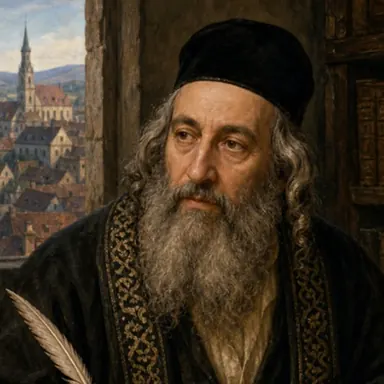
Maharash of Neustadt
13 min read2,586 words
Summary
The text surveys the figure of the Maharash of Neustadt as a connecting and foundational link in Jewish history, who worked to rebuild the world of Torah in Austria after the destruction of the Rhineland communities in the 14th century. The source stresses how the Maharash's move, through the institutionalization of the modern "semikhah" (rabbinic ordination) and the title "Morenu," gave the rabbinate an organizational power that prevented halakhic anarchy and fortified rabbinic authority. His central project focused on preserving oral traditions through the precise codification of Ashkenazi custom, giving binding force to everyday religious practice and turning it into a stable foundation for the generations to come. Through his yeshiva and his writings, he handed down a method combining piety and halakhic precision that directly influenced the rulings of the Rema, and thereby became the spiritual architect of Ashkenazi Jewry to this day.
The Work and Torah Teaching of the Maharash of Neustadt: Architect of Rabbinic Authority and of the Foundation of Ashkenazi Customs at the End of the Middle Ages
The Geopolitical and Spiritual Transition of Ashkenazi Jewry in the 14th Century
The history of Ashkenazi Jewry in the 14th century is marked by a deep and painful change: the shift from the old centers of Torah on the banks of the Rhine toward the east, and in particular to Austria. After the persecutions of the "Black Death" in 1348, which sowed destruction in the ShUM communities (Speyer, Worms, Mainz), a process of rehabilitation and re-consolidation began in the communities of Vienna and Neustadt (Wiener Neustadt).[1, 2] Within this vacuum of leadership and spirit, the figure of Rabbi Shalom ben Yitzchak Zekel of Neustadt, known by the title Maharash of Neustadt, stood out as a key figure who shaped the halakhic world of Ashkenazi Jewry for the generations to come.[1, 3]
The urgent need to preserve the oral traditions, over which the danger of oblivion hovered because of the wanderings and the riots, led to the creation of a new genre of halakhic literature: the books of customs. The Maharash of Neustadt, together with his colleagues in Vienna, understood that abstract halakha is not enough to sustain a living Jewish community, but that a precise codification of "practice" is needed: the way in which the commandments are actually fulfilled in the synagogue and in the Jewish home.[3, 4] The Maharash's work was not limited to writing alone but extended over communal leadership, the establishment of a central yeshiva, and the shaping of the modern institution of rabbinic ordination.[3, 5]
The "Morenu" Revolution: Fortifying Rabbinic Authority and the Struggle against Halakhic Anarchy
One of the most significant and controversial moves in the history of the rabbinate in Ashkenaz was the adoption of the title "Morenu" (our teacher), a move of which the Maharash of Neustadt was among the first leaders.[4] At the end of the 14th century, following the dwindling of the number of Torah scholars and the loosening of communal frameworks, a situation arose in which people who were not sufficiently trained took judicial powers for themselves and arranged divorces and marriages without supervision.[4]
The Maharash of Neustadt, together with Rabbi Meir HaLevi (Maharam HaLevi) of Vienna, decided to institute a new order: formal ordination conferring the title "Morenu."[5] This title was not meant as a mere honor but served as a binding license to teach. The enactment established that only one who had received the title was permitted to judge, to issue halakhic rulings and to conduct weddings in his area. This move was meant to prevent deviations from accepted custom and to ensure that only people of proven Torah knowledge would stand at the head of the communities.[4]
The controversy over the title reached as far as Spain, where the Rivash (Rabbi Yitzchak bar Sheshet) was called upon to decide on the legality and validity of the new title, which was perceived by some of the sages as an innovation with no source in the Talmud.[5] Nevertheless, in the long term, the move of the Maharash of Neustadt succeeded in stabilizing the rabbinic leadership in Austria and Germany and turned the yeshivot into the political and spiritual power centers of the community. The yeshiva in Neustadt, under the leadership of the Maharash, became the prototype of the "Morenu" yeshiva, in which authority derives both from knowledge and from institutional recognition.[2, 3]
The Yeshiva in Neustadt: A Hothouse for Ashkenazi Leadership
The yeshiva that the Maharash established in Neustadt was not merely an educational institution but a center for spreading a unique halakhic method that combined the plain sense of the Gemara with the fine points of the customs of Chasidei Ashkenaz.[2, 3] The institution attracted students from all over Central Europe, and its influence extended far beyond the geographical borders of Austria. The yeshiva continued to exist after his death as well, and over the years became known as the yeshiva of Rabbi Israel Isserlein (author of "Terumat ha-Deshen"), which attests to continuity and an uninterrupted transmission of tradition within this institution.[2, 6]
Within the walls of the yeshiva the personalities of the great men of the next generation were shaped. The Maharil (Rabbi Yaakov Moelin), who is regarded as the foundational figure of later Ashkenazi customs, was the outstanding disciple of the Maharash and received the bulk of his Torah from him.[1, 2, 4] The Maharil used to cite his teacher's rulings as the supreme authority, and thereby made the Maharash a source of the first rank for all Ashkenazi customs.[1, 4] Rabbi Eisik Tyrnau, author of the widespread "Sefer ha-Minhagim" (Book of Customs), also studied in Neustadt and was deeply influenced by the didactic method of the Maharash, which places practical documentation at the center of Torah activity.[4]
His Halakhic Teaching: Between the "Revealed" and the "Hidden" in the Circle of Chasidei Ashkenaz
The teaching of the Maharash of Neustadt is characterized by a delicate fusion of pure halakha with practices of piety and abstinence based on the esoteric teaching of the early "Chasidei Ashkenaz" (the Ashkenazi Pietists).[3] Although he was a central halakhic decisor who dealt with everyday questions of commerce, marriage and monetary matters, he conducted himself according to the practices of kabbalists and incorporated into his writings quotations from rare books of the Ashkenazi masters of the esoteric, some of which have not survived to our day.[3]
The influence of Ashkenazi Pietism on his rulings found expression in the emphasis on "lifnim mi-shurat ha-din" (beyond the letter of the law) and on the intentions of prayer.[3] The Maharash saw custom not merely as a ritual sequence but as an expression of inner holiness that had taken root in the community. For him, Ashkenazi custom is in the category of "a complete Torah" from which not a jot or tittle may be changed, since it reflects the broad consensus of the great sages of earlier generations, who were closer to the source.[3, 8]
The Book "Halakhot u-Minhagei Maharash": The "Codex" of Austrian Custom
The principal work of the Maharash, first published in print only in 5737 by Shlomo Spitzer, constitutes an important crossroads in the history of halakha.[2, 3] The book contains 546 sections covering the entire cycle of Jewish life, and it was originally written in response to questions addressed to him and as a record of the sermons and lessons he delivered in his yeshiva.[2]
The uniqueness of the book lies in its detail. The Maharash does not content himself with stating the bare law but describes in minute detail how the commandment is to be performed. His descriptions include references to clothing, to foods and even to the economic and social conditions of the Jews of Austria in his time.[2] The book today serves as a source of the first rank not only for halakhic decisors but also for historians seeking to understand daily life in the Jewish communities in the 14th century, the relationship with their Christian neighbors and the organizational structure of the community.[2]
Clarifying Prominent Issues: Passover Customs, Burial and the Calendar
An examination of the halakhic rulings of the Maharash reveals his decisive role in shaping norms that later became the common heritage of the entire people of Israel.
The Development of the Prohibition of Kitniyot and Sugar on Passover
The Maharash of Neustadt worked in a period in which the custom of refraining from eating kitniyot (legumes) on Passover was spreading throughout Ashkenaz.[8] Whereas earlier Rishonim (such as the "Or Zarua" in the 13th century) opposed the custom and regarded it as an error, the Maharash of Neustadt chose to give it full halakhic backing.[8, 9] He saw this prohibition as a necessary fence to prevent confusion between legume flour and grain flour, and thereby contributed to making the custom binding and universal among all Ashkenazim.[8]
Moreover, the Maharash was alert to changes in local industry and recorded a prohibition on eating sugar on Passover in the Neustadt community.[10] The reason for this was the fact that in the sugar refining process of that time it was customary to add flour as a hardening agent.[10] This sensitivity to concerns about admixtures of chametz in early manufacturing processes attests to the stringent and cautious approach of his circle, an approach that has shaped the Ashkenazi Jewish Passover cuisine to this day.[10]
Mourning Customs and the Invention of the "Yahrzeit"
A surprising linguistic and halakhic contribution of the Maharash of Neustadt is the first use of the term "yahrzeit" (Yahrzeit) to mark the anniversary of the death of one's parents.[11] The term appears in his writings and in the rulings of his disciples, which indicates that in 14th-century Austria the shift had begun from a Hebrew halakhic language to a language incorporating concepts from the local Judeo-German.[11]
In addition, the Maharash provided the halakhic explanation for the custom of placing a stone on the grave.[12] According to his explanation, placing the stone is an expression of "honor of the dead," meant to show the deceased that his grave has been visited and that his memory has not been forgotten.[12] He also recorded other ancient customs connected with the funeral, such as plucking grass and throwing earth behind one's back, linking them to the verse "and may they blossom out of the city like the grass of the earth" (Psalms 72:16) as an allusion to the resurrection of the dead.[12, 13]
His Family and the End of the Austrian Center: Destruction and Kiddush Hashem
The life of the Maharash of Neustadt was interwoven with the tragedies that befell Austrian Jewry. He himself had two sons who continued in his path: Rabbi Yudel, who served as rabbi in Neustadt, and Rabbi Yonah, who served as rabbi in Vienna.[2] The figure of Rabbi Yonah became a symbol of Kiddush Hashem (martyrdom); he was killed in the riots of the "Great Decree" (Wiener Gesera) in 1420, when the Jewish community in Austria was annihilated or expelled following a decree of Duke Albrecht V.[2]
The Maharash himself died a few years before the catastrophe (after 1415), but his Torah was saved thanks to his disciples who fled west and south.[1] His disciple the Maharil carried his customs to Mainz and throughout Germany, and thereby ensured that the Austrian center of Torah, though physically destroyed, would continue to live through Ashkenazi customs and rulings.[1, 4]
Relations between Jews and Christians in 14th-Century Austria
The writings of the Maharash of Neustadt offer a window onto the complex social reality of those days. In the 14th century, the Jews of Austria were deeply involved in economic life, including lending at interest and managing finances for the nobility.[14] The Maharash was called upon to decide many questions concerning everyday contact with gentiles, including the laws of trade in markets, business partnerships and the handling of legal disputes.[2]
One of the fascinating historical examples is the affair of "Shlom the minter" (Shlom the mint-farmer) in Vienna, who was involved in litigation with a Christian monastery and was murdered by an incited mob.[14] Although this event preceded the time of the Maharash, it reflects the constant tension in which the Jews of Austria lived, between high economic status and grave physical vulnerability.[14] The rulings of the Maharash reflect an attempt to maintain sharp religious separation (such as the prohibition of eating with gentiles) while allowing normal economic life in the public sphere.[15]
The Influence of the Maharash on Ashkenazi Halakhic Ruling through the Generations
Without the work of the Maharash of Neustadt, the character of Ashkenazi Jewry might have been entirely different. He succeeded in creating a system in which custom has binding halakhic force, and thereby gave the Ashkenazi communities an anchor of stability in a changing world full of persecutions.[3, 8]
The direct line that runs from the Maharash of Neustadt, through the Maharil, to the glosses of the Rema on the Shulchan Arukh is the central axis of Ashkenazi halakha.[6] Every time an Ashkenazi Jew conducts himself according to "the custom," he is in effect continuing the path that the Maharash charted in Neustadt more than 600 years ago. The institution of the "Morenu" that he founded made the rabbinate a profession requiring formal ordination, and thereby laid the foundations for the modern rabbinate familiar to us today.[4, 5]
Summary and Conclusions
The Maharash of Neustadt was a spiritual architect who understood the power of the collective memory embodied in custom. In a period of rupture and destruction, he rebuilt Torah authority and codified the Jewish ways of life in a manner that made them eternal.[2, 3] His legacy lies not only in the books he wrote but in the community he established and the disciples he raised, who turned the customs of Austria into the customs of all Ashkenaz.[4, 6]
The path of the Maharash of Neustadt teaches us about the importance of educational institutions and communal leadership in times of crisis. The yeshiva in Neustadt, the struggle over the title "Morenu" and the extreme precision in the details of the customs were the tools by which the Maharash ensured that Ashkenazi Jewry would not only survive the 14th century but would emerge from it as the dominant center of Torah of the Jewish world for generations to come.[3, 4, 5] The central lesson of his teaching is that Jewish continuity rests on a combination of uncompromising loyalty to the past with an organizational and leadership capacity adapted to the challenges of the present.[2, 3]
Sources15
- 1.שלום מנוישטאדט – ויקיפדיה, he.wikipedia.org/wiki/שלום_מנוישטאדט
- 2.Shalom ben Yi??ak of Neustadt | Encyclopedia.com, encyclopedia.com/religion/encyclopedias-almanacs-transcripts-and-maps/shalom-ben-yizhak-neustadt
- 3.רבי שלום מנוישטט – ויקישיבה, yeshiva.org.il/wiki/index.php/רבי_שלום_מנוישטט
- 4.SHALOM OF VIENNA - JewishEncyclopedia.com, jewishencyclopedia.com/articles/13494-shalom-of-vienna
- 5.סמיכה לרבנות – ויקיפדיה, he.wikipedia.org/wiki/סמיכה_לרבנות#.D7.94.D7.A1.D7.9E.D7.99.D7.9B.D7.94_.D7.91.D7.90.D7.A9.D7.9B.D7.A0.D7.96
- 6.Israel Isserlein - Wikipedia, en.wikipedia.org/wiki/Israel_Isserlein
- 7.שולחן ערוך אבן העזר/הלכות אישות - ויקיטקסט, he.wikisource.org/wiki/שולחן_ערוך_אבן_העזר/הלכות_אישות
- 8.The Origin of the Ashkenazic Custom Not to Eat Kitniyot on Pesach – A Journey Through The Ashkenazi Rishonim - Shulchanaruchharav, shulchanaruchharav.com/halacha/the-origin-of-the-ashkenazic-custom-not-to-eat-kitniyot-on-pesach-a-journey-through-the-ashkenazi-rishonim/
- 9.Rice, Beans and Kitniyot on Pesah: Are they Really Forbidden? Responsa in a Moment: Volume 9, Issue No. 4, March 2015 - The Schechter Institutes, schechter.edu/rice-beans-and-kitniyot-on-pesah-are-they-really-forbidden-responsa-in-a-moment-volume-9-issue-no-4-march-2015/
- 10.Page 3 – Quantitative Analysis of Rabbinic Literature - HaMapah, blog.hamapah.org/page/3/
- 11.Death in Jewish Life - OAPEN Library, library.oapen.org/bitstream/id/da8f6e6e-73be-415c-9ba1-a7f219292b93/1001714.pdf
- 12.Why is it customary to place a stone on a grave? - The Schechter Institutes, schechter.edu/customary-place-stone-grave/
- 13.Golinkin, Why Is It Customary To Place A Stone On A Grave? - Zeramim, zeramim.org/past-issues/volume-issue-3/golinkin-customary-place-stone-grave/
- 14.Bohemia, Galicia, and the other outlying provinces of contemporary Austria are only treated in so far as they are connected with the history of the monarchy as a whole. - JewishEncyclopedia.com, jewishencyclopedia.com/articles/2152-austria
- 15.שולחן ערוך יורה דעה - ויקיטקסט, he.wikisource.org/wiki/שולחן_ערוך_יורה_דעה